Care Team Huddles: Evidence and a Copyable Five Item Agenda for LTC

Care Team Huddles: Evidence and a Copyable Five Item Agenda for LTC
A care team huddle is a brief, stand-up meeting of 10 minutes or less that aligns your team at the start of the day or shift. Done well, it sharpens situational awareness, surfaces safety risks early, and tightens coordination. AHRQ and IHI guidance and a peer-reviewed systematic review support it, and this guide gives you templates to pilot one.
TL;DR:
- A 2022 review of 12 studies linked daily multidisciplinary huddles with better teamwork and staff job satisfaction, the outcomes most directly supported by evidence.
- Clinics usually meet once before the first patient is roomed, while inpatient and long term care teams hold separate huddles at each major shift change.
- Use five prompts for safety, at risk patients, unresolved items, other hazards, and announcements; assign complex problems for follow up rather than solving them.
- Record every action with a named owner, due time, and status, then review open items at the next huddle and carry them across shifts.
- During a pilot, track attendance, average meeting length, closure within a fixed follow up window, and staff reports of situational awareness or satisfaction.
Table of Contents
- What care team huddles are and the evidence they work
- Who should attend, who leads, and when to schedule huddles
- A copyable five-item agenda and short leader script
- Using a visual management board effectively
- Practical techniques to keep huddles short and focused
- Measuring impact: simple metrics and quick audits
- A pilot checklist to start and embed huddles
- Integrating care team huddles with digital tools and platforms
- Customizing huddle agendas to long-term care workflows and staff roles
- Promoting staff engagement and psychological safety during huddles
- Incorporating resident-centered care discussions within huddles
- Documenting and following up on action items from huddles
- Author perspective: why structured huddles matter for long-term care operations
- How a phone-first operations platform can support huddle follow-up
- FAQ
- Sources
What care team huddles are and the evidence they work
Start with the definition, because teams often confuse a huddle with a meeting or a handoff. Per AHRQ and IHI guidance, a huddle is a brief, stand-up gathering held once at the start of each workday, or at the start of major shifts on inpatient units. In ambulatory settings, one huddle per unit per day is the common pattern. Inpatient units tend to anchor theirs to shift change, so each team gets its own.
The purpose is narrower than most teams assume. AHRQ’s PSNet describes huddles as proactive communication tools built around reviewing previous performance, anticipating the day’s safety concerns, and reinforcing standard work. They are not exhaustive patient handoffs. A handoff transfers detailed information about individual patients from one clinician to another. A huddle gives the whole team a shared picture of the day ahead and flags what could go wrong. You need both, and each does a different job.
A 2022 systematic review of 12 studies found that daily multidisciplinary team huddles are consistently associated with positive effects on teamwork and staff job satisfaction. That is the strongest case for starting: the benefit shows up in how your people work together, which is the foundation for everything downstream.
The mechanisms matter as much as the headline. A scoping review, Huddles and their effectiveness at the frontlines of clinical care, describes how huddles reduce hierarchical barriers and improve frontline satisfaction and clinical outcomes. A complexity science view treats the huddle as a structural intervention that creates time and space for meaningful conversation, reduces role ambiguity, and strengthens the relationships that high-reliability teams depend on. Earlier research on high reliability adds that huddles create opportunities for heedful interactions and a learning culture.
In practice, this means the brief meeting is rarely about the agenda alone. The aide who mentions a resident’s changed appetite, the nurse who flags a staffing gap, and the maintenance lead who reports a broken call light all speak in the same room, on the same day, with the same listeners. That shared awareness is the active ingredient, and it is why the structure of the huddle (short, standing, same time, same questions) matters more than the topics you cover on any single day.
Who should attend, who leads, and when to schedule huddles
A huddle works when the people who can act on the day’s issues are in the room and nobody is there out of obligation. The core group is usually small.
- Frontline caregivers: nurses, aides, and therapists who see the day’s realities first and know which residents or patients need attention.
- A charge nurse or team lead: the person who convenes the huddle, keeps time, and keeps the discussion on the agenda.
- A designated recorder: one person who writes down flagged issues, owners, and due times so nothing evaporates when the huddle breaks.
- Support roles as needed: environmental services, maintenance, dietary, or the front desk, brought in when their work affects the day’s risks.
Empowering frontline staff is the point, not a courtesy. IHI’s Kathy Duncan notes that effective huddles empower frontline staff to identify environmental cues and build situational awareness so teams can anticipate problems before they escalate. AHRQ’s TeamSTEPPS guidance adds that any team member may convene a huddle when plans need adjusting, with a designated leader or situational leader communicating the change quickly. If only managers can call a huddle, you lose the early signals that frontline staff catch.
Separate the leader and recorder roles on purpose. The leader owns the flow: who speaks, when to move on, when to park an item. The recorder owns the follow-up: what was said, who owns it, when it is due. When one person does both, the leader’s attention splits and the record gets thin. Rotate both roles across the team so the huddle belongs to everyone rather than to one supervisor.
Timing follows the setting. Ambulatory clinics usually hold one huddle at the start of the workday, with a short pre-session before the first patient is roomed. Inpatient units and long-term care floors tie huddles to the start of each major shift. If your facility staffs multiple shifts, run a huddle for each, led by that shift’s charge nurse. Pick a time when people are already on site and before the work scatters them, and keep it the same every day. Predictability is what turns a meeting into a habit. When you are assigning leaders across shifts, a scheduling tool such as our shift scheduling software can help with scheduling.
A copyable five-item agenda and short leader script
Use the agenda that AHRQ publishes in its huddle kit as a starting point, then adjust it to your team’s needs.
- Safety and quality concerns and successes. What went wrong or nearly went wrong since the last huddle, and what went right. Name the wins; they sustain attendance.
- Patients or residents at risk today. Preview anyone who needs closer attention: new admissions, falls risk, a change in condition, a complex discharge, a scheduled procedure.
- Review of tracked issues. Walk the open items from previous huddles. Who owns each one, what is its status, and what is blocking it?
- Inputs and other safety issues. Open the floor for anything the first three items missed: equipment, staffing, supplies, environment.
- Announcements and close. Schedule changes, visitors, surveys, education. End on time.
Here is a short script a leader can read from:
- Opening: “Quick huddle, ten minutes, standing. [Recorder] is capturing. First: any safety concerns or good catches since yesterday?”
- Item two: “Who do we need to watch closely today? Name, one line on why.”
- Item three: “Tracked items. Which ones are closed, which are stuck, and what do you need?”
- Item four: “Anything else that could hurt someone today?”
- Close: “Announcements, then we are done. Recorder, read back the new owners.”
The recorder’s prompts are equally short: “Who owns that?” “By when?” “Is that closed or still open?” The recorder asking these three questions is what converts talk into follow-up.
Adapt the agenda to your setting with one-line variations:
- Ambulatory clinic: Preview today’s schedule for complex or high-risk visits, missing results, interpreter needs, and equipment status, then walk tracked issues.
- Inpatient unit: Preview patients with pending procedures, isolation status, high fall or pressure injury risk, and discharge barriers, then staffing and bed flow.
- Long-term care: Preview residents with a change in condition, new admissions, care-plan meetings, and wound or dining concerns, then environmental and maintenance items that affect resident safety.
Pro Tip: Print the agenda on a laminated card and clip it to the board. Teams that read the same five prompts in the same order every day stop debating the format and start talking about the work.
For the long-term care version, keep the rhythm identical and change only the vocabulary. The structure is what makes the huddle fast; the content inside each item is where your facility’s reality goes.
Using a visual management board effectively
A board turns a spoken meeting into a shared record the whole team can see, which is why IHI’s Jeff Rakover recommends integrating daily performance measurements and visual management boards into huddles. It helps teams move from day-to-day operations toward sustained quality improvement. PSNet’s guidance on daily huddles points the same way: the board is what makes tracked issues visible between huddles.
What to put on the board:
- The agenda: the five items, so anyone can see where the huddle is and how much time is left.
- Current safety flags: the day’s top risks, in a few words each.
- A preview list: the people to watch today, identified by a first name, initials, or room number only.
- Tracked items: each with an owner, a due time, and a status.
- A run chart: a daily count of something you want to move, such as items closed within 48 hours.
Follow-up is where most boards fail. Give every item a named owner, not a department. Write a due time, not “soon.” When an item is resolved, strike it through rather than erasing it, so the team can see closure accumulating; a board that only ever shows open problems is demoralizing, and a board that shows what got fixed builds momentum. Review the strike-throughs at the start of each huddle and say thank you out loud.
Privacy needs real guardrails. A board in a hallway or visitor area should not carry protected health information. Use minimal identifiers, keep detailed clinical information in the record where it belongs, and place the board where authorized staff can see it but residents, patients, and visitors cannot. If the board must be near public space, use a version with initials or room numbers only, or turn it to face the staff area.

Finally, keep the board small enough to read at a glance from a standing position. If someone needs to lean in and scan, it has too much on it. Trim to the items that drive decisions today and archive the rest.
Practical techniques to keep huddles short and focused
Brevity is a discipline, and the teams that keep it rely on a few simple mechanics rather than willpower.
Start with the clock. IHI’s practitioner tip is to use a visible 10-minute alarm and hold huddles standing. The alarm enforces the boundary without anyone having to play the villain, and standing signals respect for people’s time. A kitchen timer on the board works as well as any app.
Next, triage; do not solve. PSNet’s practitioner rule is that successful huddles identify issues and triage them for follow-up rather than solving complex problems in the room. The moment a huddle turns into a root-cause discussion, you lose the time boundary and half the team’s attention. The leader’s phrase is simple: “Let’s park that. Who owns it, and when do we report back?” Then the recorder writes it down and the huddle moves on.
Use a few structural habits to keep the group engaged:
- Rotate the lead. When different people run the huddle, the meeting stops being the supervisor’s and starts being the team’s. It also trains future leaders.
- Use a structured turn sequence. Go around the room in the same order each day, or pass a “talking object,” so quiet voices get a turn and loud ones do not dominate.
- Highlight quick wins. IHI’s guidance on safety huddles stresses framing a 5 to 10 minute huddle as a time-saver that prevents late-day crises. Name a problem that was caught early and what it saved. That story does more for buy-in than any policy.
- Start on time, every time. If you wait for stragglers, you teach the team that the start time is a suggestion.
Keep the content tight as well. If an update does not change what someone does today, it belongs in an email or a bulletin. If a topic needs more than a minute, it needs its own conversation with the right people, scheduled for later. And if the huddle regularly runs long, look at the agenda before you blame the team: usually one item is carrying work that belongs elsewhere.
Pro Tip: Name the “parking lot” on the board. When an item gets parked, write it there with an owner and a time to report back. People accept being cut off far more readily when they can see their issue is captured and has an owner.
Measuring impact: simple metrics and quick audits
You do not need a research design to know whether huddles help. A short pilot with a handful of simple indicators will tell you whether coordination is improving and where the format needs tuning.
The 2022 systematic review tied daily huddles to better teamwork and staff job satisfaction, so those are the outcomes worth measuring locally first. Staff-reported measures are the easiest to collect and the closest to what the evidence supports.
A minimal metric set:
- Attendance rate: the share of expected participants who actually attend. Low attendance means the time, place, or value is wrong.
- Average time per huddle: compare against your 10-minute target. Drift upward is an early warning.
- Percent of items resolved within a consistent follow-up window: choose one window and keep it. This is your clearest measure of whether follow-up works.
- Staff-reported situational awareness or satisfaction: a short pulse survey at baseline and again after the pilot.
Run the pilot as a before-and-after comparison. Collect baseline data on the pulse questions and on how long issues currently take to close. Start the huddles, keep tallying, and compare at the end. IHI’s guidance on better huddles encourages teams to build daily performance measurement into the huddle itself, so measurement becomes part of the routine and not a separate project.
Report on a steady cadence. A one-page summary each week during the pilot, shared with the team and with leadership, works well: attendance, average time, items opened and closed, and one quote or story. Your visual board gives you the raw material. A simple run chart of items closed within your target window, updated daily by the recorder, shows trends faster than any spreadsheet.
For leaders who want a fuller view, a dashboard that pulls task completion and ticket status together makes the follow-up rate visible without manual counting. Our article on operations dashboards in healthcare walks through how a pilot turns metrics into a working control surface. Culture also shapes what you can measure honestly; this explainer on patient safety culture is useful background for leaders deciding how openly to report near misses.
A pilot checklist to start and embed huddles
A pilot lets you test cheaply, learn quickly, and build the evidence you need to expand. The AMA’s toolkit, hosted by AHRQ, supplies a modifiable checklist and sample agenda for exactly this purpose, and AHRQ’s guidance on team-based care lays out the types of huddles and implementation strategies. Use the steps below as your skeleton.
- Define scope and goals. Choose a unit or team and a few goals, such as fewer late-day surprises or faster issue closure. Write them down.
- Choose a willing team and leader. Start with people who want to try it. Early success from a motivated group is your best argument for expanding.
- Pick a time and place. Select a daily slot at the start of the day or shift, near the work, with room to stand. Hold it constant.
- Run PDSA cycles. Plan, do, study, act. Try the agenda, review what worked, change one thing, and repeat.
- Collect attendance and time metrics. Track who comes and how long it takes. These measures reveal many format problems.
- Adjust the agenda and participants. Add the role you keep needing, drop the item no one uses, and shorten anything that drags.
- Share quick wins. Post the problems caught early and the items closed. IHI’s practitioner insight is to start small and share near-miss and benefit data to build will.
- Scale with leadership support. Take your metrics to leadership, ask for protected time, and extend to the next team.
On pilot size, small beats large at first. A single team of a handful of people can iterate daily, while a whole unit moves slower and hides problems in the crowd. Once the format is stable, segment by shift or role and replicate it rather than redesigning from scratch.
Common barriers have implementable fixes. If time is the objection, show the stopwatch data and point out that a ten-minute huddle prevents longer interruptions later. If buy-in is thin, let skeptics lead a session and bring them examples of problems the huddle caught. If the huddle drifts into problem-solving or runs long, restore the timer, reintroduce the parking lot, and have the leader reread the agenda. Each of these is a small adjustment, not a reason to stop.
Integrating care team huddles with digital tools and platforms
Huddles generate decisions, and decisions generate tasks. The integration question is simply where those tasks live after the huddle ends. A whiteboard works for the room, but the moment staff scatter, a phone-based tool keeps the follow-up visible to the person who owns it.
A practical pattern: during the huddle, the recorder captures each action item with an owner and due time. Right after, the recorder enters those items as assigned tasks, so each owner sees theirs on a phone. Maintenance issues become work tickets, recurring checks become checklist items, and the board shows status without anyone chasing people in hallways.
We built our platform for this kind of floor-level work. My Tasks handles mobile task and checklist assignment, and My Work Tickets routes maintenance requests from the huddle to the right person. You can use the same approach with any tool your facility already has. What matters is that every huddle item leaves the meeting with an owner, a due time, and a place where its status can be seen.
Keep the integration light. Do not move the huddle onto a screen; the stand-up format and the eye contact are part of what makes it work. Use the digital layer only for what happens afterward, and review it at the next huddle’s third agenda item.
Customizing huddle agendas to long-term care workflows and staff roles
The agenda is a starting point, and long-term care teams should tailor it to how their floors actually run. The principle is to keep the structure and change the content of each item.
Begin with your workflow. A skilled nursing facility has rhythms an ambulatory clinic does not: morning care and dining, medication passes, therapy blocks, activities, and shift handoffs. Place the huddle just before the busiest stretch, not in the middle of it. Then ask which risks are specific to your residents and add them to the “at risk today” item: falls, weight loss, skin integrity, behavioral changes, new admissions, and anyone with a pending care-plan meeting.
Tailor for roles. Nurses and aides need resident-specific prompts. Dietary needs a line on texture-modified diets and meal timing. Environmental services and maintenance need a chance to flag anything that affects safety, such as a wet floor, a broken bed alarm, or a malfunctioning call light. Our environmental rounds checklist and nursing rounding checklists are examples of the standard work a huddle can reinforce.
Consider variations by shift. Days may focus on resident care plans and appointments, evenings on staffing and visitors, nights on rounding and overnight changes of condition. A single base agenda with a short shift-specific insert for each keeps the huddle consistent while respecting what each team needs.
Finally, test any customization the same way you test the rest. Change one thing, run it for a week, and look at your time and follow-up numbers before adding more.
Promoting staff engagement and psychological safety during huddles
People speak up when speaking up is safe and when it leads to something. Both conditions are within your control, and the huddle is where staff learn whether they are true.
Model the behavior from the top. Leaders should say “I don’t know,” ask for input, and thank people who raise problems, especially bad news. If the first person to report a near miss is thanked and the item is acted on, the next person will speak. If the first person is blamed or ignored, the huddle goes quiet. IHI’s guidance emphasizes empowering frontline staff, and empowerment is concrete: the aide’s observation changes the day’s plan.
Use structure to protect quieter voices. A consistent turn sequence or a passed talking object gives everyone a defined opening. Rotating the lead spreads authority. The research on complex systems and huddles points to reduced role ambiguity and stronger team relationships as core benefits, which are exactly what make candor easier.
A few habits help:
- Ask specific questions. “What could hurt someone today?” gets more than “Any concerns?”
- Close the loop. At the next huddle, report back on what was done about the last issue.
- Celebrate good catches. Name the person and the outcome.
- Separate the problem from the person. Frame issues as system gaps, not individual failures.
When people see that raising a concern produces a result, engagement stops being something you have to ask for.
Incorporating resident-centered care discussions within huddles
In long-term care, the resident is the reason for the huddle, and resident-centered discussion should be built into the agenda rather than squeezed in when time allows. The challenge is doing it in a few minutes without turning the huddle into a care conference.
Use the “at risk today” item as the home for it. For each resident named, ask for one line: what changed, and what does the team need to do differently today? Add a second prompt about preference and meaning: what matters to this resident, and is anything about today likely to conflict with it? A resident who dislikes early mornings, wants to attend a family visit, or has a new fear after a fall is better served when the team knows before the day begins.
Keep the discussion short and specific. Choosing residents by risk or change is more sustainable than reviewing everyone. Rotate attention across the census so each resident gets regular airtime, and move longer conversations to scheduled care-plan meetings, with the huddle simply flagging the need.
Involve the people closest to the resident. Aides often know a resident’s rhythms, moods, and preferences better than anyone, so give them first voice on those prompts. Invite dietary, activities, and social services when their input changes today’s plan.
Privacy still applies. Discuss residents by first name or room number on the floor, keep identifiers off any public board, and leave detailed clinical information to the record. The goal is a shared awareness that leads to better moment-to-moment care, not a recitation of charts.
Documenting and following up on action items from huddles
A huddle is only as good as what happens after it. The best practice is simple and strict: every action item gets an owner, a due time, and a status, recorded in one place that the team can see.
Have the recorder capture items live and read them back before the huddle closes. A good record entry is short: what the issue is, who owns it, when it is due, and what “done” means. “Check the call light on room 14, maintenance, by noon” works. “Look into call lights” does not.
Choose a tracking home and stick with it. A visual board covers the room, and a task or ticket tool covers the follow-up that happens away from the board. Whatever you use, review open items during the agenda’s tracked-issues section. Anything past due gets a quick question: is it blocked, reassigned, or no longer needed? Close items explicitly instead of letting them fade. AMA’s daily huddle toolkit includes a modifiable checklist that can anchor this process.

Pay attention to continuity across shifts. An item opened on days should be visible to evenings and nights, so the board or tool needs to survive shift change. A short end-of-huddle statement of what carries forward helps the next team pick up cleanly.
Track your closure rate. The share of items resolved within your chosen follow-up window tells you whether accountability is working. If it is low, look for patterns: items without clear owners, owners without authority, or problems that need escalation. Fixing those turns the huddle from a talking exercise into a dependable operating rhythm.
Author perspective: why structured huddles matter for long-term care operations
Most long-term care leaders I talk to already believe in communication. What they underestimate is how much reliable care depends on the boring mechanics underneath it: who owns the broken lift, who confirms the new admission’s diet order, who checks that the fix actually happened. A huddle is the cheapest piece of operational infrastructure you can add, because it creates a daily moment when those mechanics get named out loud.
The popular framing treats huddles as a communication nicety. I think that undersells them. The evidence on teamwork and staff satisfaction is real, but in long-term care the sharper value is operational: task lists, checklists, and work tickets are how decisions reach the floor, and a huddle is where those decisions get made and owned. A team with a good huddle and no follow-up system loses the gains by mid-morning. A team with a good follow-up system and no huddle never decides what belongs in it.
That is the gap where tools like ours can help. Phone-based task assignment, work tickets, and checklists make the huddle’s output visible to the person responsible, without adding another meeting. We help the operational side keep its promises. A paper board and a marker will also do the job if you commit to the discipline.
So my advice is to stop debating whether to start and run the experiment. Copy the agenda, hold it standing for a brief period, and track attendance, time, and closure rate during a pilot. Share the numbers with your team. You will know quickly whether it earns its place.
— Philip
How a phone-first operations platform can support huddle follow-up
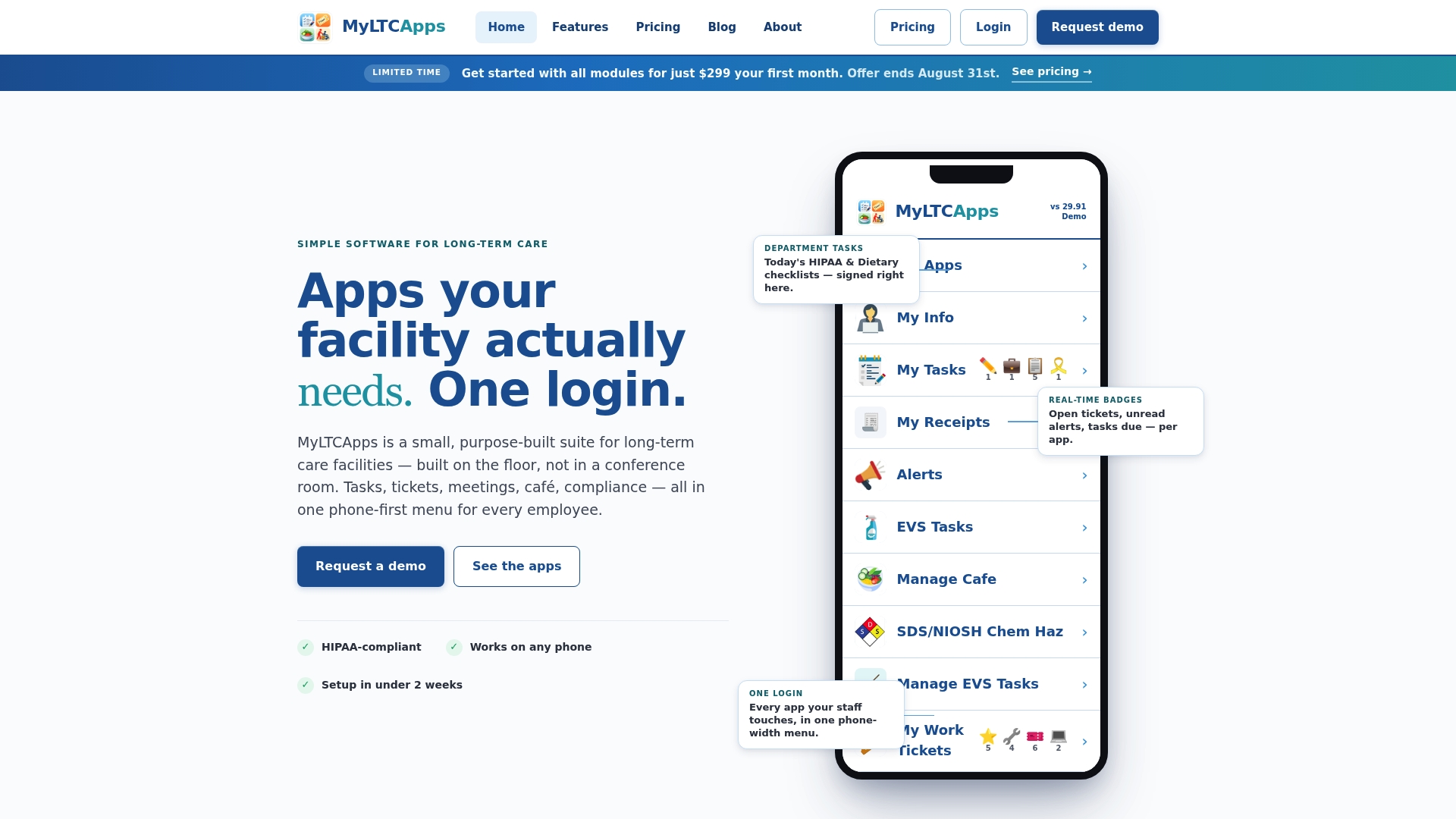
Huddles surface the work, and the hard part is making sure it gets done. We built MyLTCApps to cut the friction between “we agreed to do this” and “it is done,” so follow-up from your huddle reaches the right person in a few taps instead of a hallway conversation.
Here is how that works in practice:
- Mobile task management: assign each huddle action item to a named owner with a due time, and let them check it off from their phone. My Tasks also handles recurring checklists.
- Work tickets: turn a maintenance or environmental issue raised in the huddle into a ticket that routes to the right team and shows its status. See My Work Tickets.
- Dashboards: review open and closed items at a glance so the third agenda item takes seconds, not minutes.
- Shift visibility: use shift scheduling as part of your follow-up process.
The pitch is deliberately modest. A manual board works, and if you are just starting, begin there. When the volume of follow-up outgrows a whiteboard, we are here. You can browse the full feature overview or check pricing, where plans run from I Just Want That at 199 $ per month to the Premium Pack at 792 $ per month. Pick the next step that fits: look at the features page, compare plans, or run your first two-week huddle pilot and see what follow-up volume you actually generate.
FAQ
What are huddles in healthcare?
A healthcare huddle is a brief, stand-up meeting, typically 10 minutes or less, held at the start of the workday or shift. It aligns the team on the day’s risks and priorities rather than transferring detailed patient information.
What does team huddles mean?
A team huddle is a short, focused gathering where everyone shares what matters for the day ahead. According to AHRQ’s PSNet, the emphasis is on reviewing previous performance, anticipating safety concerns, and reinforcing standard work.
What are some good topics for nursing huddles?
Strong topics include safety concerns and good catches, residents or patients at risk today, tracked issues from prior huddles, equipment or staffing problems, and announcements. Use the agenda above, and keep detailed problem-solving for a separate, scheduled conversation.
Can you give me some examples of team huddles?
An ambulatory clinic might preview the day’s complex visits and missing results. An inpatient unit might review isolation status, fall risk, and discharge barriers. A long-term care floor might flag residents with a change in condition, new admissions, and maintenance issues affecting safety.
How do I know if our huddles are working?
Track attendance, average time per huddle, and the share of action items resolved within a consistent follow-up window, plus a short staff pulse on situational awareness. A systematic review links daily huddles to better teamwork and staff job satisfaction, so those outcomes are worth watching.
Sources
- Daily Huddle Component Kit | Agency for Healthcare Research and Quality
- Improving Patient Safety and Team Communication through Daily Huddles | PSNet
- Pubmed