10 Minute Environmental Rounds Checklist for LTC Managers

10 Minute Environmental Rounds Checklist for LTC Managers
A survey-ready environmental rounds checklist is organized by seven Environment of Care (EOC) domains, using yes/no/N/A line items and a findings table that records assigned responsibility and target resolution dates where applicable. Those seven domains are life safety, medical equipment, utilities, security, hazardous materials and waste, the general environment, and emergency management. Every round starts with a header capturing the date, area, participants, and round leader, and ends with findings routed to an owner with a deadline attached.
TL;DR:
- Most survey failures originate from common issues like obstructed egress paths, fire door malfunctions, or overflowing sharps containers, so focus on these first during quick rounds.
- Full environmental rounds should include detailed checks across seven domains, such as verifying medical equipment maintenance and confirming utility temperatures within safe ranges.
- Document findings with structured codes and photographic evidence, then assign clear ownership and deadlines to ensure timely corrective actions.
- Regular multidisciplinary rounds with dedicated owners and digital ticketing tools significantly improve follow-up and help trend issues before survey citations occur.
- Automated, mobile-first workflows streamline the transition from observation to resolution, reducing delays and enhancing compliance readiness for surveys.
Table of Contents
- Quick Start Checklist for Rapid Environmental Rounds
- Domain-by-Domain Checklist for Formal EOC Rounds
- Documentation and the Corrective-Action Workflow
- Who Should Round, and How Often
- Building a Sample Checklist Template
- Turning Rounds Into a Closed-Loop Process
- Rounding Consistently Beats Rounding Perfectly
- How MyLTCApps Supports Environmental Rounds
- Authoritative Resources for Building Your Checklist
- Sources
Quick Start Checklist for Rapid Environmental Rounds
Most citations trace back to a small set of repeat offenders. If you only have ten minutes to walk a unit, check these first:
- Egress paths are clear of storage, equipment, and clutter in corridors.
- Fire doors close fully and latch without obstruction.
- Sprinkler heads have at least 18 inches of clearance from stored items.
- Red emergency outlets are labeled and confirmed functional.
- Hand-hygiene stations are stocked and accessible at point of care.
- Clean and soiled workflows stay visibly separated, with no cross-storage.
- Sharps containers sit below the fill line, never overflowing.
- Medical gas zone valves are labeled and unobstructed.
- Crash cart seals are intact with current inspection tags.
- Water temperatures at patient-use fixtures fall within the facility’s Legionella-control range.
Phrase each item as a binary question your rounder can answer without interpretation. “Is the sprinkler deflector clear of storage?” works. “Check storage near sprinklers” does not, because it invites a paragraph instead of a checkbox.
Pro Tip: Run this rapid ten-item version weekly on high-traffic units, even if your formal EOC rounds happen quarterly. Weekly binary snapshots catch a slipping trend long before it becomes a survey finding.
Domain-by-Domain Checklist for Formal EOC Rounds
A full environmental rounds checklist needs specific, observable line items under each domain, not vague category headers. Here is what belongs in each one.
Life safety: fire doors close and latch fully; sprinkler deflector clearance of 18 inches or more; corridors free of storage exceeding 30 minutes; exit signage illuminated; fire extinguishers inspected on a current schedule in accordance with facility policy; smoke barrier penetrations sealed; fire drill documentation current for the unit.
Medical equipment: PM (preventive maintenance) stickers current on all life-support equipment; crash cart seals intact and inspection log signed; biomedical equipment tagged out of service when damaged; infusion pumps free of visible damage or recalls; portable equipment stored away from egress paths.
Utilities: medical gas zone valves labeled and accessible; red outlets tested and functional; hot water temperatures within the facility’s scald-prevention range; cold water and ice machine temperatures logged for Legionella control; generator transfer switch tested per schedule; medication refrigerator temperatures within range, with a documented cleaning and monitoring schedule.
Security: restricted-access doors secured and alarmed; duress or panic devices tested and functional; visitor sign-in process followed; ligature-risk items removed or mitigated on behavioral health units; medication room doors locked when unattended.
Hazardous materials and waste: Safety Data Sheets accessible at point of use; hazardous waste segregated and labeled correctly; sharps containers below the fill line; regulated medical waste stored in a secured, labeled area; chemical storage compatible and ventilated.
General environment: clean and soiled linen workflows physically separated; housekeeping carts stocked and secured; storage rooms free of clutter blocking access; ceiling tiles and walls free of visible damage or moisture staining. A housekeeping checklist for nursing homes can standardize the day-to-day version of this domain.
Emergency management: Interim Life Safety Measures (ILSMs) posted when construction is active; emergency contact signage current; contingency plans for utility failure accessible to staff; eyewash stations tested and logged, following a survey-ready inspection routine.
Special-care units need variations layered on top of this base structure. Behavioral health floors add ligature-risk items to security. Sterile processing departments add specific temperature and humidity ranges to utilities. Instead of writing narrative notes for every finding, use structured closure codes such as C (compliant), NC (noncompliant), CAC (corrective action complete), FU (follow up), and NA (not applicable). Coded data trends over time in a way that paragraphs of notes never will.
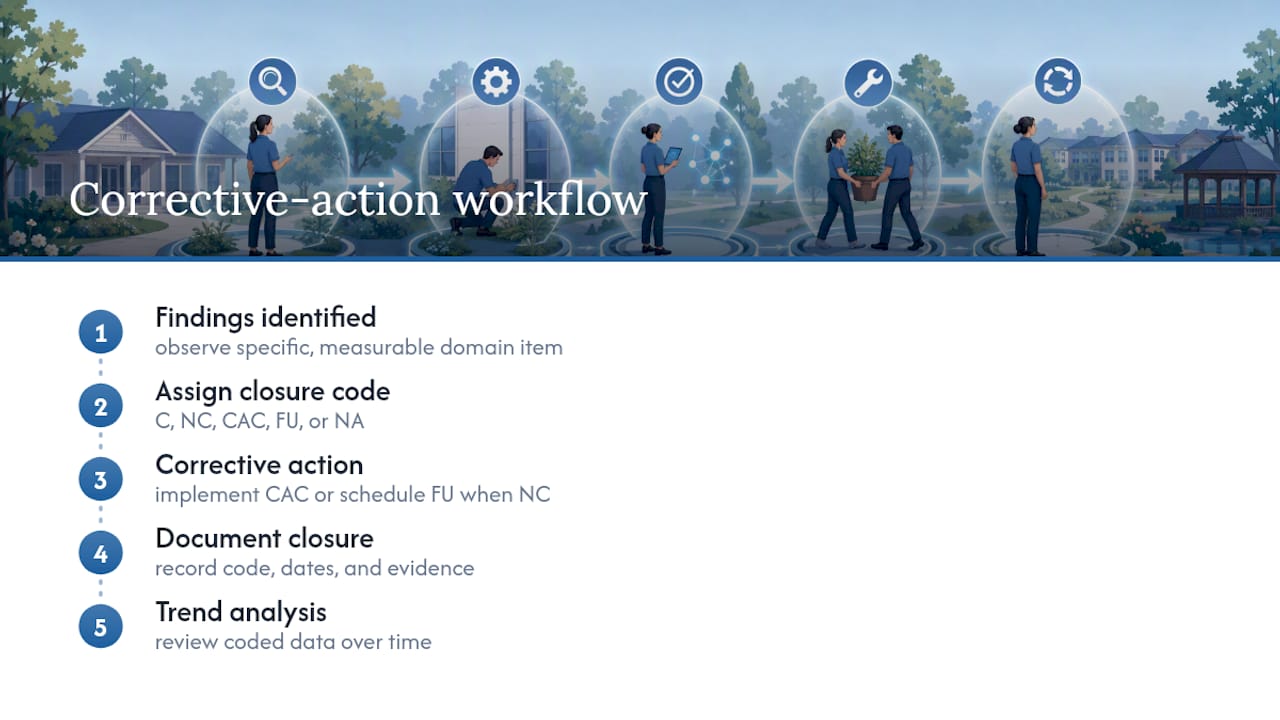
Documentation and the Corrective-Action Workflow
The header block is what turns a walk-through into a defensible record: date, unit or area, round type (announced or unannounced), participant names, and a round leader signature. Everything documented under it needs to funnel into a findings table with enough structure to drive follow-up.
A usable findings table includes:
- Item describing the specific deficiency observed.
- Location naming the room or zone.
- Severity rated on a simple scale (immediate risk, moderate, low).
- Owner assigned to a role, such as EVS, facilities, or a clinical unit leader.
- Target resolution date committed at the time of documentation.
- Closure date logged once the item is verified fixed, not just reported fixed.
- Photo evidence attached to the ticket for survey review.
Triage severity by asking whether the finding creates immediate patient or staff risk (fix same day), a moderate compliance gap (fix within the week), or a low-priority environmental issue (fix within the round cycle). A findings table that closes only after a verifier signs off on the resolution, rather than on the owner’s word alone, cuts down repeated deficiencies significantly.
Pro Tip: Photograph every finding at the moment you log it, then photograph it again at closure. That before-and-after pair is often the single most persuasive piece of evidence in a survey file.
Who Should Round, and How Often
Rounding works best as a multidisciplinary event, not a solo inspection. A well-composed rounding team routes findings to the right owner faster and closes them at a higher rate.
- EOC committee representative to anchor the round to the facility’s written plan.
- Facilities or engineering lead for utilities, medical gas, and building systems.
- Infection preventionist to flag cleaning, storage, and cross-contamination risks.
- EVS lead to own housekeeping and waste-related findings directly.
- Nurse leader or unit representative to confirm clinical-area context surveyors will ask about.
Patient-care areas should be rounded regularly, with higher-risk units like behavioral health or sterile processing rounded more frequently as an internal choice. Non-patient support areas warrant at least an annual round. Mix announced rounds, which let staff prepare and demonstrate good habits, with unannounced rounds, which show your real baseline. Both feed into your QAPI program as ongoing performance data.
Building a Sample Checklist Template
A working template starts with the same header every time: date, unit, round type, participants, and round leader signature, followed by one row per line item. A sample row might read: “Sprinkler clearance ≥18 in, Corridor B, C, [blank owner], [blank date].”
- Use one form per unit rather than one long document covering the entire building.
- Apply the C/NC/CAC/FU/NA code set consistently so results trend over months, not just within a single round.
- Attach a photo to any NC finding at the time of observation, then store it with the ticket for survey pull-through.
Turning Rounds Into a Closed-Loop Process
Paper checklists document a problem. They rarely close it fast. Mobile-first checklists convert each finding into an assigned work ticket the moment it’s logged, which shortens the gap between “noticed” and “fixed.”
- A nursing rounding checklist shows how targeted digital checklists translate into measurable follow-through.
- EVS tracking tools route housekeeping findings straight to the team responsible.
- Corrective action tracking shows how tickets stay open until a verifier, not just the assigned owner, confirms closure.
Digital tools that convert findings into tickets with dashboards materially improve follow-through, turning isolated inspections into a steady stream of performance data.
Rounding Consistently Beats Rounding Perfectly
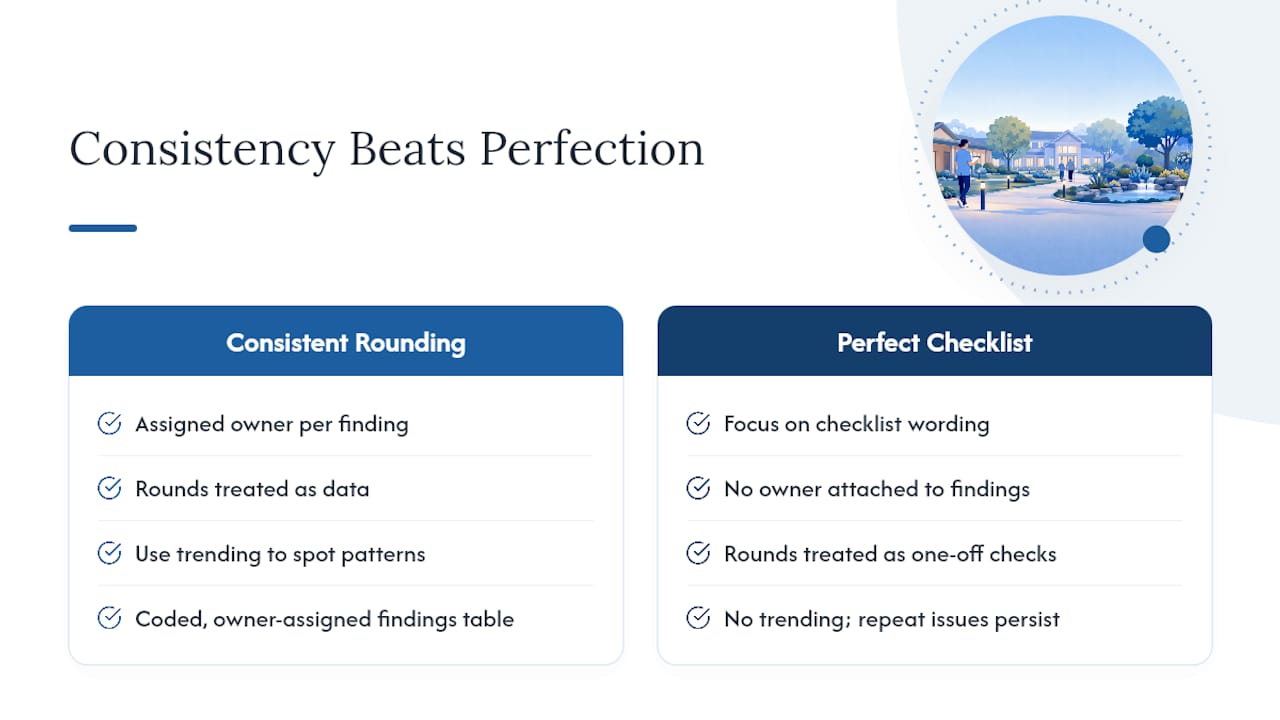
The biggest gap between facilities that pass survey cleanly and those that don’t isn’t the sophistication of their checklist. It’s whether anyone actually owns the follow-up. I’ve seen the same broken door latch documented three quarters running because nobody’s name was ever attached to fixing it. A coded, owner-assigned findings table closes that gap faster than any amount of extra checklist detail.
The teams that improve fastest treat every round as data, not a one-time event, and use trending to catch a pattern before it becomes a citation. Structure and ownership, applied consistently, do more than any single perfectly worded line item ever will.
— Philip
How MyLTCApps Supports Environmental Rounds
Paper checklists and spreadsheets slow down exactly the step that matters most: getting a finding from “observed” to “closed” with proof attached. There are mobile-first workflow solutions designed for long-term care and skilled nursing teams that replace that gap.
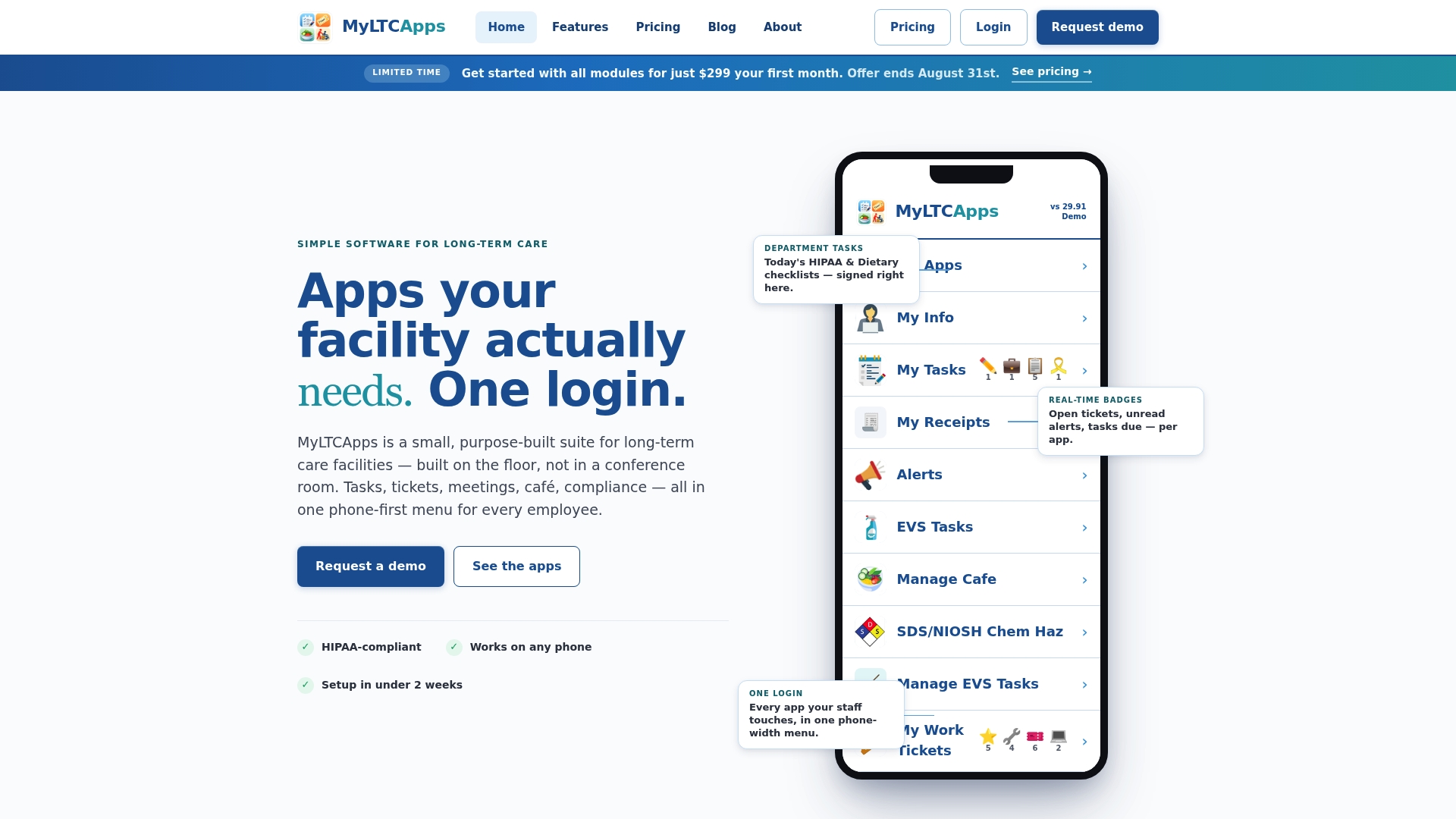
Round leaders log yes/no/N/A items on a phone, and each noncompliant item becomes an assigned work ticket with an owner and target date attached automatically. EVS-specific tracking keeps housekeeping findings routed to the right team, while compliance task tracking keeps the whole round history exportable for survey prep. Kansas facilities working toward KDADS readiness can see how the platform maps to state-specific requirements on the Kansas long-term care software page. If your current rounding process still lives on paper or in a shared spreadsheet, request a demo to see how a checklist-to-ticket workflow closes findings faster and keeps your documentation ready for the next survey.
Authoritative Resources for Building Your Checklist
- ASHE’s Environmental Rounding Tool covers building systems as infection-control variables.
- CDC offers infection control guidance and cleaning-evaluation toolkits.
- USF’s environmental rounds worksheet provides sample line items and coding.
- Chameleon Health Compliance offers broader compliance-process guidance for regulated facilities.
Sources
- Environment of Care Rounds Checklist
- Environmental Rounds: A New Approach
- Environmental Rounds Worksheet for Infection Prevention (USF)
- Environmental Rounding Tool | ASHE
- Centers for Disease Control and Prevention (CDC)