Nursing Rounding Checklists That Actually Improve Patient Outcomes

Nursing Rounding Checklists That Actually Improve Patient Outcomes
For most units, the fastest path to fewer falls, lower infection rates, and better team communication runs through two checklist types used together: a purposeful hourly rounding checklist built on the 4 Ps or 5 Ps framework for bedside nurses, and an interdisciplinary bedside checklist using the TEMP mnemonic for team rounds. In ICUs, FASTHUG replaces or supplements TEMP. When teams hit adherence above 70%, the results are measurable: the TEMP QI study reported elimination of CLABSI and CAUTI in study units and a statistically significant reduction in average hospital length of stay.
Key finding: A systematic review and meta-analysis pooling more than 30,000 patients across 30 studies found ICU rounding checklists were associated with reduced in-hospital mortality (RR 0.80; 95% CI, 0.70–0.92), along with reductions in ICU mortality, 30-day mortality, hospital length of stay, CAUTI, and CLABSI. Certainty of evidence was rated very low, so treat these as directional signals, not guarantees.
This article gives you everything you need to act on that evidence:
- Ready-to-copy checklist templates (hourly 4/5 Ps, interdisciplinary TEMP, ICU FASTHUG, leader rounding)
- Mnemonics and bedside scripts (4/5 Ps, TEMP, FASTHUG, AIDET)
- A step-by-step implementation playbook
- Metrics, audit forms, and tracking tool guidance
- Setting-specific adaptations for ICU, med-surg, and long-term care
Key Takeaways
Structured rounding checklists with adherence above 70% consistently produce measurable reductions in falls, device infections, and length of stay across ICU, med-surg, and long-term care settings.
| Point | Details |
|---|---|
| Start with two templates | Use the 4/5 Ps for hourly nurse rounds and the TEMP or leader one-pager for team and manager rounds. |
| Adherence is the lever | The TEMP study shows outcomes improve sharply when checklist adherence exceeds 70% — partial implementation produces partial results. |
| Measure two metrics first | Track rounds completed and falls per 1,000 bed days weekly; add CAUTI/CLABSI and LOS once the program is stable. |
| Close the loop visibly | Every issue needs a named owner and a follow-up date before the round ends — this is what builds staff trust in the system. |
| Myltcapps for LTC scale | Myltcapps’s mobile task and checklist module routes rounding issues to owners in real time and generates surveyor-ready audit exports. |
Table of Contents
- What does a nursing rounding checklist look like in practice?
- Mnemonics and bedside scripts that make rounds consistent
- How to implement a rounding checklist at unit level
- How do you measure the impact of rounding checklists?
- What does the evidence actually say about rounding checklists?
- What gets in the way of rounding checklists — and how to fix it
- How rounding checklists adapt across ICU, med-surg, and long-term care
- Sample checklist and audit form
- How to choose a digital checklist tool for rounding
- What rounding checklists actually demand from leaders
- Myltcapps makes rounding documentation work in long-term care
- Sources
What does a nursing rounding checklist look like in practice?
Ready-to-use templates are the fastest way to standardize rounds without reinventing the wheel. Copy any of these into a paper form, EHR note template, or mobile checklist tool and adapt field labels to your unit.
Purposeful hourly rounding (4 Ps / 5 Ps)
Intended users: RN or CNA | Frequency: Every 1–2 hours
| Field | Prompt |
|---|---|
| Pain | “Are you having any pain or discomfort right now? Rate it 0–10.” |
| Position | Reposition or assist; document last turn time and skin check |
| Potty | Offer toileting assistance; note continence status |
| Periphery | Scan environment: call light within reach, bed in lowest position, floor clear |
| Pump (5th P, optional) | Check IV lines, tubes, and alarms; confirm infusion rates |
| Closing loop | “Is there anything else I can do for you before I leave?” |
| Time completed | _____ |
A DNP purposeful nurse hourly rounding pilot using a modified 5 Ps reported falls dropping from 4.29 to 1.79 per 1,000 patient bed days over four months, exceeding its initial 10% reduction target.
Interdisciplinary bedside rounding (TEMP)
Intended users: Charge RN + physician + allied staff | Frequency: Once per shift or daily
| TEMP Element | Verification Item |
|---|---|
| T — Tubes/Lines/Drains | Is each device still indicated? Document removal date or rationale for continuation |
| E — Equipment | Ventilator settings, monitors, pumps — confirm settings match orders |
| M — Medications | Reconcile active medications; flag duplicates, interactions, or missed doses |
| P — Plan of Care | Verbalize the daily goal with patient and family; confirm discharge criteria |
| Adherence note | _____ % items completed |
ICU checklist (FASTHUG-style)
Intended users: ICU RN + intensivist | Frequency: Each ICU daily round
Leader rounding one-pager
Intended users: Charge nurse, nurse manager, or unit director | Frequency: Daily or per shift
| Field | Entry |
|---|---|
| Date / Time | _____ |
| Unit / Area | _____ |
| Staff present | _____ |
| Issue identified | _____ |
| Priority (Green / Yellow / Red) | _____ |
| Immediate action taken | _____ |
| Owner assigned | _____ |
| Follow-up date | _____ |
Leader rounding guidance recommends keeping these interactions to 10–15 minutes with a scheduled cadence, a stoplight prioritization system, and explicit closed-loop follow-up.
Which template fits which setting?
| Setting | Recommended Template | Primary Outcome Target |
|---|---|---|
| ICU | FASTHUG + TEMP | Mortality, device infections, LOS |
| Med-surg acute | 4/5 Ps + TEMP | Falls, call light use, patient satisfaction |
| Long-term care | 4/5 Ps (adapted) + Leader rounding | Skin integrity, falls, hydration, compliance |
| Leader / manager | Leader rounding one-pager | Staff engagement, issue resolution, safety culture |
Mnemonics and bedside scripts that make rounds consistent
Mnemonics do one thing well: they give every staff member the same mental checklist without requiring them to carry a paper form. Here is what each one covers and why it matters at the bedside.
4 Ps / 5 Ps (Pain, Position, Potty, Periphery, Pump) structures the hourly nurse visit so no comfort or safety item gets skipped under time pressure. The fifth P adds a device check, which is particularly useful on med-surg units where IV lines and Foley catheters are common. A systematic review on hourly rounding found moderate-strength evidence that structured hourly rounding improves patients’ perception of nurse responsiveness and reduces falls and call light use, with call light reductions ranging from 23% to 70% across studies.
TEMP (Tubes/Lines/Drains, Equipment, Medications, Plan of Care) shifts the focus from individual comfort to team-level safety. Its power is in the device-necessity question: every tube and line gets a daily justification, which is exactly the mechanism behind CLABSI and CAUTI elimination in the BMJ Open Quality TEMP study.
FASTHUG (Feeding, Analgesia, Sedation, Thromboembolic prophylaxis, Head-of-bed elevation, Ulcer prophylaxis, Glucose control) was designed for ICU daily rounds and covers the seven evidence-based bundles most likely to prevent ventilator-associated complications. Each letter maps to a specific order set, so the mnemonic doubles as an order-verification tool.
AIDET (Acknowledge, Introduce, Duration, Explanation, Thank you) is a communication script, not a clinical checklist. It structures how a nurse opens and closes a rounding visit to reduce patient anxiety and set expectations. Used at the start of a round, it takes under 30 seconds and measurably improves perceived responsiveness.
Short bedside scripts
Opening a round (AIDET-style): “Hi, Mrs. Chen — I’m Dani, your nurse for this shift. I’ll be checking in every hour. Right now I want to make sure you’re comfortable and have everything you need. It’ll take about two minutes.”
Catalyst question (4 Ps pivot): “Before I check your position and IV, can you tell me your pain level and whether you need to use the restroom?”
Closing the loop: “I’m going to note that your call light is now within reach and your bed is in the lowest position. Is there anything else before I go? I’ll be back by [time].”
Pro Tip: Scripts work best when staff treat them as a structure, not a script. Encourage nurses to swap in their own phrasing for the opening and closing while keeping the clinical questions word-for-word. That balance preserves fidelity without making rounds feel robotic.
How to implement a rounding checklist at unit level
A checklist that lives in a binder and never gets used is worse than no checklist at all — it creates the illusion of a safety system. The steps below are sequenced to build momentum before you scale.
-
Assess your baseline. Pull current fall rates, call light data, CAUTI/CLABSI counts, and any existing rounding logs. You need a before-picture to prove impact later.
-
Secure an executive sponsor. A nurse manager can pilot a checklist, but sustaining it requires a director or CNO who will protect rounding time on the schedule and defend it when staffing gets tight.
-
Choose one pilot unit. Pick a med-surg or LTC unit with a motivated charge nurse. Avoid starting on the busiest unit or the one with the highest turnover — early wins matter more than early scale.
-
Select and adapt the template. Use the 4/5 Ps template for hourly rounds and the leader rounding one-pager for manager visits. Adapt field labels to your EHR terminology so documentation is frictionless.
-
Assign roles clearly. The bedside RN or CNA owns hourly rounds and documents in real time. The charge nurse owns the leader rounding form. A designated “loop closer” — often the charge nurse — is responsible for following up on every open issue within 24 hours.
-
Train in 20 minutes, not two hours. Run a single 20-minute role-play session per shift. Pair a confident nurse with a skeptical one. Behavioral-change support, including role play and ongoing coaching, is frequently what separates projects that reach measurable adherence from those that plateau at 40%.
-
Pilot for four weeks. Audit adherence weekly. Target 70% completion of all checklist items by week three — that threshold is where the TEMP data shows LOS reductions begin to appear.
-
Review, adjust, and expand. At week four, hold a 30-minute debrief with the pilot team. Fix friction points before rolling out to the next unit. Expand one unit at a time.
Who to involve: Executive sponsor (CNO or director), charge nurses, bedside RNs and CNAs, at least one physician champion, a pharmacist for TEMP medication reconciliation, and a patient/family representative for the plan-of-care element.
Scheduling note: Schedule protected rounding windows during mid-shift lulls, not at shift change or during peak admission hours. When the assigned leader cannot attend, designate a backup charge nurse in advance rather than canceling the round.
How do you measure the impact of rounding checklists?
Measurement does not have to be elaborate. A two-metric dashboard — rounds completed and falls per 1,000 patient bed days — will tell you whether the program is working within the first month.
Core metrics to track
- Process metrics: Percentage of scheduled rounds completed; percentage of checklist items documented per round; closed-loop rate (issues identified vs. issues resolved within 24 hours)
- Outcome metrics: Patient falls per 1,000 patient bed days; CAUTI and CLABSI rates; average length of stay; call light activations per shift; patient satisfaction scores (HCAHPS responsiveness domain)
Audit design
A leader audit takes five minutes. Once per week, a manager reviews 10 randomly selected rounding logs and scores each on three items: Was the round completed on time? Were all checklist fields filled? Was every open issue assigned an owner and a follow-up date? That sample is enough to detect adherence trends without burdening staff.
Pro Tip: Cut measurement burden by combining your weekly leader audit with an existing safety huddle. Pull fall and call light data from automated reports rather than manual counts. One 15-minute weekly review covers both process and outcome metrics without adding a separate meeting.
What does the evidence actually say about rounding checklists?
The honest answer is: the signal is consistent, but the certainty is limited. Here is what the research shows and where the caveats sit.
The ICU rounding checklist meta-analysis pooled more than 30,000 patients across 30 studies and found associations with reduced in-hospital mortality (RR 0.80; 95% CI, 0.70–0.92), ICU mortality, 30-day mortality, hospital length of stay, CAUTI, and CLABSI. The authors rated the certainty of evidence as very low, primarily because most included studies were observational and checklist items varied widely across sites. That variability is itself a finding: no single universal checklist produced these results, which means local adaptation is not just acceptable — it is expected.
The TEMP QI study offers the clearest dose-response signal in the literature. Units that hit adherence above 70% showed a strong correlation with LOS reduction (r² = 0.69), and the study units eliminated CLABSI and CAUTI entirely during the study period. That correlation between adherence and effect size is the most practically useful number in the evidence base: it tells you that a partially implemented checklist produces partial results.
For hourly rounding specifically, the systematic review found moderate-strength evidence for improved patient perceptions of nurse responsiveness and reduced falls and call light use. An integrative review of ICU rounding checklists also found increases in goal verbalization during rounds, rising from 60% to 89% in some studies, and significant improvements in observed discussion rates across team members.
Key evidence points:
- Mortality association in ICU meta-analysis: RR 0.80 (95% CI, 0.70–0.92), very low certainty
- TEMP study: CLABSI and CAUTI eliminated in study units; LOS reduced by 13.3 hours overall
- Hourly rounding: call light reductions of 23%–70% across studies; falls reduced in multiple QI projects
- Goal verbalization: improved from 60% to 89% in some ICU rounding studies
- Evidence gap: few randomized controlled trials; most evidence is observational or QI-level
The practical implication is straightforward. You cannot cite this literature to guarantee outcomes, but you can use it to justify a pilot, set realistic targets, and make the case to leadership that the intervention has a consistent directional signal across diverse settings.

What gets in the way of rounding checklists — and how to fix it
Every unit that has tried to sustain a rounding program has hit the same four walls. Here is what they are and what actually works.

Low adherence is the most common failure mode. Rounds get skipped during high-census periods, and once the habit breaks, it rarely self-corrects. The fix is protected rounding time built into the schedule — not as a suggestion, but as a shift assignment. A QI project at Sacred Heart University found that structured protocols combined with consistent rounding improved teamwork satisfaction and reduced miscommunication, but only when the protocol was treated as a clinical task, not an administrative add-on.
Documentation fatigue sets in when the checklist has too many fields or requires a separate login from the primary workflow. Trim the template to the minimum viable fields for your setting. If a field has never surfaced an actionable finding in 30 rounds, remove it.
Rounding cancellations happen when the assigned leader is pulled to a crisis. Designate a backup for every scheduled leader round — a second charge nurse or a senior staff RN who can run the form in the leader’s absence. Cancellation without a backup is a program killer.
Unclear ownership means issues get identified and then disappear. The leader rounding guidance is explicit on this: every issue needs a named owner and a follow-up date before the round ends. A stoplight system (green = resolved, yellow = in progress, red = escalated) gives the team a shared language for prioritization without requiring a separate meeting.
Staff skepticism is usually a symptom of past programs that identified problems and never fixed them. The fastest way to build trust is to close the loop visibly and quickly on the first few issues the checklist surfaces — even small ones. A broken call light fixed within two hours after a round tells staff the system works.
Pro Tip: When an issue cannot be resolved on the spot, tell the staff member or patient exactly who owns it and when they will hear back. Write it on the leader rounding form and read it back aloud. That 10-second step is what separates a round that builds trust from one that feels performative.
How rounding checklists adapt across ICU, med-surg, and long-term care
The same checklist concept works in all three settings, but the items, frequency, and ownership shift substantially.
ICU: The priority is device management and bundle compliance. FASTHUG covers the seven critical elements; TEMP adds the device-necessity question that drives CLABSI and CAUTI prevention. Rounds happen daily with the full interdisciplinary team. The RN owns real-time documentation; the intensivist leads the clinical decision items. Escalation triggers are built into the form — any “No” answer requires an owner before the team leaves the bedside.
Med-surg acute care: The focus shifts to mobility, nutrition, fall risk, and patient communication. The 4/5 Ps template runs every one to two hours at the bedside level; a daily interdisciplinary round using a simplified TEMP covers medications and plan of care. The charge nurse runs the leader rounding form once per shift. Key additions for med-surg: ambulation status, diet tolerance, and discharge readiness.
Long-term care: LTC rounds emphasize skin integrity, hydration, medication reconciliation, and behavioral status. Hourly rounding frequency is often adjusted to every two hours for stable residents, with increased frequency for fall-risk or skin-breakdown residents. The CNA typically owns the 4 Ps comfort check; the RN owns the clinical assessment items. Leader rounding in LTC should include a compliance documentation check — a HIPAA compliance checklist integrated into the rounding workflow helps facilities stay surveyor-ready without separate audits.
Setting-specific checklist adaptations:
- ICU additions: Ventilator settings, sedation vacation status, RASS score, central line necessity, arterial line site check
- ICU removals: Ambulation prompts, dietary preference questions, social work referral items
- Med-surg additions: Ambulation distance, fall risk score (Morse or Johns Hopkins), diet tolerance, discharge planning status
- LTC additions: Skin integrity (Braden scale), hydration intake log, behavioral/mood status, weight trend, wound care status
- LTC removals: Ventilator bundle items, ICU-specific device checks, surgical site assessments
Sample checklist and audit form
One-page nurse checklist (purposeful rounds)
Unit: _____ | Date: _____ | Shift: _____
| Item | Completed | Notes |
|---|---|---|
| Pain assessed (0–10 scale) | ☐ | _____ |
| Position checked / repositioned | ☐ | Last turn: _____ |
| Toileting offered | ☐ | _____ |
| Environment scan (call light, bed height, floor) | ☐ | _____ |
| IV/tube check (5th P, if applicable) | ☐ | _____ |
| Closing question asked | ☐ | _____ |
| RN/CNA initials | _____ | Time |
Leader audit form
Auditor: _____ | Unit: _____ | Date: _____
| Issue Identified | Priority (G/Y/R) | Owner | Follow-up Date | Resolved? |
|---|---|---|---|---|
| _____ | _____ | _____ | _____ | ☐ |
| _____ | _____ | _____ | _____ | ☐ |
Download or copy these forms into your EHR template library or mobile checklist tool. For LTC facilities using Myltcapps, these fields map directly to the Tasks and Work Tickets modules.
Mandatory vs. optional fields
How to choose a digital checklist tool for rounding
Paper rounding logs work for a pilot. They do not scale, they cannot generate audit reports, and they make closed-loop tracking nearly impossible across a multi-unit facility. When you are ready to move beyond paper, here is what to look for.
Essential features in a digital rounding tool:
- Mobile-first entry that works on a personal phone or shared tablet without a laptop
- Offline mode for units with spotty Wi-Fi
- Real-time task assignment with named owners and due dates
- Escalation workflows that route issues to the right team (maintenance, nursing, pharmacy)
- Exportable audit reports formatted for QAPI submissions and surveyor review
- Integration with shift scheduling so rounding windows align with staffing
- Competency tracking to document rounding training and role-play sessions
When to use each format:
Lightweight mobile apps suit small facilities or single-unit pilots where the primary need is checklist completion and basic reporting. Paper forms work for a four-week pilot when you need speed over infrastructure. Enterprise EHR checklist modules offer deep integration but often require IT configuration time that delays rollout by weeks. For LTC facilities specifically, a purpose-built platform that combines checklists, task management, and compliance reporting in one interface tends to outperform both paper and EHR bolt-ons.
Myltcapps is built for exactly this use case. Its mobile checklist and task management module lets LTC staff complete rounding items from their phones, assigns owners to open issues in real time, and generates exportable reports for QAPI and survey preparation. The competency tracking module documents rounding training and audit results. Work tickets route environmental and equipment issues found during rounds directly to maintenance. The meetings module logs in-service training tied to checklist rollout. Together, these modules cover the full rounding workflow from bedside check to closed-loop resolution.
What rounding checklists actually demand from leaders
Most conversations about rounding checklists focus on the form itself. The harder question is what happens after the round ends.
The evidence is clear that adherence above 70% is where outcomes shift. But adherence is not a checklist problem — it is a leadership and culture problem. A form does not round; a nurse does. And that nurse will stop rounding consistently the moment they see an issue they raised go unaddressed for a week.
The most underestimated element in every rounding program is the closed-loop commitment. Not the documentation of it, but the visible, public follow-through. When a CNA notes during a round that a resident’s call light cord is fraying and a replacement appears the next morning, that is the moment the checklist earns its credibility with the whole unit. When the same issue sits on a log for three weeks, the checklist becomes paperwork.
Nurse leaders who sustain rounding programs tend to share one habit: they read the leader rounding log before they read anything else at the start of their shift. Not because the form is sacred, but because it tells them what their team needed yesterday and whether anyone delivered. That discipline, more than any mnemonic or template, is what separates a rounding program that improves outcomes from one that generates compliance documentation.
Myltcapps makes rounding documentation work in long-term care
Long-term care facilities face a specific challenge that acute-care rounding tools often miss: the documentation has to be surveyor-ready, the staff are often completing tasks on personal phones, and the same platform needs to handle checklists, work tickets, scheduling, and compliance reporting without requiring a separate login for each.
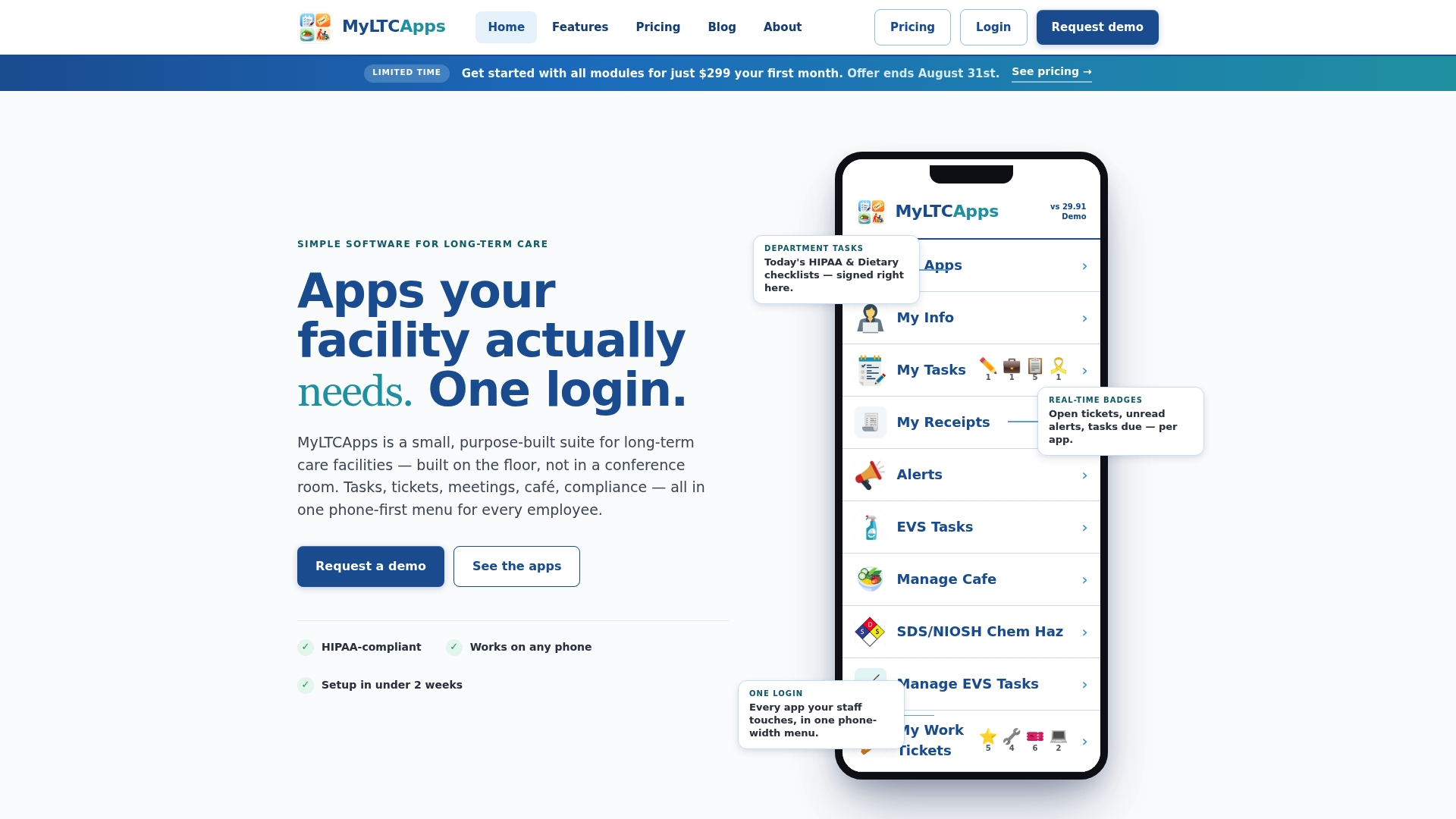
Myltcapps was built for that environment. The daily checklist and task module puts rounding forms on any phone, captures completions in real time, and routes open issues to the right owner automatically. Shift scheduling keeps protected rounding windows visible to every staff member. The competency module documents training sessions and audit results in the same system. When a surveyor asks for evidence of your rounding program, the export is ready in minutes.
Facilities that adopt Myltcapps for rounding typically see:
- Faster closed-loop resolution because issues route directly to maintenance or nursing via work tickets
- Reduced documentation burden because checklist completion and task assignment happen in one tap
- Surveyor-ready audit exports without manual report compilation
- Staff adoption driven by a phone-first interface that requires no new hardware
To see how the task and checklist module maps to your current rounding workflow, visit Myltcapps and request a walkthrough for your facility.
Sources
- Use of ICU rounding checklists to improve patient outcomes (systematic review and meta-analysis)
- Prospective application of the interdisciplinary bedside rounding checklist ‘TEMP’ is associated with reduced infections and length of hospital stay
- Purposeful Nurse Hourly Rounding (PNHR) Pilot — DNP project
This article provides general clinical and operational guidance. It is not a substitute for professional nursing judgment, facility policy, or regulatory compliance advice. Verify current standards with your state board of nursing, accreditation body, or a qualified clinical leader.