30/90/180-Day Section 1557 Compliance Plan for U.S. Providers

30/90/180-Day Section 1557 Compliance Plan for U.S. Providers
Any hospital, clinic, insurer, or Marketplace plan that receives HHS federal financial assistance must comply with Section 1557, and that means acting now, not after a complaint arrives. The core obligations are a written nondiscrimination policy with public notices, a designated Section 1557 Coordinator with a working grievance process, and functioning language-access and effective-communication procedures. Litigation has trimmed some 2024 provisions, so treat every requirement below as subject to change and watch HHS updates closely.
TL;DR:
- Organizations with federal health funding or operations within federally funded facilities must act now to meet nondiscrimination, language access, grievance, and recordkeeping requirements.
- Covered entities including hospitals, insurers, and health centers must appoint a Section 1557 Coordinator if they have 15 or more employees and maintain detailed records of training, grievances, and language services for at least six years.
- Implementing clear policies, posting notices in at least 15 common languages, and ensuring effective communication with interpreters and auxiliary aids are critical operational steps within the first 180 days.
- Compliance hinges on practical measures like posting notices, training staff, documenting decision-support tool risks, and maintaining an accessible paper trail; policies alone are insufficient.
- Enforcement by OCR involves complaint investigation, document review, and corrective actions, emphasizing swift record preservation and proactive remediation before a formal inquiry occurs.
Table of Contents
- What Does Section 1557 Compliance Actually Cover?
- Who Has to Comply, and Who Runs It Internally?
- What Do the Core Operational Requirements Look Like?
- How Does OCR Enforce Section 1557, and What Happens If a Complaint Arrives?
- What Should You Have Ready Before OCR Comes Knocking?
- How Do You Roll This Out in 30, 90, and 180 Days?
- Where Should Compliance Teams Focus First?
- How Myltcapps Supports Section 1557 Operational Compliance
- Primary Sources and Templates to Consult
- Sources
- FAQ
What Does Section 1557 Compliance Actually Cover?
Section 1557 compliance starts with a legal question most administrators skip: does federal money touch your organization at all? The statute, 42 U.S.C. § 18116, and its implementing regulation, 45 C.F.R. Part 92, prohibit discrimination on the basis of race, color, national origin, sex, age, or disability in any health program or activity that receives federal financial assistance from HHS, is administered by HHS, or is administered by any entity established under Title I of the Affordable Care Act.
That last category sweeps in insurance issuers and Health Insurance Marketplace plans, not just providers who bill Medicare or Medicaid directly. A skilled nursing facility that accepts Medicare Part B payments is covered. So is a hospital system that takes Medicaid, a home health agency that bills federal programs, and a third-party administrator that processes claims for a Marketplace qualified health plan.
The regulation, 45 C.F.R. Part 92, sets out the specific duties that flow from covered status: a coordinator requirement, written policy obligations, notice requirements, and language-assistance rules, each tied to its own compliance deadline. Coverage is not limited to clinical services either. It extends to any health program or activity the entity operates, which for a hospital can include cafeteria services tied to patient meals, billing departments, and even the hospital’s own employee health plan when that plan is part of a covered program.
Where things get genuinely tricky is the edge cases. A physician practice that accepts no federal insurance at all but leases space inside a federally funded community health center may still fall under coverage rules for that specific location. A standalone dental practice with zero Medicare or Medicaid patients typically falls outside Section 1557’s reach, since the entity itself isn’t a recipient of federal financial assistance and isn’t Title I administered. The test is always about the funding stream and the administering entity, not the size or type of the organization.
Entities that should assume coverage applies to include:
- Hospitals and health systems participating in Medicare or Medicaid
- Skilled nursing and long-term care facilities receiving federal reimbursement
- State Medicaid agencies and state-run health programs
- Health insurance issuers offering Marketplace qualified health plans
- Community health centers and federally qualified health centers
- Third-party administrators and pharmacy benefit managers tied to Title I programs
If your organization touches any federal health dollar, the safer assumption is coverage until legal counsel confirms otherwise.
Who Has to Comply, and Who Runs It Internally?
Compliance isn’t just a legal designation. It requires a named person accountable for making the rule function day to day. Under §92.7 of 45 C.F.R. Part 92, covered entities with 15 or more employees must designate a Section 1557 Coordinator. Smaller entities are not exempt from substantive obligations, but the formal coordinator role kicks in at that headcount threshold.
The coordinator’s job runs wider than most administrators expect. Specific duties typically include:
- Receiving and logging grievances filed under the entity’s Section 1557 grievance procedure
- Coordinating language-access requests, including interpreter scheduling and translated document requests
- Overseeing reasonable-modification requests from patients with disabilities
- Maintaining training records showing staff completed required nondiscrimination and accessibility training
- Serving as the point of contact listed on public notices and the entity’s website
- Reporting compliance gaps to leadership and coordinating corrective action
Beyond the coordinator role, entities applying for federal financial assistance, or seeking to participate in a Health Insurance Marketplace, generally must sign assurance forms affirming they will operate their programs free from discrimination as defined under Section 1557. These assurances are not one-time paperwork. They’re the legal hook OCR uses to justify jurisdiction if a complaint surfaces later, so keep signed copies on file indefinitely, not just for the grant cycle they accompanied.
Recordkeeping deserves the same seriousness. Retain grievance files, training logs, interpreter contracts, and notice-posting evidence for a minimum of six years, aligned with typical federal recordkeeping norms for HHS-funded programs, and longer where state licensing rules require it. When OCR opens an inquiry, the entities that fare best are the ones who can produce a clean paper trail within days, not weeks.
What Do the Core Operational Requirements Look Like?
This is where Section 1557 requirements move from legal theory into daily operations, and where most compliance failures actually happen. HHS’s own framing treats compliance as something you operationalize through policies, training, and accessible notices, not something you satisfy with a document sitting in a drawer.
Nondiscrimination policy and notices
A written nondiscrimination policy needs to state plainly that the organization does not discriminate on the basis of race, color, national origin, sex, age, or disability in its health programs and activities. Under §92.10 of the rule, notices of nondiscrimination must be posted prominently: on the organization’s website, in patient waiting areas, in intake packets, and alongside significant communications like denial-of-coverage letters.
Section 92.11 adds a language-access twist that trips up a lot of organizations: notices must be available in at least the 15 most common languages spoken by limited English proficient (LEP) populations in the state or states the entity serves, according to HHS’s language-access guidance. A facility in Kansas serving a growing Vietnamese and Spanish-speaking population needs notices reflecting that reality, not a generic English-only template pulled from a national vendor.
Language access and effective communication
Meaningful access means more than a phone number for Language Line taped to the front desk. OCR’s guidance requires covered entities to identify LEP needs at intake, provide qualified interpreters and translators, and treat machine translation as a starting point rather than a finished product. When accuracy genuinely matters, a human needs to review the machine output before it goes to a patient or family member.

For patients with disabilities, effective communication obligations run parallel to language access but focus on auxiliary aids and services: qualified sign-language interpreters, captioning, accessible electronic information technology, and telehealth platforms that work with screen readers and assistive devices. A telehealth visit that can’t accommodate a deaf patient’s interpreter isn’t a technical glitch. It’s a compliance gap.
Pro Tip: Don’t confuse “having an interpreter line” with “meaningful access.” OCR enforcement history shows that inconsistent use, staff who don’t know how to activate the service, or long wait times for interpretation are treated the same as having no service at all.
Grievance procedures and reasonable modifications
Every covered entity needs a grievance procedure under §92.8 that’s accessible to people with disabilities and LEP patients alike. HHS provides sample grievance procedures that specify minimum content: the coordinator’s contact information, a defined response timeline, confidentiality protections, and an explicit assurance against retaliation for filing a complaint.
Reasonable modification requests, meanwhile, follow a different track. A patient asking for a modification to standard policy, an extended appointment slot for a patient who needs more processing time, for instance, triggers an evaluation of whether granting it would fundamentally alter the program. If it would, the entity should offer an alternative modification rather than a flat denial.
Patient care decision tools and AI
The newest and least understood piece of the rule addresses clinical decision-support tools, including AI and algorithmic scoring systems used in patient care. HHS’s fact sheet requires covered entities to identify tools that use protected characteristics as inputs and take steps to identify and mitigate resulting discrimination risk. This does not mean banning algorithmic tools. It means inventorying what tools are in use, documenting how race, sex, age, or disability factor into their logic, and keeping a written risk assessment on file.
A short checklist for this piece alone:
- Inventory every clinical decision-support tool, scoring algorithm, or AI system in active use
- Identify which inputs include or correlate with protected characteristics
- Document a risk assessment and any mitigation steps taken
- Assign review responsibility to a named role, not a committee that meets quarterly
How Does OCR Enforce Section 1557, and What Happens If a Complaint Arrives?
The HHS Office for Civil Rights (OCR) is the enforcement body for Section 1557, and its process generally starts with a complaint filed through the OCR complaint portal, either by a patient, a family member, or an advocacy organization. OCR screens each complaint for jurisdiction first: is the entity actually covered, did the alleged conduct happen within the filing window, and does the complaint state a plausible violation.
If OCR proceeds, the agency typically requests documents, interviews staff, and reviews policies before deciding on a resolution path. In many cases, OCR seeks voluntary resolution: the entity agrees to specific corrective steps, sometimes formalized in a compliance agreement with monitoring requirements. Where an entity fails to remediate or resists cooperation, OCR can issue formal findings, refer the matter to the Department of Justice, or in the most severe cases, jeopardize the entity’s federal funding.
Recent enforcement activity illustrates what this looks like in practice. OCR has secured compliance in disability rights cases where a facility’s failure to provide qualified interpreters led not to a one-time fine, but to system-wide corrective obligations covering training, interpreter contracts, and ongoing monitoring across every location the entity operates.
If your organization receives an OCR inquiry or a formal complaint notice, act in this order:
- Preserve every relevant document immediately, including emails, training logs, and interpreter records, and suspend any routine deletion schedules that might touch them
- Notify the Section 1557 Coordinator and legal counsel the same day
- Gather training completion records and interpreter service logs covering the relevant time period
- Draft a preliminary remediation plan even before OCR requests one, since it signals good faith and often shortens the process
It’s worth noting that not every provision of the current rule is settled law. As of June 2026, HHS confirmed that a federal court vacated the 2024 rule’s provisions expanding sex discrimination protections to gender identity, while core protections tied to race, color, national origin, age, disability, and other aspects of sex discrimination remain enforceable. Treat this as a live legal landscape, and build a habit of checking HHS updates quarterly rather than assuming the rule you read this year is final.
What Should You Have Ready Before OCR Comes Knocking?
Roughly a handful of enforcement patterns keep repeating: missing interpreter documentation, notices that exist on paper but were never actually posted, and training records that can’t be tied to specific staff members. A prioritized checklist closes most of those gaps before they become a finding.
Immediate priorities (do these first):
- Designate and document a Section 1557 Coordinator, with the name and contact method published on your website and in patient-facing materials
- Post nondiscrimination notices at every patient touchpoint, including the top 15 languages relevant to your service area
- Publish or update your grievance procedure using HHS’s sample language as a baseline
Within the first year:
- Finalize written nondiscrimination policies and procedures covering language access, effective communication, and reasonable modification
- Complete staff training on nondiscrimination obligations and document attendance for every employee, not just clinical staff
- Inventory clinical decision-support tools and complete a documented risk assessment for each one
The regulatory calendar backs up this sequencing. 45 C.F.R. Part 92’s implementation schedule requires coordinator designation and notice posting within 120 days of the rule’s applicability date, written policies and staff training within one year, and decision-support tool reviews under §92.210 within 300 days. Insurance-related provisions apply by the plan year beginning on or after January 1, 2025.
Artifacts worth keeping, specifically because OCR investigators ask for them by name, include: timestamped screenshots of live website notices, intake forms capturing a patient’s language preference, interpreter invoices and credential files, training slides paired with signed attendance logs, and every AI or decision-support risk assessment you’ve produced. A HIPAA compliance checklist built for long-term care facilities offers a useful parallel structure, since much of the recordkeeping discipline overlaps between the two regulatory frameworks. For a deeper look at what auditors actually verify, what an audit trail proves in a healthcare compliance context applies almost directly to Section 1557 evidence gathering.

How Do You Roll This Out in 30, 90, and 180 Days?
A phased rollout keeps Section 1557 compliance from becoming an unmanageable all-at-once project, and it maps cleanly onto the rule’s own deadlines under §§92.7 through 92.11.
Days 1 to 30:
- Appoint your Section 1557 Coordinator and formally document the designation
- Draft your nondiscrimination policy using HHS’s fact sheet language as a starting template
- Identify the top languages spoken by patients in your service area to scope notice translations correctly
Days 30 to 120: 4. Post nondiscrimination notices across every physical location, your website, and intake materials 5. Stand up a grievance intake process, whether that’s a paper form, an email address, or a digital ticketing workflow 6. Line up interpreter services and confirm contracts specify qualified, not just bilingual, interpreters
Days 120 to 180 (and through year one): 7. Deliver nondiscrimination and accessibility training to all staff and document attendance 8. Inventory clinical decision-support tools and complete risk assessments for anything touching protected characteristics 9. Audit your evidence files, notices, training logs, grievance records, so they’re organized and retrievable before you ever need them for an OCR review
Small facilities without dedicated IT staff shouldn’t try to build this from scratch in spreadsheets. A mobile-first compliance tool that lets staff photograph posted notices, log training completions automatically, and route grievance tickets to the coordinator removes most of the administrative burden. That’s a meaningfully different lift than assigning one administrator to track everything manually across multiple buildings.
Pro Tip: Build your grievance form, coordinator job description, and language access checklist as reusable templates from day one. Facilities that treat these as one-time documents end up rewriting them every time a surveyor asks for an update.
Where Should Compliance Teams Focus First?
Most organizations over-invest in policy language and under-invest in proof that the policy actually functions. OCR’s posture is corrective first, not punitive first, which means the agency generally wants to see that you fixed the problem and can show your work, not that you wrote a flawless document nobody read.
That’s why language access and effective communication deserve priority over polishing your nondiscrimination policy’s wording. A patient turned away because no interpreter was available creates immediate harm and immediate enforcement exposure, while a slightly imperfect policy sentence rarely does. Training records and interpreter logs are what separate a defensible response from a scramble.
One caution worth stating plainly: software and mobile tools manage evidence, they don’t make legal judgment calls. A compliance platform can store your training logs and flag missing notices, but a human, ideally your coordinator working with legal counsel, still decides what counts as a reasonable modification or how to respond to a grievance. Treat any technology in this space as documentation infrastructure, not a substitute for policy judgment.
— Philip
How Myltcapps Supports Section 1557 Operational Compliance
Myltcapps is built specifically for long-term care and skilled nursing operations, which means Section 1557 recordkeeping doesn’t require a separate system bolted onto whatever you already use for scheduling and tasks.
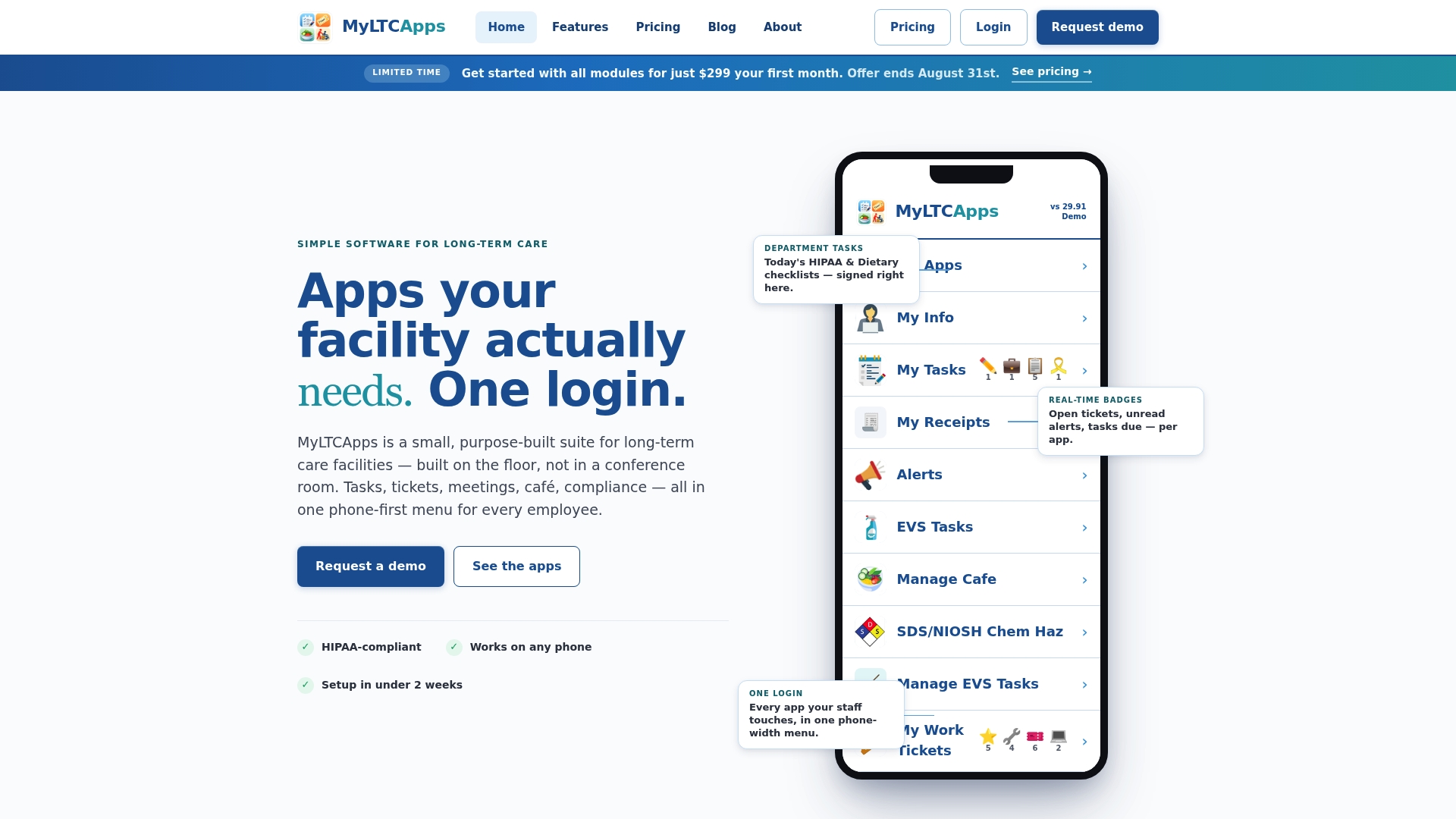
The Compliance Suite includes seeded compliance libraries covering areas like HIPAA, dietary, QAPI, and Section 1557, so your coordinator starts with structured checklists instead of building policy trackers from scratch. Mobile checklists let staff photograph posted notices at every location, training logs capture completion records tied to individual employees, and grievance tracking keeps intake, response timelines, and resolution notes in one searchable place. When an OCR inquiry or a state survey asks for proof, the platform’s surveyor-ready reporting exports pull that evidence together instead of leaving your coordinator to assemble it from five different folders.
That maps directly onto the obligations covered here: coordinator recordkeeping under §92.7, notice documentation under §92.10, training proof under §92.9, and interpreter logs supporting your language-access procedures. Facilities running multiple buildings under one corporate umbrella can see compliance status across every location from a single dashboard rather than calling each administrator individually.
Pricing runs from the I Just Want That plan at $199 per month up through the Premium Pack at $792 per month, depending on how many modules and how much headcount your facility needs. Review the Compliance Suite directly, or check the full pricing breakdown to find the plan that fits your facility’s size, then request a demo to see how the seeded compliance libraries handle your specific documentation load.
Primary Sources and Templates to Consult
Before finalizing any policy language, verify it against the primary sources directly, since HHS updates guidance as litigation develops.
- eCFR: 45 C.F.R. Part 92 Subpart A, the full regulatory text and section numbering
- HHS Section 1557 fact sheet, summarizing the final rule’s core requirements
- HHS language-access guidance (OCR DCL), covering interpreter and translation obligations
- HHS sample grievance procedures, a usable starting template
- HHS press release on the 2026 partial vacatur, reflecting the current litigation status
Check HHS’s press room periodically. Provisions tied to sex discrimination have already shifted once through litigation, and further changes remain possible.
Sources
- HHS press release: Informs covered entities of partial vacatur
- eCFR :: 45 CFR Part 92 Subpart A – General Provisions
- HHS fact sheet: Strengthening nondiscrimination protections and advancing civil rights in health care
- Language Access Provisions of the Final Rule Implementing Section 1557 of the Affordable Care Act
FAQ
Is Section 1557 Still in Effect?
Yes, Section 1557 remains in effect and enforceable. A court vacated specific 2024 rule provisions that expanded sex discrimination protections to gender identity, but HHS confirmed that core protections covering race, color, national origin, age, disability, and other aspects of sex discrimination remain fully enforceable.
What Is Considered Permissible Under Section 1557?
Section 1557 permits differential treatment only when it’s not based on race, color, national origin, sex, age, or disability, and when any modification denied would fundamentally alter the program rather than simply require reasonable accommodation. Neutral policies applied consistently, without discriminatory effect on a protected group, generally satisfy the rule.
Which Entity Enforces Section 1557?
The HHS Office for Civil Rights (OCR) is the enforcement body for Section 1557 nondiscrimination requirements. OCR handles complaint intake through its complaint portal, investigates alleged violations, and can pursue remedies ranging from voluntary compliance agreements to formal findings and referral to the Department of Justice.
Who Is Protected Under Section 1557?
Section 1557 protects individuals from discrimination based on race, color, national origin, sex, age, or disability in any health program or activity that receives HHS federal financial assistance, is administered by HHS, or is administered by a Title I entity. This includes patients seeking care from covered hospitals, clinics, and Marketplace insurance plans.
Does Myltcapps Include Section 1557 Compliance Tools?
The Myltcapps Compliance Suite includes a seeded compliance library covering Section 1557 alongside HIPAA, dietary, QAPI, and emergency preparedness needs. Current pricing details are available on the Compliance Suite page and the pricing page.