Public in 14 Days: CMS-2567 Plan of Correction for U.S. Administrators

Public in 14 Days: CMS-2567 Plan of Correction for U.S. Administrators
Form CMS-2567 is the official Statement of Deficiencies, and its Plan of Correction column must list specific corrective actions with explicit completion dates for every citation. Under QSO-25-19-All, issued June 18, 2025, CMS can now release that document to the public within 14 days of provider receipt, sometimes immediately. Your internal response window has not changed. Your window to look ready for public view has shrunk considerably.
TL;DR:
- Facilities must respond to each deficiency with a specific, measurable corrective action that includes a responsible role, clear completion dates, and supporting evidence.
- The public release of the CMS-2567 document can occur within 14 days of receipt, making timely, well-documented POCs crucial for reputation management.
- Multi-site operators need detailed site-specific documentation and responses to avoid delays and clarification requests during surveys.
- A strong POC aligns each correction directly with the survey tags and includes systemic changes tied to ongoing monitoring and quality improvement processes.
- Rejected or incomplete POCs risk operational disruptions, enforcement actions, and negative public exposure under the new accelerated release timeline.
Table of Contents
- What Is the CMS-2567 Form and Where Do You Find It?
- How Do You Complete the Plan of Correction Column?
- How Fast Do You Have to Respond, and What Changed in 2026?
- What Trips Up Most Plans of Correction?
- What Happens After You Submit Your Plan of Correction?
- How Task Tracking Supports Survey-Ready Documentation
- How Do You Identify Site-Specific Deficiencies Under a Shared Provider ID?
- How Is a Plan of Correction Different From Other Corrective Documents?
- What Happens to Your Facility if Your POC Is Approved or Rejected?
- What Does a Properly Completed POC Section Actually Look Like?
- How Do You Dispute a Deficiency You Disagree With?
- A Working Checklist for Survey Week
- Turn Every POC Line Into a Tracked, Documented Task
- Sources
What Is the CMS-2567 Form and Where Do You Find It?
The CMS-2567 is a two-column form: the Summary Statement of Deficiencies on the left, the Plan of Correction on the right. State survey agencies use it to document findings from health and life safety surveys at Medicare and Medicaid-certified facilities, including skilled nursing facilities, hospitals, and other providers subject to Requirements for Participation under 42 CFR Part 483. Each deficiency gets a tag number (an F-tag for nursing homes) and a regulatory citation, followed by the surveyor’s narrative of what they observed.
The right-hand column is where your facility responds. That response has to be tied directly to the language on the left, not a general statement about quality improvement.
You can pull the official CMS-2567 form and its completion instructions directly from CMS. Before you draft anything, confirm you’re working from the current version:
- The current CMS-2567 PDF and instructions, hosted on cms.gov
- Your state survey agency’s cover letter, which sets the exact due date for your response
- The 42 CFR citation referenced for each tag, so your corrective action matches the actual regulatory requirement
How Do You Complete the Plan of Correction Column?
Writing an acceptable Plan of Correction (POC) is less about polished prose and more about sequencing. Surveyors read hundreds of these. The ones that get approved on the first pass follow a consistent, traceable structure.
- Cross-reference the tag and citation. Start each POC entry by restating the ID Prefix Tag and regulatory citation exactly as it appears on the left side of the form. A reviewer should never have to guess which deficiency you’re answering.
- State the corrective action in concrete terms. Name what changed, not what you intend to consider. “Replaced expired stock and instituted weekly pharmacy audit” beats “will review medication procedures.”
- Assign a responsible role, not just a name. Directors of nursing turn over. Roles don’t. Tie the action to a position title so the POC stays valid even after staffing changes.
- Set an explicit completion date. A vague “ongoing” or “in progress” is one of the fastest ways to get a POC kicked back for revision.
- Describe the systemic fix, separate from the immediate one. Fixing the specific resident’s care plan is the immediate action. Changing the audit schedule so it doesn’t happen to the next resident is the systemic one. Surveyors want both.
- Attach or reference your evidence with healthcare automation tools. Training sign-in sheets, maintenance work tickets, updated policy documents, and audit logs all support the claim that the fix actually happened.
The best time to start this work is at the exit interview, not after the CMS-2567 physically arrives in the mail. Practitioner guidance across the long-term care compliance field consistently recommends beginning remediation the moment the survey team walks out the door, because evidence collected in real time is far more credible than evidence assembled retroactively under deadline pressure.
Pro Tip: Draft your POC language in the same order the tags appear on the Statement of Deficiencies, not the order you fixed them. Survey agency reviewers scan sequentially, and a mismatched order is one of the most common reasons a POC gets bounced for clarification before anyone even reads the substance.
How Fast Do You Have to Respond, and What Changed in 2026?
Facilities generally have 10 calendar days from receipt of the Statement of Deficiencies to submit a signed Plan of Correction or Allegation of Compliance, though the exact deadline is set by your state survey agency’s cover letter and may vary. That internal clock has not moved.
What changed is what happens after you submit. Under QSO-25-19-All, CMS now allows the completed CMS-2567, deficiencies and POC together, to become publicly releasable within 14 days of the facility receiving it, and in some cases immediately upon receipt.
Roughly two weeks: the new outer limit before your CMS-2567 becomes public record under QSO-25-19-All, a sharp compression from the release timelines many facilities were used to.
That policy exists to give beneficiaries and families faster access to survey results, not to punish providers. But it means your communications team, legal counsel, and administrator need to treat POC drafting as a public-facing document from day one. Build this into your checklist:
- Confirm who signs and returns the form to the state survey agency, and by what date
- Loop in marketing or family communications before, not after, release
- Keep a legal review step in the workflow if any tag carries litigation risk
- Verify your evidence file is complete enough to stand behind publicly, not just internally
What Trips Up Most Plans of Correction?
Rejected POCs tend to share the same four problems: vague corrective language, missing or “TBD” completion dates, a fix that addresses one resident instead of the underlying system, and a complete absence of supporting evidence. Any one of these can trigger a request for revision, which restarts your clock and adds stress during an already tense week.
A strong POC reads differently. Compare these two responses to the same hypothetical tag for a missed medication pass:
Weak: “Staff will be reeducated on medication administration procedures.”
Strong: “Licensed nurse educator conducted one-on-one competency review with all med-pass staff on [date]; unit manager will audit five random med passes weekly for eight weeks starting [date], with results reported to the QAPI committee monthly.”
The second version names an owner, a timeline, a monitoring mechanism, and a feedback loop back into your quality program. That combination, a named responsible party, a measurable outcome, and an ongoing audit, is what separates a POC that survives review from one that bounces.
- Assign a specific job title to every action, never “staff” or “the team”
- Set a monitoring schedule that outlasts the initial fix by weeks or months
- Reference the training or policy document by name and revision date
- Tie every systemic change back to your QAPI process so it doesn’t read as isolated
Pro Tip: If a surveyor cited a pattern across multiple residents, your POC needs a pattern-level fix. A POC that only names the residents in the original citation, and skips the audit that would catch the next one, is one of the most predictable reasons for a follow-up finding.
What Happens After You Submit Your Plan of Correction?
Your state survey agency reviews the submitted POC and responds one of three ways: acceptance, a request for revision with specific feedback, or a scheduled revisit to verify the correction actually took hold. Each outcome demands a different kind of readiness.
For an accepted POC, keep your dated completion records on file exactly as described, because that’s what a future surveyor will ask to see if the same tag ever resurfaces. For a revisit, you need more than the original fix. You need the ongoing monitoring logs, audit summaries, and any trend data showing the systemic change held over time.
- Keep POC evidence files for at least as long as your state survey cycle, typically two to three years
- Organize documentation by tag number so a revisit surveyor can move through it quickly
- Maintain a running audit log rather than a single point-in-time snapshot
- Store signed copies of the returned CMS-2567 alongside your internal evidence file
How Task Tracking Supports Survey-Ready Documentation
A Plan of Correction lives or dies on whether you can prove the fix happened when you said it did. That’s a task management problem as much as a compliance one.
Mapping each POC line item to an assignable task with a hard due date, a named owner, and an attached completion record gives you exactly the evidence structure a survey agency wants to see. Corrective action tracking tools built for long-term care can tie a tag number directly to a checklist item, so the training sign-off or maintenance ticket referenced in your POC has a timestamped record behind it, not a memory.
- Assign each corrective action to a role, with a due date that matches your POC language exactly
- Capture evidence, photos, sign-offs, completed checklists, at the point of task completion
- Pull a survey-ready export organized by tag number instead of rebuilding it manually under deadline
How Do You Identify Site-Specific Deficiencies Under a Shared Provider ID?
Multi-site operators and chains that share a single CMS Certification Number across locations face a documentation problem most single-site facilities never encounter: a deficiency cited under a shared ID has to be traceable to the exact building and unit where it occurred, not just the corporate entity.
The form itself requires this. When a survey agency documents a finding, the facility’s response has to identify the specific site within the text of the CMS-2567, since the certification number alone won’t tell a reviewer, or a family member reading the public release, which location the citation actually concerns.
This is where a lot of multi-facility operators get tripped up. If your internal recordkeeping tracks incidents, maintenance logs, and training records at the corporate level rather than the site level, you’ll struggle to produce the site-specific evidence a POC requires under time pressure. The fix isn’t complicated, but it has to be built in advance of your next survey, not during it.
- Tag every incident report, audit log, and training record with a specific building or unit identifier, not just a corporate ID
- Structure your POC language to name the site explicitly in the corrective action text
- Keep a site-level roster of responsible managers separate from your corporate compliance contact
- Confirm your state survey agency’s cover letter identifies the specific location cited before you draft a response
Facilities that get this wrong don’t usually get cited for it directly. They get slower survey agency reviews and more clarification requests, which eats into an already tight response window.
How Is a Plan of Correction Different From Other Corrective Documents?
A Plan of Correction is not the same thing as a corrective action plan under a state licensing survey, an internal QAPI performance improvement plan, or a corporate compliance program’s remediation log, even though facilities often use similar language across all four.
The POC is specifically the regulatory response to a Statement of Deficiencies under federal Medicare/Medicaid certification survey rules, and it goes to your state survey agency, which forwards it to CMS. A state licensing corrective action plan may run on a completely separate timeline and go to a different state office entirely, depending on your state’s own licensing statute. An internal QAPI action plan is a quality improvement tool your facility uses voluntarily, and while it should feed evidence into your POC, it isn’t itself a regulatory filing anyone at CMS reviews.
The distinction matters most when a survey uncovers something serious enough to trigger multiple parallel processes at once, a federal Statement of Deficiencies, a state licensing complaint, and an internal root-cause investigation, all stemming from the same underlying event. Treating all three as one document is a common and costly mistake. Your POC needs to stand on its own, cross-referenced to the specific federal tag, even when your internal investigation and state filing cover overlapping ground. Confusing the three, or submitting language written for one as if it satisfies another, is a frequent source of survey agency pushback.
What Happens to Your Facility if Your POC Is Approved or Rejected?
An approved Plan of Correction keeps your facility in good standing for continued program participation. It closes the loop on that survey cycle and becomes the record surveyors reference if the same tag reappears later.
A rejected or incomplete POC has real operational consequences. Your state survey agency will request revisions, which restarts your response clock and extends the period during which your facility carries an open, uncorrected deficiency on record, a status that becomes visible faster than ever under QSO-25-19-All’s accelerated release timeline. For severe deficiencies, an inadequate POC can escalate toward enforcement remedies, including denial of payment for new admissions or, in the most serious cases, termination proceedings.
Beyond the regulatory mechanics, there’s a reputational dimension that didn’t carry the same weight before the 2025 policy change. When your CMS-2567 becomes publicly releasable within roughly two weeks of receipt, a messy or rejected POC is no longer just an internal compliance headache. Families researching a facility, referral sources, and local reporters can all see it far sooner than under the old release schedule. An approved, well-documented POC protects your standing in both arenas at once.
What Does a Properly Completed POC Section Actually Look Like?
Here’s a sample structure for a single tag response, formatted the way a completed CMS-2567 entry should read:
| Field | Sample entry |
|---|---|
| ID Prefix Tag | F-Tag |
| Regulatory citation | 42 CFR Part 483 |
| Corrective action for cited resident | Resident’s care plan updated to reflect current fall risk interventions |
| Systemic corrective action | Unit manager to audit 10% of care plans weekly for fall risk documentation accuracy, starting 03/17/2026 |
| Monitoring mechanism | Audit results reported to QAPI committee monthly through 09/2026 |
| Responsible party | Director of Nursing |
| Completion date | Date completed (resident-specific); ongoing (systemic) |
Notice what each field does. It doesn’t summarize the deficiency again, it names an action already completed. It doesn’t say “will monitor,” it names a frequency, an owner, and an end date for the monitoring period. That level of specificity is what a survey agency reviewer is scanning for on first read, and it’s the difference between a POC that clears review and one that comes back with a request for more detail.
How Do You Dispute a Deficiency You Disagree With?
You have the right to challenge a cited deficiency, but the mechanism for doing so runs separately from your POC obligation, and the two should never be confused. Submitting your Plan of Correction does not waive your right to dispute the underlying finding, and disputing a finding does not excuse you from submitting a timely POC in the meantime.
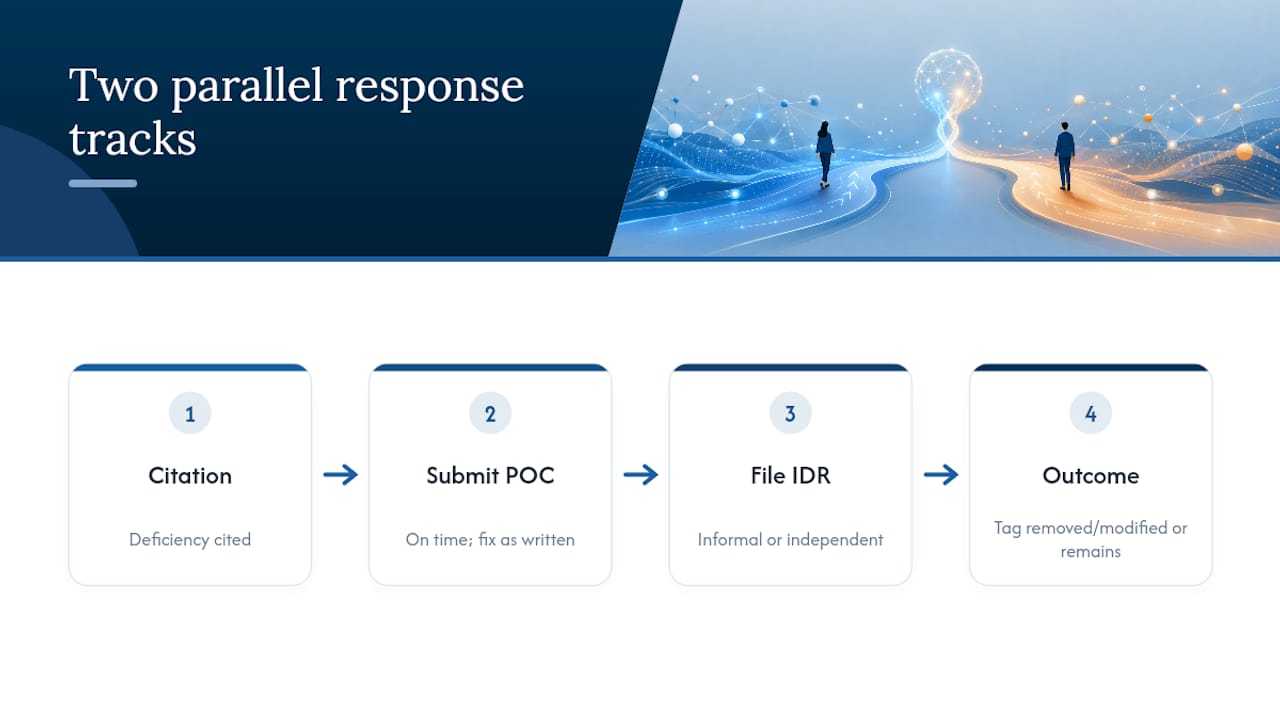
If your facility believes a citation was issued in error, misapplied the regulation, or misrepresented what surveyors observed, raise it through your state survey agency’s informal dispute resolution (IDR) process, or the independent IDR process for more serious findings, rather than by simply writing a defensive narrative into the POC’s corrective action column. The POC column is not the place to argue the facts. Surveyors expect it to state what you’re fixing, not why you think the finding was wrong.
Practically, that means running two tracks at once during your response window: submit the POC on time addressing the deficiency as written, while separately filing your dispute through the appropriate IDR channel if you have grounds to contest it. If your dispute succeeds and the tag is removed or modified, your POC record gets adjusted accordingly. If it doesn’t, you’ve still protected your facility’s standing by meeting the deadline regardless of the outcome. Facilities that skip the POC while waiting on a dispute decision risk the enforcement consequences of an unanswered deficiency, a wholly avoidable mistake.
A Working Checklist for Survey Week
Here’s the short version I’d want taped inside every administrator’s binder during survey week:
- Cross-reference every tag and citation before writing a single word of corrective action.
- Name a responsible role and a real date for every item, no exceptions.
- Separate the resident-specific fix from the systemic one, and write both.
- Collect evidence as you go, not after the fact.
- Assume the finished CMS-2567 will be public within roughly two weeks and write accordingly.
- Check your specific state survey agency’s cover letter for any deadline that differs from the general 10-day norm.
Transparency under the 2025 policy update isn’t something to fight. Families deserve fast, accurate information about the facilities where their loved ones live, and a facility with a clean, well-documented POC has nothing to lose from that visibility. The work is the same either way, tighten your evidence trail, name your owners, and set real dates. What changed is how quickly the outside world gets to see whether you did it.
— Philip
Turn Every POC Line Into a Tracked, Documented Task
Every requirement covered above, named owners, hard completion dates, evidence attached at the point of completion, is a task management problem before it’s a compliance problem. MyLTC Apps is built around that fact: instead of chasing training sign-offs and maintenance tickets across spreadsheets during survey week, you assign each corrective action as a task with a due date and a responsible role, and the completion record attaches automatically.
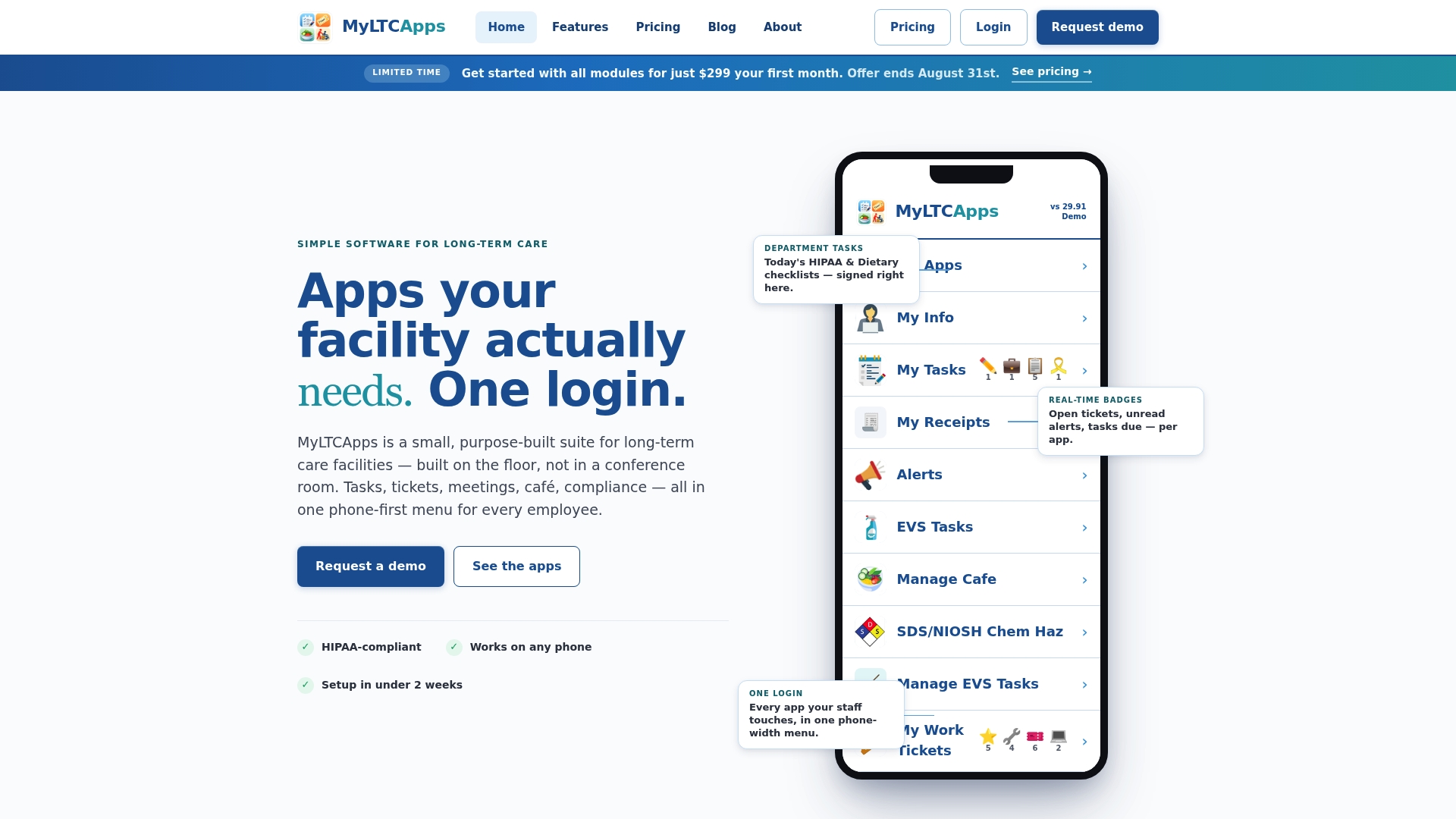
Some platforms provide seeded compliance libraries to give a starting structure for HIPAA, QAPI, and emergency preparedness items, so users don’t have to build their evidence framework from scratch every survey cycle. When it’s time to respond to a Statement of Deficiencies, your compliance task and checklist tools let you pull a dated, organized record instead of reconstructing one under deadline pressure. If your facility handles staff training documentation separately, competency tracking closes that gap too.
Request a demo of a task management platform designed for long-term care facilities to see how your next Plan of Correction could be backed by evidence already on hand, rather than evidence you’re scrambling to find.