Survey Ready in 90 Days: Emergency Preparedness for US Nursing Homes

Survey Ready in 90 Days: Emergency Preparedness for US Nursing Homes
A compliant emergency preparedness program needs four things: a facility-based hazard vulnerability assessment, an emergency operations plan built on that assessment, tested communication procedures, and a training program with exercises run at least twice a year. Add generator and utility planning on top, since power failures trigger more surveyor citations than almost any other gap. Start with the templates below, then work through the hazard assessment and communication plan before you touch a tabletop exercise script.
TL;DR:
- Emergency plans must be based on a facility-specific hazard vulnerability assessment that considers local risks, resident vulnerabilities, and assigned response responsibilities.
- Training and exercise programs should include multiple tabletop sessions and at least one full-scale drill annually, with after-action reports leading to targeted improvements.
- Power failure preparedness requires monthly generator testing per NFPA 110 standards, documented maintenance records, and offsite fuel management plans.
- Communication systems must be current, including resident transfer packets, staff contact lists, and annual renewal of transfer agreements, ideally managed with digital tools.
- Initial focus areas for the first 90 days should be updating hazard assessments, formalizing transfer agreements, and establishing a schedule for exercises and documentation review.
Table of Contents
- What Does the CMS Emergency Preparedness Rule Require?
- How Do You Run a Hazard Vulnerability Assessment That Passes Survey?
- What Belongs in Your Emergency Communication Plan?
- How Should You Design Training and Testing Exercises?
- How Do You Plan Evacuation and Shelter-in-Place for Residents With Complex Needs?
- What Are the Generator and Standby Power Requirements?
- Which Templates and Toolkits Should You Actually Use?
- What Should Administrators Do in the First 90 Days?
- An Operations-Centered View on Emergency Preparedness
- A Different Way to Handle the Administrative Load
- Sources
- FAQ
What Does the CMS Emergency Preparedness Rule Require?
The rule sits in 42 CFR §483.73, and it breaks into four core elements every long-term care facility must maintain: an emergency plan based on a facility-specific risk assessment, policies and procedures that support that plan, a communication plan, and a training and testing program. Facilities must review the plan regularly and run exercises periodically throughout the year.
Surveyors check documentation as closely as content. They want to see:
- A dated, signed emergency plan tied to an actual hazard assessment, not a boilerplate document
- Training records showing every staff member completed initial and annual emergency training
- Exercise records with after-action reports and evidence that gaps got fixed
- Generator testing logs referencing NFPA 110 and Life Safety Code standards
- Current transfer agreements and communication test logs
The CMS Emergency Preparedness Rule page has downloadable checklists and sample transfer agreements worth pulling before your next survey window. The most common deficiency isn’t a missing plan. It’s a plan that was written once, filed, and never updated against a real exercise finding.
How Do You Run a Hazard Vulnerability Assessment That Passes Survey?
Generic templates get flagged. Surveyors expect an HVA reflecting your actual building, your actual location, and your actual resident population, not a stock document swapped in from another facility. Building one that survives scrutiny takes a specific sequence:
- Pull local hazard data first. Talk to your county emergency management office about flood zones, wildfire risk, grid reliability, and regional disease surveillance trends before you touch a spreadsheet.
- Map resident vulnerabilities against each hazard. Residents on supplemental oxygen face different risks during a power outage than residents with dementia during an evacuation; your HVA should reflect that split, not treat “residents” as one category.
- Score likelihood and impact. Rank each hazard so your mitigation dollars and staff hours go to the risks most likely to hit you, not the most dramatic ones.
- Assign annexes and owners. Every high-priority hazard needs a named staff role responsible for the response annex and a timeline for when that annex gets tested.
An HVA built this way becomes the spine of your entire plan. ASPR TRACIE’s guidance on this process is worth reading before your next annual review.
What Belongs in Your Emergency Communication Plan?
Your communication plan is really three documents wearing one label: resident records, staff and external contact lists, and a system for testing both.
- Resident transfer packets need medications, allergies, care level, advance directives, and next-of-kin contact information ready to move with the resident, not chase them to the receiving facility later.
- Staff and external contact directories should list every staff member’s current phone number alongside utility companies, transportation vendors, and your local emergency management office, and someone needs to own quarterly verification of that list.
- Transfer agreements and MOUs with receiving facilities need annual renewal, not a signature from three administrators ago sitting untouched in a binder.
- Documentation practices for sharing protected resident information during a transfer need a clear chain of custody, especially when records move by hand between facilities during a chaotic evacuation.
A digital emergency contact directory removes a lot of the version-control chaos that comes with paper lists, since a printed directory from six months ago is functionally useless the moment three staff members change their phone numbers. Facilities that also handle resident information during transfers should review HIPAA compliance basics for long-term care so transfer documentation doesn’t create a second compliance problem on top of the first.
How Should You Design Training and Testing Exercises?
Tabletop exercises are the cheapest and fastest way to find command-structure gaps before you commit staff hours to a full operations-based drill. Run them first, always, because a tabletop exposes confusion about who makes the evacuation call before that confusion plays out during an actual event.
- Run exercises multiple times each year, and CMS expects at least one to be a full-scale or operations-based drill, with the other allowed to be a tabletop or workshop.
- Include one unannounced drill in your annual calendar, since staff behavior under a surprise scenario differs sharply from behavior during a scheduled walk-through.
- Build scenarios from your own HVA, not a generic script. A facility in a flood zone should be running water-intrusion and evacuation scenarios, not wildfire drills borrowed from a different region’s template.
- Write an after-action report and improvement plan (AAR/IP) after every exercise, tying each finding back to a specific hazard in your HVA and assigning a fix date.
ASPR TRACIE’s situation manual for shelter-in-place and evacuation tabletops is a strong starting script if you haven’t run one yet.
Pro Tip: Schedule your unannounced drill for a shift change or a weekend, when staffing is leanest. That’s when your real gaps show up, not during a Tuesday morning drill with your full leadership team on-site.

How Do You Plan Evacuation and Shelter-in-Place for Residents With Complex Needs?
Not every resident evacuates the same way, and matching transport resources to resident mobility is where evacuation plans usually fall apart under pressure.
- Categorize residents by transport need — ambulatory, wheelchair, and stretcher — and confirm you have contracted transport resources matching each category, not just a generic “ambulance on call” line in your plan.
- Lock in receiving facility agreements before you need them, and update those agreements at least annually since bed availability and facility contacts change.
- Track every relocated resident and staff member with a system that shows current location, not a paper roster that goes stale the moment someone moves a resident between two receiving sites.
- Set clear re-entry criteria so you’re not guessing when it’s safe to bring residents home; base it on utility restoration, structural inspection, and infection-control clearance where relevant.
Research on nursing home disaster readiness shows persistent gaps in evacuation coordination with emergency management officials, and that facilities running targeted exercises and maintaining active MOUs close those gaps faster than facilities relying on paper plans alone.
What Are the Generator and Standby Power Requirements?
Generator failure during a real event is one of the fastest ways to turn a manageable emergency into a life-safety crisis, and it’s a frequent target during survey.
- Test generators according to NFPA 110 and Life Safety Code intervals, with monthly load tests and documented annual inspections at minimum; for detailed maintenance scheduling guidance, see emergency preparedness for facilities.
- Build a fuel management plan specifying how many hours of runtime you can sustain on-site fuel and at what threshold you trigger resupply or evacuation.
- Keep dated test records accessible, since CMS’s updated Appendix Z guidance specifically calls for documented ongoing maintenance, not a one-time inspection certificate.
- Store copies offsite, so your generator records survive even if the building itself becomes inaccessible.
A generator test log template built around NFPA 110 checkpoints keeps this documentation consistent across shifts and administrators.
Which Templates and Toolkits Should You Actually Use?
Not every downloadable toolkit deserves equal attention. Some documents you can adapt with minor edits; others need a full rewrite reflecting your specific building and resident population.
| Document type | Best source | Reuse as-is or customize |
|---|---|---|
| HVA workbook | ASPR TRACIE Long Term Care Preparedness Toolkit | Customize heavily with local hazard data |
| Tabletop scenario scripts | ASPR TRACIE nursing home exercise materials | Adapt scenario to your top HVA hazard |
| Evacuation assessment form | ASPR TRACIE evacuation resources | Reuse structure, customize resident categories |
| AAR/IP template | ASPR TRACIE exercise materials | Reuse format, customize findings each time |
| Facility transfer agreement | CMS EP Rule downloads | Customize receiving-facility details annually |
The ASPR TRACIE base plan toolkit and the nursing home exercise and evacuation PDF cover most of what you need. Prioritize the HVA workbook and evacuation assessment form first. Digital checklists and contact directories reduce the version-control errors that plague paper-based versions of these same documents, particularly when multiple shifts update them independently.
What Should Administrators Do in the First 90 Days?
Break the work into three windows so it doesn’t stall out under daily operational demands.
- Days 1 to 30: Update your HVA with current hazard data, refresh your emergency contact directory, and schedule your first tabletop exercise.
- Days 30 to 60: Renew or establish transfer agreements and MOUs with receiving facilities, run at least one operations-based exercise, and complete a documented generator test.
- Days 60 to 90: Close out AAR/IP action items from your exercises, verify staff competency on emergency procedures, and archive all documentation in a format surveyors can review quickly.
Pro Tip: Assign one owner per checklist item with a hard date, not a department. “Facilities” doesn’t show up to a meeting. A named person does.
An Operations-Centered View on Emergency Preparedness
The plans that fail during a real event aren’t usually missing pieces. They’re missing follow-through, since the HVA sat untouched for two years, or the contact directory listed a phone number for someone who left the building eight months ago. Compliance paperwork and real readiness converge only when someone owns the update cycle, not just the initial draft. Centralized checklists and alerting close that gap because they surface what’s overdue instead of hiding it in a binder nobody opens until survey week.
— Philip
A Different Way to Handle the Administrative Load
Most of what breaks down in a nursing home emergency plan isn’t the plan itself. It’s the maintenance: contact lists that go stale, checklists that live on paper in three different binders, and generator logs nobody can find during survey. There are digital tools designed to help administrators keep emergency SOPs, contact directories, and daily checklists current without chasing down updates by hand.
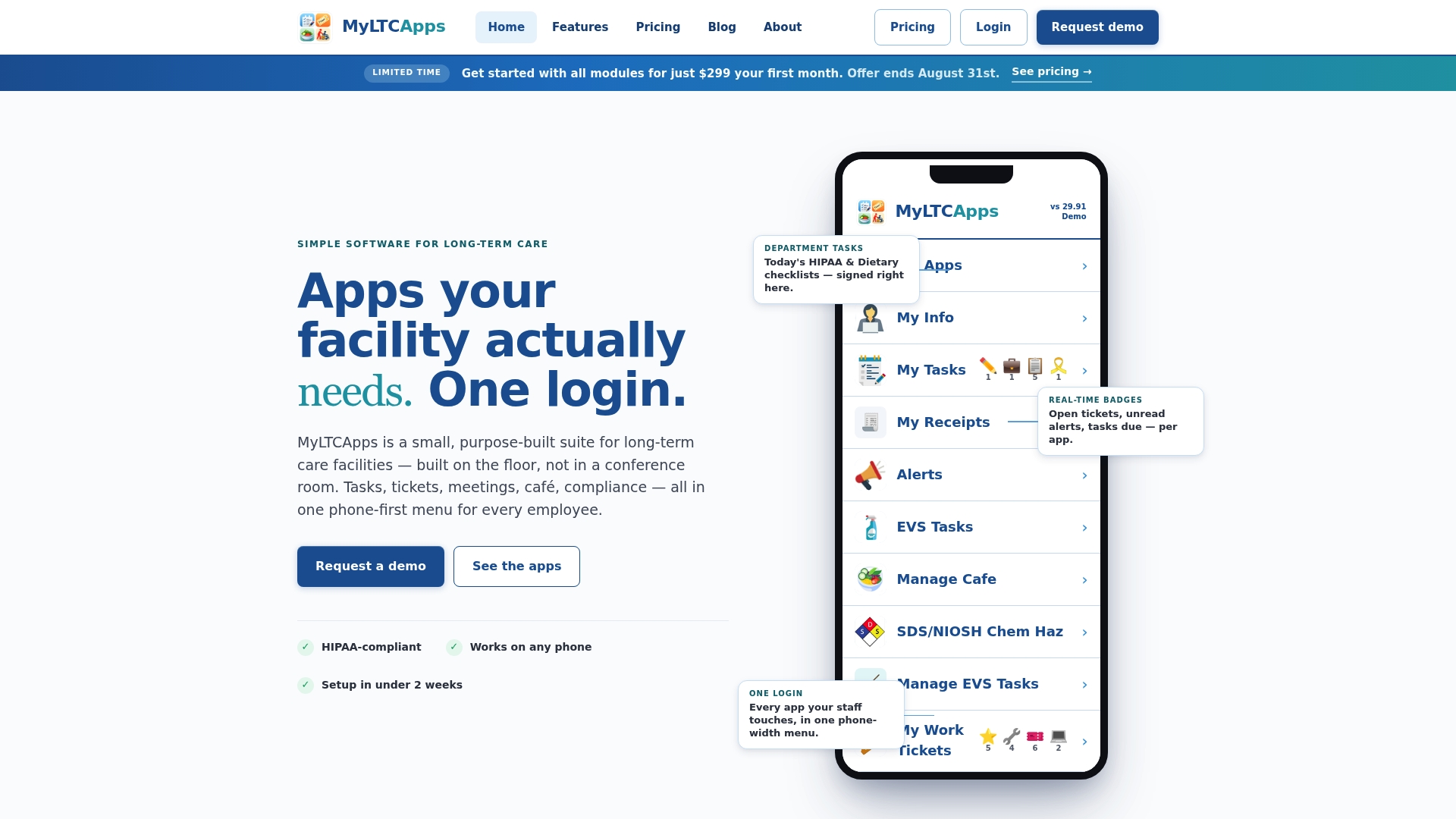
The compliance task and daily checklist module lets staff run through emergency SOPs on their own devices during a drill or a real event, with a timestamped record for your AAR/IP. The facility alert and communication system keeps your staff and external contact information current instead of relying on a printed list from last quarter. If you’re renewing transfer coordination or staging transport, the room and vehicle reservation module helps track what’s assigned where during an evacuation. Visit Myltcapps to see how the platform fits your facility’s existing preparedness program, or request a demo to walk through your specific compliance gaps.
This article is general information, not a substitute for advice from a qualified doctor. Consult a qualified healthcare professional about your own circumstances before acting on anything here.
Sources
- 42 CFR § 483.73 - Emergency preparedness. | LII / Legal Information Institute
- Emergency Preparedness Rule | CMS
- Nursing Home Exercise and Evacuation Resources (ASPR TRACIE)
- Long Term Care Preparedness Toolkit Base Plan | ASPR TRACIE
- Improving Nursing Home Disaster Readiness through Implementation Science - PMC
FAQ
What Are the Core Elements of a Nursing Home Emergency Plan?
CMS requires four elements: an emergency plan based on a facility-specific hazard assessment, supporting policies and procedures, a communication plan, and a training and testing program reviewed at least annually.
What Should Be in an Emergency Go Bag for Residents?
A resident go bag typically includes a several-day medication supply, copies of care records and advance directives, identification, eyeglasses or hearing aids, comfort items, a change of clothing, incontinence supplies if needed, water, non-perishable snacks, and emergency contact information.
What Are Good Mock Disaster Drill Scenarios for Nursing Homes?
Strong scenarios reflect your facility’s own hazard assessment: a power outage during extreme heat, a building evacuation triggered by fire or flooding, a regional disease outbreak requiring isolation protocols, and a shelter-in-place scenario during severe weather. ASPR TRACIE’s situation manuals offer ready-to-adapt scripts for several of these.
How Often Must Nursing Homes Test Their Emergency Plans?
Facilities must conduct at least two exercises per year, with at least one full-scale or operations-based drill and an unannounced component built into the annual testing calendar.
How Can Technology Support Nursing Home Emergency Preparedness?
Digital tools that centralize checklists, contact directories, and alerts help administrators keep emergency documentation current and reduce the errors that come from managing paper-based systems across multiple shifts.