Avoid the 57% Trap: Action Focused Root Cause Analysis for U.S. LTC

Avoid the 57% Trap: Action Focused Root Cause Analysis for U.S. LTC
Root cause analysis (RCA) is a structured, team-based method to identify system-level causes of adverse events and implement sustainable corrective actions. Its goal is preventing recurrence, not assigning blame. If you are starting one today, the immediate first step is to charter a multidisciplinary team and secure the event timeline and documentation before memories fade or records get altered.
TL;DR:
- More than half of proposed corrective actions in RCA are weak, relying on training or reminders instead of systemic changes to ensure durability.
- Full RCAs are generally required for sentinel events, recurring errors, or system-wide issues, but lower-risk incidents may only need rapid reviews or brief investigations.
- Strong corrective actions involve automation or engineering controls, requiring clear ownership, impact estimation, and ongoing measurement for sustainability.
- Using tools like flowcharts and Fishbone diagrams helps teams identify root causes deeper than immediate human errors, avoiding shallow fixes.
- Effective RCA implementation depends on frontline engagement, prompt evidence collection, and integrating actions into existing workflows via mobile tools to sustain improvements.
Table of Contents
- What root cause analysis is and why it matters in patient safety
- When to run an RCA and how to triage events
- Step-by-step RCA process for your team
- Common RCA tools and techniques and when to use them
- Team composition, interviewing, and evidence collection
- Designing strong, sustainable corrective actions
- Measuring outcomes and sustaining improvement with PDSA
- Translating RCA into day-to-day operations and documentation
- What implementing RCAs in clinical operations has taught us
- How MyLTCApps supports corrective action tracking and accreditation readiness
- FAQ
- Sources
What root cause analysis is and why it matters in patient safety
RCA exists because adverse events rarely trace back to one careless person. They trace back to systems: a confusing medication label, an unclear handoff protocol, a staffing gap at 3 a.m. A systems-based investigation looks past the person who made the visible error and asks what conditions made that error possible, and often likely, for anyone in that role. This distinction matters because an investigation that stops at “the nurse should have been more careful” produces no durable fix. The next nurse, on the next shift, faces the same flawed process.
RCA also does structural work inside a health care organization. It feeds accreditation requirements, supports Quality Assurance and Performance Improvement programs, and builds an internal record of organizational learning that surveyors and leadership can review. Done well, it becomes a feedback loop: incident, analysis, action, measurement, and a safer process the next time around.
The trouble is that many RCAs produce thin results. A review of proposed corrective actions found that roughly 57% were rated weak, meaning they relied on training, reminders, or policy restatements rather than changes to the system itself, according to PSNet’s review of RCA2. RCA2, developed as a refinement of standard RCA, responds directly to that problem by making action strength the measure of success, not the thoroughness of the analysis narrative. A few distinctions define the RCA2 mindset:
- Action over narrative: a root cause analysis that ends in a well-written report but no systems change has not succeeded.
- Strength hierarchy: interventions are graded weak, intermediate, or strong, and teams are pushed toward the stronger end.
- Team-based investigation: findings carry more weight and more buy-in when frontline staff help produce them, not just review them after the fact.
When to run an RCA and how to triage events
Not every incident needs a full root cause analysis, and treating every near miss identically wastes time and dilutes attention from the events that matter most. Triage decisions generally follow:
- Severity and harm level: sentinel events, deaths, and permanent harm trigger a full RCA by policy; minor near misses usually do not.
- Recurrence risk: an error pattern repeating across shifts or units deserves a full RCA even if any single instance caused no harm.
- System-wide impact: an event touching a process used facility-wide (medication administration, fall prevention, infection control) merits deeper analysis than an isolated, unit-specific slip.
- Regulatory trigger: certain events, particularly sentinel events in Joint Commission-accredited organizations, carry mandatory reporting and analysis obligations.
- Volume of related near misses: a cluster of similar near misses is often better served by an aggregate RCA or a failure mode and effects analysis that looks at the process proactively rather than reactively.
For lower-risk, single-staff errors, a rapid or abbreviated review, sometimes called a SWARM huddle, can surface contributing factors within hours rather than weeks, according to AHRQ PSNet’s guidance on event investigation. Timing matters for a separate reason: Joint Commission-accredited organizations must complete and submit a comprehensive systematic analysis and corrective action plan for sentinel events, typically within 45 business days of becoming aware of the event, and missing that window can affect accreditation standing, according to NCBI’s review of medical error prevention. Internal policy should set its own, often tighter, deadlines so the external clock never becomes the forcing function.
Step-by-step RCA process for your team
A root cause analysis moves through a sequence that CMS outlines in its guidance for performing RCA with performance improvement projects: identify the event, gather facts, identify contributing factors, find root causes, design and implement changes, and measure success. Here is how that sequence plays out operationally.
- Charter the team and scope the investigation. Name a facilitator, identify core members, and write a one-paragraph scope statement describing what the RCA will and will not cover. Scope creep is one of the fastest ways to stall an investigation for weeks.
- Secure records immediately. Pull the electronic health record notes, medication administration records, staffing schedules, device logs, and any physical evidence before routine data retention cycles overwrite or archive them.
- Reconstruct the timeline. Build a minute-by-minute or shift-by-shift sequence of events using the records gathered, then cross-check it against interviews. Gaps in the timeline usually point directly at the area needing deeper questions.
- Interview participants separately. One-on-one interviews, conducted close to the event but not in the heat of the moment, produce more candid and more complete accounts than group debriefs.
- Identify contributing factors. List every condition that played a role, communication breakdowns, equipment issues, staffing levels, environmental design, before narrowing to root causes.
- Drill to root causes using structured techniques. Five Whys, fishbone diagrams, and flowcharting (covered in the next section) each help separate symptoms from underlying causes.
- Design corrective actions and assign ownership. Every action needs a named owner, a due date, and a description of expected impact, not just a task description.
- Implement and monitor. Roll out the change, ideally piloted on a small scale first, and set a review date to confirm it is functioning as intended.
- Close the loop with measurement and documentation. Record outcome data, file the completed analysis for accreditation review, and feed lessons learned into training and onboarding materials.
A few practical notes make the difference between a checklist exercise and a real investigation. First, the timeline reconstruction step is where most RCAs either succeed or fail: an incomplete timeline produces contributing-factor lists built on guesswork rather than evidence. Second, interviews work best when staff understand the investigation is about the process, not about them personally. A just-culture framing, explained clearly before the interview begins, changes what people are willing to say.
Facilities running falls-prevention investigations, for example, often find that the “root cause” named in the first pass (a patient’s confusion) is really a symptom of a deeper gap: no standardized post-hospital discharge planning that ensures fall-risk reassessment after a medication change. Our guide to building a falls prevention program that survives an audit walks through how that kind of finding gets translated into a documented, trackable corrective action.
Pro Tip: Draft your root cause statement as a cause-and-effect sentence (“Because X, Y occurred”), never as a restatement of the event itself. If your root cause reads like the incident report, you have not finished drilling down.
Common RCA tools and techniques and when to use them
Different tools surface different kinds of causes, and using the wrong one for the situation is a common reason RCAs stall at a surface-level finding.
- Five Whys works by repeatedly asking “why” until you reach a systemic cause rather than a human action. The failure mode is stopping too early, at “the nurse missed the step,” instead of continuing to “the protocol had no built-in verification step.”
- Fishbone (Ishikawa) diagrams organize contributing factors into categories, commonly people, process, equipment, environment, and materials, and work well when a team needs to brainstorm broadly before narrowing focus.
- Flowcharts and timeline reconstruction are best for sequencing events and tying each piece of evidence (a chart entry, a log timestamp) to a specific point in the sequence, which strengthens the credibility of your final report.
- Failure mode and effects analysis (FMEA) looks forward rather than backward: instead of analyzing one event, it maps a process and scores each potential failure point by severity and likelihood, making it the right choice for recurring risks or aggregate near-miss review.
- Rapid or abbreviated reviews fit lower-risk, single-staff errors and should still be documented with a short written summary, even if the full nine-step process is not warranted.
One finding worth internalizing: roughly 57% of corrective actions proposed in RCA reviews were rated weak rather than intermediate or strong, according to PSNet’s RCA2 analysis. That statistic is really a tooling problem as much as a judgment problem: teams that stop at Five Whys without cross-checking against a fishbone diagram or a flowchart tend to land on the first plausible cause rather than the deepest one, and a shallow cause invites a shallow fix.
CMS guidance recommends pairing these analysis tools with Plan-Do-Study-Act (PDSA) cycles once an action is designed, a connection covered in more detail later in this guide.
Team composition, interviewing, and evidence collection
The people in the room shape the quality of the findings as much as the method used. A well-built RCA team typically includes:
- Frontline staff who performed the work or were present during the event, because they understand workflow realities no policy document captures.
- A clinical lead who can interpret medical records, orders, and clinical decision-making.
- A risk or patient safety officer who understands regulatory exposure and reporting obligations.
- A quality improvement representative who can translate findings into measurable corrective actions.
- A leadership sponsor with authority to approve resource-intensive or cross-departmental fixes.
Interview technique shapes how much truth surfaces. Conduct interviews one-on-one rather than in groups, since group settings suppress dissenting or self-critical accounts. Interview close to the event, ideally within days, while details remain fresh, but never during the acute emotional aftermath. Make confidentiality explicit at the start of every interview and document only what is relevant to the process, not personal characterizations.
Document collection should happen in parallel with interviews, not after. Pull shift logs, device maintenance and calibration records, EHR progress notes, medication administration records, staffing ratios for the relevant shift, and any physician or nursing orders tied to the event. Missing even one of these can leave a gap in the timeline that no interview can fill retroactively.
Protecting a just culture while still establishing facts is a balancing act. According to the VA National Center for Patient Safety, the most common trap in RCA is defaulting to individual blame, which both damages trust and produces weaker findings since staff become guarded rather than forthcoming. A systems approach, paired with genuine frontline involvement, tends to surface more usable facts and a stronger set of eventual recommendations.
Designing strong, sustainable corrective actions
This is the step where most RCAs either earn their investment or fall short of it. Corrective actions fall along a strength hierarchy:
- Weak actions: retraining, double-checking reminders, new policy memos, or verbal counseling. These are easy to implement but rely on human vigilance, which degrades over time.
- Intermediate actions: checklists, standardized forms, simplified processes, or increased staffing during high-risk periods.
- Strong actions: forcing functions, automation, engineering controls, or hardware and software changes that make the error physically or procedurally difficult to repeat, such as barcode medication verification or hard stops in an electronic ordering system.
The Joint Commission’s Sentinel Event Policy recommends identifying at least one intermediate or stronger corrective action in every corrective action plan, not merely a stack of weak ones. Examples of stronger clinical interventions include standardized order sets that eliminate ambiguous dosing instructions, mandatory barcode scanning before medication administration, and hardware changes such as free-flow protection on IV pumps that physically prevent a known failure mode.
Every corrective action, regardless of strength level, should be documented with:
- Expected impact: what measurable change the action is predicted to produce.
- Resources needed: staff time, budget, vendor involvement, or training materials.
- Owner and due date: one named accountable person, never a department or committee.
- Verification method: how completion and effectiveness will be confirmed.
Stronger actions are harder to implement because they usually require cross-departmental coordination, capital investment, or vendor changes, and that difficulty is precisely why so many teams default to weaker, easier options. Analyses of post-RCA interventions describe an inverse relationship: the harder an action is to implement, the less likely it is to get fully completed, according to PSNet’s review of intervention strength after adverse events. Planning governance up front, meaning a named executive sponsor and a tracking mechanism that surfaces overdue strong actions, counters that tendency.
Pro Tip: When a proposed action is “retrain staff,” ask the team one more question: what in the environment or process let this error happen despite existing training? The answer almost always points toward a stronger, more durable fix.
Measuring outcomes and sustaining improvement with PDSA
A corrective action without a measurement plan is a guess dressed up as a fix. Each action needs three kinds of measures: an outcome measure tied to the adverse event itself (did the event recur), a process measure confirming the new step is actually being performed (is the checklist being completed), and a balancing measure checking for unintended consequences (did the new step slow down care delivery in a way that creates a different risk).
CMS guidance recommends testing changes through small Plan-Do-Study-Act cycles before full facility-wide rollout. A PDSA cycle on a single unit or shift surfaces practical friction, a confusing checklist field, a step staff skip under time pressure, before the change scales to every unit and every shift. Document what was tried, what was observed, and what was adjusted at each cycle; this record becomes part of the accreditation file.
Sustaining the gain requires a follow-up cadence, not a one-time check. Useful practices include:
- Set a review date at 30, 60, and 90 days after implementation to confirm the action is still functioning.
- Define closure criteria in advance, such as a specific drop in recurrence or a completion rate threshold for a new checklist step.
- Retain all RCA artifacts, timelines, interview summaries, action plans, and measurement data, for accreditation review and future organizational learning.
- Report results back to the RCA team and governance committee, closing the loop rather than letting the action fade from attention once implemented.
Surveyors and internal quality committees both look for evidence that an action was not just completed on paper but verified in practice, which is why measurement data matters as much as the original analysis.
Translating RCA into day-to-day operations and documentation
A root cause analysis that lives only in a written report rarely survives contact with a busy care floor. Operationalizing an RCA finding means turning each corrective action into a trackable task with a defined workflow. At minimum, a corrective-action tracking system needs:
- A named owner responsible for the action, not a department.
- A due date with automatic reminders as it approaches.
- An evidence upload field so completion can be verified with a document, photo, or signed form rather than a verbal confirmation.
- A measurement field tied to the outcome or process measure defined during the PDSA phase.
- A status workflow (open, in progress, pending verification, closed) that gives leadership visibility without requiring a meeting.
For Joint Commission or CMS submissions, documentation should include a clear timeline of the event, a bibliography of evidence reviewed, and direct links between each identified root cause and its corresponding corrective action, so a reviewer can trace the logic without guesswork. Our guide to corrective action tracking walks through the features that make this traceability easier to maintain over time.
Mobile-first checklists and seeded compliance templates reduce friction precisely at the point where many RCAs lose momentum: the handoff from “approved action plan” to “completed on the floor.” When a corrective action becomes a work ticket assigned to a specific shift, paired with a checklist item that a caregiver checks off on a phone, completion rates improve because the task sits inside the same workflow staff already use, rather than in a separate binder or spreadsheet. A fall-related corrective action, for instance, might convert into a work ticket for a bed-alarm check, a daily checklist item confirming a fall-risk reassessment, and a simple PDSA measurement counting fall incidents over the following 60 days, a workflow pattern we describe in more detail in our falls prevention program guide.

What implementing RCAs in clinical operations has taught us
The RCAs that fail are usually the ones that become checkbox exercises: a report filed, a training scheduled, nothing in the actual workflow changed. Blame-oriented cultures make this worse, because staff learn to give the safest possible answer in an interview rather than the most useful one. The RCAs that work share a pattern: frontline staff are involved from the first interview, not just informed of the outcome, and the corrective action lands inside a tool caregivers already touch every shift rather than a new system they have to remember to check. Facilities that try to fix everything at once typically finish nothing. Start with your highest-severity, highest-recurrence events, measure what you change, and let early wins build the case for tackling harder, systems-level fixes next.
— Philip
How MyLTCApps supports corrective action tracking and accreditation readiness
Once an RCA produces a corrective action plan, the harder work is keeping it alive past the meeting where it was approved. We built our Compliance Suite around that exact gap: seeded compliance libraries give facilities a documentation structure already aligned to accreditation expectations, rather than starting from a blank template every time an event occurs.
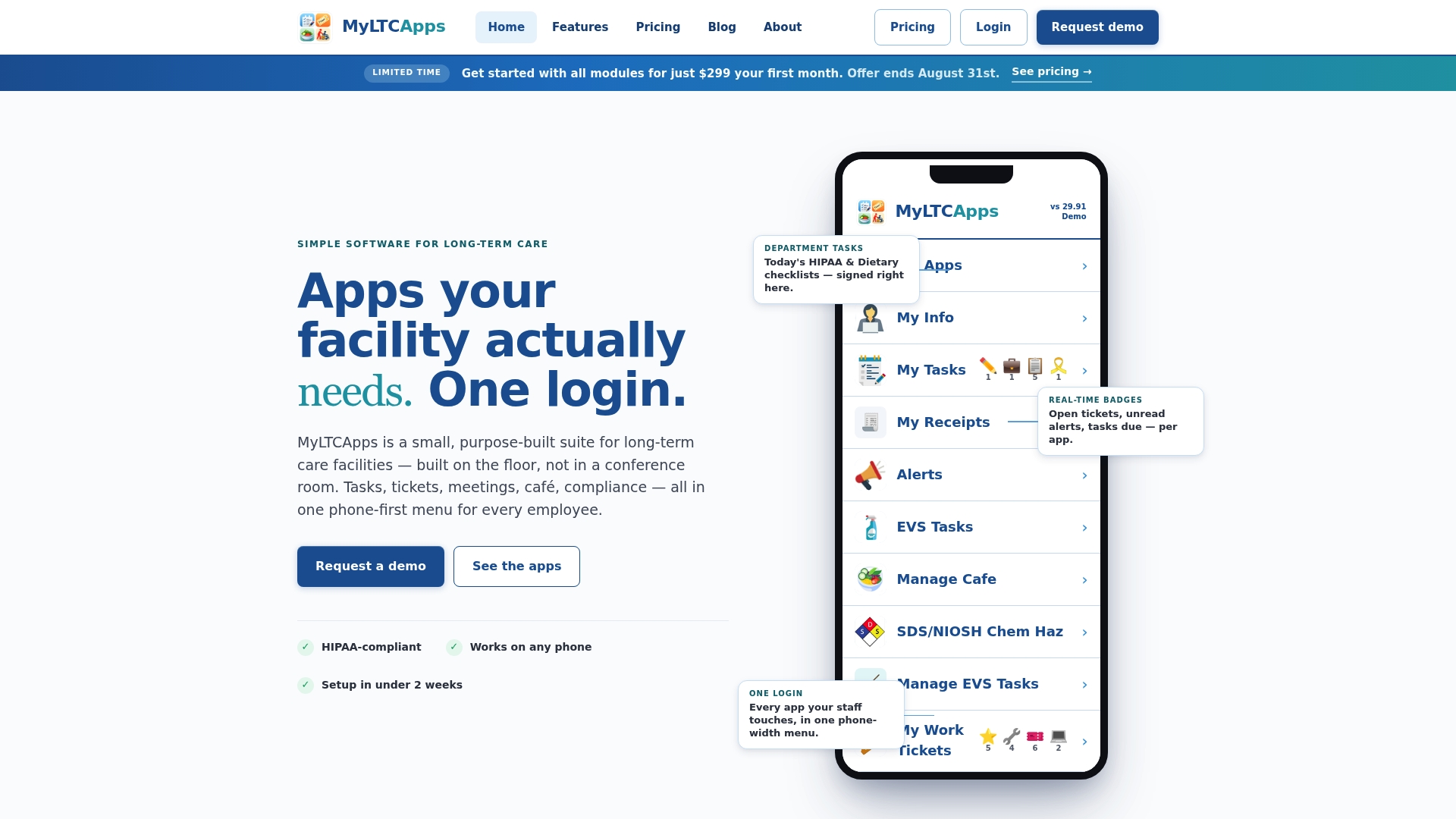
Our My Work Tickets module lets a corrective action become an assigned, trackable ticket with an owner and a due date, while My Tasks turns the follow-through, a checklist item, a verification step, a PDSA measurement, into something a caregiver completes in a few taps on a personal device during a normal shift. Because the workflow lives on the phone staff already carry, completion data accumulates automatically instead of depending on someone remembering to update a spreadsheet, and our administrator dashboard gives leadership a single view of which actions are open, overdue, or verified closed.
If your facility is weighing how to keep RCA findings from stalling after the report is filed, our pricing page outlines plan options, from I Just Want That through Premium Pack, so you can match modules to the scope of your corrective-action workload and see what fits your facility’s size and compliance needs.
FAQ
What are the 7 steps of root cause analysis?
A common version follows CMS guidance: identify the event, gather facts and secure documentation, reconstruct the timeline, identify contributing factors, determine root causes, design and implement corrective actions, and measure the results, according to CMS’s RCA guidance. Some organizations compress or expand these into five or nine steps, but the underlying sequence stays the same.
What are the 5 steps of root cause analysis?
A condensed five-step version typically covers: define the problem, collect data and reconstruct the timeline, identify contributing and root causes, develop corrective actions, and implement and monitor results. It follows the same logic as the longer CMS-recommended process, just grouped into broader phases.
What are different root cause analysis techniques used in healthcare?
Commonly used techniques include Five Whys, fishbone (Ishikawa) diagrams, flowcharting and timeline reconstruction, and failure mode and effects analysis (FMEA), each recommended in CMS’s guidance for performing RCA. Rapid or abbreviated reviews are also used for lower-risk, single-staff errors that do not warrant a full investigation.
Can you provide examples of root cause analysis in healthcare?
Common examples include investigating a medication error to find a missing verification step, analyzing a patient fall to uncover a gap in fall-risk reassessment after a medication change, and reviewing a diagnostic delay to trace a breakdown in result communication between departments. Each example typically ends with a corrective action, such as a forcing function or a standardized checklist, rather than a retraining memo alone.
How does RCA2 differ from standard root cause analysis?
RCA2 keeps the same investigative process but places its emphasis on the strength of the resulting corrective action rather than just the thoroughness of the analysis narrative. It pushes teams toward intermediate or strong actions, such as forcing functions or engineering controls, since reviews found that many proposed actions default to weaker options like training or policy reminders, according to PSNet’s RCA2 overview.
Sources
- Medical Error Prevention and Root Cause Analysis - NCBI - NIH
- RCA2: Improving root cause analyses and actions to prevent harm — PSNet (AHRQ)