Corrective Action Tracking: Features, Process, and Tools

Corrective Action Tracking: Features, Process, and Tools
Corrective action tracking, formally known as CAPA (Corrective and Preventive Action), is a closed-loop quality process that captures a nonconformance, traces it to its root cause, assigns and verifies a fix, and confirms the problem has not recurred before final closure. The recommended approach is a purpose-built CAPA tracker that enforces separate verification roles and scheduled recurrence-window checks, not a spreadsheet or generic ticketing tool. For regulated U.S. organizations, that means meeting the requirements of ISO 9001 Clause 10.2 and FDA QMSR / 21 CFR Part 820 at minimum. For long-term care and skilled nursing facilities, Myltcapps delivers exactly that framework in a phone-first, facility-level subscription built around HIPAA, QAPI, and surveyor-ready exports.
Table of Contents
- What is corrective action tracking, and when is it required?
- Why does corrective action tracking software outperform spreadsheets?
- What features must a corrective action tracking system include?
- How do you implement corrective action tracking from scratch?
- What mistakes do quality leaders make with CAPA tracking?
- Which KPIs should you track to measure CAPA effectiveness?
- How much does corrective action tracking software cost?
- Key Takeaways
- Why verified evidence matters more than paperwork volume
- Myltcapps brings phone-first CAPA tracking to long-term care
- Useful sources and references
What is corrective action tracking, and when is it required?
A corrective action addresses a nonconformance that has already occurred. A preventive action addresses a potential nonconformance before it does. CAPA combines both into a single, documented workflow that regulators and auditors treat as evidence of a functioning quality management system.
The regulatory expectations are specific:
- CMS Conditions of Participation — and state survey programs for long-term care facilities require documented QAPI (Quality Assurance and Performance Improvement) processes that map directly to CAPA logic.
CAPA is typically triggered by internal audits, resident or patient incidents, customer complaints, supplier nonconformances, or environmental findings. What you actually track across each record: the trigger event, containment actions, root cause analysis (RCA) method and findings, corrective and preventive actions, implementation evidence (attachments, timestamps, signatures), and a scheduled effectiveness check.
Large U.S. research organizations, including national laboratories, use centralized Corrective Action Tracking Systems (CATS) that function as data warehouses, storing objective evidence, documents, and URLs to prove resolution during audits and to monitor effectiveness trends across the organization. That institutional model is the right mental frame for any regulated facility.
Why does corrective action tracking software outperform spreadsheets?
The short answer: spreadsheets cannot enforce a workflow, and auditors know it.

Manual tracking creates what practitioners call “silo traps,” where nonconformances logged in one spreadsheet are never linked to related incidents in maintenance logs, audit findings, or complaint records. Without automated links between related records, trend analysis becomes manual, slow, and error-prone. A recurring equipment failure that triggered three separate CAPAs looks like three isolated events instead of one systemic problem.

Purpose-built CAPA software solves this with enforced workflows, traceable records, role-based approvals, automated notifications, and electronic signatures and audit trails that spreadsheets cannot replicate reliably. Generic ticketing tools (help desks, project management apps) fall short for a different reason: they have no RCA enforcement, no concept of a separate verifier role, and no audit-export capability formatted for regulatory review.
The aggregate analytics angle matters just as much. Viewing CAPA records as individual tasks causes organizations to miss systemic weaknesses. The real prevention work happens when you analyze patterns across dozens of records: which departments generate the most CAPAs, which root causes repeat, which corrective actions fail their effectiveness checks. That analysis is only possible when all records live in one connected system.
What features must a corrective action tracking system include?
Purchasing decisions fail when teams buy a system that looks good in a demo but cannot produce a defensible audit trail under scrutiny. Build your requirements checklist around these categories.
Mandatory workflow gates
- Trigger capture: structured intake form with date, location, trigger type (audit, incident, complaint), and immediate containment action.
- RCA enforcement: the system must require a documented root cause before the record can advance. Support for 5-Why, Fishbone (Ishikawa), and 8D methods covers most regulated industries.
- Separate action owner and independent verifier: the person who implements the fix cannot be the person who verifies it. Platforms that implement Verified Closure require a distinct verifier role and block final closure until that role completes its review.
- Recurrence-window check: a scheduled follow-up (30–180 days, risk-based) to confirm the problem has not returned before the record closes permanently.
- Effectiveness check timing: same-day effectiveness checks are almost always flagged by auditors. The system should enforce a minimum elapsed period and require the rationale to be documented in the record.
Evidence management
- Attachment support for photos, PDFs, and video clips with automatic timestamps.
- Document version control so procedure changes triggered by a CAPA are linked to the record.
- Electronic signatures with audit-log entries for regulated environments where 21 CFR Part 11 applies.
Mobile-first capture and integration
Phone-first reporting materially increases the accuracy and timeliness of initial reports. Staff who can log a finding on their personal device the moment it occurs produce better data than staff who reconstruct events at a desktop terminal at the end of a shift. Integration with EHR, LMS, CMMS, and single sign-on (SSO/API) keeps CAPA records connected to the operational systems where root causes actually live.

Analytics and reporting
Aging dashboards, time-to-close by trigger type, recurrence rate, and verified-effectiveness rate are the four metrics that tell you whether your CAPA process is working. Surveyor-ready exports (PDF or Excel formatted for ISO or state survey evidence) are non-negotiable for regulated facilities.
Feature priority table
| Feature | Priority | Notes |
|---|---|---|
| Structured trigger capture | Must-have | Date, location, type, containment |
| RCA method enforcement | Must-have | 5-Why, Fishbone, or 8D required |
| Separate verifier role | Must-have | Blocks closure until independent review |
| Recurrence-window scheduling | Must-have | 30–180 days, risk-based |
| Electronic signatures / audit trail | Must-have | Required for 21 CFR Part 11 environments |
| Mobile / phone-first capture | Must-have | Increases report accuracy and speed |
| Cross-module incident linking | Should-have | Enables trend detection across sources |
| EHR / LMS / CMMS integration | Should-have | Connects CAPA to operational root causes |
| Aging dashboards and KPI exports | Should-have | Surveyor-ready reporting |
| Automated escalation rules | Should-have | Notifies management on overdue actions |
| AI-assisted RCA suggestions | Advanced | Useful at scale; not a substitute for process |
| Validation documentation support | Advanced | Required for FDA-regulated sites |
Pro Tip: When configuring your verification fields, require the verifier to document the specific evidence reviewed (observation date, data source, sample size) rather than just clicking “approved.” That single change turns a checkbox into a defensible audit record.
How do you implement corrective action tracking from scratch?
A realistic rollout for a single facility or small chain runs 60–90 days from kickoff to steady-state operation. Here is a phased approach that quality managers can follow without a dedicated IT team.
-
Plan (weeks 1–2). Audit your current state: count open CAPAs in spreadsheets, identify trigger sources, and map existing roles. Define your SLA policy (e.g., critical findings closed within 30 days, minor findings within 60 days) before you configure anything. Document your electronic signature and validation requirements if your facility is FDA-regulated.
-
Configure and migrate (weeks 2–4). Set up workflow stages, RCA templates, role assignments, and recurrence-window defaults. Migrate open records from spreadsheets. A seven-step CAPA framework (Identification, Evaluation, Investigation, Analysis, Action Plan, Implementation, Follow-Up) maps cleanly to most platform workflow builders and gives you a defensible procedural basis.
-
Pilot (weeks 4–6). Run 10–15 real CAPAs through the new system with a small group of trained users. Focus on the handoff between action owner and verifier. Auditors will look at this handoff first.
-
Train and roll out (weeks 6–10). Train all users on mobile capture, evidence attachment, and the difference between “action complete” and “action effective.” Assign a system administrator responsible for overdue escalations and role changes.
-
Measure (day 30, 60, 90). Pull time-to-close, recurrence rate, and verified-effectiveness rate at each milestone. If more than 20% of records are overdue at day 30, your SLA policy or staffing model needs adjustment before you scale.
-
Iterate. Quarterly trend reviews with management close the loop. Aggregate CAPA data reviewed at this level is where systemic prevention work actually happens.
Roles to assign before go-live: action owner, independent verifier, system administrator, quality lead (trend reviewer), and management reviewer (quarterly sign-off). In a small facility, one person may hold two roles, but the action owner and verifier must always be different people.
What mistakes do quality leaders make with CAPA tracking?
The most expensive mistake is treating the system as a task list. When staff see CAPA as a compliance checkbox, records get closed on the fastest path, not the most defensible one. Aggregate analytics are where long-term prevention is achieved, and that only happens when records are complete and honest.
Watch for these specific failure patterns:
- Closing without an effectiveness check. The single most common CAPA audit failure is closing a record before an independent effectiveness verification. Configure your system to block final closure until the verifier completes the check and the recurrence window has elapsed.
- Same-day effectiveness checks. An effectiveness check completed the same day the corrective action is implemented has no meaningful data behind it. Auditors flag this routinely. Set a minimum elapsed period in your system configuration and document the rationale.
- Unlinked incidents. A fall in room 14 and a staffing gap finding from last month’s internal audit may share a root cause. High-value tracking systems link incidents across modules — maintenance logs, audits, complaints — into a single audit trail. Without that linking, you will miss systemic issues every time.
- Weak chain of evidence. Auditors expect a documented chain connecting the trigger to root cause, corrective action, and independent effectiveness verification. A record that says “trained staff” with no attachment, no date, and no verifier signature is not a chain of evidence. It is a note.
Pro Tip: Separate “completion” from “effectiveness” in your workflow as two distinct status fields. Assign the effectiveness review to someone who was not involved in implementing the action. This one structural change eliminates the most common audit finding in CAPA programs.
For long-term care facilities, the stakes are concrete: a repeat deficiency on a state survey costs more in remediation, reputation, and potential civil money penalties than the entire annual cost of a purpose-built tracking system. Linking near-miss reports to CAPA records before incidents escalate is one of the highest-leverage practices available to LTC quality teams.
Which KPIs should you track to measure CAPA effectiveness?
A CAPA program without metrics is an administrative exercise. These five KPIs give you a complete picture of process health:
- Time-to-close: the number of calendar days from trigger capture to verified closure. Calculate separately by trigger type (audit finding vs. incident vs. complaint) because SLA expectations differ. Track as a rolling 90-day average.
- Percent verified effective: the share of closed CAPAs where the independent verifier confirmed the action worked and the recurrence window passed without a repeat finding. Below 80% signals either weak corrective actions or premature closure.
- Recurrence rate: the percentage of closed CAPAs where the same or substantially similar nonconformance reappeared within 12 months. A rising recurrence rate is the clearest sign that root cause analysis is superficial.
- Aging buckets: count of open CAPAs by age band (0–30 days, 31–60 days, 61–90 days, over 90 days). Anything in the over-90 bucket needs management escalation, not just a reminder notification.
- CAPA throughput by trigger source: how many CAPAs originated from audits, incidents, complaints, and supplier issues respectively. Sudden spikes in one category often precede survey findings or regulatory attention.
For reporting cadence: daily task lists go to action owners and verifiers; weekly aging dashboards go to the quality lead; quarterly trend reviews with recurrence analysis and root-cause category breakdowns go to management. A well-designed dashboard includes five panels: open CAPA count by status, aging distribution, time-to-close trend, recurrence rate trend, and top five root-cause categories by volume.
How much does corrective action tracking software cost?
Pricing models vary, and the right structure depends on your organization’s size and regulatory profile.
-
Per-facility subscription (module-based). Common for long-term care and healthcare. You pay a flat monthly or annual fee per facility, with add-on modules (competencies, maintenance, meetings) priced separately. Predictable for multi-site chains; scales without per-user penalties as headcount grows.
-
Per-user subscription. Common in manufacturing and life sciences. Cost scales directly with active users, which works for small teams but becomes expensive at 50+ users across a facility.
-
Tiered platform subscription. A base platform fee plus usage tiers (number of records, API calls, storage). Flexible but harder to budget for organizations with variable CAPA volume.
For a single long-term care facility, realistic annual costs break down roughly as follows:
- Platform subscription: varies by vendor and module count; not publicly listed for most LTC-focused platforms, so request a quote.
- Implementation and configuration: typically a one-time cost covering workflow setup, data migration, and role configuration.
- User training: plan for at least two hours per role type (action owner, verifier, administrator) plus refresher training annually.
- Validation (FDA-regulated sites only): if your facility requires IQ/OQ/PQ validation under 21 CFR Part 11, budget for a formal validation project, which can add significant one-time cost depending on scope.
- Ongoing support: most SaaS platforms include a base support tier; premium SLA tiers (faster response, dedicated CSM) cost more.
For a small chain of three to five facilities, the per-facility model almost always delivers better total cost of ownership than per-user pricing, because care staff headcounts are high relative to the number of people who actually manage CAPA records.
Key Takeaways
A purpose-built CAPA tracker with enforced verified closure, an independent verifier role, and scheduled recurrence-window checks is the only approach that consistently passes regulatory scrutiny in U.S. quality management environments.
| Point | Details |
|---|---|
| Verified closure is non-negotiable | Block final closure until an independent verifier confirms effectiveness and the recurrence window has elapsed. |
| Mobile-first capture improves data quality | Staff who log findings immediately on a phone produce more accurate initial reports than those reconstructing events later. |
| Cross-module linking reveals systemic issues | Connect incidents, audits, and maintenance records in one audit trail to detect patterns spreadsheets will miss. |
| Five KPIs drive oversight | Track time-to-close, percent verified effective, recurrence rate, aging buckets, and throughput by trigger source. |
| Myltcapps fits LTC workflows | Myltcapps delivers phone-first CAPA tracking with seeded HIPAA/QAPI compliance libraries and surveyor-ready exports for long-term care facilities. |
Why verified evidence matters more than paperwork volume
Most CAPA programs fail not because the team is careless, but because the system rewards completion over verification. A record marked “closed” feels like progress. A record marked “closed, effectiveness unconfirmed” feels like a problem. So organizations unconsciously optimize for the former.
The facilities that perform best on state surveys and FDA inspections share one habit: they treat the chain of evidence as the product, not the paperwork. The trigger, the root cause, the action, and the independent verification are four links in a chain. Remove any one of them and the chain breaks. Auditors are specifically trained to look for that break.
For long-term care administrators, this is not abstract. A surveyor who finds a repeat deficiency will ask to see the CAPA record from the previous cycle. If that record shows a completed action with no independent effectiveness check and no recurrence window, the facility has documented its own failure to follow through. Phone-first capture and HIPAA-aligned documentation practices make it easier for floor staff to contribute accurate evidence in real time, which is where the chain actually starts.
The operational argument for mobile-first CAPA tracking in LTC is straightforward: care staff are not at desks. If the system requires a desktop login to log a finding, findings get logged late, incompletely, or not at all. The best corrective action program in the world produces nothing if the intake process creates friction at the point of observation.
Myltcapps brings phone-first CAPA tracking to long-term care
Long-term care facilities face a specific compliance challenge: the people closest to quality issues, floor staff and charge nurses, are the least likely to have desktop access when something goes wrong. Myltcapps is built around that reality.
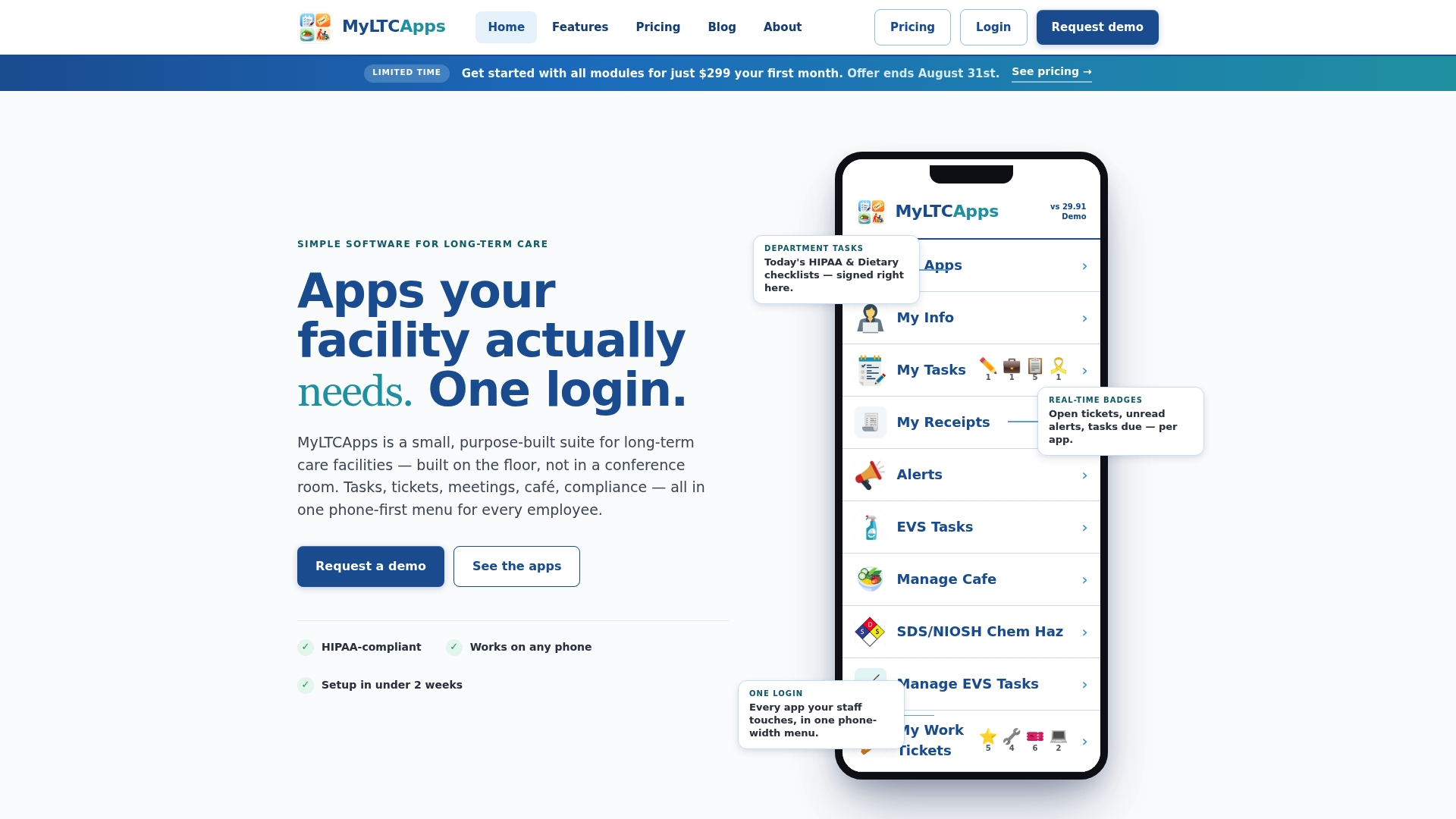
The platform’s phone-first design means staff can capture a finding, attach a photo, and route it to the right owner in seconds, from anywhere in the facility. Seeded compliance libraries covering HIPAA, QAPI, Section 1557, and emergency preparedness give administrators a head start on workflow configuration rather than building from scratch. The compliance task and checklist module handles action assignment, due-date tracking, and escalation notifications at the facility level, while the competency tracking module documents staff retraining required as CAPA evidence. Meeting and in-service records link directly to verification evidence, closing the chain auditors look for.
For facilities ready to move off spreadsheets, the recommended starting point is the tasks and competencies modules, which cover the core CAPA workflow and the most common corrective action type (staff retraining) in a single pilot. Request a demo at myltcapps.com to see how the platform maps to your survey-readiness requirements.
Useful sources and references
These primary and institutional sources support procurement decisions, audit preparation, and deeper study of CAPA process requirements.
| Source | What it covers |
|---|---|
| Corrective Actions Tracking System (CATS) — Lawrence Berkeley National Laboratory | Institutional CATS implementation: how a major U.S. research lab logs, tracks, and closes issues with objective evidence |
| DOE CATS User’s Guide | Federal corrective action tracking system documentation; useful for understanding evidence and closure requirements at the program level |
| ISO 9001 Clause 10.2 — CAPA Best Practices (eLeaP Quality) | ISO 9001 corrective action requirements, effectiveness review obligations, and QMS integration guidance |
| Seven Steps of CAPA — qmsdoc.com | Procedural CAPA framework with templates for each step; useful for workflow configuration and audit documentation |
| CAPA Process: Investigation to Effectiveness Check (iFactory) | Detailed guidance on effectiveness check timing, recurrence windows, and common audit findings |
| CAPA Management System Requirements (Dot Compliance) | Cross-module linking requirements, single audit trail concept, and software selection criteria |