Building a Falls Prevention Program That Survives an Audit

Building a Falls Prevention Program That Survives an Audit
A falls prevention program is an operational system, not a policy binder. It combines immediate post-fall response, structured assessment and documentation, multidisciplinary care planning, staff training, and data-driven reporting, anchored to AHRQ and CMS expectations. Facilities running this well can prove it with timestamped records. If you’re still relying on narrative notes and end-of-month spreadsheets, start with your post-fall documentation workflow this week.
TL;DR:
- Effective falls prevention relies on timely, structured documentation of immediate response actions within the same shift, not just end-of-day notes.
- Scheduled assessments and risk re-evaluation must happen within one to seven days after a fall, regardless of injury severity, to prevent repeated incidents.
- Digital incident reporting systems with required fields improve documentation completeness, especially when paired with automated, mobile task assignment tools.
- Organizing survey artifacts such as timestamped incident records and care plan revisions is crucial for passing CMS inspections, with evidence of timely intervention.
- Implementing a clear rollout plan and consolidating documentation systems significantly increase compliance and reduce fall recurrence in less than three months.
Table of Contents
- Core Components Of A Facility Falls Prevention Program
- What To Document After Every Fall (And When)
- How Digital Reporting And Dashboards Change Outcomes
- Mapping The Program To CMS Survey Expectations
- A Six-To-Twelve Week Rollout Checklist
- The Gap Between A Policy And A Working Program
- Running Your Program On MyLTCApps
- Sources
Core Components Of A Facility Falls Prevention Program
A survey-ready program has four moving parts, and each one needs an owner, a deadline, and a paper trail.
The immediate response window matters most. When a resident falls, staff must evaluate the resident on the spot, begin monitoring for 72 hours, run neurologic checks on a set schedule, notify the physician and family, and put at least one intervention in place before the shift ends. Waiting until the next shift to document or act is the single most common gap surveyors flag.
From there, the program moves into structured assessment. AHRQ’s Falls Management Program calls for a comprehensive falls assessment and an individualized care plan update within one to seven days of the event, not “when someone gets to it.”
Beyond the post-fall cycle, screening has to run on a schedule: at admission, quarterly, and any time there’s a change of condition, as detailed in top safety risks for seniors living alone. A resident who was walking independently in January and needs a gait belt by March has changed risk categories, whether or not anyone updated the chart.
Roles need to be explicit, not assumed:
- Falls coordinator: owns the program calendar, tracks open action items, and reports monthly to the quality improvement team.
- Unit managers: confirm immediate-response steps happened on their shift and sign off on documentation.
- CNAs: execute monitoring, alarms checks, and environmental rounds, and flag near-misses.
- QI team: reviews trends quarterly and approves changes to the care planning template.
Without named owners, “the program” becomes whatever the DON remembers to check on a busy Tuesday.
What To Document After Every Fall (And When)
Every fall, and every near-miss, needs the same structured data capture. AHRQ’s TRIPS-style approach gives you the fields to standardize:
- Circumstances: what the resident was doing, time of day, and who was present or nearby.
- Location and environment: room, hallway, bathroom, flooring, lighting, and any equipment involved.
- Alarms and assistive devices: whether one was in use, whether it functioned, and whether staff responded to it.
- Vital signs and neuro checks: captured immediately, then at defined intervals across the 72-hour monitoring window.
- Injury assessment: visible injury, suspected injury, and follow-up imaging or provider notes.
- Staff response: who intervened, what was done, and when the physician and family were notified.
Same-shift documentation covers the immediate response. The longer-form assessment, including the updated care plan, is due within one to seven days.
Intercepted falls count too. A resident caught mid-fall by an aide, or found on the floor with no clear injury, needs the same investigation as a completed fall. Skipping this is where most programs quietly fail.
Why this urgency matters: AHRQ reports that a significant proportion of residents who fall will fall again. Every incomplete post-fall record is a missed chance to break that cycle before it repeats.
How Digital Reporting And Dashboards Change Outcomes
Paper incident forms get filled out inconsistently, and narrative fields get skipped when staff are slammed. A controlled study in nursing homes found that menu-driven, structured incident reporting systems produced more complete post-fall documentation than free-text narrative reports. Standardized fields with required entries close the gaps that a blank text box invites.
A functioning program runs on a handful of recurring reports, all of which AHRQ defines explicitly:
- A weekly high-risk resident list, combining existing risk factors, recent change-of-condition flags, and new contributing factors.
- A monthly contextual factors report, breaking down falls by shift, time of day, and location.
- A quarterly risk-factor summary, tracking patterns across units.
- A post-fall assessment summary, confirming every required field got completed on time.
The dashboards worth building visualize repeat fallers, unit-level trends, and staff-shift mapping, tied into MDS data and timestamped incident records so patterns actually surface instead of staying buried in individual charts. A nursing home administrator dashboard that pulls this together in one view turns four separate reports into a single Monday-morning check.
Pro Tip: Push post-fall tasks straight to the assigned CNA or nurse’s phone as they happen. Mobile-first task assignment with automated reminders closes the loop faster than a paper form sitting in an inbox, and it gives you a timestamp you can defend later.

Mapping The Program To CMS Survey Expectations
Surveyors don’t grade intentions. They grade evidence. CMS guidance under F323 and 42 CFR 483.25 ties accident prevention directly to four operational areas: hazard identification, adequate supervision, correct use of assistive devices, and individualized care plans that get updated, not just filed.
What surveyors actually request during a visit:
- Timely post-fall assessments completed within the expected window.
- Documented interventions tied to each identified risk factor.
- Evidence that staff monitoring compliance is being checked, not just assumed.
- Records showing corrective action after a repeat incident or a missed intervention.
| Audit artifact | What it proves |
|---|---|
| Timestamped incident records | Response happened within the required window |
| Post-fall assessment exports | Documentation was complete, not partial |
| QI meeting minutes | The facility acted on trends, not just logged them |
| Care plan revision history | Interventions were individualized, not generic |
Keeping these artifacts organized and exportable is the difference between a smooth survey and a plan of correction.
A Six-To-Twelve Week Rollout Checklist
Getting a program from “written policy” to “operational habit” doesn’t take a year. It takes a plan.
- Weeks 1 to 2: Run a self-assessment using the AHRQ Falls Management Program framework and pick one or two pilot units.
- Weeks 2 to 4: Standardize your TRIPS-style documentation fields and build them into your incident reporting tool or task platform, not a separate paper form.
- Weeks 3 to 5: Assign the falls coordinator, unit manager, and QI roles, and put a weekly falls huddle and a monthly QI review on the calendar.
- Weeks 4 to 8: Train staff on the new workflow, run competency checks, and record a baseline for documentation completeness before you change anything else.
- Weeks 8 to 12: Use your weekly and monthly reports to adjust interventions, then scale the workflow facility-wide.
Pro Tip: Track documentation completeness rate, not just fall counts, in your first quarter. A rising completeness rate is often the leading indicator that the program is actually being followed, weeks before your fall rate itself moves.
Tie training rollout into your existing new hire onboarding checklist so new staff learn the falls workflow from day one, not as a retrofit six months later.

The Gap Between A Policy And A Working Program
Three problems sink most falls programs. Fragmented paperwork spread across paper forms, EHR notes, and a separate incident log means nobody can reconstruct a timeline fast. Near-misses go unreported because staff assume only completed falls “count.” And even good documentation dies without follow-through, since an intervention gets noted but never checked again.
The fix isn’t more paperwork. It’s fewer systems holding the same information. One facility that consolidated its post-fall workflow into a single tool saw documentation completeness climb within a quarter, largely because staff had one place to log everything instead of three. Track completeness before you track outcomes. It moves faster, and it tells you whether the program is actually being run.
— Philip
Running Your Program On MyLTCApps
MyLTCApps gives long-term care and skilled-nursing facilities one mobile-first place to run what this article just described, instead of stitching together paper forms, spreadsheets, and a separate EHR note. Mobile checklists push post-fall tasks straight to the assigned staff member’s phone, incident reporting captures TRIPS-style fields at the point of care, and seeded compliance libraries keep your documentation aligned with survey expectations without building templates from scratch.
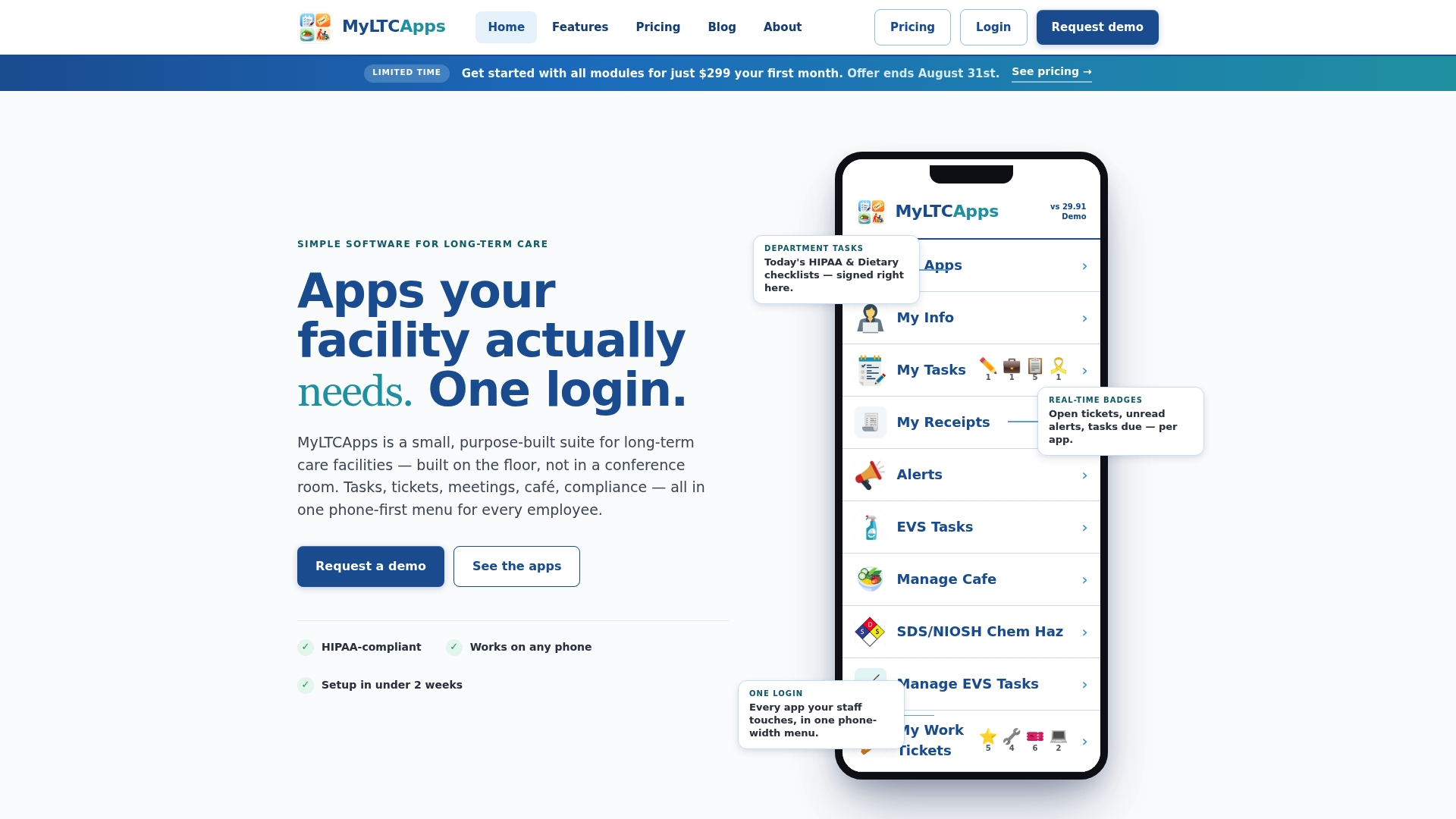
The practical payoff is speed and defensibility: timelined task completion, audit-ready exports with timestamps and user IDs, and dashboards that surface repeat fallers and unit trends before your next survey does it for you. For facilities operating in Kansas, MyLTCApps also offers a KDADS-ready platform built around state survey expectations. If your post-fall documentation still lives in three different places, start by reviewing the compliance task and checklist module or requesting a walkthrough of the full LTPAC operations platform to see how it fits your current workflow.
Sources
- Agency for Healthcare Research and Quality — Falls Management Program: Fall Response
- Use of a falls incident reporting system to improve care process documentation in nursing homes | BMJ Quality & Safety
- CMS surveyor guidance (Appendix P / F323) and interpretive guidelines