30, 90 and 180 Day Language Access Roadmap for U.S. Administrators

30, 90 and 180 Day Language Access Roadmap for U.S. Administrators
A compliant language access plan in healthcare guarantees free, timely, and qualified language assistance at every patient touchpoint, anchored in three federal frameworks: Section 1557 of the Affordable Care Act, the National CLAS Standards, and AHRQ patient-safety guidance. Building one starts with three moves: appoint a language access coordinator, run a formal needs assessment, and add language preference flags to registration. Everything else in the plan flows from those three steps.
TL;DR:
- A formal needs assessment should prioritize languages based on volume, risk level, and available data, with focus on high-risk clinical encounters.
- Qualified interpreters must demonstrate proficiency and adhere to confidentiality, with in-person and video modes reserved for complex or sensitive situations.
- Mandatory notices, posted in required languages and formats, must clearly inform patients that language assistance is free and accessible before any encounter.
- Specific staff roles and trigger points are essential, with interpreter use becoming non-negotiable at key workflow steps like consent and discharge.
- Operational systems should track every step, document verification, and training in an organized platform to ensure continuous compliance and readiness for audits.
Table of Contents
- What Does a Language Access Plan in Healthcare Actually Require?
- Conducting a Needs Assessment: Identify Priority Languages and Materials
- Interpretation and Translation Services: Modalities, Qualification, and Documentation
- Notices, Patient Rights, and Public Transparency
- Governance, Roles, and Operational Ownership
- High-Risk Encounter Workflows and Mandatory Checkpoints
- Staff Training, Competence, and Interpreter-Team Integration
- Translation Best Practices and Document Control
- Monitoring, Evaluation, and Continuous Improvement
- Implementation Checklist and 30/90/180-Day Timeline
- What Practitioners Get Wrong About Language Access Implementation
- Turning the Plan Into Daily Operations With Myltcapps
- Authoritative Resources and Templates to Consult
- Sources
- FAQ
What Does a Language Access Plan in Healthcare Actually Require?
A language access plan is the written policy document that turns legal obligations into daily practice. Regulators expect certain sections as mandatory, while others count as strong best practice that survey teams still look for.
- Needs assessment and language data (mandatory): identifies which languages your patient population speaks and at what volume.
- Interpreter and translation services policy (mandatory): defines qualified interpreters and sets rules for when staff may or may not interpret informally.
- Notice of availability and nondiscrimination statement (mandatory under Section 1557): posted and distributed in required languages.
- Staff training plan (best practice, increasingly expected): covers interpreter access, TeamSTEPPS communication tools, and escalation steps.
- Monitoring and grievance procedure (mandatory): tracks complaints and ties language data to safety review.
The CMS guide to developing a language access plan uses this same section map as its template. In practice, a compliance officer or language access coordinator drafts the plan, while a governing body, medical director, or administrator signs off, since the document becomes evidence during a Section 1557 complaint investigation or state survey.
Conducting a Needs Assessment: Identify Priority Languages and Materials
The federal four-factor analysis is the standard method for deciding where to spend your interpreter and translation budget: the number of limited English proficiency (LEP) individuals in the service area, how often they interact with your programs, the nature of the service (a surgical consult carries more risk than a routine reminder call), and the resources available to your facility.
- Pull language data already in your registration system and electronic health record scheduling logs.
- Cross-reference against Lep and American Community Survey data for your county or service area.
- Interview community partners, referral sources, and front-desk staff about languages they encounter but that never get recorded.
- Rank languages by volume and by risk (obstetrics, oncology, and emergency intake outrank low-acuity services).
- Build an initial “vital documents” translation list from the top-ranked languages.
Pro Tip: Do not wait for a perfect dataset. Start with your top five languages by volume, translate the highest-risk documents for those first, and expand the list every quarter as registration data improves.
Interpretation and Translation Services: Modalities, Qualification, and Documentation
A “qualified interpreter” under Section 1557 is someone who has demonstrated proficiency in both languages, adheres to confidentiality and ethics standards, and has been vetted through testing or certification, not just a staff member who happens to speak a second language. Family members and minors should never serve as primary interpreters for clinical encounters.
Modality choice depends on acuity and complexity:
- In-person interpreters: best for surgical consent, mental health, and end-of-life conversations.
- Video remote interpreting (VRI): works well for ASL and moderate-acuity visits when no in-person interpreter is available.
- Telephonic interpreting: fastest to deploy, appropriate for lower-risk, shorter encounters.
- Sight translation: a stopgap for reading a document aloud, never a substitute for full written translation of vital forms.
- Bilingual staff: usable only after formal language competency testing, and only within their clinical scope.
Every encounter should log the language, modality, interpreter ID or credential, and start and end time. When negotiating a vendor contract, pin down response time guarantees, confidentiality terms, and how the vendor verifies interpreter credentials.
Notices, Patient Rights, and Public Transparency
Patients need to see, in plain terms, that language help is free and available before they ever ask for it. The Section 1557 final rule requires a notice of nondiscrimination and availability of language assistance in English and in the 15 most common languages spoken in your service area, and sample HHS notice language is available to adapt directly.
- Post notices at reception, on your website homepage, on patient portal login pages, and on telehealth landing screens.
- Use accessible formats: large print, screen-reader compatible web pages, and taglines for the most common LEP languages in your county.
- Train front-desk and scheduling staff on a short script offering interpretation before intake begins, not after a communication breakdown starts.
Font size and placement matter more than administrators expect. A notice buried in a privacy packet does not satisfy the intent of the rule the way a lobby poster or portal banner does.
Governance, Roles, and Operational Ownership
A plan without named owners becomes a binder nobody opens. The CMS language access guide recommends naming a specific trigger, owner, and documentation point for every plan element, not a vague department assignment.
- Language access coordinator: owns the plan, tracks the needs assessment refresh cycle, and reports metrics upward.
- Interpreter scheduling owner: usually a charge nurse or unit supervisor who summons interpretation at the point of care.
- Translation approval owner: reviews vendor translations for accuracy and cultural fit before publication.
- Monitoring owner: connects language data to the facility’s quality and patient-safety committee.
Version control matters here too. A HIPAA compliance checklist approach works well as a model: track who approved each translated document, when, and when it is due for review, the same way you would track a policy update.
High-Risk Encounter Workflows and Mandatory Checkpoints
AHRQ’s research on patient safety for LEP populations found that communication breakdowns cause more frequent and more severe adverse events in patients with limited English proficiency, particularly around informed consent, medication reconciliation, discharge instructions, and surgical care. These are the encounters where interpreter use should be mandatory, not optional.
- Flag the encounter type at scheduling, so front-line staff know in advance that a qualified interpreter is required, not merely available.
- Summon the interpreter before the conversation starts, never mid-encounter after confusion appears.
- Use teach-back, asking the patient to repeat instructions in their own words through the interpreter, and document that the check occurred.
- Log interpreter presence in the medical record or care log, including credential ID, alongside the clinical note.
Pro Tip: Build the interpreter checkpoint directly into your consent and discharge checklists so staff cannot complete the workflow without confirming interpreter involvement.
Staff Training, Competence, and Interpreter-Team Integration
Training should cover how to request an interpreter, when informal interpretation is prohibited, and how to use structured communication tools drawn from AHRQ’s TeamSTEPPS LEP module, which treats interpreters as full members of the care team rather than outside vendors.
- Run initial training at onboarding and refresh it annually for clinical and front-desk staff.
- Teach briefs, check-backs, and teach-back techniques, plus CUS words (“I am Concerned, I am Uncomfortable, this is a Safety issue”) that any team member can use to pause an unsafe interaction.
- Credential bilingual clinicians through formal language proficiency testing before letting them interpret clinically, and log competency status the same way you log any clinical certification.
Interpreters who sit in on team huddles and shift handoffs catch communication gaps that a phone-in-and-out model misses entirely.
Translation Best Practices and Document Control
“Vital documents” are anything a patient needs to understand to access care or exercise a right: consent forms, discharge instructions, medication labels, and notices of privacy practices top the list. Everything else can wait for a later translation cycle.
CMS guidance on translation best practices recommends forward translation followed by back translation and a cultural review pass, especially for clinical instructions where a literal translation can distort meaning. Machine translation tools can speed up drafting, but a qualified human reviewer should sign off before any AI-assisted translation reaches a patient.

Keep a translation register listing each document, its language versions, the reviewer, and its next review date. Treating translated forms as permanent once finished is a common mistake. Clinical guidance changes, and a form that goes two years without revalidation can drift out of sync with current practice.
Monitoring, Evaluation, and Continuous Improvement
A plan only works if someone is watching whether it works. Useful KPIs include interpreter utilization rate, average wait time for interpretation, percentage of vital documents translated into priority languages, teach-back completion rate at discharge, and the count of LEP-related safety events.
- Link language and race/ethnicity data collected at registration directly to your incident reporting system so LEP-related events surface as a distinct category, not buried in general safety data.
- Review interpreter utilization and complaint logs quarterly with your quality committee.
- Refresh the full needs assessment at least annually, or sooner if your service area’s demographics shift.
AHRQ’s background research on LEP patient safety points to language data linkage as one of the more reliable ways facilities catch preventable errors before they repeat.
Implementation Checklist and 30/90/180-Day Timeline
Administrators rarely need more theory at this point. They need a sequence.
- Days 1 to 30: Name a language access coordinator, add language preference fields to registration, post baseline nondiscrimination notices, and produce a prioritized language list from existing data.
- Days 31 to 90: Finalize interpreter vendor SLAs, translate the top vital documents for your priority languages, and launch staff training on interpreter access and teach-back.
- Days 91 to 180: Embed mandatory interpreter checkpoints into consent, medication reconciliation, and discharge workflows, link REL data to your safety reporting system, and run your first internal audit.
Pro Tip: Smaller facilities often share interpreter contracts or telephonic interpretation subscriptions across a regional network to keep per-encounter costs manageable without sacrificing coverage.
Budgeting should account for both hard costs (interpreter contracts, translation vendors) and staff time for training and documentation. Facilities that treat language access as a line item tied to patient-safety funding, rather than an unfunded compliance mandate, tend to sustain the program past year one.

What Practitioners Get Wrong About Language Access Implementation
The most common failure is not lack of interpreters. It is lack of a mandatory trigger. Facilities buy a telephonic interpretation subscription, post a notice, and assume the job is done, but without a hard checkpoint at consent or discharge, staff default to whoever is in the room who speaks a second language.
The highest-impact, lowest-cost fixes are almost boringly simple: flag language preference at registration so it follows the patient everywhere, make interpreter use non-negotiable at the point of consent, and translate discharge summaries before they’re needed rather than after a complaint. None of that requires new headcount.
What administrators consistently underestimate is documentation drag. Every interpreter log, every training record, every translation review date is a small task that gets skipped under pressure unless it lives inside a checklist someone actually has to complete. Operational platforms that turn these steps into recurring, assignable tasks close that gap far more reliably than a policy binder ever will.
— Philip
Turning the Plan Into Daily Operations With Myltcapps
Myltcapps is not an interpreter vendor or translation service. It is the operational layer that keeps everything this article describes from falling through the cracks: registration flags, interpreter logs, training records, and document version control all living in one mobile-first system your care staff actually opens.
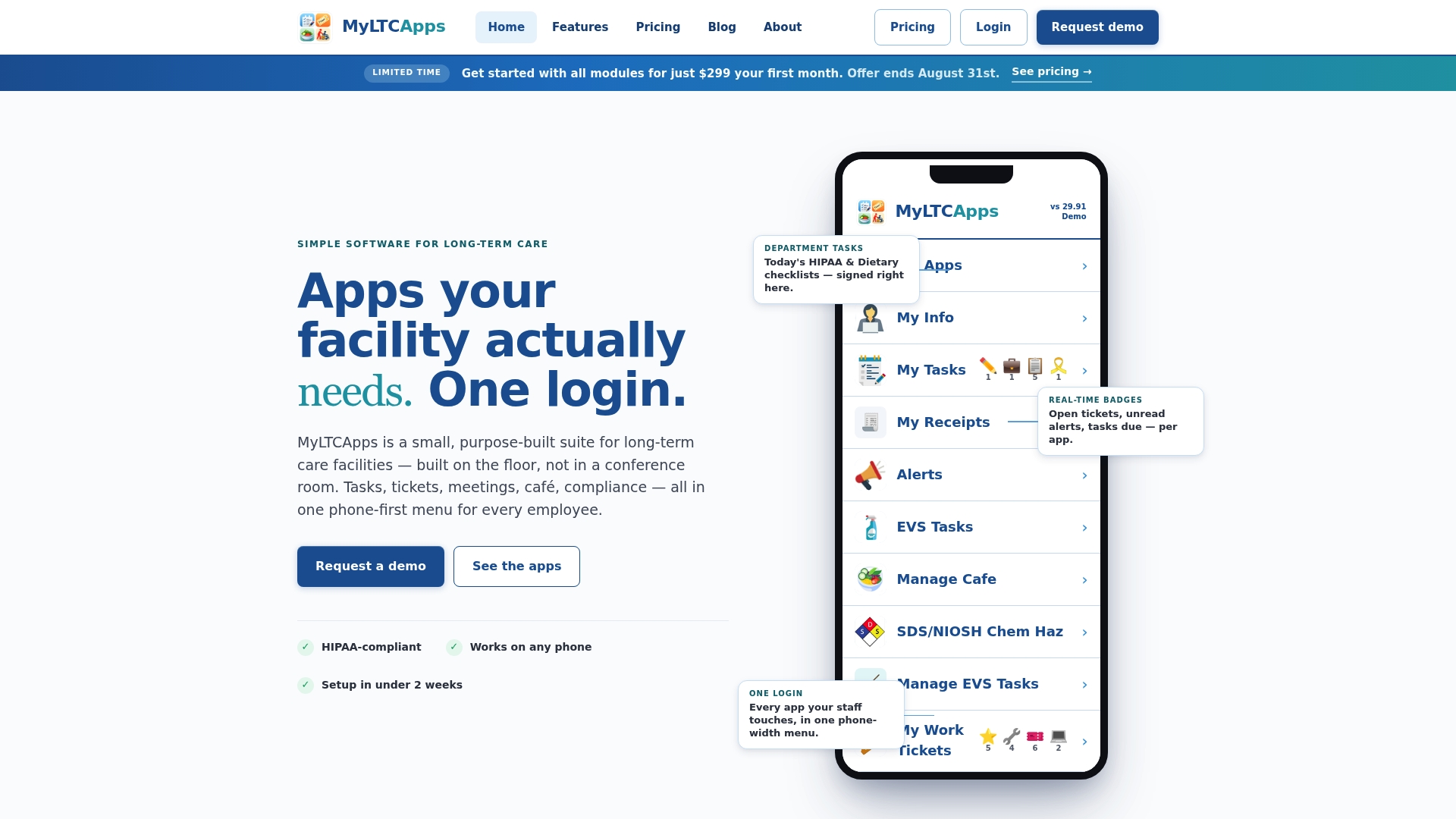
Instead of a language access coordinator chasing paper checklists across departments, My Tasks assigns interpreter checkpoints and teach-back confirmations directly to staff at the point of care, with a timestamped record when each step is completed. The Compliance Suite keeps translated documents, training completion records, and audit exports organized in one place, so when a surveyor asks for your notice-of-availability history or your interpreter training log, you are not digging through file cabinets. That same document control approach works well for maintaining exposure control plans and other regulated paperwork facilities juggle year-round.
Plans start at $199 per month with the I Just Want That tier, scaling up through Starter, Growth, and Premium packs as your facility’s operational needs grow. If your language access plan is still living in a binder nobody updates, check the features overview and see what a checklist-driven system looks like in practice.
Authoritative Resources and Templates to Consult
- Section 1557 language access provisions (HHS OCR): the core legal text defining qualified interpreters and notice requirements.
- CMS language access plan guide: the template most facilities build their plan sections around.
- AHRQ LEP patient-safety guide: the source for high-risk workflow guidance and TeamSTEPPS practices.
- CLAS Standards implementation lessons (CMS): field-tested approaches to needs assessment and modality choice.
This article is general information, not a substitute for advice from a qualified doctor. Consult a qualified healthcare professional about your own circumstances before acting on anything here.
Sources
- Language access provisions of the final rule implementing Section 1557 of the Affordable Care Act
- Guide to developing a language access plan
- Improving patient safety systems for patients with limited English proficiency (AHRQ LEP guide)
- Implementing the National CLAS Standards for communication and language assistance services: Lessons from the field
FAQ
What Is a Language Access Plan in Healthcare?
It is a written policy that guarantees patients with limited English proficiency get free, timely, qualified language assistance at every point of care. It typically maps a needs assessment, interpreter and translation policies, notices, training, and monitoring into one governed document, following the structure in the CMS language access plan guide.
Does Section 1557 Require Healthcare Facilities to Have a Language Access Plan?
Section 1557 requires covered entities to provide meaningful access to LEP individuals, offer language assistance free of charge, and post notices in English plus the top languages in the service area, per the final rule. A written plan is the practical way most facilities demonstrate they meet that obligation consistently.
Who Counts as a Qualified Interpreter Under Federal Guidance?
A qualified interpreter has demonstrated proficiency in both languages, follows confidentiality and ethics standards, and has been vetted through testing rather than simply speaking a second language informally. Family members, especially minors, should not serve as primary interpreters for clinical encounters under Section 1557.
How Often Should a Facility Update Its Language Needs Assessment?
Most facilities refresh the full needs assessment annually, or sooner when local demographics shift noticeably. The CMS guide recommends tying the refresh cycle to registration data reviews so priority languages stay current.
Can Myltcapps Help Manage Language Access Plan Documentation?
Myltcapps centralizes checklists, task assignments, and document control that support operating a language access plan, including training records and audit-ready compliance exports through its Compliance Suite. It does not provide interpretation or translation services directly; those remain separate vendor relationships the plan should document.