QAPI Change Management for Nursing Homes: Start With One Unit

QAPI Change Management for Nursing Homes: Start With One Unit
Effective change management in a nursing home starts by organizing the work under CMS QAPI, pairing technical fixes with adaptive strategies drawn from AHRQ implementation modules, and proving the idea through a small pilot tied to one metric. Run a readiness check on one unit, name a sponsor and a champion, and define a single measure before you launch anything.
TL;DR:
- Before launch, confirm governing body approval, protected staff hours, a usable existing data source, training across shifts, and infection prevention support when relevant.
- If gaps remain, secure the sponsor first, then protected time, the data source, and training; record commitments as scheduled hours and a signed charter.
- Choose a unit with steady leadership, stable staffing, and a respected champion, avoiding troubled units; track one process measure and one outcome measure.
- Use repeated Plan Do Study Act cycles to compare results with baseline, gather staff feedback, revise tools, and update policies and orientation after success.
- A bundled electronic stewardship intervention in 13 nursing homes increased early antibiotic discontinuation by 10.5%, and staff feedback drove revisions to tools and training.
Table of Contents
- Why QAPI and your nursing home context should shape every change project
- Which change frameworks should guide your plan?
- How do you assess readiness before launching?
- How do you pilot, test and scale a change?
- How do you build staff engagement, champions and training that stick?
- What should you measure, and how do you document it?
- What do worked examples look like in practice?
- Which operational tools help turn policy into daily practice?
- Author perspective: lead with patience and protect staff time
- How a mobile-first operations platform can support your QAPI projects
- FAQ
- Sources
Why QAPI and your nursing home context should shape every change project
CMS requires nursing homes to run a QAPI program. QAPI integrates Quality Assurance and Performance Improvement so you examine all systems of care and management practices instead of chasing one problem at a time. That makes it the natural home for any change project, because the structure, documentation and governance expectations already exist. When you launch a change inside QAPI, you are not adding a side initiative. You are doing the work surveyors already expect to see.
The Five Elements give you the scaffold: design and scope, governance and leadership, feedback and data systems, performance improvement projects, and systematic analysis and systemic action. Use them as a checklist when you plan. If a proposed change has no clear owner, no data source or no path into your QAPI committee, it is not ready.
Nursing home conditions shape how you design the work:
- Staff turnover means any training plan must survive people leaving. Build short, repeatable training instead of one big session.
- Limited infection prevention resources mean one person may cover several roles. CDC guidance on building capacity lists the core program elements (policies, staff training, auditing, feedback and supplies) that a small team has to carry.
- Resident vulnerability raises the cost of a failed rollout. A badly timed change to medication or infection routines can hurt people, so you test small first.
- Protected time is the resource most often promised and least often delivered. CDC-hosted research on organizational readiness points to management support in concrete form, including allocated resources that let teams function.
You also do not have to invent your improvement ideas. The NNHQCC Change Package is a menu of strategies, change concepts and action items drawn from site visits to high-performing nursing homes. It organizes ideas across leadership, staffing, person-centered care, communication, continuous learning, clinical care and business practices. Browse it when you pick a performance improvement project (PIP). Choose a concept that matches a problem your own data already shows, then adapt it to your building.
For a deeper look at running the program itself, see our practical QAPI guide for administrators.
Which change frameworks should guide your plan?
Frameworks keep you from improvising. Two classic models fit nursing homes well, and one practical distinction decides whether either of them works.
Kotter’s eight steps move from creating urgency to anchoring change in culture. In a nursing home, that looks like showing staff a real problem (rising falls on one wing), building a small guiding coalition of nurses and aides, stating a simple vision, removing obstacles such as clunky paperwork, and celebrating short-term wins before declaring victory. The last step matters most: write the change into policy so it survives the next leadership shift.
Lewin’s model is simpler: unfreeze, change, refreeze. You unfreeze by helping people see why the current routine is not good enough. You change by testing the new routine in a small area. You refreeze by updating policies, checklists and orientation so the new routine becomes the default. Many facilities skip the refreeze, which can make improvements harder to sustain.

Technical versus adaptive work
The distinction that matters most comes from AHRQ. Technical solutions are clear procedures, resources and training, while adaptive solutions address attitudes, beliefs and behaviors. AHRQ’s examples show that combining both is what produces sustained change in long-term care. Practitioner guidance in PubMed Central makes the same point from the other side: initiatives tend to fail when an adaptive problem gets treated as a technical one.
Here is how that plays out on a care floor:
- Technical: a new hand-off checklist, a revised catheter care policy, a short training video, a supply cart restocked at the point of use.
- Adaptive: nurses who believe “we have always done it this way,” aides who do not feel safe speaking up about a missed step, managers who say they support the change but schedule no time for it.
The prescription is a hybrid. For every planned change, write two columns: the technical pieces and the adaptive pieces. Then budget for both. If your plan has five technical tasks and nothing in the adaptive column, you have a document, not a change.
How do you assess readiness before launching?
Readiness is where many projects are won or lost. Research on pre-implementation readiness in nursing homes stresses gauging communication structures and problem-solving capacity, and securing concrete management commitments of time and resources, so the initiative does not become “just another task.” Use the list below to decide whether to launch now or fix gaps first.
The readiness checklist
- Governing body support. Your governing body or owner has reviewed the project and agrees it fits the QAPI plan.
- A named sponsor. One senior leader owns the outcome and clears obstacles.
- Dedicated time and budget. Staff have protected hours, and a budget line exists, even a small one.
- A usable data source. You can pull the metric you picked from records you already keep.
- A communication plan. You know who tells staff what, how often and through which channel.
- Training capacity. Someone can deliver short sessions across all shifts, including nights and weekends.
- Infection prevention support. If the project touches infection routines, your IP lead is involved from day one.
The Guide for Developing a QAPI Plan walks through meeting formats, data systems, and how to prioritize PIPs, which helps you confirm the structure behind these items.
Document the commitments you cannot see
Verbal support is cheap. Make management commitment visible by recording it:
- Protected hours written into the schedule, not just promised in a meeting
- A budget line with an amount, even if modest
- A standing meeting cadence on the calendar for the project team
- A one-page charter signed by the sponsor
Fixes before launch
If you find gaps, clear them in this order: secure the sponsor first, then protect time, then confirm the data source, then schedule training. A project with a sponsor and protected time can recover from a weak communication plan. A project without them rarely recovers from anything.
How do you pilot, test and scale a change?
Start small on purpose. Small tests are cheaper, safer for residents and easier to learn from. Change packages from high-performing systems, such as the NAA safety culture and governance package, recommend small pilots, visible tests of change, and listening to late adopters.
Choose the pilot unit and the metrics
Pick one unit where leadership is steady, staffing is reasonably stable and a respected champion works. Avoid your most troubled unit for a first pilot, because you want a fair test of the idea, not a rescue mission. Then choose a small set of metrics. A process measure (did staff do the new step?) and an outcome measure (did the result improve?) are usually enough.
Write a PIP charter
A short charter keeps everyone aligned. It should include:
- The problem statement, in plain words, backed by your own data
- The goal and the metrics, with a baseline and a target
- The sponsor, champion and team members
- The pilot unit and the timeline
- How and when results will be reported to the QAPI committee
The QAPI plan guide and the NNHQCC Change Package both help you shape the charter and select a change concept.
Run Plan-Do-Study-Act cycles
- Plan. Decide what you will try, who does it, and what you expect to see.
- Do. Run the change for a short window on one unit.
- Study. Compare results to your baseline and ask staff what got in the way.
- Act. Keep, adjust or drop the change, then start the next cycle.
Expect to revise your tools. The JAMDA stewardship work discussed later found that success required iterative revisions to training and tool bundles based on staff feedback, and your pilot will likely follow the same pattern.
Share results and scale
Report results to your QAPI committee in plain terms: what we tried, what changed, what we learned. Then plan a phased spread, one unit or shift at a time, with room to adapt. A routine that works on days may need rework for nights.
For help turning problems into trackable tasks as you scale, our post on turning facility risk assessments into work tickets shows one practical path.
How do you build staff engagement, champions and training that stick?
People carry change, not documents. Define roles early so nobody assumes someone else is handling a piece.
Roles and accountabilities
- Executive sponsor: removes barriers, protects time, reports to the governing body.
- Nurse champion: a respected peer who models the new routine and gives honest feedback.
- Infection prevention lead: guides clinical content and audits practice. CDC guidance treats this role as central to a working program.
- Operational lead: handles supplies, schedules and workflow so the new routine fits the day.
The Five Elements stress that governance sets expectations, provides training, and ensures time and equipment. Treat that as a leadership promise, not a suggestion.
Tactics that work on a care floor
- Micro-trainings. Short sessions at huddles can be more practical than a long session no night-shift aide can attend.
- Protected time windows. Block a specific slot, and make sure the schedule reflects it.
- Leadership rounds. Walk the unit, ask staff how the new routine feels, and fix small problems on the spot.
- Focus groups. Short, structured conversations with aides, nurses and housekeeping often surface issues that surveys miss.
- Safety culture surveys. The AHRQ Long-Term Care Safety Toolkit links survey findings to learning modules you can adapt to the gaps you find.
AHRQ’s Artifacts of Culture Change Self-Assessment Tool offers prompts for assessing culture change, which helps with the adaptive side of your plan.
Turn feedback into action
Collecting feedback and doing nothing with it damages trust faster than not asking. Keep a simple “you said, we did” board on the unit. When an aide points out that a form takes too long, fix the form and say so publicly. When feedback cannot be acted on, explain why. Reward participation too: recognize champions in staff meetings and thank people who report problems.
What should you measure, and how do you document it?
Measurement turns a good idea into evidence. Pair every project with a small set of measures you can pull reliably.
Priority measures
- Process adherence: did staff complete the new step, such as a checklist item or a hand-off review?
- Antibiotic days of therapy and new antibiotic starts per 1,000 resident-days
- CAUTI rates, where catheter care is the focus. CDC material reports measurable outcomes, including CAUTI reductions, from large-scale interventions.
- Falls and antipsychotic starts, for clinical quality projects
- Staff checklist completion as a leading indicator of whether the routine has taken hold
Early discontinuation of antibiotics rose by 10.5% at intervention sites in a JAMDA study of a bundled electronic intervention in 13 nursing homes. That shows a structured, measured intervention can shift real prescribing behavior.
Dashboards for different audiences
Do not build one dashboard for everyone. Segment it:
- Governing body: a one-page view of trends and whether goals are being met, reviewed on a set cycle
- QAPI committee: the full project data, with baselines, targets and cycle notes
- Frontline leads: simple, current numbers they can act on this week, such as checklist completion by shift
Match the reporting frequency to the audience. Frontline leads need regular views they can act on. The QAPI committee meets on its own cadence. The governing body needs a periodic summary.
Document for surveyors and for sustainability
Write down what you did and what happened. The QAPI plan guide calls for documenting systemic analysis and systemic action, and CMS describes QAPI as an ongoing method involving all levels of the organization. When a pilot succeeds, update the relevant policy, revise the QAPI plan and adjust orientation materials. That is the refreeze step, and it is what keeps results from sliding. Our guidance on action-focused root cause analysis can help when results fall short and you need to understand why.
What do worked examples look like in practice?
Two compact projects you can adapt follow below. Neither requires a large budget, only clear ownership and honest measurement.
Example 1: Antibiotic stewardship PIP
A bundled electronic intervention study in 13 U.S. nursing homes standardized documentation and training, and early antibiotic discontinuation rose by 10.5% at intervention sites by the end of the implementation phase. The researchers found that success required iterative revisions to tools and training based on staff feedback. A companion feasibility article documents the study design and implementation phases.
To copy the approach, start with one or two activities from CDC’s adapted stewardship core elements, define your measures, and set up an antibiotic review process. Expect to revise your tools after the first cycle.

Example 2: Infection prevention PIP
Use findings from an infection control assessment to staff an infection prevention role, then add auditing with feedback. CDC guidance lists policies, staff training, auditing and monitoring, feedback and supplies as the core elements. Track CAUTI and C. difficile as outcome measures, and track audit completion as the process measure.
| Project | Starting activity | Process measure | Outcome measure |
|---|---|---|---|
| Antibiotic stewardship | Standardized documentation and an antibiotic review process | Review completed for each new start | Days of therapy; new starts per 1,000 resident-days |
| Infection prevention | Named IP role with auditing and feedback | Audits completed on schedule | CAUTI and C. difficile rates |
Steps you can follow for either project:
- Pick one unit and one or two activities, not the full program
- Set the baseline from your own records before you change anything
- Review results at every PDSA cycle and revise tools and training
- Report to the QAPI committee and update policy when the routine works
Which operational tools help turn policy into daily practice?
A policy on paper does not change a shift. Tools help when they put the new routine in front of the person doing the work. Know the categories before you evaluate anything:
- Mobile task and checklist apps that let staff complete and log routine steps on a phone
- Work-ticket systems that route maintenance and environmental problems to the right person
- Shift hand-off and daily-shift reports, such as the survey-ready approach in our daily shift report guide
- Compliance libraries with seeded templates you can adapt
- Alerts and SMS for time-sensitive notices
Evaluation criteria
Score any tool against a short list:
- Ease of use for a busy aide with one hand free
- Offline capability, since signal can be poor in some buildings
- Reporting exports that feed QAPI dashboards and surveyor requests
- Implementation support, including training and onboarding help
- Seeded compliance templates, so you do not start from a blank page
A simple pilot plan
Connect one PIP to one workflow element. For example, turn a stewardship or infection-prevention step into a checklist, track task completion, and send that completion data to your dashboard. If completion is high and outcomes move, expand. If not, you have learned cheaply. For software built around PIPs and goals, see our QAPI software page.
Author perspective: lead with patience and protect staff time
In my view, most change projects fail on timing and attention, not on ideas. Leaders expect results in weeks, then abandon a sound plan before the second cycle teaches anything. Real improvement takes repeated testing, and your staff will notice whether you protect their time or only talk about it.
A few reminders I would keep on the wall. Celebrate early wins out loud. Keep your documentation survey-ready as you go instead of rebuilding it later. Update the QAPI plan when something works. And pair a clinical leader with an operational one so accountability has two sides. Start with a pilot you can actually finish.
— Philip
How a mobile-first operations platform can support your QAPI projects
We built MyLTCApps for long-term care floors, so the feature categories above map directly to the work we support:
- Mobile tasks and checklists that make process adherence easy to log and track
- Compliance Suite with seeded libraries and surveyor-ready reporting
- Work tickets that turn identified problems into assigned, trackable items
- Shift scheduling that helps protect the time your project team needs
- Alerts and SMS that keep staff informed without extra meetings
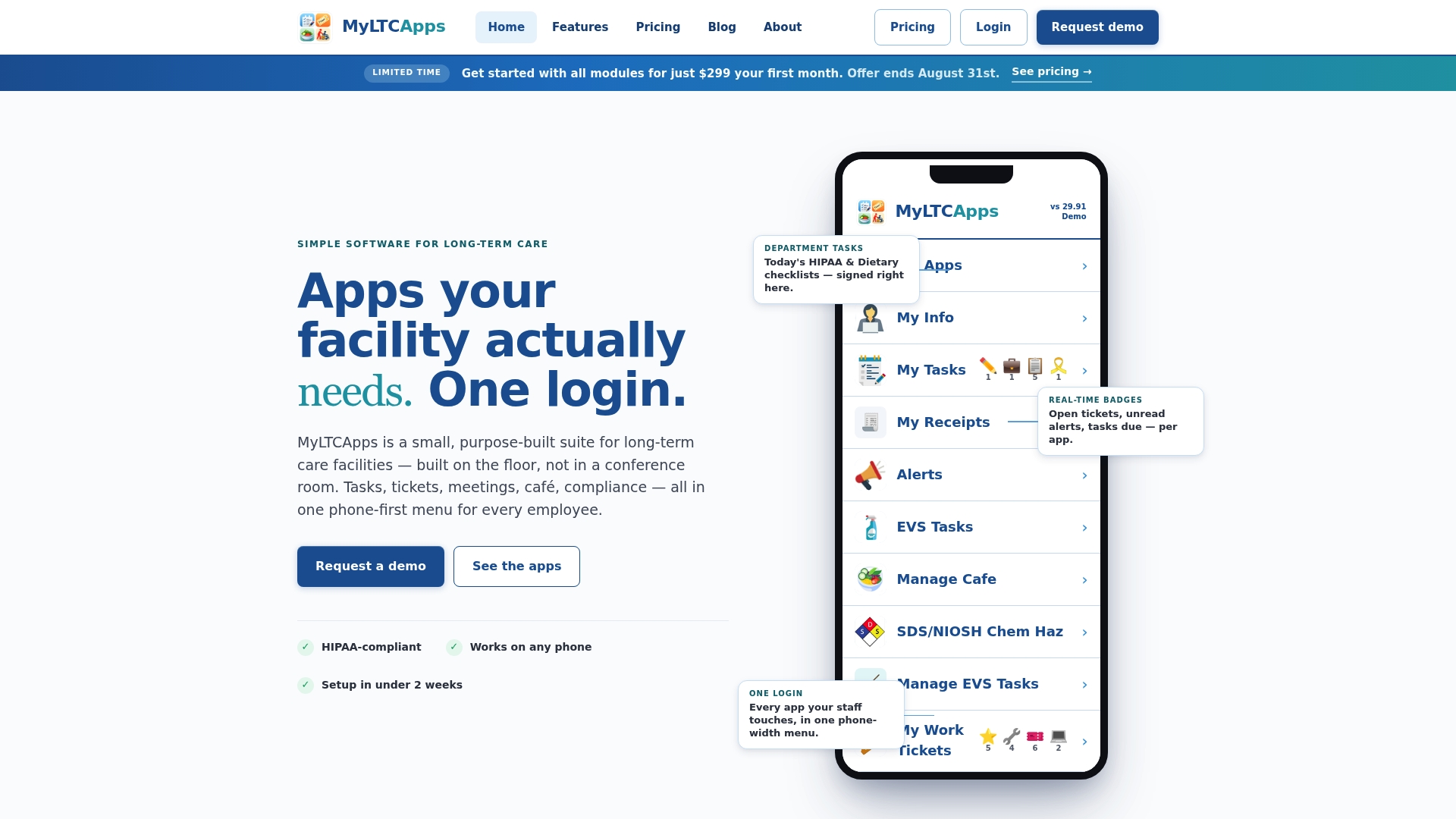
Tie a pilot to a single PIP and see what the completion data tells you. You can review our feature pages, our Compliance Suite and our pricing, where plans run from I Just Want That at $199 per month to the Premium Pack at $792 per month. When you are ready, request a demo to learn more about MyLTCApps.
FAQ
What is change management in nursing homes?
Change management in a nursing home is the planned way you introduce a new routine, tool or policy so staff adopt it and residents benefit. Under CMS QAPI, it usually takes the form of a performance improvement project with clear owners, measures and reporting.
What are some examples of change management in nursing?
Common examples include an antibiotic stewardship program, a catheter care and infection prevention project, and a standardized hand-off process. A JAMDA study of a bundled electronic stewardship intervention in 13 nursing homes is one documented example.
What is the difference between technical and adaptive change?
Technical change fixes a process with procedures, resources and training. Adaptive change shifts attitudes, beliefs and behaviors. AHRQ guidance shows that sustained change in long-term care usually needs both.
Which change management models work best?
Kotter’s eight steps and Lewin’s unfreeze, change, refreeze model are widely used, and both fit a pilot-first approach. Definitions of the “5 C’s” or “7 C’s” of change vary by author, so pick one framework and apply it consistently inside your QAPI plan.
Sources
- Cms
- Pubmed
- Examples of Technical and Adaptive Solutions for Change | Agency for Healthcare Research and Quality
- C.2 Change Package
- Building Capacity to Implement Infection Prevention and Surveillance