4 Step Mobile Daily Shift Reports for Nursing Homes, Survey Ready

4 Step Mobile Daily Shift Reports for Nursing Homes, Survey Ready
An operational daily shift report is a non-clinical, mobile-first shift summary covering census, staffing, and open tasks. The recommended move for any nursing home this shift: replace the paper handoff sheet with a structured template that turns unresolved items into assigned tasks and generates an auditable export. Two anchors make this defensible: CMS Appendix PP guidance for survey readiness and a mobile operations platform like MyLTCApps that builds the trail automatically.
TL;DR:
- Mobile shift reports should explicitly separate routine updates from urgent issues, with clear ownership, due dates, and cross-references to clinical incident reports.
- Converting paper sheets into digital tasks only requires a four-step workflow, including completion, conversion, acknowledgment, and archiving, with role-based permissions.
- The report must support staffing and PBJ documentation with time-stamped logs, accurate census, and flagging of agency staff, avoiding clinical detail to maintain compliance.
- Regular review of unresolved action items, staffing variance, incident rates, and acknowledgment times helps turn shift reports into effective quality improvement tools.
- Proper rollout planning, staff training, and strict adherence to data privacy policies are key to avoiding common pitfalls and ensuring a successful digital shift report system.
Table of Contents
- What Goes Into a Daily Shift Report in Nursing Homes?
- How Do You Turn a Paper Shift Report Into a Mobile Checklist?
- Where Shift Reports Support Appendix PP, PBJ, and Survey Readiness
- Turning Daily Reports Into QAPI Data and Operational KPIs
- Legal and Compliance Considerations for Shift Reports
- A Rollout Checklist and the Pitfalls That Sink It
- Put Your Shift Reports on Autopilot With MyLTCApps
- Sources
What Goes Into a Daily Shift Report in Nursing Homes?
A daily shift report nursing teams can actually rely on has five fixed sections, in the same order every shift, so charge nurses and department leads can scan it in under two minutes. This isn’t clinical charting. It’s an operational log that tracks facility conditions and open work, and it feeds directly into staffing dashboards and compliance exports.
Here’s what belongs on it:
- Shift header and census changes. Date, shift, unit, census count, plus every admission, discharge, and transfer since the last report.
- Resident-level operational notes. Isolation status changes, mobility equipment failures, meal service issues, and anything affecting daily operations, not diagnosis or treatment.
- Staffing log. RN coverage confirmed, agency or pool staff on the floor, and an hours per patient day (PPD) snapshot pulled from the daily staffing grid.
- Action items with ownership. Each unresolved item gets a named owner, a due date, and a priority flag (routine or urgent).
- Incident pointer. A reference number linking to the official incident report or chart entry, never a restatement of the clinical detail itself.
That last point matters more than it looks. Template guidance for shift handoffs consistently warns against duplicating medical record content in an operational log; the fix is a cross-reference, not a summary. Standard fields like these come straight from 24-hour charge nurse shift report templates used across long-term care, adapted for a mobile format.
The ordering matters too. Field-order consistency is what lets a night-shift nurse triage a report in seconds rather than hunting for the one line that actually needs action. Template design research on assisted living handoffs backs this up directly: separating routine updates from urgent follow-ups and assigning owners up front cuts the chance an item gets lost between shifts.
How Do You Turn a Paper Shift Report Into a Mobile Checklist?
Converting a laminated handoff sheet into app-based tasks isn’t a redesign project. It’s a four-step workflow you can pilot in two weeks.
- Complete the shift report in the app at handoff, using the fixed field order from the section above.
- Convert unresolved items into tasks. Anything flagged as an open action item becomes a work ticket or staffing note automatically, with owner and due date already attached.
- Acknowledge. The assigned owner (maintenance lead, unit manager, dietary supervisor) taps to confirm receipt, which time-stamps accountability.
- Close and archive. Once resolved, the item closes with a timestamp, building the audit trail without anyone re-typing anything.
Mapping fields correctly is where most rollouts stumble. Census and staffing fields feed the staffing dashboard directly. Action items become work tickets in a module like work order tracking. Maintenance and housekeeping notes route the same way through EVS task management. Permissions should be role-based from day one: charge nurses submit, department leads acknowledge, administrators export.
Run the pilot on one unit for 7 to 14 days before facility-wide rollout. Track three numbers during that window: how many reports get submitted on time, how many action items close within 24 hours, and how many staff need a second training pass. Build a short training checklist covering login, field order, and how to escalate an urgent item, then walk every shift lead through it once before go-live.
Pro Tip: Test your export before you need it in a survey. Pull a 30-day report during the pilot and check that time-stamps, staff sign-offs, and cross-references all render cleanly, not after a surveyor asks for one.
Don’t skip the audit trail configuration. Every entry, edit, and acknowledgment needs its own timestamp, and role-based access should be locked down the same way you’d handle any resident-related data, a point worth reviewing against a HIPAA compliance checklist for long-term care.
Where Shift Reports Support Appendix PP, PBJ, and Survey Readiness
Surveyors don’t ask to see your shift reports by name. They ask whether staffing claims and follow-up actions are backed by records, and a well-built daily report is exactly that evidence. CMS revised its Appendix PP guidance under QSO-25-12-NH, with surveyors using the updated guidance starting March 24, 2025, and nursing services and PBJ documentation both got sharper attention in that revision.
Three ways your daily report ties directly into that guidance:
- Nursing services and staffing documentation. A time-stamped staffing log that separates confirmed RN coverage from agency fill matches exactly what surveyors probe when reviewing staffing adequacy.
- PBJ support. Recording census and actual hours worked, with agency staff flagged separately, gives you a same-day record that lines up with what facilities submit for Payroll-Based Journal reporting.
- Incident follow-up trail. A cross-reference from the shift report to the incident number shows a surveyor the item was tracked and closed, without the operational log ever touching clinical content.
The export itself needs three things to hold up: time-stamps on every entry, a staff sign-off field, and a clean link from action item to the official incident report or chart. What it must never do is stand in for that official documentation. Every credible shift-report template carries this exact caution, and it’s worth repeating here: operational logs are a handoff tool, not a substitute for medical records. Keep the two systems separate and the export defends itself.
Turning Daily Reports Into QAPI Data and Operational KPIs
A daily shift report that nursing leadership reviews for patterns can become QAPI inputs, not just a handoff artifact. Four numbers are worth pulling weekly:
- Unresolved action items, counted and aged (how many sit open past 48 hours)
- Staffing variance frequency (how often posted plan misses actual coverage)
- Incidents per 100 resident days
- Average acknowledgment time on escalated items
A workable escalation cycle looks like this: a unit logs three equipment-related falls in one week, root cause traces to a mobility aid backlog, the fix is a standing weekly equipment check added to the shift report itself, and the following month’s incident count drops. That’s an operational QAPI project built entirely from daily report data, no clinical judgment required.
One caution on interpreting technology’s role here: observational research on integrated alert and analytics platforms in skilled nursing facilities found lower adjusted readmission rates over time compared with peer facilities, but the researchers tie that to integration into daily workflow, not the software alone. A report nobody acknowledges produces no benefit. Feed daily counts into a weekly leadership review, then a monthly QAPI cycle, and the pattern becomes visible fast.
Legal and Compliance Considerations for Shift Reports
The single biggest legal risk in a daily shift report is scope creep, the moment an operational log starts carrying clinical detail it was never designed to hold. Keep resident-specific medical information, diagnoses, medication changes, and treatment decisions entirely out of the operational report. That content belongs in the official medical record and, where applicable, the incident reporting system. Template guidance across the industry repeats this same warning for a reason: mixing the two creates a document that’s neither a reliable operational log nor a defensible clinical record, and it complicates discovery if either is ever requested in litigation or a survey.
Retention matters too. Facilities should set a written retention policy for shift-report exports that aligns with state requirements and internal record-keeping standards, and that policy should specify who can access historical reports and for how long. Role-based access isn’t optional here. A shift report often contains resident names, room numbers, and equipment or safety notes, information that still falls under privacy protections even though it isn’t clinical charting.
Electronic documentation carries its own advantage on the compliance side. Health information technology in nursing homes has been shown to improve documentation accuracy and accessibility, which cuts both ways legally: better records protect the facility when questions arise, but they also mean errors are harder to explain away as “just a paperwork issue.” Build the sign-off step into every report so accountability is clear, and treat the export function as a compliance tool from day one, not an afterthought you configure right before a survey.

A Rollout Checklist and the Pitfalls That Sink It
Most rollouts fail for boring reasons, not technical ones. Give yourself 30 days: week one for pilot design and picking a single unit, week two for staff training and a dry run, week three live on the pilot unit while you track close rates, week four for facility-wide rollout with owners assigned by role, not by name.
The pitfalls repeat across facilities. Vague action items (“check on supplies”) that nobody can act on. Items with no assigned owner, so they float until someone finally notices. Late entries logged after the shift ends, which breaks the time-stamp trail surveyors care about. And the one that causes real damage: staff typing clinical detail into an operational field because it felt easier than opening the chart. Train against that specifically.
MyLTCApps’ competency tracking resources and onboarding checklist are worth building into that first training week.
— Philip
Put Your Shift Reports on Autopilot With MyLTCApps
Myltcapps is built for exactly the workflow this article describes: a mobile-first daily checklist that turns every unresolved shift item into an assigned task automatically, with the time-stamps and sign-offs already built in for when a surveyor asks for the export.
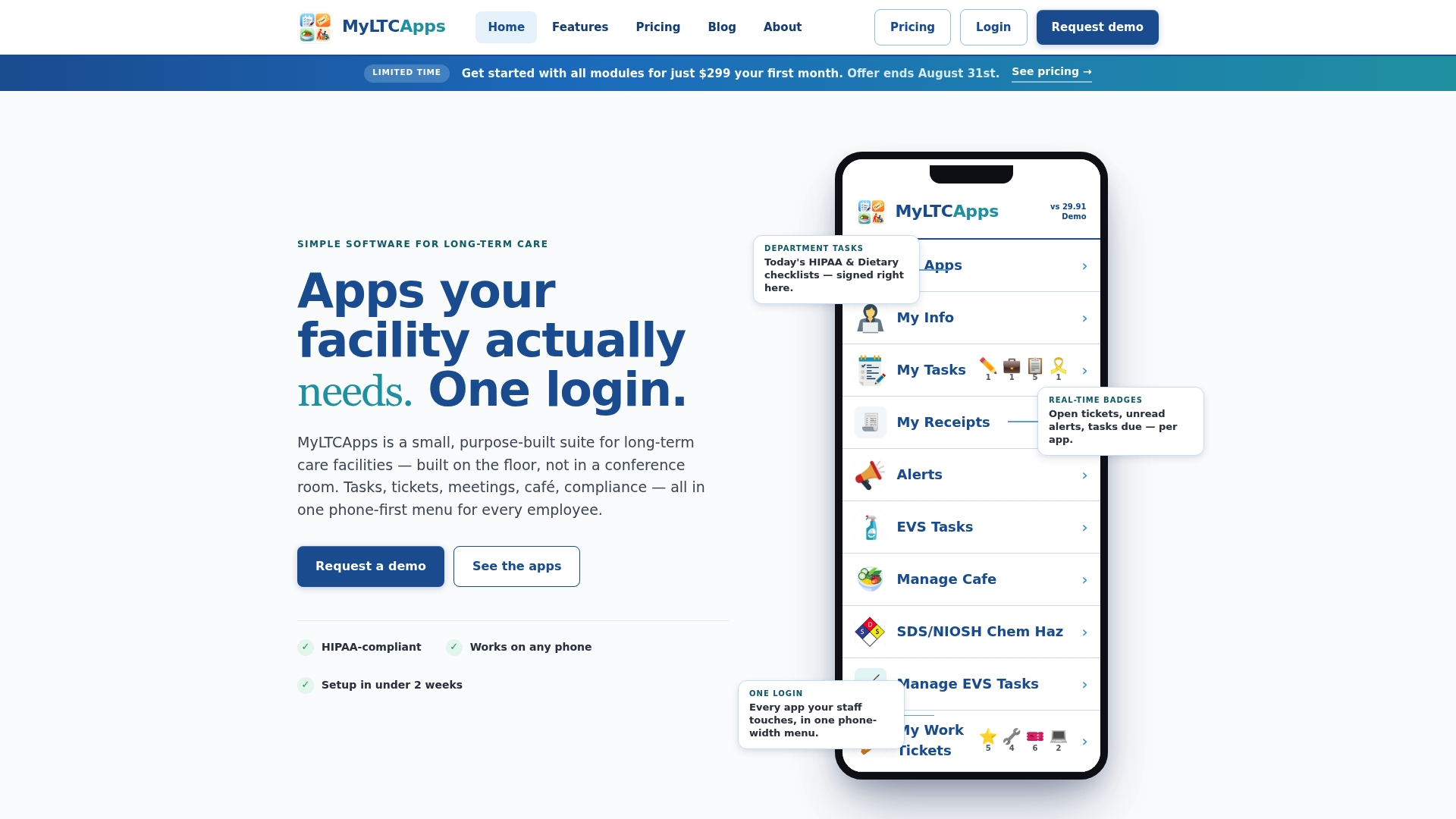
You’ve read the template, the four-step workflow, and the pitfalls that trip up rollouts. Skip the trial-and-error and start with a system already structured around Appendix PP and PBJ evidence requirements. The compliance task and daily checklist module handles the field mapping, permissions, and export testing described above out of the box, so your team is filling out a shift report on day one instead of building one from scratch. Request a demo and see how your current paper process maps onto it, unit by unit, before you commit to a facility-wide switch.
Sources
- Health Information Technology in Nursing Homes — NCBI Bookshelf (2022)
- Revised Long-Term Care (LTC) Surveyor Guidance: QSO-25-12-NH — CMS (2024)
- AJMC study on integrated analytics/alerts in SNFs (2024) — doi:10.37765/ajmc.2024.89557