Turn Facility Risk Assessments Into Work Tickets in 5 Steps for LTC

Turn Facility Risk Assessments Into Work Tickets in 5 Steps for LTC
A correct facility risk assessment is not a form you fill out once a year. It’s a living risk register that names every hazard, scores it, assigns an owner and a deadline, and links directly to a work ticket that proves the fix happened. If your current process ends in a filed PDF instead of an active task list, the next step is simple: rebuild it as a team-based, all-hazards review that feeds your maintenance and compliance systems year-round.
TL;DR:
- Continuously update the risk register with real-time data from work tickets, near-miss reports, and maintenance logs instead of relying on annual paper-based assessments.
- Identify hazards across multiple categories, including physical, chemical, biological, ergonomic, security, fire, and utility failures, through multiple staff interviews and off-hours inspections.
- Score hazards based on likelihood and severity, adjusting for resident vulnerabilities and regulatory risks, and prioritize those with the highest combined risk scores for immediate action.
- Implement the hierarchy of controls, favoring elimination and engineering solutions over administrative measures and PPE, and document interim steps for unresolved hazards.
- Use mobile platforms to streamline assessment updates, generate auto-linked work tickets, and ensure survey-ready documentation that integrates with compliance and emergency planning.
Table of Contents
- What Are the Steps in a Facility Risk Assessment?
- What Hazards Should a Facility Risk Assessment Cover?
- How Do You Score and Prioritize Facility Risks?
- Which Controls Actually Reduce Facility Risk?
- What Documentation Makes an Assessment Survey-Ready?
- How Often Should You Review and Test Your Risk Register?
- What Do CMS and OSHA Require for Facility Risk Assessments?
- How Software Keeps Facility Assessments Current
- Common Pitfalls and Quick Wins From the Field
- Turn Your Risk Register Into a Working System
- Sources
What Are the Steps in a Facility Risk Assessment?
A facility risk assessment moves through five stages, and skipping any one of them is why so many end up as static paperwork instead of a working safety tool.
Start by setting the scope. Decide which buildings, resident populations, departments, and operations you’re evaluating, and write that scope down before anyone walks the floor. A rehab wing has different exposures than a kitchen or a boiler room, and vague scope leads to vague findings.

Next, build the right team. Long-term care facilities are required to use a facility-based and community-based, all-hazards approach, and that only works with input from more than one department. Pull in your safety officer, maintenance lead, director of nursing, IT, and someone who can speak to communications and emergency notification. Frontline direct care staff belong in this group too. They spot operational risks administrators routinely miss, because they’re the ones pushing carts down the hallway that’s always cluttered.
Before the walk-through, gather your records:
- Safety data sheets (SDS) for chemicals in use
- Incident and near-miss logs from the past 12 to 24 months
- Maintenance history on HVAC, generators, and life-safety systems
- Fire alarm and monitoring logs
- Prior survey findings and corrective action plans
A realistic timeline runs several weeks for a mid-size facility, allowing time for scope and records, the physical walk-through and interviews, scoring and prioritization, and documentation and leadership sign-off.
What Hazards Should a Facility Risk Assessment Cover?
Hazard identification fails most often not because teams miss the obvious dangers, but because they stop looking too soon. OSHA’s hazard identification guidance frames this as an ongoing task, not a one-time inspection, and recommends working through defined categories rather than wandering the building with a clipboard.
Cover these categories at minimum:
- Physical: wet floors, blocked egress, faulty flooring, exposed wiring
- Chemical: cleaning agents, improperly stored SDS-listed substances
- Biological: infection control gaps, waste handling, water system risks
- Ergonomic: resident lift equipment, staff repetitive-motion injuries
- Security: unsecured entry points, elopement risk, visitor management
- Fire: blocked sprinklers, improper storage in corridors, alarm testing gaps
- Utility failure: generator readiness, HVAC redundancy, water supply interruptions
Photograph every finding, review SDS binders against what’s physically stored on shelves, and interview staff on multiple shifts to capture a full range of operational perspectives, including those present outside typical inspection times.
Pro Tip: Walk the building at a time your facility doesn’t normally get inspected, like a Saturday overnight shift. That’s when maintenance backlogs and staffing gaps actually show themselves.
How Do You Score and Prioritize Facility Risks?
OSHA defines risk as hazard multiplied by exposure, and that formula is the backbone of any usable prioritization method. A hazard that exists but is rarely encountered scores lower than one that’s constant, even if the hazard itself looks similar on paper.
Score each finding on two axes:
- Likelihood (1 to 5): how often exposure occurs, from rare to constant
- Severity (1 to 5): potential consequence, from minor to catastrophic
Multiply the two for a risk score on a defined scale. Set thresholds in advance so scoring is objective: higher scores indicate high risk requiring prompt action, mid-range scores suggest medium risk within a standard timeframe, and lower scores are managed through routine maintenance planning.
For long-term care specifically, adjust severity upward when a hazard affects residents with mobility limitations, cognitive impairment, or ventilator dependence. A blocked exit door scores differently in a memory care unit than in an administrative office. Factor in regulatory and financial exposure too. A citation risk or a hazard tied to a past survey finding should never be scored purely on physical danger alone.
Which Controls Actually Reduce Facility Risk?
OSHA’s recommended practices rank controls by effectiveness, and the hierarchy matters because facilities default to the weakest options out of habit. Elimination and engineering controls fix the hazard itself; administrative controls and personal protective equipment (PPE) just manage exposure to it.
Here’s how that hierarchy plays out in a typical facility:
- Elimination: remove a tripping hazard by relocating stored equipment out of a hallway
- Substitution: replace a harsh chemical cleaner with a lower-hazard alternative
- Engineering: install auto-closing doors on a memory care unit instead of relying on staff vigilance
- Engineering: add backup generator capacity rather than hoping outages stay short
- Administrative: rotate lift-heavy tasks among staff to reduce ergonomic strain
- Administrative: update chemical storage protocols and retrain staff quarterly
- PPE: require gloves and eye protection during specific cleaning tasks
- PPE: issue slip-resistant footwear where flooring can’t be replaced immediately
When a permanent fix isn’t feasible right away, document the interim control clearly: what’s being done temporarily, who approved it, and the target date for the permanent solution. An unresolved hazard with no documented interim step is exactly what surveyors flag first.
Pro Tip: Never let an administrative control sit as the “permanent” fix for a hazard that engineering could actually solve. Signage and training wear off; a fixed door closer doesn’t.
What Documentation Makes an Assessment Survey-Ready?
Surveyors and auditors don’t just want to see that you identified a hazard. They want proof of the whole chain: finding, evidence, decision, and closure. Structure every entry in your risk register with these fields:
- Scope and location of the hazard
- Team members who identified and reviewed it
- Evidence (photos, SDS excerpts, incident report numbers)
- Likelihood and severity score with justification
- Assigned owner and due date
- Control selected and its place in the hierarchy of controls
- Closure date and verification method
NFPA-formatted templates, including the NFPA 99 facility risk assessment tool, give a useful structure for life-safety specific items if you need a starting checklist format. Whatever template you use, every finding needs a direct link into your work-ticket system so remediation status is checkable in real time, not buried in a spreadsheet nobody updates.
How Often Should You Review and Test Your Risk Register?
A risk register that only gets touched once a year during survey prep is already out of date. Feed it continuously from four sources: closed and overdue work tickets, near-miss reports, HVAC and fire alarm logs, and incident investigations.
- Pull open work tickets weekly and flag anything past its remediation deadline
- Log every near miss immediately, not in a monthly batch
- Review HVAC and alarm logs monthly for recurring fault patterns
- Run a full risk register review quarterly, with a deeper annual pass tied to your regulatory update
- Schedule tabletop exercises at least twice a year to test whether controls actually hold up under a simulated event
Track key performance indicators such as the proportion of controls completed on schedule, the timeliness of remediation by risk category, and trends in near-miss incident reporting. If time-to-remediate keeps stretching past your threshold windows, that’s a staffing or ownership problem, not a documentation problem.
What Do CMS and OSHA Require for Facility Risk Assessments?
Long-term care facilities must conduct and document a facility-wide assessment at least annually, and again whenever a substantial change occurs, under 42 CFR §483.71. That regulation specifically requires both a facility-based and a community-based risk assessment using an all-hazards approach, not just a walk-through of the building interior.
CMS guidance clarifies that this assessment needs multidisciplinary participation and has to reflect your actual resident population, including how staffing and resources tie back into it. That guidance also expects your facility assessment to integrate with your emergency preparedness plan under §483.73, so flood zones, regional utility risks, and local hazards belong in the document too.
For survey readiness, keep these practices tight:
- Get dated sign-off from every discipline involved, not just the safety officer
- Tie each finding to a specific resident-population impact where relevant
- Loop in your local emergency management contact when community-based hazards change
- Cross-reference NFPA life-safety codes for any fire or egress-related finding
How Software Keeps Facility Assessments Current
A paper-based assessment goes stale the moment it’s filed. Mobile-first platforms close that gap by turning each hazard finding directly into a tracked task instead of a line item nobody revisits.
A tool like Myltcapps’s facility assessment feature lets teams build assessment templates once and reuse them across buildings, so findings don’t require re-entering the same fields every cycle, as detailed in this breakdown of assessment without duplicate data entry. Key workflow benefits include:
- Auto-generated work tickets from flagged hazards, closing the loop between finding and fix
- Mobile checklists accessible to any staff member on a personal device, no separate hardware
- Compliance exports formatted for survey documentation
- Centralized near-miss reporting that feeds straight into the same risk register
Common Pitfalls and Quick Wins From the Field
The recurring failure is a static assessment nobody updates and no direct care input. Quick wins: tackle your highest-risk areas first, require photo evidence for every finding, and assign a named owner with a deadline. Nothing else fixes compliance gaps faster.
— Philip
Turn Your Risk Register Into a Working System
Myltcapps replaces the binder full of last year’s findings with a mobile tool your team actually opens. Instead of an assessment that sits in a drawer until the next survey, hazards flagged during a walk-through become work tickets automatically, tracked to closure, with an export ready the moment a surveyor asks for it.
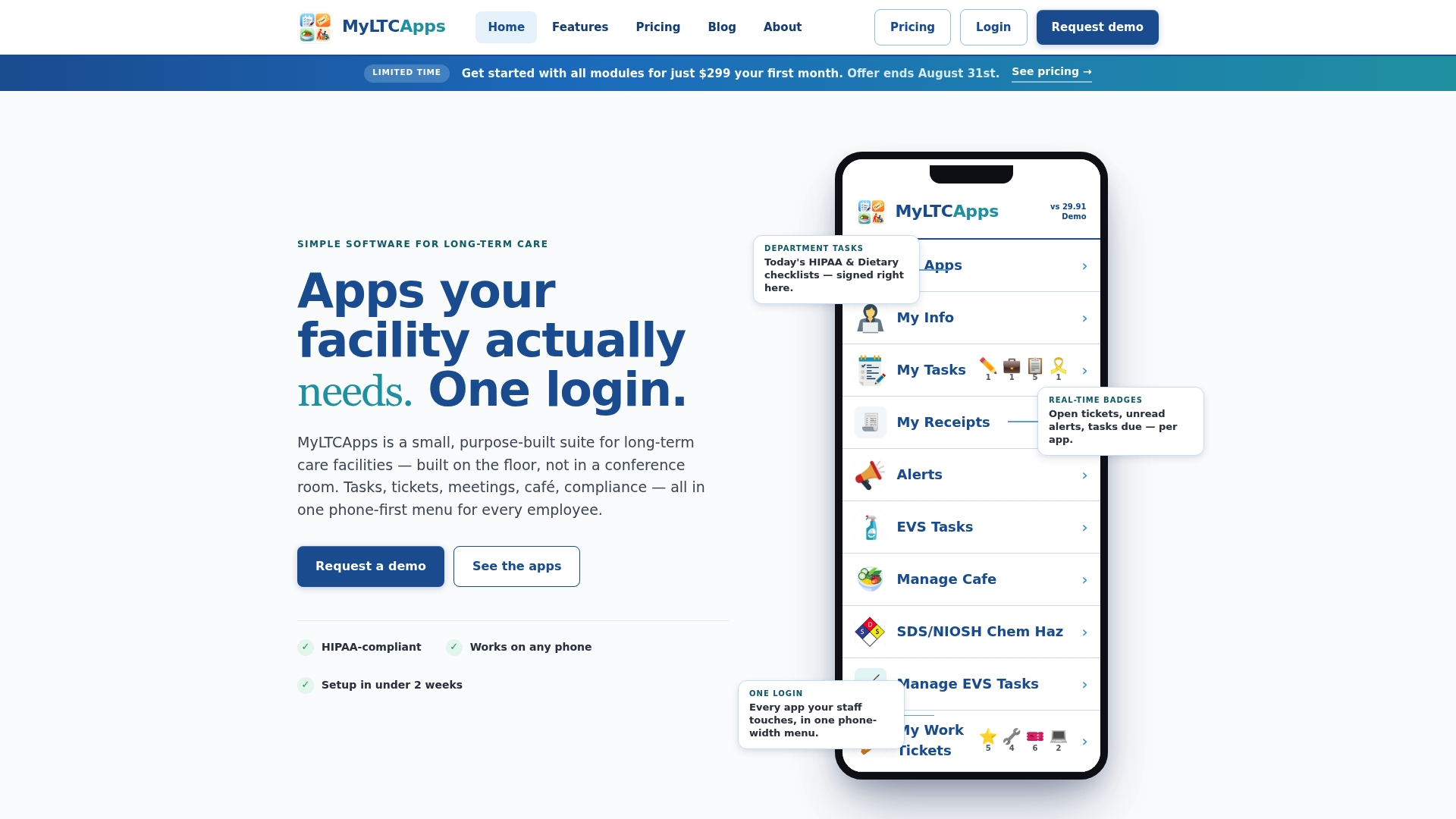
The platform’s facility assessment module supports the exact workflow this guide walks through: scoring, ownership, deadlines, and closed-loop remediation through work order tracking. Compliance libraries covering HIPAA, dietary, and QAPI requirements are seeded in from day one, and staff can log a hazard or a near miss from a phone in the hallway instead of waiting to reach a desktop. If your risk register still lives in a spreadsheet, visit Myltcapps and request a demo to see how it runs as a live system instead.
Sources
- 42 CFR § 483.71 - Facility assessment | LII / e-CFR
- Safety management - Hazard identification and assessment | OSHA
- Revised guidance for long-term care facility assessment requirements | CMS