Time Clock Rounding Policy: Rules, Examples and Audit Steps

Time Clock Rounding Policy: Rules, Examples and Audit Steps
A time clock rounding policy is legal under federal law, but only if it is neutral: it must not, over time, leave employees short on pay for time they actually worked. In practice that means rounding to the nearest 5 minutes, 6 minutes or quarter hour, rounding in both directions, writing the rule down, and checking real punch data against it on a schedule. This guide covers what the rule allows, where it breaks, how states differ, and what to put in your written policy. It also covers what shift-based operations such as nursing homes should watch for.
TL;DR
- Federal rules accept rounding when it averages out so employees are paid for all time worked. A policy that only ever favors the employer is the one that gets challenged.
- The 7-minute rule is a quarter-hour method: 1 to 7 minutes round down, 8 to 14 minutes round up. It is one accepted method, not a separate law.
- Rounding can never hide overtime. Hours over 40 in a workweek must be paid even if no one approved them.
- Some states are stricter. California, for example, bars rounding of meal period punches.
- If your system captures time to the minute, exact time is the simplest way to remove rounding risk.
Table of Contents
- What federal law says about rounding
- The 7-minute rule, explained
- What makes a rounding policy neutral
- Overtime and rounding
- When to record exact time instead
- State rules: where the federal floor is not the whole story
- What to put in a written rounding policy
- How to audit your rounding policy
- Special issues in nursing homes and shift-based care
- Our perspective
- Where scheduling fits
- FAQ
- Sources
What federal law says about rounding
There is no federal rule that requires rounding, and no rule that bans it. The Department of Labor’s regulation on time clocks says rounding practices are acceptable as long as they average out so employees are fully compensated for all time worked. The same regulation notes that time clocks are not required, and that minor differences between clock records and actual hours worked cannot ordinarily be avoided.
The key word is “over a period of time.” A single punch rounded in the employer’s favor is not a violation by itself. A pattern is. If the rule you wrote down, or the way the system behaves, consistently shaves minutes off paychecks, you have a wage problem, not a rounding policy.
The Department of Labor’s own summary of a Ninth Circuit case shows what a defensible policy looks like. The court upheld a quarter-hour rounding policy as neutral on its face and as applied to the plaintiff. Two tests are packed in there: the rule must be neutral as written, and it must be neutral in actual results.
The 7-minute rule, explained
The 7-minute rule is the most common version of rounding. The Department of Labor’s health care fact sheet describes it this way: when using 15-minute rounding, 1 to 7 minutes may be rounded down and 8 to 14 minutes must be rounded up to the next quarter hour.

Employers are not limited to quarter hours. Commentary summarizing the rule notes that work time can be rounded to the nearest five minutes, six minutes or 15 minutes.
A worked example
Assume a 7:00 a.m. shift start and a 15-minute increment.
| Clock-in punch | Rounded to | Effect on the employee |
|---|---|---|
| 6:53 a.m. | 7:00 a.m. | Loses 7 minutes of paid time if she worked from 6:53 |
| 6:54 a.m. | 6:45 a.m. | Wait: 6:54 is 6 minutes before 7:00, so it rounds to 7:00 |
| 7:04 a.m. | 7:00 a.m. | Paid from 7:00, gains nothing, loses 4 minutes if working |
| 7:08 a.m. | 7:15 a.m. | Paid from 7:15, loses 7 minutes |
The table shows the first problem with rounding: it only looks neutral across a whole population of punches. Someone who walks in at 6:53 and starts working immediately is not paid for those minutes, even though the rule is technically symmetrical. That leads to the next point, which is where most disputes start.
Rounding is not permission to ignore work
Rounding applies to punch times, not to work. If an employee is actually working before the shift start, in report, setting up, or answering a call, that time is hours worked. The federal elaws advisor allows employers to disregard infrequent and insignificant periods beyond scheduled hours only when they cannot practically be recorded. It does not apply to fixed or regularly occurring work time that can be easily ascertained, however small.
The other side is also in the regulation. Employees who clock in early or out late without working do not have to be paid for that time. But large gaps between punches and work should be discouraged because they raise doubts about the accuracy of the records. Texas Workforce Commission guidance goes further and suggests employers should not let employees punch in or out more than a minute or two early or late.
What makes a rounding policy neutral
Neutrality has two parts, and your written policy needs to address both.
Neutral on its face. The rule must be capable of helping or hurting either side. Texas guidance puts it plainly: round both up and down so the system balances over time. A rule that says “round down all late arrivals and round down all early departures” is one-directional on its face. So is any rule that rounds only the start of shift and never the end, or that rounds up for the employer only when it saves overtime.
Neutral in practice. Even a symmetrical rule can produce lopsided results if the workforce’s behavior is lopsided. If most employees clock in a few minutes early and out right on time, a rule that rounds 1 to 7 minutes down is consistently taking early minutes. Only real payroll data tells you this, which is why audit steps below matter as much as the wording.
Overtime and rounding
Rounding gets expensive at the 40-hour line. The Department of Labor fact sheet explains that if a rounding policy consistently results in unpaid time, the employer may violate minimum wage and overtime requirements. Overtime has to be paid for all hours worked over 40 in a workweek, even when those hours were not authorized.
North Carolina’s labor department states the same practical point. Employers may discipline employees for unauthorized overtime, but they must still pay non-exempt employees proper overtime for those hours regardless of approval. The right response to unapproved overtime is a conversation, not a rounding rule.
A small illustration: an aide who rounds down 6 minutes at both ends of a shift loses 12 minutes a day. Across five shifts, that is an hour a week, and if she is already at 40 hours, that hour is overtime. Multiplied across a headcount and a year, that is how class actions get their numbers.
When to record exact time instead
Rounding is allowed only when the rounded record still reflects the hours worked. Texas guidance says that when employees work more or fewer hours than their fixed schedule, the employer must supplement the record with the exact hours worked that day and week. An older Department of Labor opinion letter makes the same point: employers must override scheduled hours and record actual time when employees work outside the scheduled shift.
Exact time is the better choice in these cases:
- Meal periods, in states that treat them strictly.
- Shifts that run over, such as a late admission, a fall or a handoff that takes longer than usual.
- Anyone near the overtime threshold in the workweek.
- Employees paid on a minute-accurate basis under a state rule or a union contract.
- Any workplace where your system already records to the minute. Commentary on the rule notes that some experts suggest employers who can track time to the minute move away from rounding.
State rules: where the federal floor is not the whole story
Federal law is the minimum. States can add to it, and employees sue under state law because remedies can be larger.
California. The state’s supreme court held in 2021 that employers cannot round time punches in the meal period context, because meal period rules are designed to prevent even minor infringements. A meal period punch rounded to a neat number can create a violation that exact punches would not. Large employers have faced class actions over rounding there, with one national retailer reported to have changed payroll practices in 2023 after litigation.
North Carolina. The state labor department allows rounding that is consistent up and down and requires accurate records of daily and weekly hours worked.
Texas. The Texas Workforce Commission publishes guidance that follows the federal approach and stresses balancing over time and exact records when work departs from the schedule.
If you operate in more than one state, write the policy to the strictest state you employ in, or use exact time everywhere. Several articles that rank for this topic list state-by-state rounding “requirements” in a single line, and some of those summaries are oversimplified. Read your own state’s labor department page, and ask employment counsel before you rely on a summary table.

What to put in a written rounding policy
A written policy is your first piece of evidence if anyone ever questions your practice. Keep it short and specific. A workable policy includes:
- Scope. Which employees it covers (non-exempt, hourly) and which locations.
- Increment. The exact method: nearest 5 minutes, 6 minutes (one-tenth of an hour), or quarter hour. State the cutoff, such as “1 to 7 minutes round down, 8 to 14 minutes round up.”
- Direction. A plain statement that rounding applies the same way to every punch, in and out, and can raise or lower paid time.
- Exceptions. Meal periods in states that bar rounding, and any shift where actual time differs from scheduled time.
- Work before and after the punch. Employees must not perform work off the clock, and any work outside the punch must be reported and recorded exactly.
- Correction process. How an employee flags a missed punch or an error, who approves it, and how fast.
- Overtime. A statement that all time worked over 40 hours in the workweek is paid at the overtime rate, whether or not approved in advance.
- Review cadence. Who audits the policy, how often, and what triggers a change.
- Decimal conversion. Note how your payroll software converts minutes to hours. A figure like 8.30 is eight and three-tenths hours, or 8 hours 18 minutes, not 8 hours 30 minutes. Mixing the two is a common way for errors to creep in.
Have an employment attorney review the final language, especially if you have employees in California or other states with meal period or minute-level rules.
How to audit your rounding policy
The written rule shows intent. The audit shows effect. A practical routine:
- Pull raw punches, not rounded ones. Export the original punch times and the rounded times for a representative period, ideally a few pay periods across all shifts.
- Calculate the net effect per employee. Add up minutes gained and lost through rounding. Over time, totals should be close to zero, with no systematic loss.
- Segment the results. Look at each department, shift and supervisor. A problem can hide in a single unit where habits differ, such as a night shift that clocks in early to hear report.
- Check the overtime weeks. Recalculate weeks that cross 40 hours using exact time and compare to what was paid.
- Review meal periods. Confirm that meal punches are recorded exactly where state law requires it.
- Sample for off-the-clock work. Compare punch data against schedules, task logs and call records to see whether work is happening before or after punches.
- Document and fix. Write down what you found, who reviewed it and what changed. If employees were short-paid, correct it through payroll and consult counsel on back pay.
Repeat at least annually and whenever you change timekeeping systems, increment or scheduling pattern.
Special issues in nursing homes and shift-based care
Care settings create rounding risk for reasons that have nothing to do with intent. Shift handoffs are verbal and rarely start exactly on the minute. Staff arrive early for report and stay late to finish documentation or finish with a resident. Float coverage, call-ins and partial shifts change the schedule mid-week. Each of these produces a gap between scheduled and actual time, which is exactly where the rules say to record actual hours.
Three habits reduce the risk:
- Make the schedule match the real shift. If report starts at 6:45 for a 7:00 shift, schedule it that way. Our guide to on-call scheduling for nurse managers covers how fatigue and overtime exposure build when schedules drift from reality.
- Know the scheduling laws in your state or city. Some jurisdictions add notice and premium pay rules on top of timekeeping rules. See our overview of predictive scheduling laws.
- Track compliance as a routine, not a project. Timekeeping audits belong on the same recurring calendar as other regulatory tasks. Our compliance tracking guide for nursing homes shows how to build that calendar.
Our perspective
We build software for long-term care operations, and we see the same pattern in facilities that struggle with rounding questions: the problem is rarely the increment. It is the gap between the schedule on paper and the shift as it is actually worked. When the schedule is wrong, the punch is the only record, and rounding then decides who absorbs the error.
Our view is that administrators should fix the source first. Put real start times for report and handoff on the schedule, make changes visible to staff on the phone in their pocket, and give supervisors an easy way to record a shift that ran long. Then pick the simplest rounding rule you can defend, or none at all if your timekeeping system records to the minute. We do not provide legal advice and we do not replace your timekeeping or payroll system, so have your employment counsel sign off on the final policy.
— Philip
Where scheduling fits
A rounding policy only works if schedules reflect how the floor runs. MyLTCApps offers Shift Scheduling as part of its phone-first suite for long-term care, so staff can see their shifts and changes from their own devices. It sits alongside task management and compliance tools, and you can see the current plans on the pricing page: I Just Want That at $199 per month, Starter Pack at $299 per month, Growth Pack at $499 per month and Premium Pack at $792 per month.
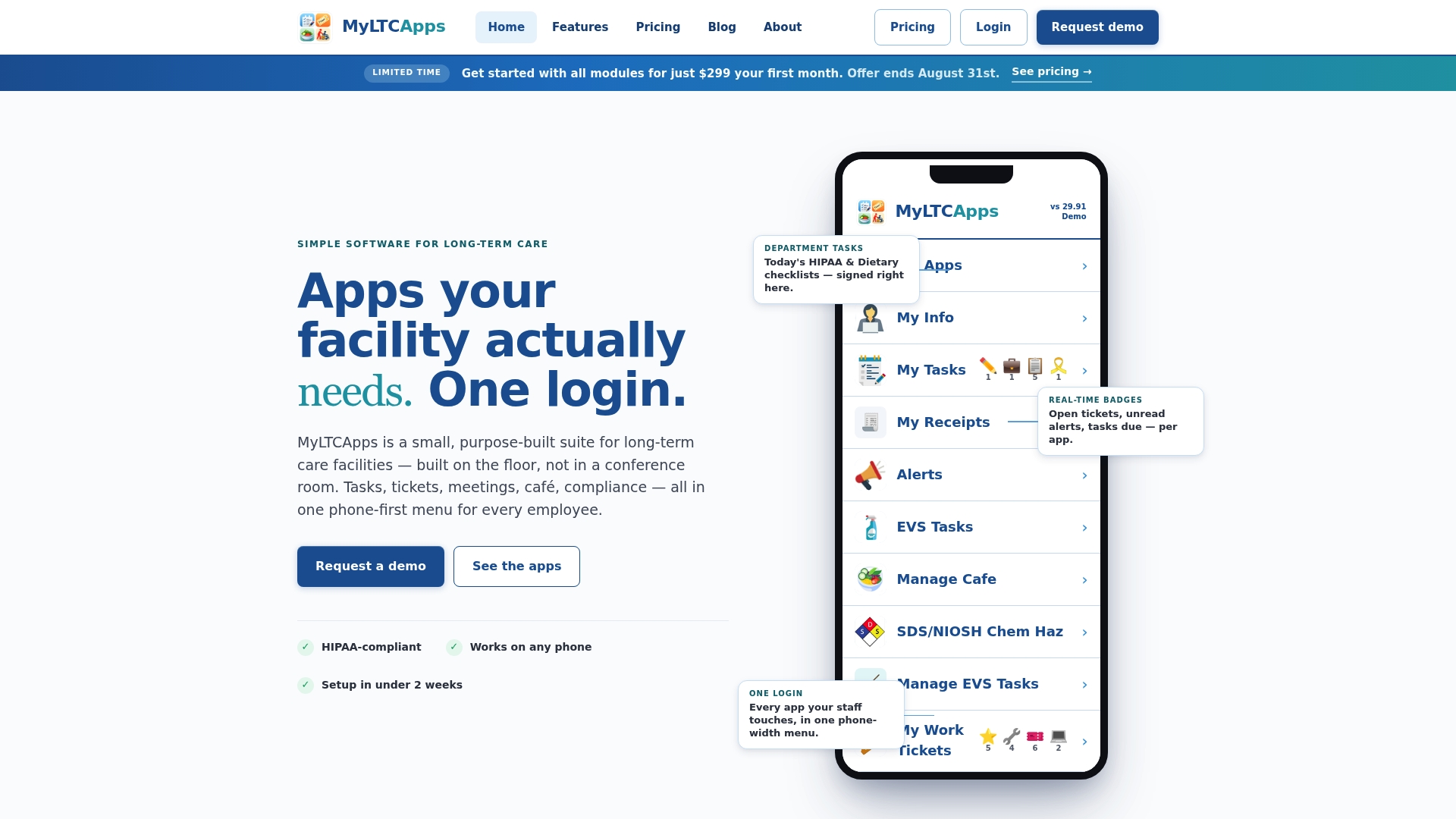
Scheduling is one input to accurate hours, not a replacement for a timekeeping and payroll system. Use it to keep the planned shift close to the real one, and keep your rounding rule or exact-time rule in the system that actually records and pays hours.
FAQ
Is time clock rounding legal?
Yes, under federal rules, if it is neutral and does not result over time in underpaying employees for hours actually worked. Some states restrict it further. California, for instance, does not allow rounding of meal period punches.
What is the 7-minute rule?
It is a quarter-hour rounding method. Punches 1 to 7 minutes past a quarter hour round down, and punches 8 to 14 minutes past round up. It is accepted only when it works in both directions and averages out.
Can I round only in the company’s favor if it saves overtime?
No. A rule that only ever rounds down is one-directional and invites a wage claim. Overtime must also be paid for all hours worked beyond 40 in a workweek, whether or not they were approved.
Do I need a time clock at all?
Federal regulations do not require time clocks. You do need accurate records of the hours employees work each day and each workweek, so many employers use a clock, an app or exact manual records.
How often should I audit my rounding policy?
At least once a year, and any time you change the increment, the timekeeping system or the schedule pattern. Compare raw punches with rounded time per employee and per unit, and recheck overtime weeks with exact time.
Sources
- eCFR, 29 CFR 785.48, Use of time clocks
- U.S. Department of Labor, 2019 FLSA opinion letter
- U.S. Department of Labor, Fact Sheet #53, The Health Care Industry and Hours Worked
- FindLaw, 7-Minute Rule for Timekeeping
- Texas Workforce Commission, Time Clock Rounding
- North Carolina Department of Labor, Recording Time and Rounding of Hours Worked
- U.S. Department of Labor, elaws FLSA Hours Worked Advisor
- U.S. Department of Labor, opinion letter FLSA-1122 (1983)
- Donohue v. AMN Services, LLC, Supreme Court of California (2021)