U.S. HR Playbook: Predictive Scheduling Laws, 14 Day or 72 Hour Rules

U.S. HR Playbook: Predictive Scheduling Laws, 14 Day or 72 Hour Rules
Predictive scheduling laws require covered employers in certain cities and states to post work schedules in advance, typically 14 days or 72 hours, and to pay employees when the employer changes that schedule afterward. If your facility operates in New York City, Chicago, Los Angeles County, Oregon, or several other jurisdictions, you likely owe your staff advance notice and predictability pay for last-minute changes. The first move for HR is simple: audit every work site against the jurisdictions below and time-stamp your next two scheduling cycles.
TL;DR:
- Global headcount can trigger coverage: Oregon’s threshold is 500 employees, while Los Angeles County covers retail employers with 300 worldwide employees as of July 2025.
- Notice rules vary: Oregon and Chicago require 14 days; New York City requires 72 hours and employee consent for changes within that window.
- Chicago pays one extra hour at the regular rate for additions or changes, plus 50% of canceled hours when notice is under 24 hours.
- Predictability pay may count toward the FLSA regular rate unless it was unanticipated and not prearranged, potentially increasing overtime owed for that workweek.
- In several jurisdictions, missing records shift the burden to employers; keep timestamped schedules, written swap consent, schedule estimates for new hires, and separate payroll entries.
Table of Contents
- What predictive scheduling and fair workweek laws actually require
- Jurisdiction snapshot: Oregon, NYC, Chicago, and LA County compared
- How employers calculate and pay predictability pay
- How scheduling penalties interact with FLSA overtime math
- Recordkeeping, exceptions, and where enforcement bites
- Building a scheduling playbook that holds up to an audit
- How phone-first scheduling tools support these obligations
- Compliance works best as a routine, not a reaction
- A practical next step for facilities tracking schedule compliance
- FAQ
- Sources
What predictive scheduling and fair workweek laws actually require
Predictive scheduling laws (also called fair workweek laws) exist to give hourly workers enough notice of their shifts to arrange child care, second jobs, and transportation. The policy goal is straightforward: unpredictable scheduling pushes financial and logistical risk onto workers who have the least ability to absorb it, so lawmakers shifted some of that risk back to employers through notice requirements and pay penalties.
Most of these laws target retail, hospitality, and food service employers, though a handful of jurisdictions extend coverage to building services and other sectors. Coverage usually depends on employer size, and the thresholds catch more employers than HR teams expect, since several laws count employees globally, not just at the local site.
- Oregon’s law covers retail, hospitality, and food service employers with 500 or more employees worldwide.
- Los Angeles County’s ordinance applies to retail employers with 300 or more employees worldwide as of July 1, 2025.
- Chicago’s Fair Workweek Ordinance uses its own size and industry tests, detailed in the city’s 2026 rules.
Because these are a mix of state and municipal rules, a multi-site employer has to check both layers. Some states have gone the other direction entirely: Florida, Arizona, and Georgia have passed preemption statutes that block cities from adopting their own private-sector scheduling ordinances, so a local rule you read about online may simply not apply if your facility sits in one of those states.
Jurisdiction snapshot: Oregon, NYC, Chicago, and LA County compared
Each jurisdiction sets its own notice window, pay formula, and rest requirement, and the differences matter for any employer running sites in more than one city or state. The table below pulls the core mechanics from each law’s official text.
| Jurisdiction | Advance notice | Predictability-pay trigger and formula | Right-to-rest / clopening rule | Notable admin requirement |
|---|---|---|---|---|
| Oregon (state) | 14 calendar days | One hour at regular rate for added time; half regular rate per hour for subtracted or cancelled hours | Right to decline shifts with less than 10 hours’ rest between shifts | Written schedule posted in advance, per Oregon BOLI |
| New York City (retail) | 72 hours | Employee consent required for changes inside the 72-hour window; on-call shifts prohibited | Not separately specified for retail | Posted notice of scheduling rights required, per NYC DCA |
| Chicago | 14 days | One hour at regular rate for additions or changes; 50% of pay for cancelled hours with under 24 hours’ notice | 10-hour right-to-rest, with premium pay if a shift violates it | Written good-faith estimate at hire, per Chicago’s Fair Workweek rules |
| Los Angeles County | 14 days | Predictability pay owed for employer-initiated changes; employees may request or decline changes | Rest periods required between shifts | Good-faith estimate and 300+ global employee threshold, per LA County DCBA |
Reading this table correctly means paying attention to what counts as “covered”: an employer can meet the size threshold nationally while having only a handful of workers in the regulated city, and the ordinance still applies to that site. A multi-state employer should map every physical location against this list before assuming a law does not reach a particular facility, since new ordinances and rule updates (Chicago revised its rules in 2026) can change coverage without much public notice. None of this replaces reading the jurisdiction’s own text or rules PDF; treat the table as a starting point for a compliance review, not the final word, and confirm current language before changing a policy.
How employers calculate and pay predictability pay
Predictability pay kicks in when an employer changes a posted schedule in ways the law treats as disruptive to the worker. The most common triggers are added hours, subtracted hours, a changed date, time, or location, outright cancellations, and on-call shifts that never materialize into actual work.
- Added or changed hours: many jurisdictions require one additional hour of pay at the employee’s regular rate.
- Subtracted or cancelled hours: several laws require half the regular rate for each hour not worked, as long as the change happens inside the notice window.
- Payroll timing: predictability pay is often due on the next regular payday, not held for a later cycle.
Two short examples show how this plays out. If an employee’s posted shift grows from 6 hours to 8 hours after the notice window closes, Chicago’s formula adds one hour of pay at the regular rate on top of the two added hours actually worked. If a facility cancels a posted 8-hour shift with only a few hours’ notice, the same ordinance requires 50% of the wages for those unworked hours, calculated at the employee’s regular rate, as described in Chicago’s Fair Workweek rules.
One hour at the regular rate for additions or changes, and 50% of wages for hours cancelled with less than 24 hours’ notice is the specific formula Chicago’s ordinance spells out, and it is a useful benchmark even for HR teams operating under a different jurisdiction’s similar structure.
Documentation matters as much as the math. Chicago requires predictability pay to appear as its own line on the wage stub, which makes the payment easy to verify during an audit and also easy to miss if your payroll system lumps it into regular wages. Confirm whether your jurisdiction requires separate wage-stub reporting before you finalize a payroll mapping.
How scheduling penalties interact with FLSA overtime math
Predictability pay does not automatically sit outside the Fair Labor Standards Act’s regular-rate calculation, and getting this wrong can quietly inflate your overtime liability. The U.S. Department of Labor’s Fact Sheet #56B explains that these payments may be excluded from the regular rate only when they were not prearranged, meaning the employer and employee did not agree to the payment ahead of time as a built-in part of the compensation structure.
- A payment tied to a genuinely unanticipated schedule change is the kind of fact pattern that supports exclusion from the regular rate.
- A payment that follows a routine, expected pattern (the same cancellation penalty every week, for example) looks more like regular compensation and may need to be included.
- Fact Sheet #56A describes similar logic for show-up and call-back pay, which the DOL treats comparably when the payment is infrequent and unanticipated.
Pro Tip: Keep a contemporaneous note for each predictability-pay event explaining why the change was unanticipated; a payroll ledger with no business-reason documentation is the first thing an investigator will question.
The practical risk shows up at overtime. If a facility treats every predictability payment as excludable without documentation and an investigator disagrees, those payments get folded back into the regular rate retroactively, which raises the overtime rate for every hour worked that week and can turn a single misclassified payment into a multi-week back-pay exposure.
Recordkeeping, exceptions, and where enforcement bites
Missing records are the fastest way to turn a minor scheduling dispute into a presumptive violation, since several ordinances shift the burden to the employer when documentation does not exist. Keep these records on file for every covered location:
- Time-stamped copies of every posted schedule, plus the individual transmissions sent to employees.
- Written consent forms for any voluntary, employee-initiated shift change.
- Good-faith schedule estimates given to new hires at the start of employment.
- Payroll entries showing predictability pay as a distinct line item, mapped to the schedule-change event that triggered it.
The most commonly claimed exceptions are voluntary employee-initiated swaps, which must be documented in writing to count, and force majeure events outside the employer’s control. Internal offer-of-hours rules, which require offering open shifts to existing employees before outside hires, also function as a partial shield in several ordinances, but only when the offer itself is logged. Facilities that cannot produce these records during an audit often face the full predictability-pay exposure by default, regardless of what actually happened on the floor.
Building a scheduling playbook that holds up to an audit
A few operational habits cut most of the compliance risk without sacrificing scheduling flexibility.
- Issue a written good-faith schedule estimate to every new hire covering expected hours, days, and on-call likelihood.
- Post schedules with a timestamp no later than your jurisdiction’s notice window, whether that is 14 days or 72 hours.
- Standardize a written consent form for voluntary swaps so employee-initiated changes are documented every time, not just when someone remembers.
- Log every open-shift offer made to existing staff before posting the role externally.
Pro Tip: Run a mock audit once a quarter: pull three schedule-change events at random and confirm you can produce the posting timestamp, the pay calculation, and the consent form (if applicable) for each one.
Scheduling software with built-in audit trails and automatic postings removes much of the human error that causes these gaps, particularly across multi-site operations where each administrator might otherwise track compliance differently, and using appointment demand forecasting helps align staffing needs more accurately with predicted demand.
How phone-first scheduling tools support these obligations
Shift scheduling tools built for long-term care can capture exactly what these laws require: time-stamped postings, consent records for voluntary changes, and payroll-ready exports that map each predictability payment to its trigger. Our Shift Scheduling tool, paired with our Compliance Suite’s seeded libraries, keeps those records in one place instead of scattered across spreadsheets and text threads. A facility evaluating any scheduling software should pilot it on one unit first, run a few schedule-change scenarios through it, and confirm the audit export actually produces what a labor office would ask for.

Compliance works best as a routine, not a reaction
Treat predictive scheduling compliance as a recurring audit, not a one-time project. The jurisdictions change their rules often enough (Chicago updated its own in 2026) that a policy written two years ago may already be outdated. Start with the one or two jurisdictions where you have the most exposure, fix those first, and automate the schedule-posting timestamp before you worry about anything else.
— Philip
A practical next step for facilities tracking schedule compliance
Keeping time-stamped postings, consent records, and predictability-pay calculations organized gets harder as a facility grows, and our Shift Scheduling tool was built around that exact problem for long-term care operators.
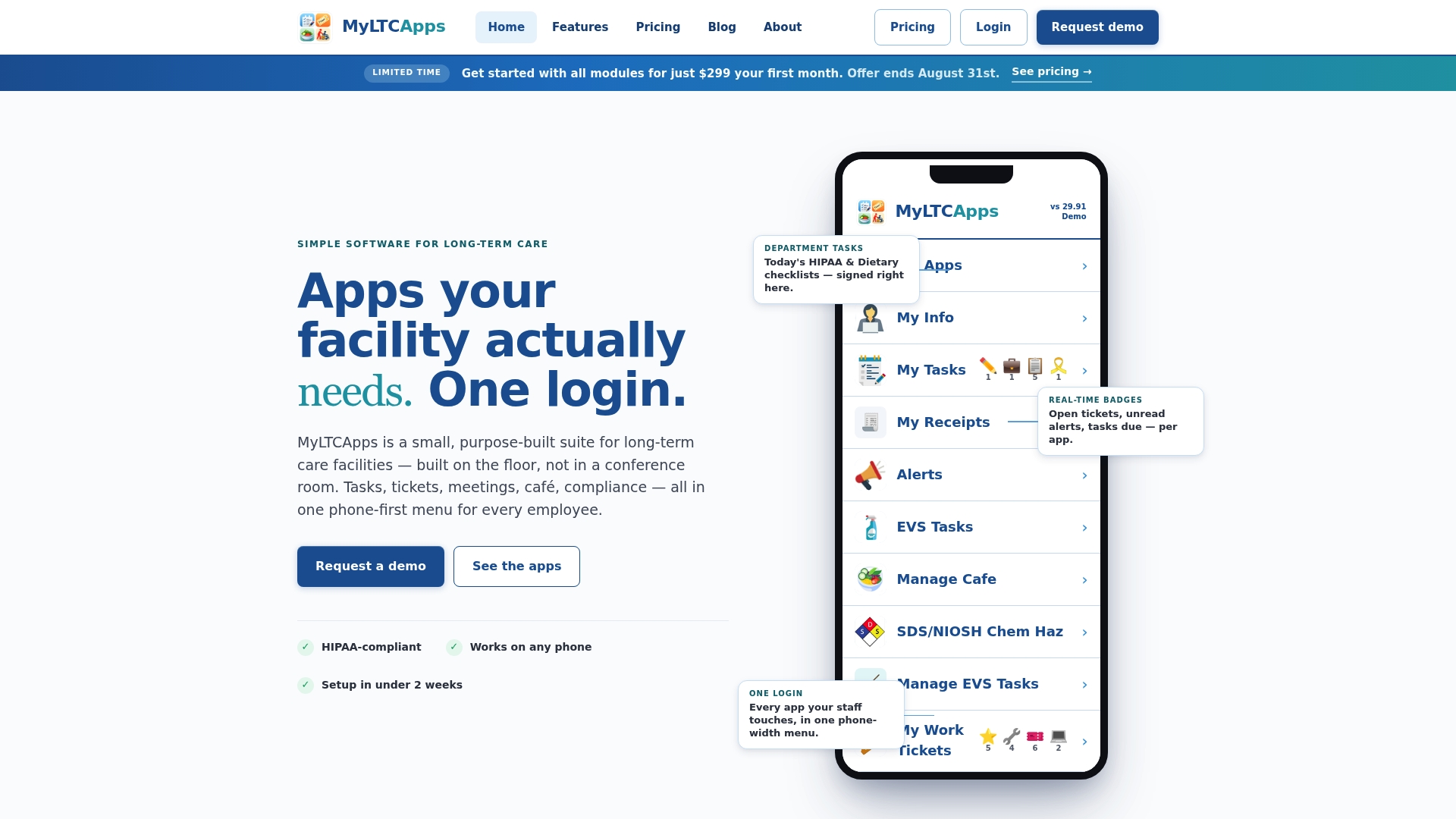
Facilities that want to see the audit trail and payroll export in action can check pricing and plans starting with the I Just Want That plan at an affordable monthly price, or request a walkthrough of how the Compliance Suite and Shift Scheduling tools work together.
FAQ
What is the 7 minute rule for employees?
The rule is a federal timekeeping convention under the Fair Labor Standards Act for rounding clock-in and clock-out times to the nearest quarter hour, and it is separate from predictive scheduling requirements. It governs how worked time gets rounded for pay purposes, not how far in advance a schedule must be posted.
Can a company just stop scheduling you?
In jurisdictions with predictive scheduling laws, an employer generally cannot cut a worker’s hours or cancel scheduled shifts without triggering notice requirements and predictability pay, depending on the timing of the change. Outside those covered jurisdictions, most employment is at-will, which gives employers more latitude to reduce scheduled hours, though wage and hour rules still apply to any hours already worked.
Can my boss change my schedule last minute?
An employer can usually make last-minute changes, but in a covered jurisdiction that change often triggers a required payment to the employee, such as one hour of pay at the regular rate for an added shift under Chicago’s rules. The specific notice window and payment formula depend on which jurisdiction’s ordinance applies to that work site.
Sources
- Fact Sheet #56B: State and Local Scheduling Law Penalties and the Regular Rate under the Fair Labor Standards Act (FLSA) | U.S. Department of Labor
- Predictive scheduling : For Workers : State of Oregon
- Fair Workweek: Retail employers — NYC Department of Consumer and Worker Protection / DCA
- 2026 OLS FWW RULES_Final_20260514 — Chicago Office of Labor Standards
- Fair Workweek — Los Angeles County Department of Consumer and Business Affairs