Staffing Ratios: Check CMS Data for Nursing Homes During the Pause

Staffing Ratios: Check CMS Data for Nursing Homes During the Pause
Federal rules set staffing benchmarks at 3.48 total hours per resident day, with at least 0.55 registered nurse hours and 2.45 nurse aide hours, but enforcement of those minimums is currently suspended by congressional action through 2034. That means no facility faces federal penalties for missing the targets right now. Anyone evaluating a specific facility can still check its actual staffing using CMS payroll-based journal data and public dashboards like NursingHome411.
TL;DR:
- Compare total HPRD with RN HPRD and skill mix: facilities can meet an overall hours target while still providing limited registered nurse oversight.
- Higher RN staffing is most consistently associated with fewer pressure ulcers and infections, but turnover, staff stability, and facility culture also shape outcomes.
- Facilities must keep assessments tied to current resident acuity and involve leadership, frontline staff, and resident representatives; surveyors can still cite unmet care needs.
- Check CMS payroll based staffing records for weekend and night coverage, agency hours, turnover, and vacancies, then compare those figures with facility claims.
Table of Contents
- What CMS Proposed and Why Enforcement Is on Hold
- How Staffing Is Measured: HPRD, Skill Mix, and Coverage Gaps
- What the Research Says About Staffing and Resident Outcomes
- What Happens When States Set Their Own Minimums
- How Facilities Are Supposed to Set Staffing Levels
- A Practical Checklist for Evaluating Staffing Adequacy
- What Staffing Data Looks Like on the Ground
- Tools That Help Facilities Make the Most of Staffed Hours
- FAQ
- Sources
What CMS Proposed and Why Enforcement Is on Hold
The 2024 CMS final rule set national minimum staffing levels for long-term care facilities, intended to phase in over several years with different timelines for rural and non-rural facilities. The rule paired the numeric minimums with new facility assessment and transparency requirements tied to Medicaid payment reporting.
Then Congress intervened. Public Law 119-21, signed in mid-2025, along with related Federal Register actions, prohibits federal enforcement of the core staffing provisions until September 30, 2034. For administrators, that shifts the near-term compliance picture:
- The 3.48 HPRD, 0.55 RN HPRD, and 2.45 NA HPRD targets remain published but are not currently enforceable at the federal level.
- Facilities can still face scrutiny under existing sufficiency rules if resident care suffers.
- Hardship exemption criteria in the original rule, built around workforce availability in a given area, remain part of the framework for whenever enforcement resumes.
- Facility assessments are still required regardless of enforcement status.
That last point matters most for families doing research today: the numeric floor is paused, but the obligation to document and justify staffing decisions never went away.
How Staffing Is Measured: HPRD, Skill Mix, and Coverage Gaps
Hours per resident day, or HPRD, is the standard unit for nursing home staffing. It’s calculated by dividing total staff hours worked in a role by the number of residents on a given day. Total nurse HPRD combines RN, LPN, and certified nurse aide hours into one figure.
Skill mix describes what share of those hours comes from RNs rather than LPNs or aides. A facility can hit a total HPRD target while running thin on RN coverage, and that distinction changes the clinical picture considerably.
- Total HPRD adds RN, LPN, and nurse aide hours together into one daily average.
- RN HPRD isolates registered nurse hours, the credential most tied to clinical judgment and oversight.
- Skill mix is the RN share of total nursing hours, a separate signal from the raw total.
The national average sat at 3.76 total nurse HPRD as of 2022, according to the Abt Associates staffing study conducted for CMS, giving some context for where the proposed 3.48 floor sits relative to typical staffing.
Turnover, weekend and night coverage, and reliance on agency staff round out the picture, highlighting the importance of nurse burnout recovery strategies to support staff wellbeing and retention. A facility can report decent average HPRD while still leaving residents short-staffed on Saturday nights if agency nurses fill gaps inconsistently.
What the Research Says About Staffing and Resident Outcomes
Peer-reviewed research consistently links higher direct care staffing, particularly more RN hours, to better resident safety outcomes. A recent analysis found that increased staffing levels correlate with fewer pressure ulcers, reduced urinary tract infections, and improved functional status among residents.
A systematic review of reviews reached a similar conclusion but added an important caveat: the relationship between staffing and outcomes is not a simple straight line. Skill mix, staff stability, and the facility’s organizational culture all mediate how much staffing numbers translate into actual care quality. Two facilities with identical HPRD can produce different outcomes depending on how experienced and consistent that staff is.
A separate NCBI Bookshelf review of nurse staffing effects on care processes found that higher RN skill mix tends to track with fewer pressure ulcers and lower rates of certain infections, though the strength of that association varies by outcome measured.
- Higher RN presence is the staffing variable most consistently tied to better clinical outcomes.
- Turnover and culture can blunt or amplify the effect of a given staffing number.
- Methodological limits, including varying definitions of staffing across studies, make precise thresholds hard to pin down.
The Abt staffing study modeled what happens as staffing rises: omitted and delayed care dropped substantially as total nurse staffing increased, according to CMS’ modeling, which is part of why the agency proposed numeric floors in the first place even though enforcement is currently paused.
What Happens When States Set Their Own Minimums
Several states have adopted their own minimum staffing laws independent of the paused federal rule, and the research on those mandates is informative for what might happen nationally once enforcement eventually resumes.
Mandates generally work: facilities subject to them increase total staffing hours, often by adding LPN and CNA hours rather than RN hours specifically. A broader analysis of minimum direct care staffing requirements found the same pattern, that mandates raise overall staffing but don’t automatically improve skill mix, and in some cases shift the balance toward lower-skilled roles if facilities are filling a headcount requirement rather than a clinical one.
The financial fear that often accompanies these mandates, that higher labor costs will force closures, hasn’t played out as dramatically as critics predicted. Research covering facilities from 2010 to 2023 found minimal impact on closures despite the added staffing costs.
- Mandates tend to raise total staffing hours, often through LPN and CNA additions.
- Skill mix doesn’t automatically improve unless the mandate specifically protects RN hours.
- States vary widely in how they structure penalties, some tying staffing compliance to Medicaid payment rates.
How Facilities Are Supposed to Set Staffing Levels
Federal rules require every nursing home to complete a facility assessment under §483.71, a document that’s supposed to tie staffing decisions to actual resident acuity rather than a generic headcount. The assessment has to involve facility leadership, direct care staff, and resident or family representatives, and it needs to cover the resident population’s care needs, the competencies required to meet them, and the physical plant and equipment on hand.
Surveyors don’t just check whether the assessment exists. Under §483.35, a facility can be cited for insufficient staffing if residents’ needs go unmet, even if a facility assessment is on file and technically current. The assessment is a planning tool, not a shield.
- The assessment must reflect current resident acuity, not a snapshot from years earlier.
- Leadership, frontline staff, and resident representatives all need a voice in the process.
- Surveyors evaluate actual outcomes, not just paperwork compliance.
Pro Tip: Update the facility assessment any time there’s a meaningful shift in resident acuity or a wave of new admissions, not just on the annual schedule.
A Practical Checklist for Evaluating Staffing Adequacy
Whether you’re a family member choosing a facility or an administrator benchmarking your own numbers, the same data points matter.
- Check total and RN HPRD on CMS Care Compare or the underlying PBJ dataset, not just the facility’s self-reported marketing numbers.
- Look at weekend and night staffing specifically, since averages can hide serious gaps during off-hours when fewer staff are typically scheduled.
- Ask what percentage of hours come from agency or contract staff, a figure tied to care continuity and often visible in PBJ breakdowns.
- Ask administrators how the facility assessment informs scheduling, and whether it’s been updated recently.
- Ask about turnover and vacancy rates directly, since high turnover tends to erode the benefits of an otherwise adequate HPRD number.
Red flags worth investigating further include a facility that can’t explain its own HPRD numbers, staffing that looks fine on weekdays but thins out dramatically on weekends, or a facility assessment that hasn’t been touched since a major change in resident population. State survey results and the NursingHome411 interactive maps are good places to cross-check any claims a facility makes about its own staffing.
Pro Tip: Cross-reference a facility’s own staffing claims against PBJ data before taking them at face value; self-reported numbers and payroll-verified numbers don’t always match.

What Staffing Data Looks Like on the Ground
Numbers on a spreadsheet only tell part of the story. The gap between a facility’s reported HPRD and what residents actually experience day to day usually comes down to how clearly shifts are scheduled, how quickly gaps get covered, and whether staff can find the information they need without hunting through paper logs.
Clear schedules and simple checklists don’t fix a genuine staffing shortage, but they do determine whether the hours a facility has are used well. A facility with adequate but poorly coordinated staff can underperform one with slightly tighter numbers and better workflow discipline. That’s the operational layer underneath the regulatory numbers, and it’s worth paying attention to alongside HPRD when judging a facility’s actual care quality.
— Philip
Tools That Help Facilities Make the Most of Staffed Hours
Staffing ratios set the ceiling on what a facility can deliver, but how administrators organize those hours determines whether residents feel the benefit. We built MyLTCApps around that gap: a phone-first suite that helps care staff turn staffing plans into daily execution without wrestling with paper logs or disconnected systems.
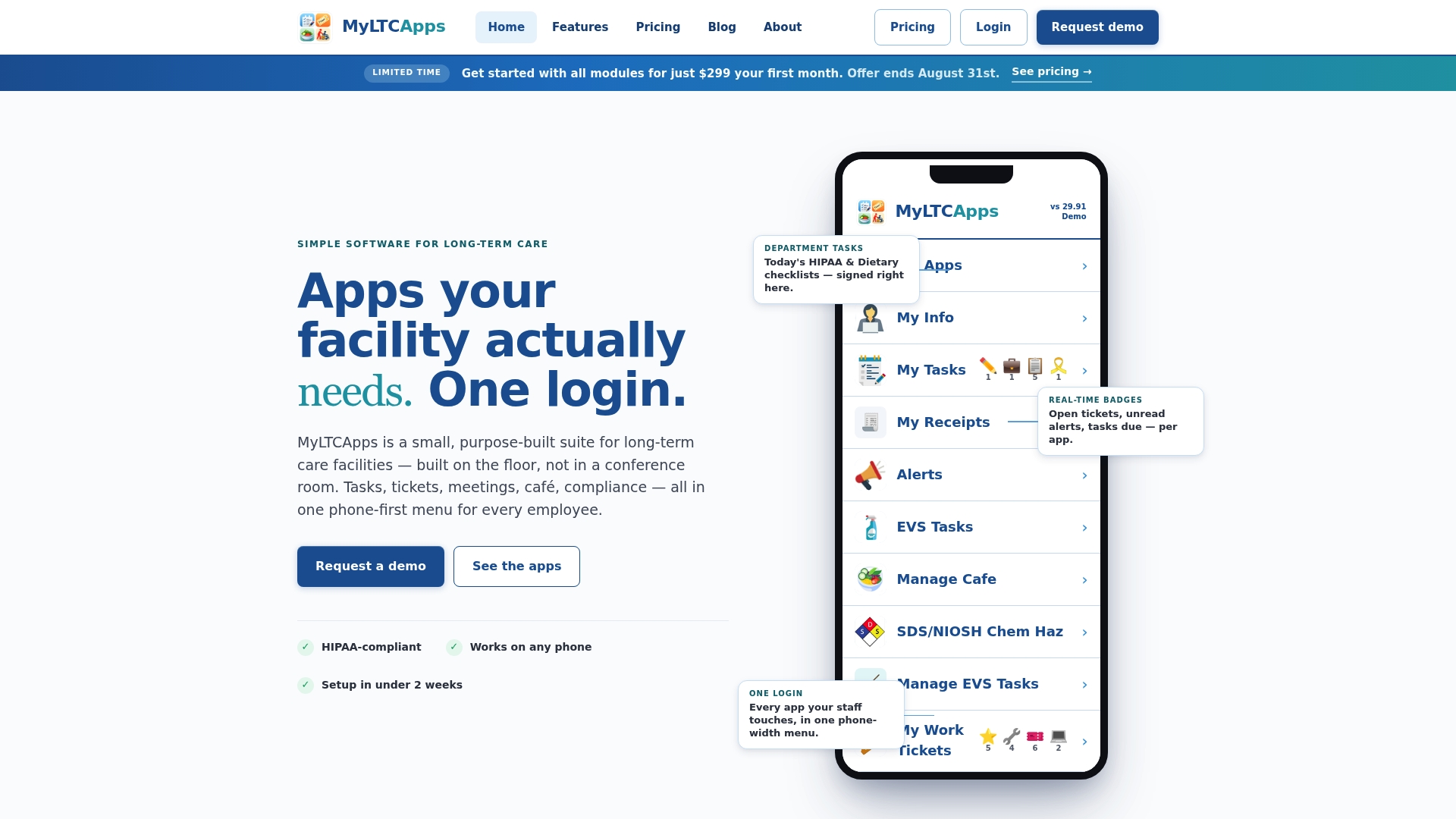
Our Shift Scheduling tool helps administrators build and adjust rosters around acuity-driven staffing plans, while our Compliance Suite supports documenting facility assessments and generating survey-ready reports when surveyors come calling. My Tasks and My Work Tickets round out the daily workflow:
- Shift Scheduling keeps coverage visible across shifts, including weekend and night gaps that are easy to miss on paper.
- My Tasks gives frontline staff mobile checklists they can complete in a few taps during a shift.
- Compliance Suite keeps facility assessment documentation organized and ready for surveyor review.
- My Work Tickets routes maintenance and operational requests without phone tag.
None of this replaces adequate hiring. It’s built to help facilities operate efficiently within the staffing levels they have. Find current prices on our pricing page, or explore the features overview to see how the pieces fit together.
This article is general information, not a substitute for advice from a qualified doctor. Consult a qualified healthcare professional about your own circumstances before acting on anything here.
FAQ
What are the current federal minimum staffing requirements?
CMS finalized minimums of 3.48 total nurse HPRD, at least 0.55 RN HPRD, and 2.45 NA HPRD in its 2024 rule. Enforcement of these specific provisions is currently suspended through 2034 under subsequent federal action.
Where can I check a nursing home’s actual staffing levels?
CMS publishes payroll-based journal data on data.cms.gov, which shows facility-reported nurse hours that can be used to calculate HPRD. NursingHome411 also offers interactive maps built on this same underlying data.
Does higher staffing actually improve resident care?
Peer-reviewed research links higher direct care staffing, especially more RN hours, to fewer pressure ulcers and infections. The relationship isn’t perfectly linear, since skill mix, turnover, and facility culture all influence how much a given staffing number translates into outcomes.
Do state minimum staffing laws cause nursing homes to close?
Research covering facilities from 2010 to 2023 found that state mandates increased staffing levels with minimal impact on facility closures. Costs did rise, but closures tied directly to the mandates were not widespread in that period.
What is a facility assessment and why does it matter?
A facility assessment under §483.71 is a required document where leadership, direct care staff, and resident representatives evaluate resident acuity and staffing needs. Surveyors can still cite a facility under separate sufficiency rules if residents’ needs go unmet, regardless of whether the assessment is on file.
Sources
- State Nursing Home Minimum Staff Mandates: Increased Staff Levels, Minimal Impact on Finances and Closures, 2010–23 - PMC
- The Nursing Home Staffing Study Comprehensive Report
- FOR FURTHER INFORMATION CONTACT: