Self-Scheduling Nurses in LTC: A Compliance-First Guide

Self-Scheduling Nurses in LTC: A Compliance-First Guide
Self-scheduling nurses can work in long-term care and skilled nursing facilities — but only when administrators pair clear operational guardrails with credential-aware software and genuine staff co-creation. The model gives nurses control over shift preferences within pre-set boundaries while the manager retains authority to balance skill mix and meet resident-care needs. Done right, it improves staff retention and cuts admin scheduling time. Done carelessly, it creates coverage gaps, perceived favoritism, and surveyor risk.
Three steps to take this week:
- Form a staffing committee with front-line nurses, a manager, HR, and a union rep, where applicable
- Draft mandatory guardrail clauses covering scheduling deadlines, overtime caps, credential requirements, and backfill rules before opening a single shift to staff sign-up
- Evaluate credential-aware scheduling tools — Myltcapps belongs on that shortlist
Research confirms the benefits are real: self-scheduling can improve job satisfaction and retention when facilities meet regulatory requirements, and the risk is equally documented. A PubMed study found a significant negative perception of procedural justice when governance and transparency are weak. CMS staffing expectations, including Hours Per Resident Day (HPRD) minimums, do not flex for a failed pilot.
Table of Contents
- What does self-scheduling mean for nurses in long-term care?
- Policies you must draft before opening the schedule to staff
- What scheduling software must do for long-term care self-scheduling
- How to involve nurses and build governance so self-scheduling sticks
- Step-by-step rollout plan, timeline, and cost considerations
- What to measure and the common ways self-scheduling fails
- How Myltcapps supports self-scheduling and LTC guardrails
- Key Takeaways
- What actually makes or breaks self-scheduling in long-term care
- Myltcapps gives Kansas LTC facilities a practical path to compliant self-scheduling
- Useful sources and further reading
What does self-scheduling mean for nurses in long-term care?
In a hospital context, self-scheduling often runs on large units with deep float pools. In LTC and skilled nursing, the margin is thinner. A 40-bed wing with three CNAs on nights cannot absorb a coverage gap the way a 300-bed hospital floor can.
The operational definition for LTC: staff select shifts from a pre-approved open-shift list within a defined scheduling window. The manager reviews the draft schedule, confirms skill-mix requirements are met, and retains override authority before the schedule posts. Staff do not “own” a shift until the manager approves the final roster.
Core benefits when guardrails hold:
- Increased staff autonomy and reported job satisfaction
- Reduced scheduler time building and revising rosters
- Improved recruitment attractiveness, particularly for part-time and per-diem staff
- Lower absenteeism tied to better work-life fit
The risks are just as concrete. Implementation research shows self-scheduling can increase perceived procedural unfairness when rules are inconsistently enforced. Holiday clustering, credential lapses, and rule nonadherence are the three failure modes that appear most often in LTC pilots. A Belgian nursing-home case study found that facilities where self-scheduling matched the existing organizational culture saw positive outcomes, while those using it to paper over structural problems saw lower participation and heavier reliance on the head nurse to fix gaps.
Policies you must draft before opening the schedule to staff
No software fixes a policy vacuum. Write these clauses before your first pilot shift posts.
Policy checklist:
- Scheduling window: Staff may sign up during a defined window (example: days 1–5 of the month for the following month’s schedule). Late sign-ups are not accepted.
- Tiered entry: Seniority or rotation groups access the schedule in tiers to prevent senior staff from claiming all preferred shifts before junior staff can log in.
- Minimum staffing enforcement: The schedule must meet CMS HPRD minimums and state-mandated nurse-to-resident ratios before it closes. No shift posts as “filled” below that floor.
- Credential requirement: Staff may only sign up for shifts their active, unexpired credentials authorize. Expired license or certification = automatic block.
- Overtime and rest rules: No self-scheduled shift may create a violation of applicable rest-period requirements or push a staff member into unapproved overtime without manager sign-off.
- Swap and backfill rules: Swaps require manager approval and credential verification for both parties. Backfill for call-offs follows a defined escalation order (per-diem pool first, then agency).
- Holiday rotation: Holidays are distributed by a published rotation formula. Staff may not sign up for a holiday shift if they worked the same holiday the prior year unless the rotation formula permits it.
- Manager override: The manager may reassign or block any shift for skill-mix, credential, or coverage reasons. Override decisions are documented with a reason code.
Pro Tip: Include explicit audit-trail and automatic-blocking language in your policy document itself, not just in your software configuration. Surveyors reviewing staffing records want to see that the policy required the control, not just that the software happened to enforce it.
Union contract constraints add another layer. Review your collective bargaining agreement before finalizing any tiered-entry or seniority rule. State nurse practice acts govern what tasks each credential authorizes; your policy’s credential requirement clause must reference the applicable state standard, not a generic job title.
What scheduling software must do for long-term care self-scheduling
Credential-aware eligibility blocking is the single highest-leverage feature in any LTC scheduling platform. It prevents an administrator from unknowingly scheduling a nurse whose license lapsed last Tuesday, which is both a patient-safety issue and a direct path to a surveyor citation.
Feature requirements for LTC self-scheduling software:
- Credential-aware blocking: automatically prevents sign-up when a license, certification, or required training has expired
- Real-time open-shift feeds visible to eligible staff only
- Role and skill matching so a CNA shift cannot be claimed by a dietary aide
- Automatic HPRD and overtime calculations that flag violations before the schedule closes
- Audit logs and reporting exports formatted for survey readiness
- Mobile-first staff self-service so nurses can sign up from a personal device without calling the scheduler
- Manager override with documented reason codes
- Payroll sync, time-and-attendance integration, and incident/task module connections so schedule changes flow automatically to downstream records
“Administrators should prioritize credential-aware scheduling to mitigate regulatory risk and prevent compliance deficiencies. Scheduling ineligible staff — even unintentionally — creates both patient-safety exposure and surveyor findings that are difficult to defend.” — Vars Health, 2026
When evaluating vendors, ask specifically: how does your platform handle an expired credential discovered mid-shift? What happens when a last-minute call-off leaves a shift below HPRD minimums? The answer to those two questions tells you more than any feature checklist.
How to involve nurses and build governance so self-scheduling sticks
Dr. Jennifer Mensik Kennedy of the American Nurses Association recommends partnering with front-line nurses on policy design to align self-scheduling with actual unit workflows. That is not a soft suggestion. The MIT Workplace Center’s implementation research found that the most common failure mode is cultural, not technical: staff begin treating the schedule as a personal entitlement rather than a shared commitment to unit needs.
Governance structure:
- Form a staffing committee: two to three front-line nurses, the scheduling manager, HR, and a union rep where applicable
- Define the committee’s decision authority: which policy clauses require committee approval to change, and which the manager can adjust unilaterally
- Set a meeting cadence: monthly during the pilot, quarterly once stable
- Build an appeals process: staff who believe a manager override was unfair submit a written request; the committee reviews within five business days
Pilot co-design steps:
- Draft guardrail clauses with committee input before finalizing
- Publish trial metrics (fill rate, overtime, HPRD compliance) to all staff monthly so everyone sees the same data
- Rotate tier-access order each scheduling cycle so no group always goes last
- Collect structured feedback at weeks four and eight of the pilot using a short written survey
Training is where most rollouts underinvest. Schedulers need hands-on configuration training. Nurses need a 30-minute walkthrough covering how to sign up, what blocks mean, and what happens when they miss the window. Use your in-service tracking module to document attendance at both sessions — that record matters if a staff member later claims they were never trained.
Step-by-step rollout plan, timeline, and cost considerations

Pilot on a complex unit, not an easy one. A float pool or a memory-care wing will surface credentialing edge cases and last-minute call-off handling that a stable day-shift unit will never reveal.
Rollout phases:
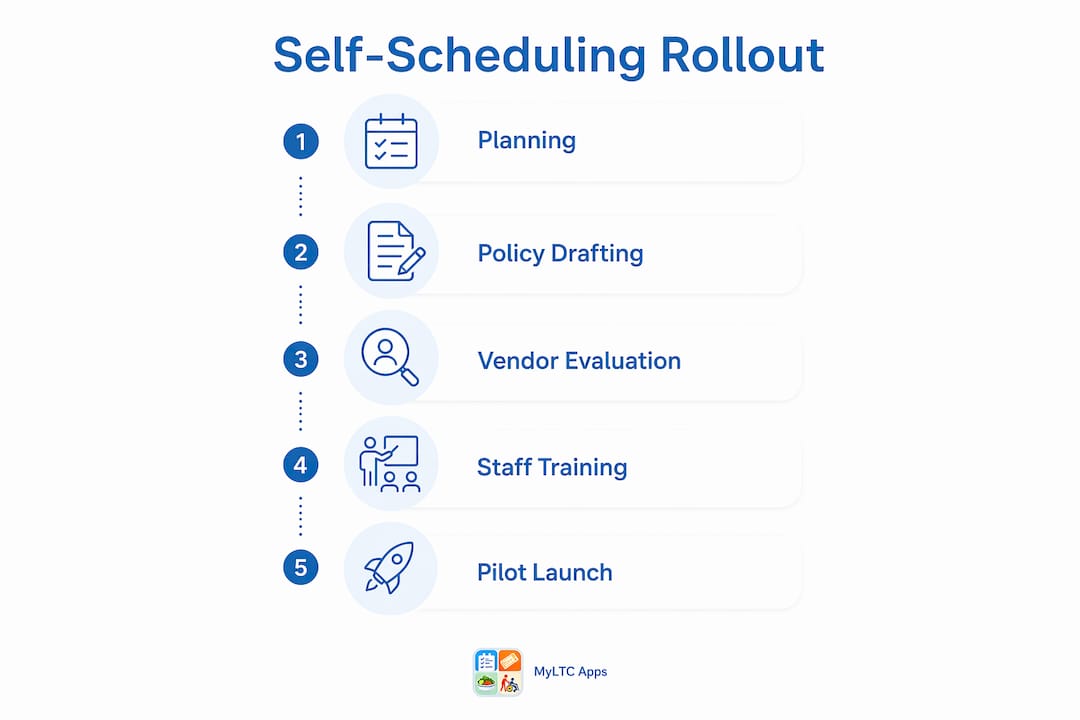
- Planning and policy drafting (weeks 1–4): committee formed, guardrails written, union review complete
- Vendor selection and configuration (weeks 3–6): demo, credential sync tested, HPRD rules configured
- Staff training (weeks 5–6): schedulers trained first, then nursing staff via in-service
- Pilot execution on selected complex unit (weeks 7–18)
- Review and iterate (weeks 19–22): analyze KPIs, adjust guardrails, address failure modes
- Phased scaling to additional units (week 23 onward)
| Phase | Duration | Owner |
|---|---|---|
| Planning and policy drafting | 2–4 weeks | Administrator + committee |
| Vendor selection and configuration | 2–4 weeks | Administrator + IT |
| Staff training | 1–2 weeks | Scheduling manager |
| Pilot execution | weeks | Scheduling manager + committee |
| Review and iterate | 2–4 weeks | Administrator + committee |
| Phased scaling | Ongoing | Administrator |
Budget line items to plan for: software subscription (per facility, per module), implementation and credential-sync configuration, staff training hours (backfill those shifts), and potential overtime during the pilot adjustment period.
Facilities that implement automated scheduling tools have reported reductions in manager hours spent building rosters and lower reliance on agency staff once the system stabilizes.
What to measure and the common ways self-scheduling fails
Track these KPIs from day one of the pilot:
- Shift fill rate: percentage of shifts filled by eligible staff without manager intervention
- Credentialed coverage rate: percentage of shifts staffed by personnel with active, verified credentials
- Overtime percentage: total overtime hours as a share of scheduled hours
- HPRD compliance: actual hours per resident day against CMS minimums, by unit and shift
- Schedule-change request rate: number of post-posting changes per scheduling cycle
- Manager override count: how often and why the manager reassigned or blocked a shift
- Staff fairness score: a simple 1–5 survey question asked monthly
Research shows that mixed outcomes in self-scheduling pilots often trace back to weak procedural justice — staff who feel the process is unfair disengage from it, which drives up override counts and change requests.
Common failure modes and fixes:
- Rule nonadherence: Retrain the specific staff involved; document the incident; tighten the software block if the policy allows workarounds.
- Perceived favoritism: Publish the tier-rotation formula and override reason codes. Transparency is the only fix.
- Credential lapses: Confirm the software blocks expired credentials at sign-up, not just at schedule review. If a lapse slips through, freeze that staff member’s sign-up access until renewal is confirmed.
- Holiday clustering: Enforce the rotation formula strictly in the first cycle. Staff learn quickly that the formula applies to everyone.
When metrics drift, run a brief root-cause review: pull the override log, review the fairness survey, and interview two or three nurses from the last tier group. Usually one of three things is happening — the guardrail has a loophole, training was incomplete, or a small group of staff is testing the boundaries.
How Myltcapps supports self-scheduling and LTC guardrails
Myltcapps is built specifically for long-term care operations, which means its scheduling module is designed around the constraints that matter in this setting: credential checks, HPRD tracking, mobile access for floor staff, and audit-ready reporting exports.
| Must-Have Feature | Myltcapps Capability |
|---|---|
| Credential-aware blocking | Flags and blocks ineligible staff at sign-up |
| Mobile self-service | Phone-first interface; staff sign up from personal devices |
| Audit logs and reporting exports | Surveyor-ready exports from the scheduling and compliance modules |
| Payroll and attendance integration | Schedule changes flow to payroll and time-and-attendance records |
| Manager override with documentation | Override reason codes logged for every manual change |
| HPRD and overtime calculations | Automatic flagging before schedule closes |
Pilot configuration checklist for Myltcapps:
- Sync credentialing records before the pilot window opens — do not rely on manual entry
- Configure HPRD minimums and overtime thresholds at the unit level, not just facility-wide
- Assign role-based access through the staff directory module so tier permissions are enforced automatically
- Test the expired-credential block with a dummy record before go-live
- Export a sample audit log and confirm it matches the format your state surveyor expects
Administrators who run a successful pilot typically report three changes within the first 90 days: schedulers spend fewer hours building and revising rosters, staff report higher transparency about why overrides happen, and last-minute scramble calls drop as the open-shift feed becomes the first place nurses look for available shifts.
Key Takeaways
Self-scheduling works in long-term care when policy guardrails, credential-aware software, and staff co-creation operate together from the start.
| Point | Details |
|---|---|
| Guardrails come first | Draft scheduling deadlines, credential requirements, and override rules before opening any shift to staff sign-up. |
| Credential-aware blocking is critical | Software must automatically block ineligible staff at sign-up to prevent surveyor citations and patient-safety risk. |
| Pilot on complex units | Float pools and memory-care wings reveal credentialing and call-off edge cases that easy units mask. |
| Measure fairness alongside fill rate | Track staff fairness scores monthly; perceived procedural injustice is the leading early warning of pilot failure. |
| Myltcapps fits LTC requirements | Its phone-first scheduling module includes credential checks, audit logs, and surveyor-ready exports built for this setting. |
What actually makes or breaks self-scheduling in long-term care
The facilities that struggle with self-scheduling almost always frame it as a software project. Buy the tool, configure the rules, flip the switch. What they miss is that the schedule is a social contract, and social contracts require ongoing maintenance.
The most instructive failure pattern involves holiday rotation. A facility launches a pilot in the spring, everything runs smoothly through summer, and then October arrives. Suddenly staff who followed the rules all year are watching colleagues with more seniority claim every Thanksgiving and Christmas shift in the first tier window. The fairness score tanks. Override counts spike. The manager spends more time managing complaints than the old system ever required.
The fix is not technical. It is communicating the rotation formula before the first holiday cycle, not after the first complaint. Staff accept constraints they understand and helped design. They resist constraints that feel arbitrary or retroactive.
The cultural piece that most implementation guides understate: nurses need to hear, repeatedly and from leadership, that self-scheduling is a shared commitment to unit needs, not a perk. The MIT Workplace Center research is blunt about this. When staff treat sign-up slots as entitlements, the dual agenda collapses and everyone loses the flexibility they valued. Build that framing into onboarding, into committee meetings, and into the language of every manager override explanation.
Myltcapps gives Kansas LTC facilities a practical path to compliant self-scheduling
Kansas long-term care administrators face the same CMS HPRD requirements and survey scrutiny as any facility in the country, with the added reality that rural and mid-size facilities often run lean on both staff and IT support. Myltcapps is built for exactly that context: a phone-first SaaS platform that puts shift scheduling, credential tracking, compliance task management, audit logs, and surveyor-ready reporting exports in a single interface your staff can use from their own devices.
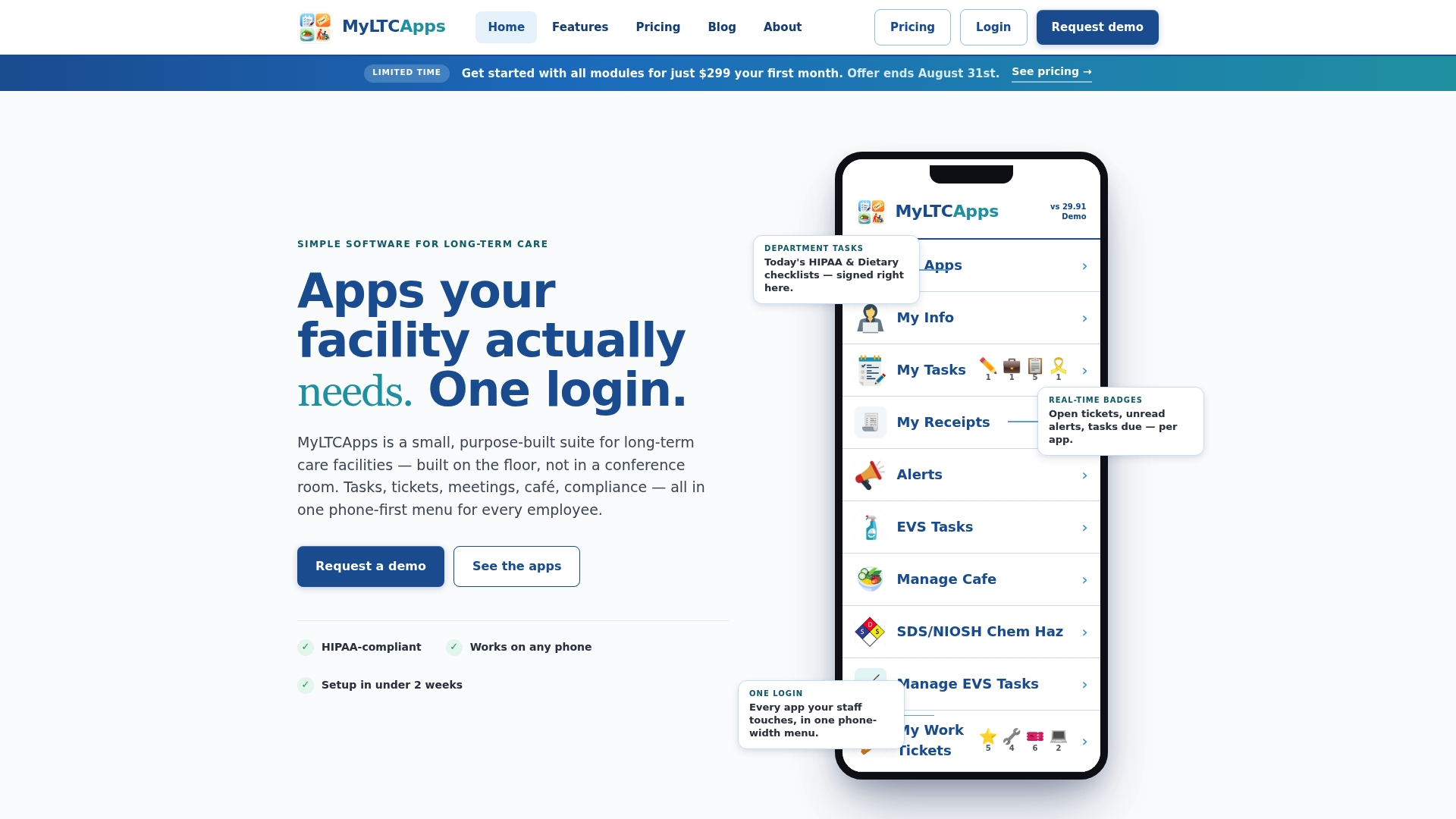
The scheduling module handles the guardrails this article describes: credential-aware blocking, HPRD calculations, manager override documentation, and payroll integration. The in-service and meeting tracking module covers the training documentation your pilot requires. Everything connects, so a schedule change flows to the right records without a separate data entry step.
To start your pilot, bring three things to a Myltcapps demo: your current HPRD targets by unit, your credentialing renewal calendar, and the draft policy clauses from your staffing committee. The configuration conversation becomes specific and fast. Visit myltcapps.com to schedule a demo or explore the Kansas-specific compliance features built for KDADS survey readiness.
Useful sources and further reading
Administrators should keep these documents accessible for survey preparation and ongoing policy review:
- MIT Workplace Center — Implementation of a Self-Scheduling System for Hospital Nurses: web.mit.edu/workplacecenter/docs/wpc0019.pdf — the most detailed implementation failure analysis available; required reading before drafting guardrail clauses
- PubMed — Organizational design and self-scheduling in nursing homes: doi.org/10.1111/jan.15559 — multiple-case study on how organizational culture determines outcomes
- Becker’s Hospital Review — ANA guidance on nurse self-scheduling: beckershospitalreview.com — includes Dr. Jennifer Mensik Kennedy’s recommendations on co-creation
- PubMed — Self-scheduling effects on procedural justice: pubmed.ncbi.nlm.nih.gov/34329916 — supports the case for transparent governance and fairness metrics
- CMS staffing guidance: Review the current CMS Minimum Data Set staffing reports and your state’s nurse practice act for applicable HPRD floors and credential scope-of-practice rules; store printed copies in your survey-readiness binder
This article provides general operational guidance for long-term care administrators. Confirm current CMS staffing requirements, state nurse practice act standards, and any applicable collective bargaining obligations with your compliance counsel or state agency before implementing a self-scheduling program.