Facility Admins: Run 20 Minute Resident Surveys and Fix Top 3 Issues

Facility Admins: Run 20 Minute Resident Surveys and Fix Top 3 Issues
Run resident satisfaction surveys with a validated instrument such as the CAHPS Nursing Home Long-Stay Resident Survey or an equivalent state-validated tool, administer it privately with consent in about 20 minutes per resident, and pull item-level reports right after. Schedule a QAPI meeting within two weeks to rank the three lowest-scoring items and assign owners before the data goes stale.
TL;DR:
- Validated resident satisfaction surveys measure subjective experiences but weakly correlate with clinical quality indicators, so both data types should be reviewed together.
- For accurate results, keep survey questions intact, customize local questions carefully, and sample based on the facility’s size, not the entire corporation.
- Conduct interviews privately in about 20 minutes, starting with consent, and use consistent modes to avoid bias, especially for residents with communication limits.
- Analyze item-level percent-positive scores regularly, using trend data over cycles and benchmarking to target specific issues for improvement.
- Close the feedback loop with targeted PDSA cycles on low-scoring items, and pair survey insights with structured follow-up supported by specialized workflow tools.
Table of Contents
- Why validated resident instruments matter
- Choosing and customizing an instrument for your facility
- How to run interviews without compromising consent or accuracy
- Reporting and analysis administrators need
- From results to improvement: a short QAPI playbook
- Common admin mistakes and practical fixes
- How our tools support surveys and the follow-up work
- FAQ
- Sources
Why validated resident instruments matter
A validated instrument earns its credibility because its questions have been tested for reliability across large resident populations, not written by a committee trying to sound thorough. The CAHPS Nursing Home Surveys cover domains like care, communication, autonomy, activities, environment and quality of life, with separate instruments for current residents and those recently discharged.
Reliable domains matter because they let you compare scores across quarters without wondering if the drop is a measurement artifact or a real problem. But validated surveys have a boundary you need to respect: they measure subjective resident experience, not clinical status. A peer-reviewed analysis found that resident satisfaction and quality-of-life scores correlate weakly with MDS clinical proxies and facility deficiency citations. A resident can report high satisfaction while a clinical indicator flags risk, and the reverse happens too.
That gap is not a flaw in the instrument. It means satisfaction surveys and clinical audits answer different questions:
- Validated surveys tell you how residents experience daily life, choice and communication.
- Clinical metrics and deficiency citations tell you about care outcomes and regulatory compliance.
- The two data streams should sit side by side in your QAPI review, never substitute for each other.
Choosing and customizing an instrument for your facility
Pick the Long-Stay Resident Survey when you want to interview residents currently living in your facility. Use the Discharged Resident Survey, administered by mail, when you want feedback from people who recently left, including those who moved to another level of care. Some administrators instead adopt a state-validated template, such as instruments used in Ohio or Minnesota, when state reporting requirements already point to that format or when local benchmarking matters more than national comparability.
A few practical rules apply regardless of which instrument you choose:
- Keep the core CAHPS or state-validated items intact: altering wording breaks the psychometric validity that makes the scores trustworthy.
- If you add local questions, the Long-Stay instrument specifies inserting them before Item 39, not scattered throughout.
- Confirm whether your organization’s review process requires consent documentation or IRB review before adding custom items, since some sites do.
- Size your sample to the facility, not the corporation: a facility-level estimate generally needs enough completed interviews to represent the resident population reliably, which for many mid-size facilities means surveying most or all interviewable residents rather than a small subset.
Pro Tip: Pilot any added question with five residents before rolling it facility-wide. Confusing wording shows up fast in a small test and costs nothing to fix early.
How to run interviews without compromising consent or accuracy
Every interview starts the same way: introduce yourself, state the purpose, explain confidentiality and ask for consent before the first substantive question. CMS guidance for resident interviews recommends this sequence precisely because residents who understand why they are being asked tend to answer more candidly.
The long-stay interview runs close to 20 minutes when conducted in person, according to AHRQ’s administration instructions, a length short enough to limit fatigue while covering the full domain set.
A workable interview sequence looks like this:
- Confirm the resident is interviewable; if cognition or communication limits make that uncertain, follow the assessment steps in the CMS script rather than guessing.
- Choose a private location away from roommates, staff and family, since privacy changes how honestly residents answer.
- Read questions as written, rephrasing only to aid comprehension while keeping the original intent, per CMS guidance.
- Record REFUSED, DON’T KNOW or vague answers consistently using the instrument’s specified response categories instead of filling in your own interpretation.
- Probe briefly on negative responses to capture specifics that later help with root-cause work.
On mode: in-person administration is the CAHPS preference for the long-stay survey because it supports residents with visual or dexterity limits. Mixed-mode approaches, combining phone or mail with in-person interviews, can raise response rates, but research on survey modes cautions that mixing modes without controls can introduce bias, so keep mode assignment consistent within comparison groups. When a resident genuinely cannot respond, CMS and quality-of-life research point toward structured observation rather than substituting a family member’s opinion for the resident’s own voice.
Reporting and analysis administrators need
Item-level results are the most useful output for internal quality improvement because they show you exactly which question is driving a low score, not just that satisfaction overall dipped. The AHRQ SOPS user’s guide recommends percent-positive scoring, where you report the share of residents who gave a favorable response to each item, as the clearest format for staff-facing reports. Composite scores, which roll several related items into one number, work better for board summaries or public-facing comparisons where detail would overwhelm the audience.

A basic percent-positive calculation: count the residents who answered favorably on an item, divide by the number who answered that item at all (excluding refusals), and multiply by 100. For a composite, average the percent-positive scores of the items grouped under one domain.
Internal reports should include:
- Item-level percent-positive scores for every domain, not just an overall average.
- Trend lines across at least three survey cycles so a one-time dip does not trigger overreaction.
- Local or state benchmarks and percentile standing where available, which state survey report data can help you locate and compare against.
- Distribution of responses per item, since a bimodal split (some residents very satisfied, others not) tells a different story than a uniform middling score.
| Report element | Audience | Typical frequency |
|---|---|---|
| Item-level percent-positive | Department heads, QAPI committee | Quarterly |
| Composite domain scores | Administrator, board | Semiannually |
| Trend charts across cycles | QAPI committee | Quarterly |
| Benchmark/percentile comparison | Administrator, corporate | Annually |
From results to improvement: a short QAPI playbook
Scores only matter once they change something. A workable sequence:
- Rank low-scoring items by resident impact, how often the issue affects daily life, and how feasible a fix is within the next quarter, prioritizing items that score high on all three.
- Run a focused PDSA cycle on the top one or two items, with a named owner, a specific small change and a defined review date, following the structure in our QAPI guide for administrators.
- Re-measure using a short pulse check on just that item rather than waiting for the next full survey cycle, and pair it with observation-based checks where relevant, such as staff competency reviews.
- Close the loop by telling residents what changed as a direct result of their feedback, then watch the next full survey for movement on that item.
Pro Tip: Post a one-page “you said, we did” notice near the dining room or activity board. Residents who see their feedback acted on tend to engage more honestly with the next survey.
Common admin mistakes and practical fixes
The most common mistake is treating the survey as an annual event rather than a feedback loop. A once-a-year survey tells you where things stood months ago, not where they stand now, and by the time results are tabulated, the window for a timely fix has often closed.

The second mistake is collecting item-level data and then reporting only the overall average to the board, which erases the exact information that made the survey worth running. The fix is structural: build the habit of reviewing item-level results every quarter, not just the headline number once a year.
Interview length is another quiet failure point. Interviews that run long because of scripting drift or rambling conversation wear residents down, and fatigue shows up as flatter, less honest answers toward the end. Keep interviews close to the intended length, schedule them during quiet parts of the day, and build follow-up tasks into the same workflow staff already use for daily operations so action items do not get lost in a separate spreadsheet.
— Philip
How our tools support surveys and the follow-up work
Running a good resident satisfaction survey is only half the job. The harder half is making sure the follow-up actually happens on the floor, and that is the gap our phone-first platform is built to close. Once you have identified the three items that need attention, we help you turn each one into a tracked task instead of a line in a meeting summary.
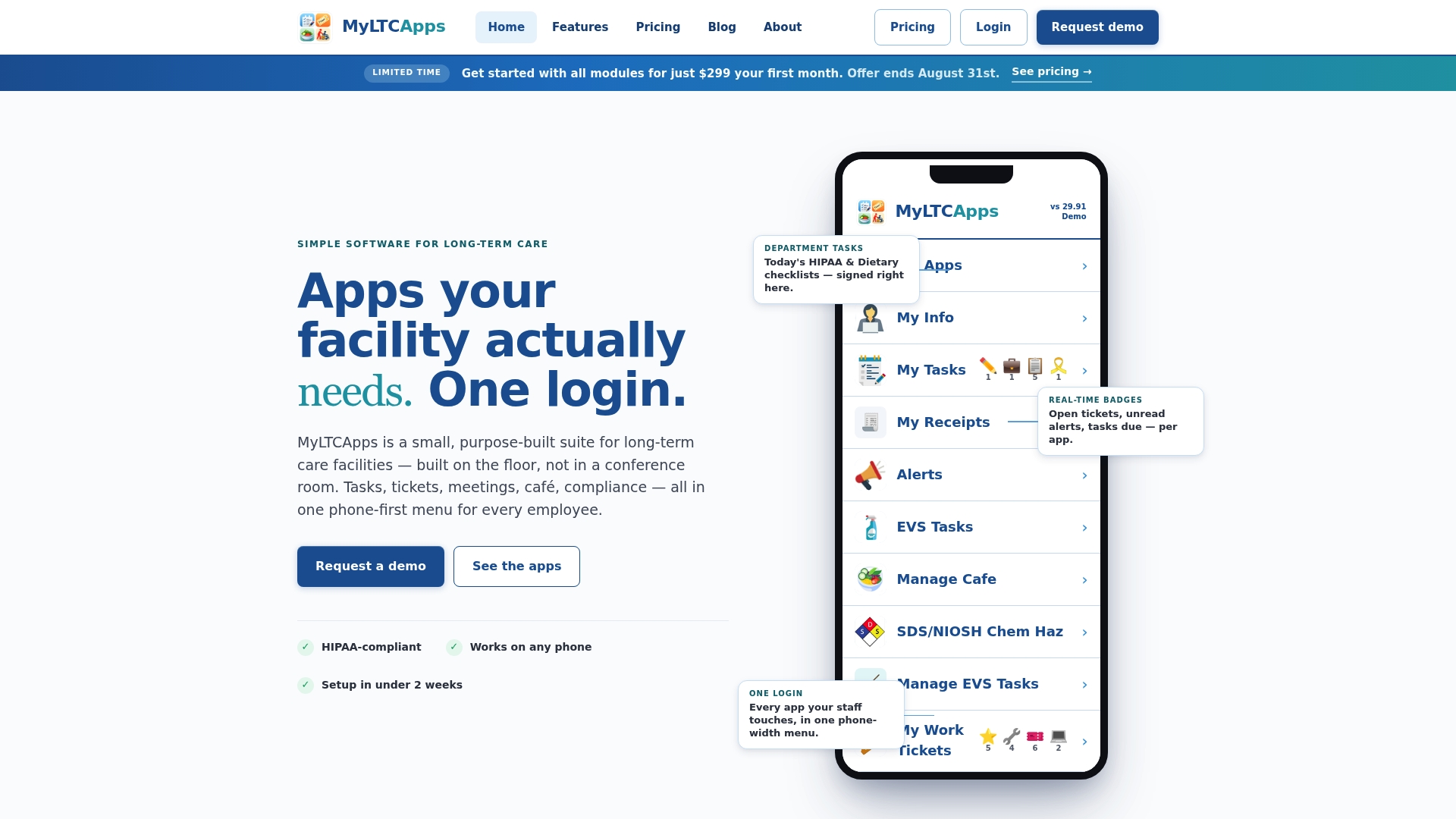
Through My Tasks, we let you assign follow-up items straight to the staff member responsible, with due dates and completion tracking visible to the administrator. Our Compliance Suite holds seeded libraries for HIPAA, dietary and QAPI documentation, so when a surveyor asks for proof of your follow-up actions, you can export it in minutes rather than rebuilding a paper trail.
Specifically, we support the workflow described above with:
- Mobile checklists for recurring environment or housekeeping fixes flagged by survey items, built on the same structure as our housekeeping checklist templates.
- Work tickets in My Work Tickets that convert a single resident complaint into an assigned, trackable job.
- Shift-level visibility through Shift Scheduling so interview time can be blocked into quieter parts of the day.
- Meeting sign-in and in-service tracking to document QAPI follow-up sessions tied to survey results.
Facilities evaluating a phone-first operations suite can review plans starting with the I Just Want That package at our pricing page, where every plan scales by module and headcount.
FAQ
What is a resident satisfaction survey in long-term care?
A resident satisfaction survey is a structured interview or questionnaire that asks residents in a nursing home or skilled nursing facility about their experience with care, meals, environment, autonomy and activities. The CAHPS Nursing Home Surveys are the most widely used validated versions, with separate instruments for current long-stay residents and recently discharged residents.
How long does a resident satisfaction interview take?
A long-stay resident interview conducted in person typically takes close to 20 minutes, based on AHRQ’s administration guidance. Keeping interviews near that length helps limit resident fatigue and supports more consistent, honest answers.
What should we do if a resident cannot be interviewed?
When a resident is not interviewable due to cognition or communication limits, CMS resident interview guidance recommends switching to structured observation protocols rather than defaulting to a family member’s opinion in place of the resident’s own voice. Proxies are used only when direct response and observation are not possible.
Do resident satisfaction scores reflect clinical quality of care?
Not directly. Peer-reviewed research found that validated resident satisfaction and quality-of-life scores correlate weakly with clinical proxies and facility deficiency citations, since surveys measure subjective resident experience rather than clinical outcomes. Both data sources are useful, but they answer different questions and should be reviewed together, not interchangeably.
How should we report survey results internally?
Internal QI reporting works best with item-level percent-positive scores and trend data across multiple survey cycles, as outlined in the AHRQ SOPS user’s guide. Composite scores are better suited for board-level or public-facing summaries where item-level detail would be excessive.
Sources
- CAHPS Nursing Home Surveys | Agency for Healthcare Research and Quality
- Measuring Nursing Home Quality of Life: Validated Measures vs clinical proxies (PMC)
- Strategies for Surveyor Success with Resident Interviews (CMS)