QAPI in Nursing Homes: A Practical Guide for Administrators

QAPI in Nursing Homes: A Practical Guide for Administrators
QAPI is a CMS-required, facility-wide, data-driven program. Under CMS Requirements of Participation §483.75, every nursing home must develop, implement, and maintain a written QAPI plan and produce it to surveyors on request. Start here:
- Document your written QAPI plan covering all systems of care, clinical quality, quality of life, and resident choice.
- Assign leadership accountability — a named administrator or DON who owns the program and reports to the governing body.
- Launch one prioritized Performance Improvement Project (PIP) using PDSA cycles, with documented baseline data and measurable goals.
The CMS QAPI How-To Guide and the AHCA/NCAL 12 action steps are the two resources surveyors expect you to know cold.
Table of Contents
- What does QAPI actually require in a U.S. nursing home?
- How to implement QAPI step by step
- Which KPIs and tools should you track?
- How to run and document PIPs so surveyors see sustained action
- What governance and culture actually require
- Realistic 30/90/365 timeline and cost drivers
- Quick-start checklist and where to find official templates
- Key Takeaways
- What actually separates programs that survive survey from ones that don’t
- Myltcapps puts your QAPI documentation where your staff already works
- Useful sources
What does QAPI actually require in a U.S. nursing home?
QAPI stands for Quality Assurance and Performance Improvement. The two halves are distinct. Quality Assurance (QA) is the monitoring side: setting standards, tracking compliance, catching problems before they become deficiencies. Performance Improvement (PI) is the corrective side: using structured PDSA (Plan-Do-Study-Act) cycles to change the underlying process, not just fix the symptom.
§483.75 requires that the program be ongoing and comprehensive, covering every system of care the facility operates. A binder that gets updated once a year before survey does not meet the standard. Surveyors look for evidence of continuous activity: meeting minutes, PIP charters, run charts, and policy updates tied to specific improvement cycles.
The CMS Five Elements framework organizes the full requirement into five categories: Design and Scope, Governance and Leadership, Feedback and Data Systems, Systematic Analysis and Systemic Action, and Performance Improvement Activities. Every section of your written plan should map to at least one of these elements.
The AHRQ frames QAPI as a combined approach that moves facilities from reactive problem-solving to proactive, data-driven improvement. QAPI at a Glance is the fastest way to get frontline staff oriented to both concepts in a single read.
How to implement QAPI step by step
The CMS QAPI How-To Guide organizes implementation into 12 action steps. Here is how each one translates to a real task with a named owner and a survey-ready output.
- Conduct a facility self-assessment — Use the CMS or AHCA/NCAL drilldown tools to identify gaps. Output: a completed self-assessment with scored domains.
Pro Tip: When selecting your first PIP, use the “high-risk, high-volume, or problem-prone” language directly from §483.75(e). Falls and unplanned rehospitalizations almost always qualify — and surveyors recognize the criteria immediately.
Which KPIs and tools should you track?
The right KPIs give surveyors something concrete to evaluate and give your team a signal before a problem becomes a deficiency.
| KPI | Recommended Denominator | Review Frequency |
|---|---|---|
| Falls per resident days | Resident days | Monthly |
| Unplanned rehospitalizations | Admissions | Monthly |
| Pressure ulcer incidence | Residents at risk | Monthly |
| Antipsychotic use (non-hospice) | Eligible residents | Monthly |
| Staff turnover rate | FTE positions | Quarterly |
| Timely wound care documentation | Wound care orders | Weekly |

Retrospective monthly reports tell you what happened. Real-time data capture tells you which shift, which unit, and which staff member were involved — and that level of detail is what makes root cause analysis precise rather than speculative. Facilities that have moved to event-level data find corrective action faster and document it more cleanly for survey.
When evaluating QAPI tools, prioritize these capabilities: configurable dashboards, automated incident workflows, exportable survey-ready reports, role-based access, and mobile-first data capture. A HIPAA-compliant documentation framework is non-negotiable for any data system handling resident-level incident records.
Pro Tip: Define your numerator and denominator in writing before you start tracking. “Falls” means different things in different facilities — specify whether you count assisted falls, near-misses, or only documented injuries. Consistent definitions make your data defensible at survey.
How to run and document PIPs so surveyors see sustained action
A PIP without documentation is invisible to a surveyor. Every project needs a paper trail that shows the full PDSA cycle.
Required documentation artifacts:
- PIP charter (problem statement, goal, team, timeline)
- Baseline data with source and date range
- Tests of change with dates and responsible staff
- Measurement plan (what you track, how often, who pulls it)
- Run chart showing trend before and after intervention
- Results summary with comparison to baseline
- Sustainment plan with monitoring schedule and responsible owner
- Staff training records tied to the intervention
- Policy or procedure updates resulting from the PIP
| PDSA Phase | Key Output | Survey Evidence |
|---|---|---|
| Plan | Charter, baseline data | Signed charter, data extract |
| Do | Tests of change log | Staff sign-in, task records |
| Study | Run chart, results summary | Trend chart, meeting minutes |
| Act | Policy update, training | Revised policy, competency records |
Scale the number of active PIPs to your resources. A 60-bed facility running two concurrent PIPs is more credible than one running six with thin documentation on each.
What governance and culture actually require
The governing body is legally accountable under §483.75. That means the board or ownership group must allocate resources — staff time, equipment, and training — not just approve a plan on paper. The CMS Five Elements make this explicit: governance is one of the five pillars, not a formality.

The Quality Assurance and Assessment (QAA) committee must meet at least quarterly and include the director of nursing, the medical director or designee, at least three other facility staff (including the administrator or owner), and the infection preventionist. The committee reports its findings to the governing body.
Culture-building responsibilities:
- Implement no-blame incident reporting so frontline staff flag problems without fear of discipline.
- Involve CNAs and floor nurses in PIP teams — they see the process failures first.
- Train all staff on QAPI basics at orientation and annually; keep sign-in sheets as evidence.
- Assign a backup QA lead so the program survives staff turnover.
For facilities managing urgent care transitions as a recurring PIP topic, frontline involvement in the review process is especially important — the staff executing the transition are the ones who can identify the process gap.
Realistic 30/90/365 timeline and cost drivers
- Days 1–30: — Complete the facility self-assessment, draft the written QAPI plan, assign leadership roles, and identify your first PIP topic. Cost drivers: administrator and DON time (roughly 20–40 hours total), AHCA/NCAL template downloads (free).
Phasing spend matters. Start with documentation and one SaaS module — checklists or meeting sign-in — before adding dashboards or integrations. The rural nursing home compliance approach of starting with mobile-first, low-IT tools applies equally well to facilities with limited IT staff in any geography.
Quick-start checklist and where to find official templates
30-day checklist:
- Download and complete the CMS or AHCA/NCAL facility self-assessment tool
- Draft written QAPI plan using the CMS How-To Guide template
- Assign QA coordinator and QAA committee members
- Schedule first monthly QAPI meeting
- Identify first PIP topic using high-risk/high-volume criteria
90-day checklist:
- Sign and date the written QAPI plan
- Complete PIP charter and collect baseline data
- Hold first monthly meeting with documented minutes
- Stand up KPI tracking for at least three indicators
- Distribute QAPI awareness materials to all staff
365-day checklist:
- Complete first full PDSA cycle with run chart and results
- Conduct four quarterly QAA committee meetings with governing body reports
- Update written plan based on year-one findings
- Prepare survey packet: plan, PIP charters, minutes, run charts, training records
Official templates and guidance: CMS QAPI How-To Guide, AHRQ QAPI at a Glance, AHCA/NCAL QAPI tools, and the CMS QAPI resource hub.
Key Takeaways
A compliant, survey-ready QAPI program requires a written plan, named leadership accountability, at least one documented PIP with PDSA evidence, and a quarterly QAA committee reporting to the governing body.
| Point | Details |
|---|---|
| Written plan is mandatory | CMS §483.75 requires a documented, data-driven plan producible to surveyors on request. |
| First PIP selection | Choose based on high-risk, high-volume, or problem-prone criteria — falls and rehospitalizations qualify immediately. |
| Real-time data wins | Event-level data (shift, unit, staff) enables precise root cause analysis; retrospective reports alone are not enough. |
| QAA committee cadence | The committee must meet at least quarterly; minutes and governing body reports are required survey evidence. |
| Myltcapps operationalizes QAPI | Myltcapps maps task checklists, meeting sign-in, competency tracking, and dashboards directly to QAPI documentation needs. |
What actually separates programs that survive survey from ones that don’t
Most administrators I talk with think their QAPI problem is documentation. It usually isn’t. The documentation is thin because the underlying process is thin — meetings that happen but aren’t really working, PIPs that get started and quietly abandoned, KPIs that get pulled from a report nobody reads between surveys.
The facilities that pass survey without drama share one habit: they treat QAPI as an operational rhythm, not a compliance project. Monthly meetings with a fixed agenda, one active PIP at a time with a named owner, and a dashboard someone actually looks at on Tuesday morning. That’s it. The paperwork follows naturally when the process is real.
The 12-month topic cadence is underrated. Assigning infection control to January and falls to February means your team builds genuine familiarity with those standards before a surveyor asks about them. It also means your meeting minutes show a year of continuous, topical engagement — which is exactly what “ongoing” means in §483.75.
Start smaller than you think you need to. One well-documented PIP with a clean run chart and a signed sustainment plan is worth more at survey than five projects with incomplete charters.
Myltcapps puts your QAPI documentation where your staff already works
Running QAPI on paper binders and shared drives means your evidence is always one missing signature or lost printout away from a survey gap. Myltcapps is built specifically for long-term care operations — and its modules map directly to what §483.75 requires you to document.
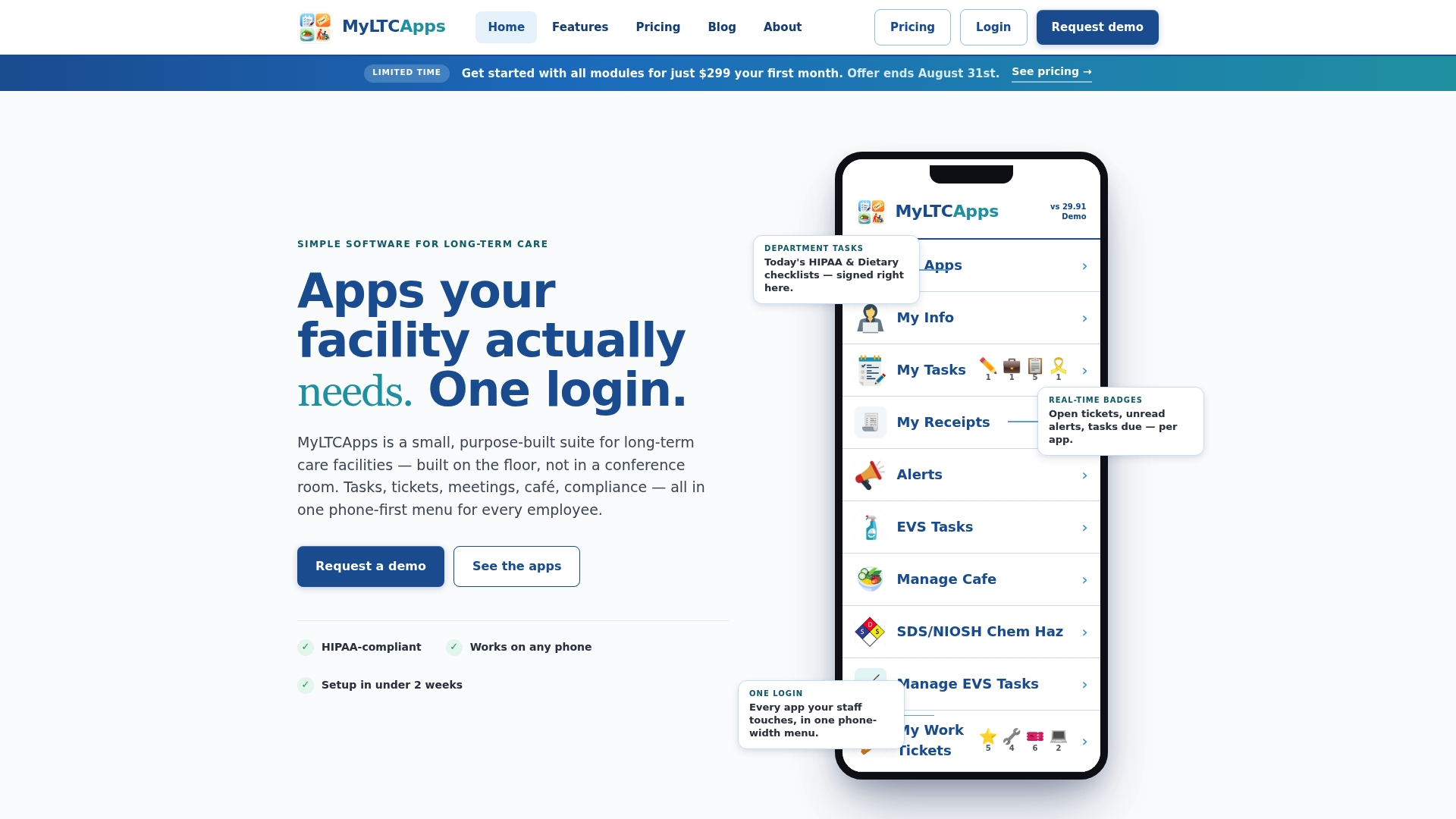
Meeting sign-in and minutes capture your monthly QAPI cadence digitally, with attendance records and agenda notes exportable for your survey packet. Compliance task checklists turn PIP action items into assigned, trackable mobile tasks that staff complete from their phones. Competency tracking stores the training records your PIPs generate. And the operational dashboard gives your QA coordinator a real-time view of the KPIs that matter, without waiting for a monthly report to land in their inbox.
Facilities evaluating the platform can request a quote at myltcapps.com to see module pricing and configuration options for their census size.
Useful sources
- Centers for Medicare & Medicaid Services, HHS § 483.75
- CMS QAPI Plan How-To Guide
- CMS QAPI Website | CMS
- QAPI at a Glance
- Quality Assurance/Performance Improvement (QAPI) — AHCA/NCAL
- Beyond QAPI’s clinical benefits: Nursing homes use data for successful acquisitions, adding service lines, improving reimbursement — Skilled Nursing News
- Strengthening Skilled Nursing Leadership through QAPI Integration