PowerDMS Alternatives for Long-Term Care: Top Picks

PowerDMS Alternatives for Long-Term Care: Top Picks
For LTC and skilled nursing administrators, the strongest PowerDMS alternatives fall into three categories: phone-first operational suites, standalone document-evidence layers, and SOM-native survey workflow engines. Myltcapps is the recommended operationally focused option for facilities that need mobile task management, seeded compliance libraries, and survey-ready exports without the complexity of an enterprise GRC platform.
TL;DR by category:
- Phone-first operational suite (single-site or small chain): Myltcapps — mobile checklists, EVS/dining/work tickets, seeded HIPAA and CMS libraries, survey-ready exports
- Document-evidence layer (any size): Platforms like PolicyStat (Wolters Kluwer) or NAVEX PolicyTech — policy lifecycle, attestations, version control
- SOM-native survey/workflow engine (mid-to-large chain): RLDatix or ComplyAssistant — F-Tag mapping, corrective action workflows, enterprise GRC
- Enterprise policy/accreditation (accreditation-heavy): PowerDMS itself, or a comparable platform, if accreditation management is the primary driver
Top operational pick: Myltcapps. For administrators who need staff accountability on the floor, not just a policy repository, it covers the operational gap that document-only DMS solutions leave open.
Table of Contents
- How do these PowerDMS alternatives compare for LTC administrators?
- What criteria actually matter when evaluating LTC compliance software?
- What features should you test in every vendor demo?
- What should you expect from implementation and training?
- How are LTC compliance platforms typically priced?
- How do you run a vendor demo and score finalists?
- Why Myltcapps is a recommended alternative for LTC/SNF
- What do users say about these platforms?
- What does total cost of ownership actually look like?
- What security certifications should LTC platforms carry?
- How do scalability and customization differ across platforms?
- What should you expect from vendor support?
- How do you migrate data from PowerDMS or another system?
- Key Takeaways
- The compliance gap most administrators underestimate
- Myltcapps: a phone-first operational alternative worth piloting
- Authoritative sources and further reading
How do these PowerDMS alternatives compare for LTC administrators?
| Category | Best For | Core Focus | Mobile/Task Mgmt | Seeded Regulatory Content | Survey-Ready Reporting | Integrations | Implementation Model | Pricing Model | Security |
|---|---|---|---|---|---|---|---|---|---|
| Phone-first operational suite (Myltcapps) | Single-site to small chain LTC/SNF | Operations + compliance | Yes — phone-first checklists, EVS, work tickets | Yes — HIPAA, Section 1557, dietary, QAPI, emergency prep | Yes — surveyor-ready exports | EHR, HR/payroll, SSO | Train-the-trainer, fast deploy | Per facility/module subscription | HIPAA-aligned |
| Document-evidence layer (e.g., PolicyStat) | Any size, policy-heavy | Policy lifecycle, attestations | Limited | Partial — depends on configuration | Policy/attestation audit trail | EHR, SSO/AD | Moderate, admin-led | Per facility or enterprise | HIPAA, SOC2 |
| SOM-native survey engine (e.g., RLDatix, ComplyAssistant) | Mid-to-large chain | F-Tag workflows, GRC, corrective actions | Moderate | Yes — CMS/F-Tag mapped | Strong — ePOC templates, binder generation | EHR, MDS, HR | Multi-week to multi-month | Enterprise, per module | HIPAA, SOC2 |
| Enterprise policy/accreditation (PowerDMS) | Accreditation-driven orgs | Policy distribution, accreditation | Limited | Accreditation standards only | Accreditation-focused | SSO, HR | Structured, consultant-led | Per facility/enterprise | HIPAA, SOC2 |
What criteria actually matter when evaluating LTC compliance software?
Most evaluation frameworks for document management software are built for hospitals or corporate compliance teams. LTC and SNF administrators need a different lens.
Prioritized criteria for LTC/SNF selection:
- Seeded regulatory libraries: Pre-mapped CMS F-Tags, HIPAA, Section 1557, dietary, QAPI, and emergency preparedness content. Facilities that start with a blank template spend months building what a seeded library delivers on day one.
- Configurable workflows: Rigid approval chains break down in LTC environments where staffing ratios shift daily. Configurable workflows with real-time dashboards and automated alerts are the standard to meet.
- Mobile/phone-first task execution: Floor staff do not sit at desks. If the platform requires a laptop to complete a checklist, adoption fails within weeks.
- Survey-ready binder generation: The ability to pull training rosters, policy libraries, and incident reports into one exportable binder cuts survey prep time dramatically.
- EHR integrations: MDS 3.0, ePOC workflows, and billing live in the clinical EHR. The compliance layer needs to connect, not duplicate.
- Credential and training alerting: Role-based renewal tracking with notifications to both employee and manager prevents credential lapses before surveyors find them.
- HIPAA/SOC2 security controls: MFA and an annual Security Risk Analysis are non-negotiable for any system touching ePHI.
- Implementation model: Train-the-trainer delivery builds internal ownership. Vendor-configured systems create dependency.
Pro Tip: Seeded libraries are not just a convenience feature. Facilities that rely on manual configuration to keep pace with CMS updates consistently fall behind. A vendor that ships pre-mapped F-Tag procedures and updates them when CMS revises guidance reduces your ongoing maintenance burden by a measurable margin.
For single-site facilities, weight mobile execution and seeded content heavily. For multi-site chains, prioritize EHR integration depth and enterprise reporting.
What features should you test in every vendor demo?
The gap between a polished demo and real-world LTC use is where most purchasing mistakes happen.

Policy and document lifecycle should include version control, electronic attestations, and a searchable library mapped to §483.x survey items. Electronic acknowledgments and audit trails are the minimum standard for survey-ready policy evidence.
Mobile task management needs offline capability, time-stamped completion records, and photo attachments. EVS cleaning logs, dining checklists, and maintenance work tickets all generate the kind of timestamped evidence surveyors request on-site.
Training and credentialing alerts should fire to both the employee and their direct manager before an expiration, not after. The 10-day ePOC window after a survey citation is unforgiving — platforms with prebuilt corrective-action templates mapped to common F-Tags reduce the risk of a missed deadline.
| Feature Dimension | Minimum Acceptable | Strong Implementation |
|---|---|---|
| Policy version control | Manual archive | Auto-archive on publish, audit trail |
| Mobile task execution | Web-responsive | Native app, offline mode, photo capture |
| Credential alerting | Email notification | Role-based alerts to employee + manager |
| Survey binder export | Manual PDF assembly | One-click binder with training rosters + policies |
| ePOC support | None / manual | Prebuilt templates, 10-day countdown alert |
| MFA / SRA tracking | Optional MFA | Enforced MFA, documented annual SRA |
MFA and an annual Security Risk Analysis are required for any platform accessing ePHI. Confirm both before signing.
What should you expect from implementation and training?
Implementation timelines vary significantly by product scope. Document-evidence layers can deploy in days for a single site. EHR-integrated survey modules typically need 8–16 weeks for full go-live.
Pre-launch checklist (insist these appear in the SOW):
- Policy mapping and seed-library import completed before go-live
- EHR integration scope and data-field mapping documented
- User roles, permissions, and SSO configured and tested
- Role-based access reviewed by DON and administrator
- Mock survey run-through completed with internal team
- Train-the-trainer sessions scheduled for all department heads
- Success metrics defined (task closure rate, binder compile time, credential lapse rate)
- Support SLA and escalation path confirmed in writing
The train-the-trainer model matters more than most administrators expect. Vendors that configure the system for you create a dependency. Vendors that train your internal team to own workflows produce facilities that stay compliant after the implementation consultant leaves.
How are LTC compliance platforms typically priced?
Most platforms use one of three models: per-facility flat fee, per-bed per-month, or per-module add-ons with volume discounts for chains. None of them advertise the full cost upfront.
Hidden and recurring costs to confirm before signing:
- Third-party EHR connector fees (often billed separately by the integration middleware vendor)
- Custom report development outside the standard template library
- Data migration and historical document import
- Template or seed-library setup fees for state-specific content
- Premium support tiers with faster response SLAs
- Upgrade and maintenance windows that require paid professional services
Negotiation questions to ask every vendor:
- Does the pilot or trial include full feature access, or a limited sandbox?
- What are the data-export rights if we switch platforms?
- What is the uptime SLA, and what remedies apply if it is missed?
- Are CMS regulatory updates to the seed library included in the base subscription?
- What triggers a price increase at renewal?
How do you run a vendor demo and score finalists?
Two-round demos work better than one long session. Round one is operational: put floor staff and the DON in front of the mobile interface. Round two is executive: pricing, contract terms, and integration architecture.
Demo questions by role:
- Administrator: Show me how a surveyor would request evidence for F-Tag 684. How long does it take to compile that binder?
- DON/CNO: How does the platform alert me when a CNA’s CPR certification is 30 days from expiring?
- IT/Security: Does the platform enforce MFA? Where is the annual SRA documented?
- EVS/Operations: Can a housekeeper complete a room-cleaning checklist from a personal phone without a company login?
Red flags during demos:
- No seeded content for CMS or state regulations — you will build everything manually
- Mobile UX that requires more than three taps to complete a routine task
- Evidence export limited to screenshots or manual PDF assembly
- No MFA enforcement or no documented SRA process
- Vague answers about EHR integration depth (“we can connect to most EHRs”)
Scoring template (1–5 scale):
| Criterion | Weight | Score (1–5) |
|---|---|---|
| Seeded CMS/F-Tag library | High | |
| Mobile/phone-first UX | High | |
| Survey binder generation | High | |
| EHR integration depth | High | |
| Credential/training alerting | Medium | |
| Configurable workflows | Medium | |
| ePOC template support | Medium | |
| HIPAA/SOC2 certifications | Medium | |
| Implementation timeline | Low | |
| Pricing transparency | Low |
Why Myltcapps is a recommended alternative for LTC/SNF
Most document management software built for healthcare was designed around hospital policy distribution or accreditation management. Myltcapps was built specifically for the operational reality of long-term care: floor staff on personal phones, surveyors requesting timestamped evidence, and administrators who need task closure rates, not just policy acknowledgments.
Capability mapping to evaluation criteria:
- Phone-first compliance checklists with seeded HIPAA, Section 1557, dietary, QAPI, and emergency preparedness libraries
- EVS task management and housekeeping logs with timestamped, photo-supported evidence
- Work ticket and maintenance tracking for environmental compliance workflows
- In-service and meeting attendance tracking for staff training evidence
- Role-based staff directory supporting access control and task ownership
- Surveyor-ready reporting exports and operational dashboards
- KDADS-ready configuration for Kansas facilities
Myltcapps deploys on a train-the-trainer model, with pilots available before full commitment. For Kansas facilities, the platform is configured to meet KDADS expectations out of the box.
What do users say about these platforms?
User feedback across platforms like Capterra, G2, and TrustRadius reveals consistent patterns by category.
PowerDMS earns strong marks for policy distribution and accreditation management. Users in public safety and hospital settings praise the centralized repository and electronic acknowledgment workflows. LTC-specific users frequently note that operational task management and floor-level mobile execution are outside the platform’s core strength.
NAVEX PolicyTech and PolicyStat (Wolters Kluwer) receive positive reviews for policy lifecycle management and version control. Common criticisms include limited mobile functionality and the need for significant manual configuration to align with CMS-specific content.
RLDatix and ComplyAssistant are rated well by enterprise compliance teams for F-Tag workflow depth and corrective action management. Smaller facilities often find the implementation complexity and cost disproportionate to their operational scale.
Myltcapps is positioned by users as the platform that closes the gap between policy management and floor-level execution, particularly for facilities where staff primarily use personal mobile devices.
What does total cost of ownership actually look like?
The base subscription is the starting point, not the finish line. A realistic 24-month TCO for any compliance platform in LTC should include:
- Base subscription: Per-facility or per-bed monthly fee, multiplied across all sites
- Integration costs: EHR connector fees, SSO setup, and HR/payroll data mapping
- Migration: Historical document import, policy reformatting, and data validation
- Training: Initial implementation, train-the-trainer sessions, and annual refreshers
- Template and library setup: State-specific content, custom report templates, and workflow configuration
- Premium support: Faster SLA tiers, dedicated customer success, and after-hours coverage
- Renewal increases: Most SaaS contracts include annual escalators; confirm the cap before signing
For single-site facilities, a phone-first operational suite like Myltcapps typically carries a lower TCO than enterprise GRC platforms, because the implementation scope is narrower and the seeded content reduces configuration labor.
What security certifications should LTC platforms carry?
Any platform that stores or transmits ePHI must meet the HIPAA Security Rule’s technical safeguard requirements. The practical minimum for LTC compliance software includes enforced MFA, documented annual SRA, encrypted data at rest and in transit, and role-based access controls.
SOC2 Type II certification is the industry benchmark for cloud-hosted healthcare software. It confirms that a vendor’s security controls have been independently audited over a sustained period, not just at a point in time. Confirm whether a vendor holds SOC2 Type II or only SOC2 Type I — the difference matters for OCR audit risk.
For LTC facilities in Kansas, HIPAA technical safeguards apply to every system that touches resident health information, including operational platforms that capture incident reports or medication administration logs. Verify that any platform you evaluate documents its SRA process and can provide evidence of annual completion.
How do scalability and customization differ across platforms?
Single-site facilities and 50-site chains have fundamentally different needs, and most platforms optimize for one end of that spectrum.

Document-evidence layers like PolicyStat scale well across sites because policy libraries are centralized and permissions are role-based. The limitation is that operational customization (facility-specific checklists, department workflows, local regulatory variations) often requires professional services.
Enterprise platforms like RLDatix and ComplyAssistant are built for multi-site governance but carry implementation complexity that smaller facilities cannot absorb without dedicated IT support.
Myltcapps is designed to scale from a single facility to a small chain without requiring a dedicated IT team. The LTPAC companion model sits alongside the clinical EHR, adding operational modules as the facility’s needs grow, without replacing the clinical system.
What should you expect from vendor support?
Support quality separates platforms that sustain compliance from those that get abandoned after go-live. Key questions to ask before signing:
- What is the guaranteed first-response time for critical issues?
- Is there a dedicated customer success manager, or shared support queue?
- Are regulatory library updates pushed automatically, or do they require a support ticket?
- What is the process for reporting a security incident?
Enterprise platforms typically offer tiered support with faster SLAs at higher price points. Smaller, LTC-focused platforms often provide more direct access to implementation staff, which matters when a surveyor arrives and a report needs to run immediately.
How do you migrate data from PowerDMS or another system?
Migration is where most platform transitions stall. The core challenge is not moving documents — it is preserving version history, attestation records, and audit trails that surveyors may request for prior periods.
Before committing to any platform, confirm:
- Whether historical policy versions and acknowledgment records can be exported in a standard format (PDF, CSV, or XML)
- Whether the new platform can import those records and maintain their original timestamps
- What the vendor’s documented process is for data validation post-migration
- Whether migration is included in the base contract or billed separately
For facilities moving from PowerDMS, the primary export assets are policy documents, acknowledgment logs, and accreditation mapping records. Most document-evidence layers and operational suites can ingest these formats, but the mapping work (aligning old policy categories to new workflow structures) typically takes two to four weeks for a single site.
Key Takeaways
For LTC and SNF administrators, the right PowerDMS alternative depends on whether you need a document-evidence layer, an operational suite, or both — and Myltcapps is the recommended phone-first operational option for facilities that need floor-level task accountability alongside compliance tracking.
| Point | Details |
|---|---|
| Two layers are better than one | Clinical EHRs handle MDS and billing; a specialized operational platform handles the non-clinical F-Tag evidence surveyors request. |
| Seeded libraries reduce maintenance | Platforms with pre-mapped CMS/F-Tag content cut configuration labor and keep facilities current when CMS updates guidance. |
| Mobile execution drives adoption | If floor staff cannot complete checklists from a personal phone, adoption fails regardless of how strong the policy library is. |
| TCO extends beyond the subscription | Budget for integration, migration, training, and template setup across 24 months before comparing platform prices. |
| Myltcapps fits the operational gap | For Kansas LTC facilities, Myltcapps covers EVS, dining, work tickets, in-service tracking, and survey-ready exports in a single phone-first platform. |
The compliance gap most administrators underestimate
The platforms that win in long-term care are not the ones with the most features. They are the ones that get used on the floor, every shift, by staff who were never trained as software users.
That sounds obvious, but the purchasing process consistently rewards the wrong signals. A polished demo with enterprise reporting dashboards impresses an administrator in a conference room. It does not help a housekeeper log a room cleaning at 6 AM from a personal Android phone.
The seeded library question is equally underrated. Facilities that start with blank templates are not just doing extra work at implementation — they are committing to ongoing maintenance work every time CMS revises an F-Tag. That cost compounds over years, and it rarely shows up in a TCO calculation.
The facilities that sustain compliance between surveys are the ones that built internal ownership into the implementation. A vendor that trains your team to manage the system is worth more than one that manages it for you. The train-the-trainer model is not a cost-cutting measure — it is the only adoption model that actually works when the implementation consultant is gone and a surveyor walks in unannounced.
Myltcapps: a phone-first operational alternative worth piloting
If the platforms above feel like they were built for hospital compliance teams or enterprise GRC departments, that is because most of them were. Myltcapps was built for the operational reality of long-term care: staff on personal phones, surveyors requesting timestamped floor-level evidence, and administrators who need task closure rates alongside policy acknowledgments.
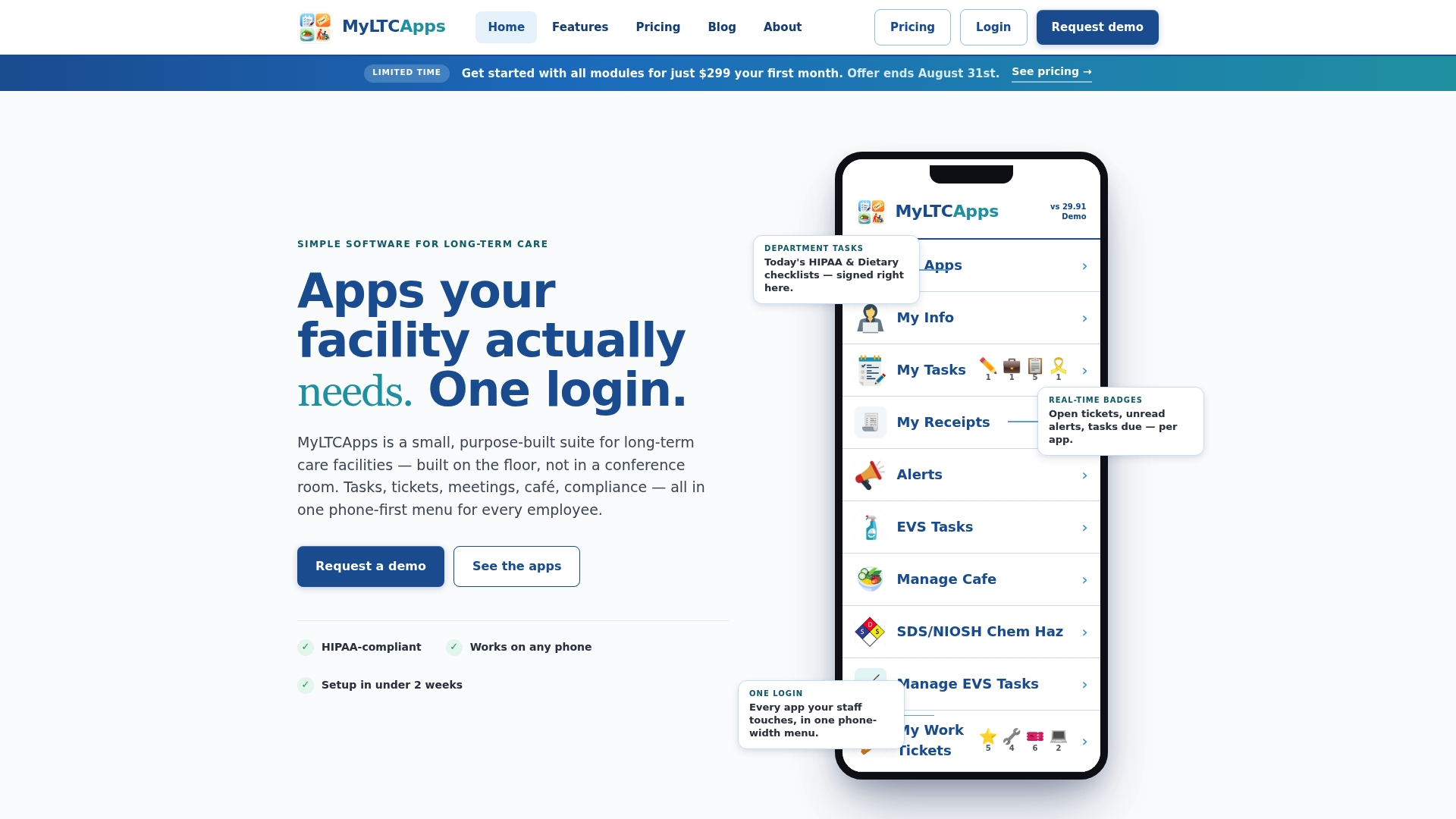
The platform covers compliance checklists, EVS workflows, work tickets, dining management, in-service tracking, and surveyor-ready exports in a single subscription, priced per facility and per module. Kansas facilities get KDADS-ready configuration out of the box. Pilots are available before full commitment.
Request a quote or schedule a demo at myltcapps.com and see how the platform fits your facility’s survey prep workflow before your next KDADS inspection.
Authoritative sources and further reading
- CMS ePOC timing and survey processes: Primary source for the 10-day electronic Plan of Correction deadline and survey process requirements. Essential reading for any administrator evaluating ePOC-ready platforms.
- HHS HIPAA Security Rule guidance: Official HHS guidance on technical safeguards, MFA requirements, and annual Security Risk Analysis expectations for systems accessing ePHI.
- FileFlo: Best SNF Compliance Software 2026: Covers the dual-layer EHR/compliance platform strategy and implementation timeline expectations by product category.
- FileFlo: Best CMS Audit Preparation Software 2026: Explains how document-evidence platforms aggregate training rosters, policy libraries, and incident reports for survey binder generation.
- Performance Health: Compliance Management Software Buyer’s Guide: Practical buyer guidance on configurable workflows, automated credential alerting, and policy lifecycle controls for healthcare settings.