Nursing Overtime Reduction in Long-Term Care: A Practical Playbook

Nursing Overtime Reduction in Long-Term Care: A Practical Playbook
Nursing overtime drops when you stop treating it as a payroll problem and start treating it as a scheduling, communication and workload problem. In a nursing home, the facilities that make progress do four things. They separate mandatory from voluntary overtime. They plan coverage before a call-out happens. They put open shifts in front of staff quickly. And they take avoidable work off nurses so shifts end on time. This guide walks through each step and the numbers to watch.
TL;DR
- Overtime in a mandatory-overtime law usually means hours beyond the schedule a nurse agreed to work, not hours past 40 in a week. Federal overtime pay is a separate question.
- Roughly 18 states limit or prohibit mandatory overtime for nurses, so check your state’s rules before you write any policy.
- Written coverage plans, voluntary pick-up lists, shorter notice gaps on open shifts and fewer non-nursing tasks on the floor are the most practical levers.
- Long shifts and evening work are linked to higher voluntary turnover, so reducing overtime protects retention as well as budget.
- Track overtime hours per pay period, open-shift fill time, call-out rate and turnover together. One number alone can mislead.
Table of Contents
- What counts as nursing overtime
- Know the rules in your state
- Why overtime piles up in long-term care
- Build coverage before the call-out
- Fix scheduling so open shifts fill early
- Take avoidable work off nurses
- Track whether it is working
- Perspective: why we build for the floor
- How MyLTCApps fits into an overtime-reduction plan
- FAQ
- Sources
What counts as nursing overtime
Two definitions are in play, and mixing them up causes bad policy.
The first is overtime pay. Under the federal Fair Labor Standards Act, hospitals and other institutions primarily engaged in caring for the sick, the aged or the mentally ill must pay nonexempt employees time-and-one-half for hours over 40 in a workweek. Nursing care facilities have a second option. With a prior agreement, they can use the “8 and 80” system, which counts hours beyond 8 in a day and 80 in a 14-day period.

The second is mandatory overtime. State laws that restrict it define overtime differently. New York’s Department of Labor describes it as hours beyond the predetermined, regularly scheduled hours a nurse agreed to work, and notes that the law does not stop nurses from working overtime voluntarily. Alaska’s labor department says the same thing and adds that the term does not refer to overtime pay or eligibility for it.
In practice, a nurse can hit overtime pay without being mandated, and can be mandated to stay without crossing 40 hours. Your policy needs to address both: the cost side and the legal side.
Know the rules in your state
Mandatory-overtime rules for nurses are set mostly at the state level, and they differ. One summary counts 18 states with laws or regulations that prohibit or limit mandatory overtime for nurses, including Alaska, California, Connecticut, Illinois, Maine, Maryland, Massachusetts, Minnesota, Missouri, New Hampshire, New Jersey, New York, Oregon, Pennsylvania, Rhode Island, Texas, Washington and West Virginia. Some of these laws cover only hospitals, so confirm whether your setting is in scope.
A few examples show how different the details are:
| State | What the rule says | Source |
|---|---|---|
| New York | Mandatory overtime only in a patient care emergency, as a last resort after the Nurse Coverage Plan is implemented | NY Department of Labor |
| Washington | No required overtime for LPNs or RNs unless one of four exceptions applies, such as an unforeseeable emergent circumstance or documented reasonable efforts to obtain staffing | Washington L&I |
| Illinois | Only in an unforeseen emergent circumstance as a last resort, up to 4 hours beyond an agreed shift, with at least 8 consecutive hours off after a mandated shift of up to 12 hours | Illinois Administrative Code |
| Massachusetts | Hospital setting; permitted only in an emergency where patient safety requires it and no reasonable alternative exists | Mass. General Laws |
| Texas | A hospital may not require mandatory overtime, a nurse may refuse it, and on-call time cannot substitute for it | Texas Health and Safety Code |
Two themes repeat. First, mandatory overtime is a last resort, which means you must be able to show what you tried first. Second, nurses who refuse prohibited overtime are protected from retaliation. Washington bars employers from discriminating against, dismissing or penalizing a nurse for refusing, and Massachusetts says a refusal cannot be grounds for discrimination or dismissal.
For your own facility, ask your state labor department or counsel which law applies to your license type. Write the answer into your staffing policy.
Why overtime piles up in long-term care
Most overtime has a few ordinary causes: vacancies, unplanned absences, late-notice schedule changes and tasks that run past the end of a shift.
The staffing pressure is well documented. A JAMA Network Open study of 40 nursing home administrators found that during the COVID-19 pandemic they leaned on overtime, cross-training, ratio adjustments, agency staff and curtailed admissions to keep running and meet minimum staffing rules. The authors noted these short-term measures may hurt long-term workforce stability. A 2022 survey of 4,000 assisted living facilities reported by McKnight’s Long-Term Care News found 98% had asked staff to work overtime or take extra shifts.
Overtime also feeds itself. Long shifts and extra hours push people toward the exit. A case-control study of 18 for-profit nursing homes found that shifts longer than 8 hours were associated with a 42% higher prevalence of voluntary termination, and evening shift work roughly doubled the hazard (HR = 2.00). Each departure leaves a hole that the remaining staff fill with more overtime.
If you want a quick diagnosis, pull four months of overtime by unit, shift and reason. You will usually find that a small number of recurring patterns drive most of the hours: a weekend gap, a night unit with chronic vacancies, or a handoff that runs late.
Build coverage before the call-out
The single most useful idea in the state rules is the coverage plan. New York requires one, and its employer checklist is a good template even if you are elsewhere. It calls for reviewing typical absenteeism, analyzing patient census and the types of patients served, setting up alternative staffing options, and documenting the actions taken to avoid mandating overtime. Those alternatives include voluntary overtime, per diem nurses, registries and floats.
Here is how to turn that into an operating routine:
- Map predictable absence. Look at call-out patterns by day of week, holiday and season. Staff for the pattern, not the average.
- Keep a voluntary pick-up list. Staff who want extra hours opt in, and you offer shifts to them first, in a fair order you have published.
- Maintain a per diem and float pool. Cross-trained floats cover gaps without turning one nurse’s day into a double.
- Set a call-out escalation ladder. Decide who is called, in what order and how long you wait before moving to the next option.
- Document every attempt. If you ever need to ask someone to stay, a record of earlier steps protects both the nurse and the facility.
On-call design matters too. The McKnight’s piece cites Wei Deng, who flags frequent day/night changes, offering only 8-hour shifts, and adding on-call hours to long shifts as problem practices. On-call hours added to long shifts can raise short-term mistakes and long-term burnout. Our guide to on-call scheduling for nurse managers covers how to structure it without creating fatigue problems.
Fix scheduling so open shifts fill early
A shift posted three days out costs less than one posted three hours out. Most overtime reduction in practice is about speed and fairness in filling gaps.
Publish schedules earlier and change them by rule. A clear schedule change policy tells staff how and when changes happen, which cuts the last-minute swaps that spill into overtime. If you operate where predictive scheduling laws apply, check the notice rules too.
Give staff a say. The same case-control study recommends programs that increase employee decisions about work schedules, chances to earn more for off-shift or long-shift work, recognition for people who cover off-shifts, and real listening when family or social conflicts come up. Options like self-scheduling and a shift bidding pilot with published rules put that advice into practice.
Run open shifts as a process. Post the shift to everyone eligible at once, set a response window and show the rules for who gets it. A 60-day open shift pilot is a manageable way to test this with one unit before rolling it out.
Use software built for the floor. Spreadsheets and group texts hide gaps until they are urgent. Dedicated shift scheduling software for nursing homes makes open shifts visible and lets staff respond from their phones.
Watch the health side of scheduling as well. Extended and irregular shifts affect the people who work them, and the signs mirror what families see at home. Our friends writing about caregiver burnout signs and causes describe the pattern of exhaustion that builds when there is no real break. The same logic applies to your staff: rest between shifts is part of safe staffing.
Take avoidable work off nurses
Not every overtime hour is a staffing hole. Some come from nurses finishing work that never needed to be theirs.
A 2022 study in PMC at a Colorado facility, Columbine West Health and Rehab, shows what that looks like. Baseline reports from the second quarter of 2021 showed an average of 8.3 hours of nursing overtime per day, costing about $39,000 per quarter. After the facility added unit clerks in July 2021, average overtime wages fell from $39,217 to $29,106 in the third quarter. The lesson is not that every facility needs the same role. It is that moving administrative work away from nurses can measurably reduce overtime.
Look for the same kind of work in your building:
- Maintenance requests that nurses relay by phone or hallway conversation
- Supply, linen and housekeeping requests that wait on a nurse to chase them
- Paper checklists that must be hunted down, completed and filed
- Meeting sign-ins, document hunts and repeated messages about who is on duty
- Assignment sheets rebuilt by hand each shift; a standard nurse assignment sheet template saves that time
Each item is small. Together they can be the difference between clocking out on time and staying 30 minutes.
Track whether it is working
Overtime hours alone will mislead you. They can drop because you cut care or because turnover has removed the people who used to work extra. Track a small set of measures together, by unit and by shift, and review them monthly.
| Measure | What it tells you |
|---|---|
| Overtime hours and cost per pay period | The headline trend, ideally per resident day so census changes do not distort it |
| Share of overtime that is mandated versus voluntary | Whether you are relying on last-resort tools or on willing pick-ups |
| Open-shift fill time | How early gaps are closing, in hours from posting to fill |
| Call-out rate by day and shift | Where to build float and per diem coverage |
| Overtime concentrated in a few people | Fatigue risk and fairness problems hiding behind a flat average |
| Voluntary turnover and exit reasons | Whether the changes are helping retention, which the research links to shift length |
| Hours off between shifts | Whether rest rules in your state are being met |
| Staffing against posted requirements | Whether lower overtime came with adequate coverage; see our look at staffing ratios and CMS data |
Set a baseline for one quarter, change one thing at a time, and compare. If a unit’s fill time falls but its overtime does not, the cause is elsewhere, perhaps late-running tasks. If overtime falls and turnover stays high, look at schedule predictability and recognition next.
Perspective: why we build for the floor
Overtime is rarely one big failure. It is a hundred small delays: a work order nobody saw, a checklist on paper, a shift gap discovered at 5 p.m.
That is why we built MyLTCApps around the phone in a caregiver’s pocket. Our design goal is simple: a task, a ticket or an open shift should be reachable in about three taps, using a single thumb. When the tools are that light, the work that clogs a nurse’s day gets routed to the right person sooner.
We also believe scheduling and compliance belong in the same place. When shift scheduling, tasks, alerts and survey-ready documentation sit in one menu, administrators spend less time stitching together reports and more time fixing the patterns behind their overtime.
Philip
How MyLTCApps fits into an overtime-reduction plan
MyLTCApps is a phone-first suite for long-term care and skilled nursing facilities. It covers shift scheduling, mobile task and checklist management, work tickets, alerts and compliance tracking, so the open shifts and daily tasks behind overtime are visible to the people who can act on them. Plans are priced per facility and published: Starter Pack is $299 per month, Growth Pack is $499 per month and Premium Pack is $792 per month, with an entry plan, I Just Want That, at $199 per month. See the full plan details to find the fit for your building.
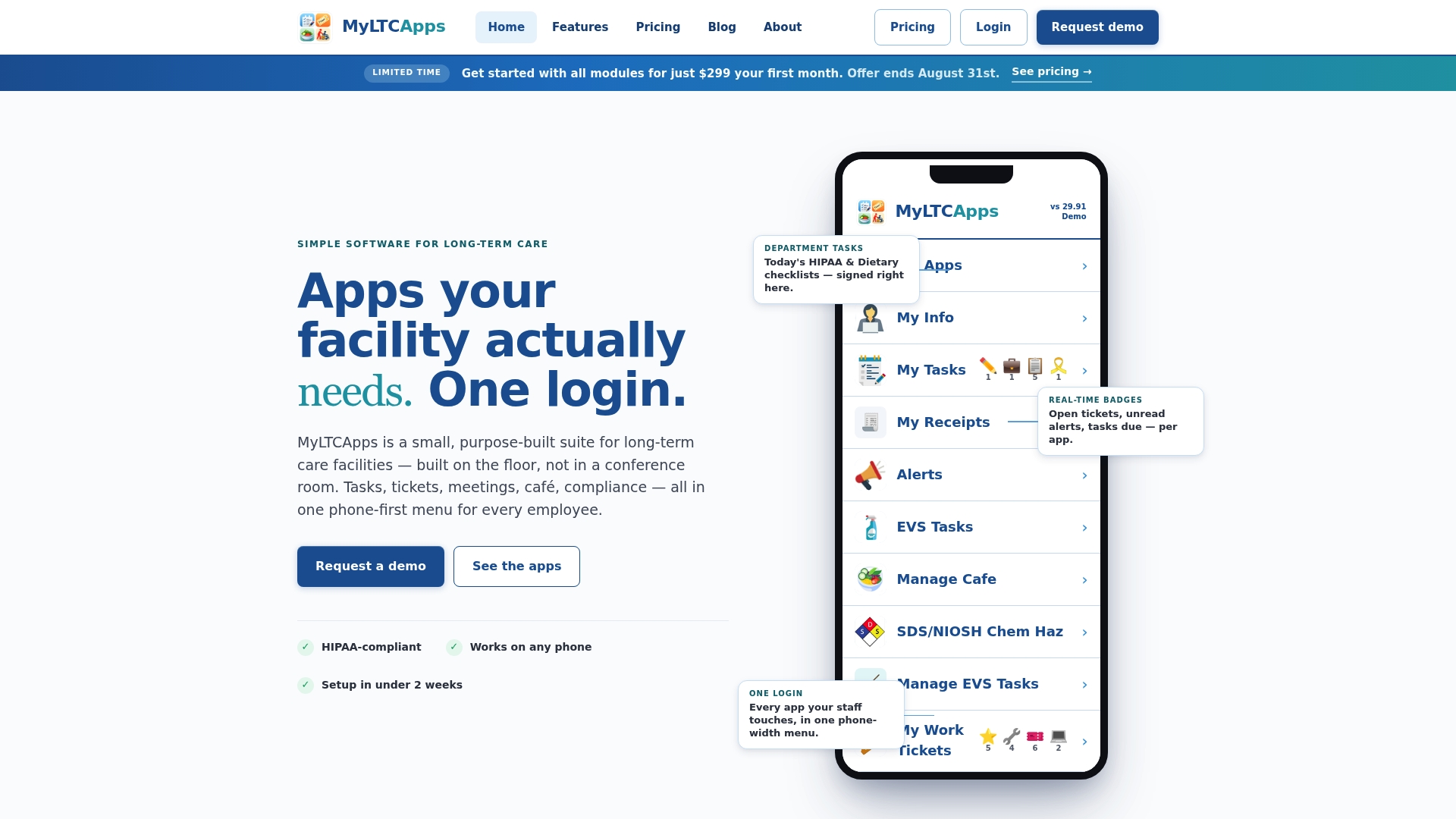
If you want to start with the daily workload, look at mobile task and checklist tools and work ticket management.
FAQ
How many hours is overtime in healthcare?
Under federal law, nonexempt healthcare employees get time-and-one-half after 40 hours in a workweek. Nursing care facilities can instead use the 8 and 80 system if there is a prior agreement. State mandatory-overtime laws use a different definition: hours beyond what the nurse agreed to work in the schedule.
Can a nurse refuse mandatory overtime?
In states with these laws, often yes, with limits. Texas says a nurse may refuse mandatory overtime in a hospital, and Washington and Massachusetts protect nurses from discipline for refusing prohibited overtime. Exceptions such as emergencies vary by state, so check your state’s labor department.
What is the fastest way to cut overtime in a nursing home?
Start with predictable gaps. Review call-outs by day and shift, build a voluntary pick-up list and float pool for those windows, and post open shifts to all eligible staff at once. Then remove non-nursing tasks that push shifts past their end time.
Does reducing overtime help retention?
The research points that way. A case-control study of nursing home staff linked shifts over 8 hours to a 42% higher prevalence of voluntary termination. Giving staff more say in schedules and recognizing those who cover off-shifts are among the retention steps the authors recommend.
Sources
- Fact Sheet #54: The Health Care Industry and Calculating Overtime
- Fact Sheet #31: Nursing Care Facilities Under the FLSA
- New York DOL: Nurse Mandatory Overtime FAQ
- New York DOL: Nurse Mandatory Overtime Employer Requirements checklist
- Alaska Department of Labor: Mandatory Overtime Limitations for Nurses
- Washington L&I: Law Restricting Mandatory Overtime for Nurses
- Massachusetts General Laws, Chapter 111, Section 226
- Illinois Administrative Code, Title 77, Section 250.1110
- Texas Health and Safety Code Section 258.003
- NurseJournal: Understanding Mandatory Overtime for Nurses
- JAMA Network Open: Examination of Staffing Shortages at US Nursing Homes
- McKnight’s Long-Term Care News: To address the staffing crisis in LTC, start with scheduling
- PMC: Predictors of Nursing Staff Voluntary Termination
- PMC: Nursing Administrative Support Role Proves Reduction in Overtime
- Family Caregiver Burnout: Signs, Causes and Getting a Break