Nursing Home KPIs: What to Track and How to Measure

Nursing Home KPIs: What to Track and How to Measure
The nursing home KPIs worth tracking fall into five groups: resident care and quality, staffing, daily operations, census, and finances. Start with the measures CMS already publishes about your building, then add a few internal indicators that show problems before a survey or a Care Compare update does. A KPI only helps if it has a clear formula, a target, an owner and a place on the QAPI meeting agenda.
This guide shows how to choose long term care KPIs, how to calculate them, which ones are reported to the public and which are internal choices, and how to turn the numbers into action.
TL;DR
- A KPI is a measurable value that shows progress toward a goal. Each one needs a numerator, a denominator, a target, a data source, an owner and a review schedule.
- CMS already rates your facility on three domains: health inspections, staffing and quality measures. Treat those as your baseline scoreboard.
- Add internal operational KPIs, such as task completion, work ticket turnaround and cleaning checks, because they move before your public ratings do.
- Fewer KPIs, defined well, beat a long dashboard nobody reviews. Bring them to QAPI meetings with a baseline, a threshold and a decision.
- Compare results only when the definitions match: same denominator, exclusions and time period.
Table of Contents
- What a nursing home KPI should look like
- Start with what CMS already measures
- Resident care and quality KPIs
- Staffing KPIs
- Operations KPIs that predict the rest
- Census and financial KPIs
- How to calculate a nursing home KPI
- Set targets and turn KPIs into action
- How often to review, and how to keep it real time
- Interpreting benchmarks across facilities
- Our perspective
- Put operational KPIs on your team’s phones
- FAQ
- Sources
What a nursing home KPI should look like
KPI stands for key performance indicator. The American Association of Post-Acute Care Nursing describes it in its QAPI meeting tool as a measurable value demonstrating progress toward goals. The same tool separates a few terms that administrators often blur together:
- Baseline: where you started.
- Benchmark: a reference point, such as a state or national comparison.
- Threshold: the level that triggers action.
- Pattern, shift and trend: how the number behaves over time.
A useful KPI is written down as a specification, not just a name. Healthcare KPI guidance from a healthcare KPI resource lists what to state: the title, the description and population, the rationale, the target, the numerator and denominator, the data source, how often it is collected, who collects it and who receives the report.
Here is what that looks like for a simple internal measure:
| Element | Example: daily checklist completion |
|---|---|
| Title | Daily environmental checklist completion rate |
| Population | All assigned checklists on all units |
| Numerator | Checklists finished by end of shift |
| Denominator | Checklists assigned that shift |
| Target | Set by your leadership team from your own baseline |
| Data source | Digital checklist timestamps |
| Frequency | Daily, summarized weekly |
| Owner | Department manager |
| Recipient | Administrator and QAPI committee |
If you cannot fill in every row, the measure is not ready to track yet.
Start with what CMS already measures
You do not have to invent a scoreboard from scratch. CMS’s Five-Star technical users’ guide (September 2026) describes nursing home quality through three domains: health inspections, staffing and quality measures.
Health inspections. The rating draws on the number of deficiencies, their scope and severity, recent complaints, focused infection-control surveys and the revisits needed to verify correction. Your internal view of this domain is survey readiness: open plans of correction, repeat citations and how fast you close findings. Our guides to CMS F-tags and to finding your state survey reports help you read the results.
Staffing. The 2026 staffing domain uses three nurse-staffing measures expressed as hours per resident day and three turnover measures, according to the same guide.
Quality measures. These come from resident assessment data, covered in the next section.
The data behind the ratings comes from specific reporting requirements. All Medicare- and Medicaid-certified nursing homes must assess residents with the MDS resident assessment instrument, and CMS’s 2024 Care Compare update describes posting facility-level aggregate MDS information and CMS-671 facility characteristics. Staffing comes through Payroll-Based Journal. CMS’s PBJ policy manual explains that Section 6106 of the Affordable Care Act requires electronic submission of direct-care staffing information, including agency and contract staff, drawn from payroll and other auditable data.
Everything else in this article is an internal choice. Federal rules decide what gets reported. You decide which additional indicators earn a place in your own reviews.
Resident care and quality KPIs
CMS’s quality measures page is the best menu for this category. The nursing home measure set includes:
- Rehospitalization and outpatient emergency department visits
- Antipsychotic medication use
- Pressure injuries
- Vaccination
- Hospitalizations
- Falls with major injury
- Urinary tract infection
- Catheter use
- Worsening of independent walking
- Increased need for help with activities of daily living
You do not need to chase all of them at once. Pick the two or three where your numbers sit furthest from your own target, and give each a clinical owner. Falls with major injury and pressure injuries are common first picks because they are easy to explain to staff and families.
CMS’s SNF quality reporting manual (effective October 1, 2025) explains that quality measures quantify care processes, outcomes, resident perceptions and organizational structures or systems, each with defined inclusion, exclusion and calculation rules. When you track one of these internally, copy the official definition exactly. A homegrown version of a CMS measure will not match what Care Compare shows, and the gap will confuse your team.
Pair the clinical outcome measures with process indicators your staff controls, for example the share of scheduled resident rounding tasks completed on time. Process measures move weekly. Outcome measures can take months to show a change.

Staffing KPIs
Staffing is the domain administrators watch most closely, and it is where precise definitions matter most. Core indicators include:
- Total nurse hours per resident day
- RN hours per resident day
- Weekend staffing hours
- Nursing staff turnover and RN turnover
- Administrator departures
- Agency and contract staff share of hours
CMS’s affiliated-entity performance measures file from January 2025 lists nurse hours per resident day, weekend and RN hours, nursing and RN turnover and administrator departures among the indicators used to compare groups of facilities. That tells you which numbers outside observers are likely to look at.
The definitions have changed. The 2024 update revised the turnover methodology so that employees on leave for 90 days or less are not counted as turnover, and it introduced a new case-mix method for staffing levels. If you compare your current turnover to a figure from before that change, you are not comparing like with like. Our article on checking staffing ratios against CMS data walks through where to find your published numbers.
Staffing is also tied to how smoothly people move through the building. Faster admissions and cleaner handoffs reduce the strain on the floor, and this overview of staff efficiency in nursing homes shows how those pieces connect to the KPI categories above.
Internal staffing indicators worth adding:
- Open shifts filled before the shift starts
- Call-offs per 100 scheduled shifts
- Overtime hours as a share of total hours
- Time to fill an open position
Operations KPIs that predict the rest
Public ratings are lagging indicators. Operational KPIs tell you what is happening this week, and they are where a digital system can supply the data without extra paperwork.
- Checklist and task completion rate. Tasks done on time divided by tasks assigned, by department and shift. Our task and checklist tools timestamp each completion, so the rate calculates itself.
- Work ticket turnaround. Median time from a maintenance request to its closure, plus the count of tickets open past your own limit. See how work ticket management captures this.
- Environmental services audit pass rate. Rooms or areas passing inspection divided by those inspected. A housekeeping checklist gives you the standard to score against.
- Incident reporting timeliness. Incidents reported within your policy window divided by total incidents. Related reading: CMS-aligned abuse reporting.
- Compliance task currency. Required items such as training, drills and policy reviews completed by their due date, divided by items due. Our guide to compliance tracking covers how to build this list.
- Meeting attendance. Required staff present at QAPI, safety and department meetings, divided by those expected.
These measures are inexpensive to collect and easy for staff to understand, which makes them good starting points for a first dashboard.
Census and financial KPIs
Operational health needs financial context. Common indicators are occupancy rate, payer mix, length of stay, admissions and discharges per month, labor cost per resident day, and operating margin.
For perspective on where the sector stands, the AHCA-published 2023 industry report found that 2021 year-end median SNF occupancy was 74.0% and median operating margin was negative 3.9%. Those are 2021 figures, so use them only as historical context and not as a current target.
If you decide to compare yourself with peers, take care. Occupancy can be counted on licensed beds or on staffed beds, and a margin can include or exclude management fees. Write down the definition before you compare.
How to calculate a nursing home KPI
Most KPIs are percentages or rates. CMS’s measure indicator development worksheet calculates a percentage as the numerator divided by the denominator, multiplied by 100, after applying the exclusion criteria. The same worksheet asks you to document the goal, the threshold, the data source, the sampling method, how often you measure and for how long.
| KPI | Formula | Typical owner |
|---|---|---|
| Task completion rate | Tasks completed on time ÷ tasks assigned × 100 | Department manager |
| Work ticket closure within limit | Tickets closed within your limit ÷ tickets opened × 100 | Maintenance director |
| Call-off rate | Call-offs ÷ scheduled shifts × 100 | Staffing coordinator |
| Nurse turnover | Use the CMS definition and period | Administrator or DON |
| Occupancy | Occupied beds ÷ available beds × 100 (state which bed count) | Administrator |
Two habits keep the math honest. First, decide exclusions up front. A resident discharged on day one, or an employee on short leave, may or may not belong in the denominator, and you must apply the rule the same way every month. Second, keep the period consistent. A rolling 30-day figure and a calendar-month figure are not interchangeable.
Set targets and turn KPIs into action
A number with no response attached is just reporting. CMS’s QAPI written plan how-to guide describes QAPI as data-driven and proactive, involving residents and everyone in the organization in continually finding and addressing opportunities to improve. Its approach: use data to monitor performance, set goals and thresholds, involve residents and staff, prioritize opportunities, analyze root causes and develop corrective or performance improvement activities.
CMS’s QAPI at a Glance adds that facilities should monitor care and services using multiple data sources, include staff, resident and family feedback, and review performance indicators against benchmarks or targets.
A practical sequence:
- Record a baseline. Use at least a few months of your own data before setting a target.
- Set a threshold. Decide the level that triggers a root-cause review, not just a goal.
- Name an owner. One accountable person per KPI.
- Review the pattern. Look at trend, not one bad week. AAPACN’s framework separates a shift from a trend for this reason.
- Document the decision. Record what you changed, who does it and when you will check again.
AAPACN’s QAPI meeting tool recommends the meeting cover explanations of performance, action plans or performance improvement projects, accidents and incidents, survey readiness, plans of correction, policy updates and new compliance concerns. If you want a head start on turning a weak KPI into a project, see our QAPI project examples and our QAPI guide for administrators. When a new process meets resistance, starting with one unit tends to work better than a building-wide launch.
How often to review, and how to keep it real time
Match review frequency to how fast the measure can change and how quickly you can act on it. This is our working approach, not a regulatory requirement:
- Daily or every shift: task completion, open work tickets, call-offs, incidents.
- Weekly: staffing hours, overtime, audit results, open compliance items.
- Monthly, at QAPI: clinical quality measures, turnover, trends and project status.
- Quarterly: a review of whether the KPI list itself still fits your priorities.
Real-time tracking depends on where the data is captured. If staff record tasks on paper and someone types them in on Friday, your dashboard is a week late. When checklists and tickets are completed on a phone at the point of work, the completion data exists the moment someone taps, and supervisors can follow up the same shift.
Interpreting benchmarks across facilities
Comparisons are where good intentions go wrong. CMS’s own measurement worksheet shows why: comparability depends on explicit denominators, exclusions, sampling rules, data sources and collection periods. Before you say you are above or below a peer group, confirm:
- The peer group uses the same formula.
- The time window matches.
- Case mix is comparable. The 2024 CMS staffing methodology applies case-mix adjustment for a reason.
- You are looking at a trend, not one data point.
The most reliable benchmark is often your own history, measured the same way each period.
Our perspective
Most facilities we talk with are not short of data. They are short of data that is collected at the moment work happens and reaches the right person while it still matters.
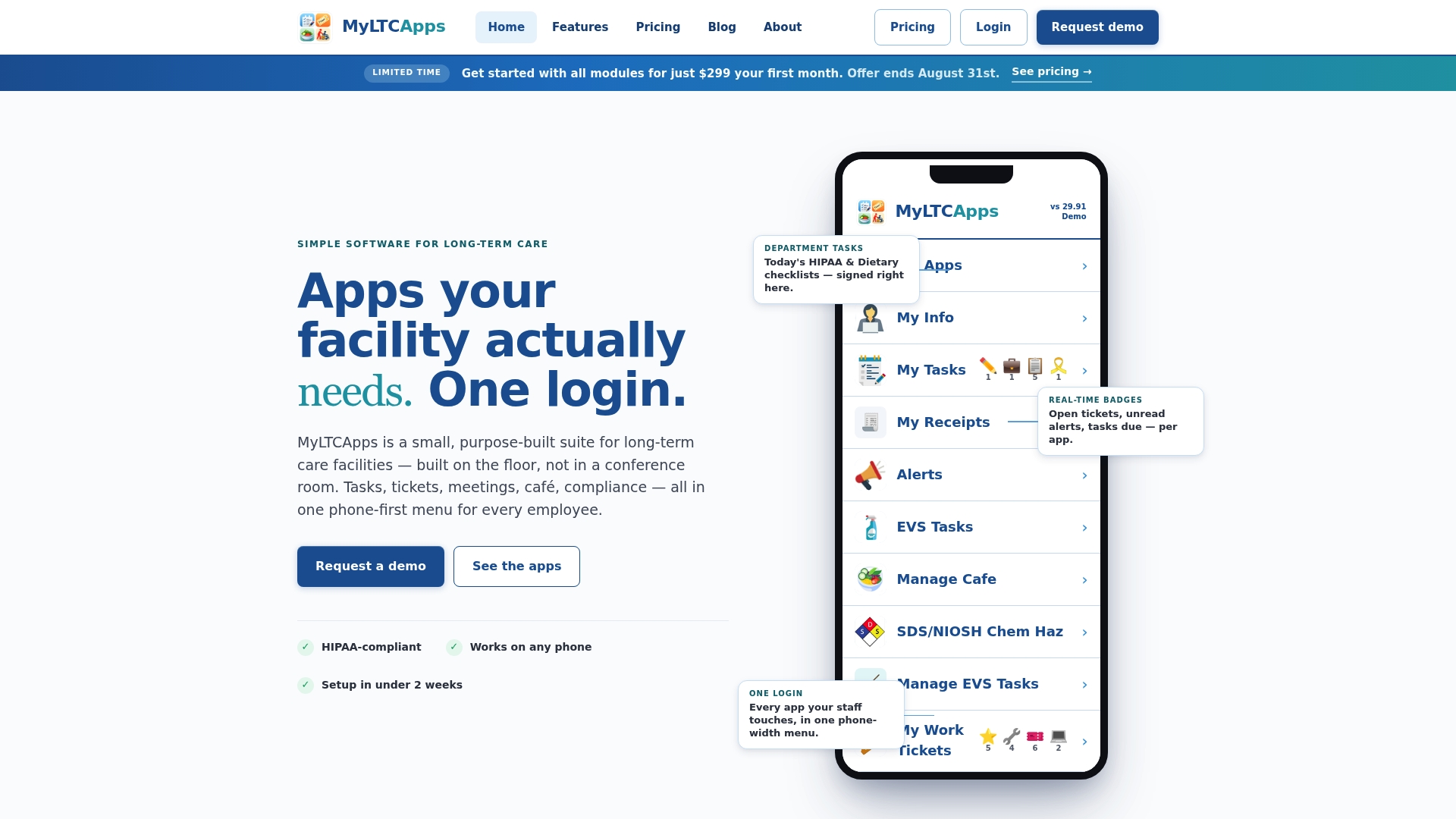
That is why we built MyLTCApps around the care floor. Checklists, work tickets, alerts and compliance tasks live in one phone-first menu, reachable in about three taps and usable with one thumb. Staff do not have to learn a heavy system, so the information arrives complete and on time.
Our view is that a small set of KPIs, each tied to a task someone actually performs, does more for survey readiness and QAPI than a large dashboard. When the task record and the KPI come from the same tap, you spend your meeting time deciding what to change and not reconciling spreadsheets.
Our compliance libraries are seeded with HIPAA, Section 1557, dietary, QAPI and emergency preparedness content, and reporting can be exported in a survey-ready form, so your operational KPIs and your documentation stay connected.
Philip
Put operational KPIs on your team’s phones
MyLTCApps is a phone-first suite for long-term care and skilled nursing facilities. It covers task management, compliance tracking, work tickets, shift scheduling, alerts, incident reporting and operational dashboards. Pricing is per facility and per module, with published plans at $199, $299, $499 and $792 per month. See the details on our pricing page.
If your first KPI project is compliance-related, start with the Compliance Suite or our QAPI software for goals and performance improvement projects.
FAQ
What is a good example of a KPI in a nursing home?
The percentage of assigned daily checklists completed by the end of the shift is a simple one: tasks completed divided by tasks assigned, multiplied by 100. A clinical example is falls with major injury, which CMS includes in its quality measures. Both have a clear numerator and denominator, which is what makes them usable.
Which KPIs does CMS require nursing homes to report?
CMS collects resident assessment data through the MDS and direct-care staffing data through Payroll-Based Journal. It uses that data, plus inspection results, to produce the Five-Star ratings. Other KPIs, such as task completion or ticket turnaround, are internal choices that support your QAPI program.
How many KPIs should a facility track?
There is no regulatory number. Many administrators begin with a handful across care, staffing, operations and finance, then expand once each one has an owner and a review habit. A short list reviewed on schedule is more valuable than a long one that is ignored.
Can I compare my results with other facilities?
Yes, if the definitions match. Check the formula, exclusions, time period and case-mix adjustment before you draw a conclusion. CMS Care Compare and your own prior periods are the most dependable comparisons.
Sources
- AAPACN QAPI Meeting Tool (2022)
- Practical guidance for selecting key performance indicators in healthcare
- CMS Nursing Home Quality Measures
- CMS SNF Quality Reporting Program Measure Calculations and Reporting Users’ Manual
- CMS Measure Indicator Development Worksheet
- CMS Nursing Home Five-Star Quality Rating System: Technical Users’ Guide
- CMS PBJ Policy Manual
- CMS Nursing Home Data and Care Compare Updates (QSO-24-14-NH)
- CMS Nursing Home Affiliated Entity Performance Measures (January 2025)
- State of the Skilled Nursing Facility Industry (2023 report)
- CMS QAPI Written Plan How-To Guide
- CMS QAPI at a Glance