Incident Command in a Nursing Home: NHICS Setup and Drill Records

Incident Command in a Nursing Home: NHICS Setup and Drill Records
A nursing home runs incident command by using the Nursing Home Incident Command System (NHICS): a standard chain of command with named roles, written into your emergency operations plan and activated early, before an event gets out of hand. It is the FEMA Incident Command System, adapted for long-term care. Federal rules also require you to train on your plan, test it, and document what happened in every drill and real event. This guide covers the structure, the activation steps, the federal requirements and what a good evacuation drill record contains.
TL;DR
- NHICS is the nursing home version of the FEMA Incident Command System. It gives every emergency one commander, defined roles and one set of objectives.
- Define activation triggers in your emergency operations plan (EOP) and activate early. It is easier to stand down than to catch up.
- 42 CFR 483.73 requires a risk assessment, policies, a communication plan, and a training and testing program.
- Every drill record should show who ran it, when, who took part, what was simulated, what went wrong and how long evacuation took.
- Analyze each drill and event, then revise the plan. That last step is the one surveyors ask about.
Table of Contents
- What incident command means in a nursing home
- The roles in an NHICS structure
- How to activate NHICS
- What federal rules require
- Evacuation drills: who takes part
- What evacuation drill documentation should contain
- Closing the loop: analyze, correct, revise
- Common gaps we see in incident command plans
- Perspective
- Put your drill records and checklists on every phone
- FAQ
- Sources
What incident command means in a nursing home
Incident command is a way of organizing people during an emergency so that decisions are made by one accountable person, tasks are assigned by role rather than by who happens to be nearby, and everyone works toward the same objectives. The FEMA Incident Command System (ICS) is used in both the public and private sectors. Nursing homes adapted it to their own needs as NHICS, which lets a facility fit into the wider emergency management system used by fire departments, emergency management agencies and hospitals.
The reason this matters on a care floor is simple. During a fire alarm, a power loss or a flood warning, your normal routine stops working. The charge nurse is still responding to residents, the administrator is on the phone with a family member, and the maintenance lead is checking a panel. Without a structure, three people give three different instructions. With NHICS, one person holds authority and the rest of the team knows who to report to.
NHICS is built for facilities with limited staff, which is why it differs from the hospital version (HICS). A nursing home on a Sunday night may have a handful of people on duty. NHICS lets those people double up on roles and scale the structure up as help arrives, instead of requiring a full roster that does not exist.
The roles in an NHICS structure
The structure is a small command group on top of functional sections. You do not fill every box on day one. You fill the boxes the incident needs, and the person in charge can combine roles.
| Role | What it covers in practice |
|---|---|
| Incident Commander | Holds overall authority. Sets objectives, decides priorities, approves evacuation or shelter-in-place. |
| Safety Officer | Watches for hazards to residents and staff and can stop unsafe actions. |
| Liaison Officer | Is the contact for outside agencies such as fire, EMS, the health department and partner facilities. |
| Public Information Officer | Handles messages to families, media and the public so that only one voice speaks for the building. |
| Section Chiefs | Lead operations, planning, logistics and finance/administration as the incident grows. |
Two habits make this work. First, name a primary and at least two backups for each role, because emergencies do not wait for the administrator to arrive. Second, keep the role descriptions short enough to fit on a card or a phone screen. Nobody reads a 40-page binder during a power outage.
At the start, the first qualified person on site, often the charge nurse or the manager on duty, takes the Incident Commander role and hands it off when a more senior leader arrives. Write that handoff into your plan so it is not improvised.
How to activate NHICS
Activation and use should be clearly defined in your EOP. Guidance for Arizona nursing homes recommends early activation so you have a consistent process as the event changes in size, complexity and scope. In other words, do not wait until you are sure an event is serious. Start the structure, and scale it down if the problem resolves.
A workable activation process looks like this:
- Write the triggers. List the events that start NHICS: fire alarm with confirmed smoke or fire, loss of power beyond the generator’s ability, a boil-water or no-water situation, severe weather warnings, an infectious disease outbreak, a missing resident, a threat to the building.
- Name who can activate. Any charge nurse or manager on duty should have the authority, with an immediate call to the administrator.
- Declare it out loud. The first person says the incident type, their name and that they are Incident Commander until relieved. Write it down with the time.
- Assign the command group. Pick a Safety Officer, a Liaison and a Public Information Officer, even if one person covers two of them.
- Set objectives for the first operational period. Keep them short: resident safety, accountability for everyone in the building, communication, and resource needs.
- Document as you go. Start a timeline of decisions, calls and resource requests. You will need it for the after-action review.
- Demobilize deliberately. Announce the end of the incident, collect the records and schedule a debrief.
If you want to see how this fits into a full readiness program, our guide to emergency preparedness for US nursing homes walks through building the plan toward survey readiness.
What federal rules require
Incident command is the working core of the emergency preparedness program that CMS requires. Under 42 CFR 483.73, long-term care facilities must maintain an emergency preparedness program that includes a risk assessment, policies and procedures, a communication plan, and a training and testing program. They must also comply with applicable federal, state and local requirements.
That last phrase deserves attention. Your state fire marshal, state health department and local emergency management office may add requirements on drill frequency, evacuation routes or record keeping. Build the plan to the strictest rule that applies to you, and keep the local contact numbers in your Liaison Officer’s kit.
Here is how the pieces connect:
- Risk assessment tells you which events deserve an NHICS trigger.
- Policies and procedures state how the structure activates and who fills each role.
- Communication plan is the Liaison and Public Information Officer’s playbook.
- Training and testing is where drills and tabletop exercises come in.
There is one useful provision for facilities that handle a real event. According to the ASPR TRACIE summary of the CMS rule and guidance, a facility that activates its emergency plan during an actual emergency is exempt from its next required full-scale community-based or facility-based functional exercise. Document the event as thoroughly as you would a drill, because that record is what supports the exemption.
For the exercise side, see our walkthrough of an HSEEP-aligned tabletop exercise, which is a low-cost way to rehearse command roles without moving a single resident.
Evacuation drills: who takes part
Drill rules vary by state, so check with your state fire marshal for frequency and timing. As one example, Minnesota’s State Fire Marshal guidance on fire drills says residents should participate to the extent possible, and that infirm or bedridden residents are not required to be moved during drills.
A few practical points follow from that:
- Rotate drills across all shifts, including nights and weekends, so every team practices with the staffing it actually has.
- Vary the scenario. A fire in a resident wing and a fire in the kitchen call for different routes.
- Use drills to practice command, not just movement. Have the charge nurse declare NHICS, name the command group and set objectives, so the structure is a habit before it is needed.
- Include agency staff and new hires, who are the people most likely to hesitate.
What evacuation drill documentation should contain
Surveyors do not just ask whether you ran a drill. They ask for the record. The same Minnesota guidance lists what a drill record should include: the person who conducted the drill, date and time, notification method, staff on duty and participating, number of occupants evacuated, simulated conditions, problems encountered, weather and evacuation time.
Turn that into a template your team can fill out in two minutes:
| Field | Why it matters |
|---|---|
| Drill conductor | Shows who is accountable and who can answer questions. |
| Date and time | Proves the drill rotation covers all shifts. |
| Notification method | Confirms alarm, overhead page or phone alert actually reached staff. |
| Staff on duty and participating | Shows who was trained and who was missed. |
| Occupants evacuated | Shows resident participation and how many were moved. |
| Simulated conditions | Records the scenario, such as blocked exit or smoke in a corridor. |
| Problems found | Feeds directly into corrective action. |
| Weather | Matters for outdoor assembly and transport. |
| Evacuation time | Gives a number to beat next time. |
Add two fields of your own: the NHICS roles that were activated, and the corrective actions assigned with an owner and a due date. Those make the record useful, not just compliant.
How long to keep drill records
The Minnesota State Fire Marshal Division recommends keeping fire drill records for at least three years, and having at least two people in the facility who know where they are, so someone can produce them during an inspection. Check your own state’s retention rule, and keep tabletop and real-event records on the same schedule. If your retention practices are loose, our guide to healthcare document retention shows how to tighten them quickly.

For paper versus phone-based logs, see our fire drill log templates.
Closing the loop: analyze, correct, revise
A signed log is not the end of the process. The federal rule expects you to analyze and document your response to all drills, tabletop exercises and emergency events, and to revise your emergency plan as needed. A facility that runs ten drills and never changes anything has not met the spirit of that requirement.
A simple after-action routine takes 30 minutes:
- Hold a hot wash right after the drill. Ask each participant what worked and what did not while it is fresh.
- Sort findings into three buckets: people (training gaps), equipment (a radio that did not charge, a door that stuck), and plan (a role no one could fill).
- Assign each fix an owner and a date. Put it on the same list the administrator reviews weekly.
- Update the EOP. Note the revision date and what changed.
- Retest the fix. The next drill should target the weakness found in the last one.
Facilities often struggle to turn this kind of documentation into steady operational habits. Resources on improving nursing home staff efficiency can help when you are looking at how teams record, review and act on what they find.
Related scenarios use the same command structure. A missing resident is an incident that deserves its own activation triggers, which our elopement playbook covers. Power loss ties to your generator test log, and a water outage ties to an emergency water supply plan.
Common gaps we see in incident command plans
These are patterns worth checking against your own plan:
- Roles assigned to titles that are not on site at night. Assign by shift, with backups.
- Triggers written vaguely. “Serious event” is not a trigger. “Loss of main power for more than the time the generator can carry the building” is.
- Records scattered across binders, shared drives and notebooks. When a surveyor asks for last year’s night-shift drill, someone has to find it in minutes.
- No link between findings and plan revisions. The drill log says a problem occurred, but the EOP is unchanged.
- Command practiced only by the administrator. If only one person has ever declared an incident, the structure collapses on the night that person is away.
Perspective
We built MyLTCApps around the people who actually face an emergency first: the aide, the nurse and the maintenance tech holding a phone, not the person at a desk with a binder. Incident command works when the structure is simple enough to use in the first three minutes. That is why we designed our apps so common actions are reachable in three taps with one thumb.
Our view is that preparedness is mostly a documentation and habit problem. Most facilities have a plan. What they lack is a way for every shift to run the checklist, log the drill, and see the open corrective actions without hunting through paper. A phone-first checklist and a surveyor-ready export make that routine instead of a scramble before survey season.
We also think compliance libraries should be seeded, not blank. Starting from emergency preparedness, HIPAA, dietary and QAPI content means your team edits a working draft instead of building from zero, which is how onboarding gets faster.
Philip
Put your drill records and checklists on every phone
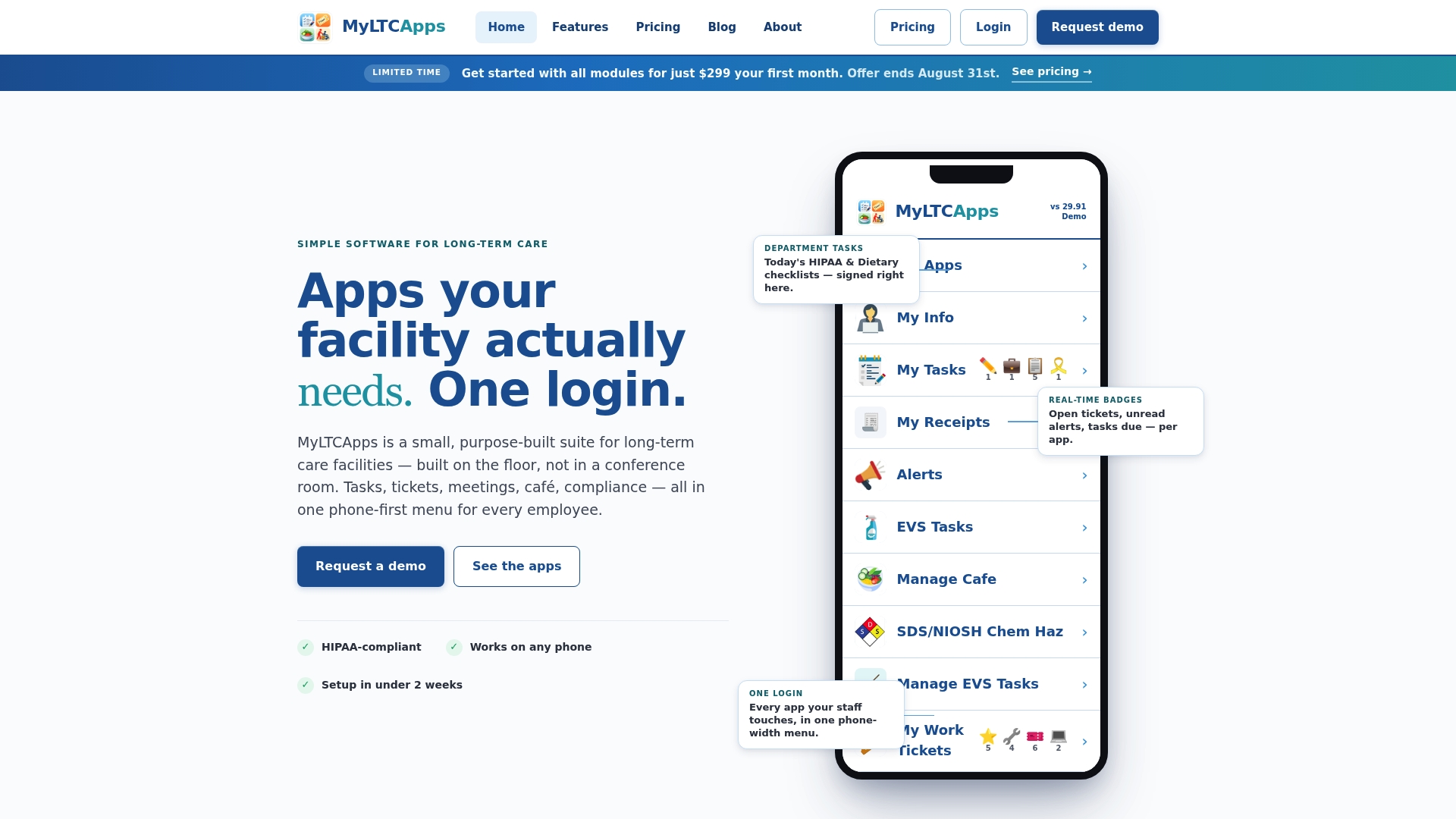
If your plan is sound but your records live in binders, our Compliance Suite gives long-term care teams seeded libraries for emergency preparedness, mobile checklists for each shift and surveyor-ready reporting exports. Staff complete tasks from their own phones, and administrators see what is done and what is open. MyLTCApps does not include medical charting. It focuses on operations, compliance and communication.
Plans are priced per facility and per module. Published pricing runs from the I Just Want That plan at $199 per month, to the Starter Pack at $299 per month, the Growth Pack at $499 per month and the Premium Pack at $792 per month. See the full plan details, explore the Compliance Suite, or look at daily checklist software for the shift-by-shift routine.
FAQ
What is the difference between ICS and NHICS?
ICS is the FEMA standardized emergency management model used across public and private sectors. NHICS is the version adapted for nursing homes, so a facility can use the same logic as responding agencies while scaling roles to a small staff.
When should a nursing home activate its incident command system?
When your EOP says so, and earlier rather than later. Guidance recommends early activation so the process stays consistent as an event grows or changes. Write specific triggers into the plan and let any manager on duty declare activation.
What should an evacuation drill record include?
Include the conductor, date and time, notification method, staff on duty and participating, occupants evacuated, simulated conditions, problems, weather and evacuation time, as listed in Minnesota’s fire drill guidance. Add corrective actions with owners and dates.
Does a real emergency count as a drill?
In part. Under the CMS rule as summarized by ASPR TRACIE, a facility that activates its plan in an actual emergency is exempt from its next required full-scale functional exercise. You still need to document and analyze the event and revise the plan as needed.
Sources
- NHICS Guidebook (California Association of Health Facilities)
- Nursing Home Incident Command System (NHICS), EPIC
- 42 CFR 483.73 Emergency preparedness
- ASPR TRACIE: CMS Emergency Preparedness Rule, Long Term Care Requirements
- Minnesota Department of Health: Fire Drills
- 42 CFR 483.73, Code of Federal Regulations (GovInfo)
- Improving staff efficiency guide for nursing homes