Start in 10 Minutes: OSHA Four Step Fall Investigation for U.S. LTC
Start in 10 Minutes: OSHA Four Step Fall Investigation for U.S. LTC
Start the fall incident investigation immediately, and preserve the scene before anything gets moved or cleaned; for detailed international guidance, see our incident-reporting guide for businesses. Follow OSHA’s four-step systems approach: preserve and document, collect information, determine root causes, and implement corrective actions. Put a trained investigator and a worker representative on the initial team, and make sure medical care comes first, evidence second.
TL;DR:
- Most root causes of falls are systemic failures, such as staffing shortages or delayed cleaning, rather than the immediate hazard like a wet floor.
- Investigations should be initiated within the first hour to prevent evidence loss and include scene documentation through photos, sketches, and environmental notes.
- Collecting witness statements and records in sequence is essential to build an accurate timeline and separate facts from assumptions.
- Corrective actions must be SMART, owner-assigned, and verified through follow-up procedures to ensure they address systemic issues effectively.
- In long-term care, reviewing recent medication changes, care plan adherence, and involving clinical staff is critical to identifying clinical and environmental risk factors.
Table of Contents
- What Are the First Steps in a Fall Incident Investigation?
- How Do You Collect Information and Reconstruct the Timeline?
- How Do You Find the Root Cause of a Fall?
- How Do You Write Corrective Actions That Actually Stick?
- What Belongs in a Fall Incident Report?
- What Extra Steps Apply in Long-Term Care Settings?
- Building Trust Through Investigation, Not Blame
- How MyLTCApps Supports Your Investigation Workflow
- Sources
- FAQ
What Are the First Steps in a Fall Incident Investigation?
The first ten minutes after a fall decide whether your investigation produces real answers or guesswork. Get medical attention started, then lock down the area before anyone straightens a rug, mops a spill, or moves a wheelchair back into place.
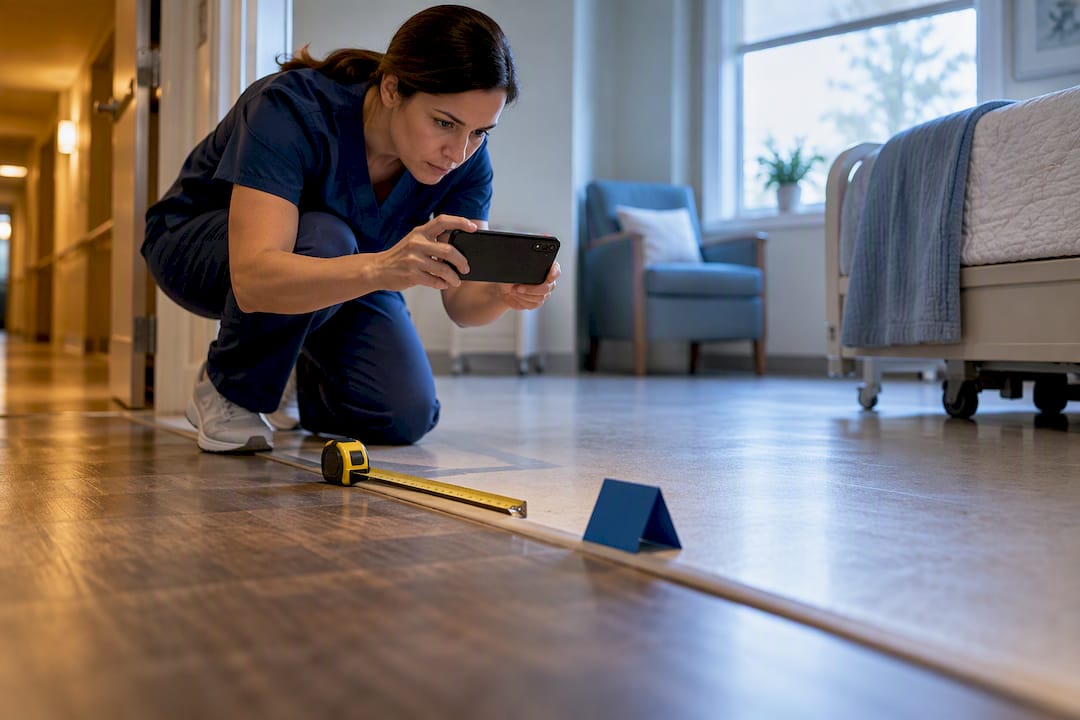
Cordon off the immediate area, limit foot traffic, and post someone at the entry point if you’re in a hallway or common area. Photograph and sketch before you touch anything.
- Take wide shots that show the whole scene, then medium shots, then close-ups of the specific hazard, each with a scale reference like a ruler or coin.
- Sketch the layout: furniture placement, distance from the fall point to the nearest exit, doorway, or obstruction.
- Note environmental conditions: lighting levels, floor surface and material, visible spills or debris, the person’s footwear, and any mobility aid nearby.
- Log a simple chain of custody. If you move an object, write down when, why, and who authorized it.
Pro Tip: Photograph the floor at the same angle a walking person would see it. Overhead shots miss glare, wet patches, and uneven transitions that are often the actual hazard.
Photo and sketch evidence degrades fast once housekeeping or maintenance steps in, so document first and clean second.
How Do You Collect Information and Reconstruct the Timeline?
Once the scene is documented, move to interviews and records. Order matters here, because memories shift and get influenced by conversations with coworkers.
- Talk to first responders and anyone who provided immediate aid, while details are fresh.
- Interview direct witnesses individually, not as a group, using open-ended questions like “What did you see?” rather than leading ones.
- Speak with the injured person when medically appropriate, and always ask permission before recording or taking notes verbatim.
- Pull the surrounding records: staffing rosters, training logs, maintenance and inspection history, surveillance footage, and clinical notes where privacy rules allow access.
Build the timeline in sequence: last known safe condition, the activity right before the fall, the moment of discovery, and the response that followed. Keep facts and assumptions in separate columns on your notes. A structured investigation template that forces this separation catches vague conclusions before they make it into the final report.
- Mark anything unconfirmed as “unverified” rather than presenting it as fact.
- Cross-check witness accounts against physical evidence like sketches and photo timestamps.
How Do You Find the Root Cause of a Fall?
Most falls trace back to more than one failure, and the 5 Whys technique is the fastest way to get past the obvious answer. Start with the proximate cause and keep asking “why” until you hit something systemic.
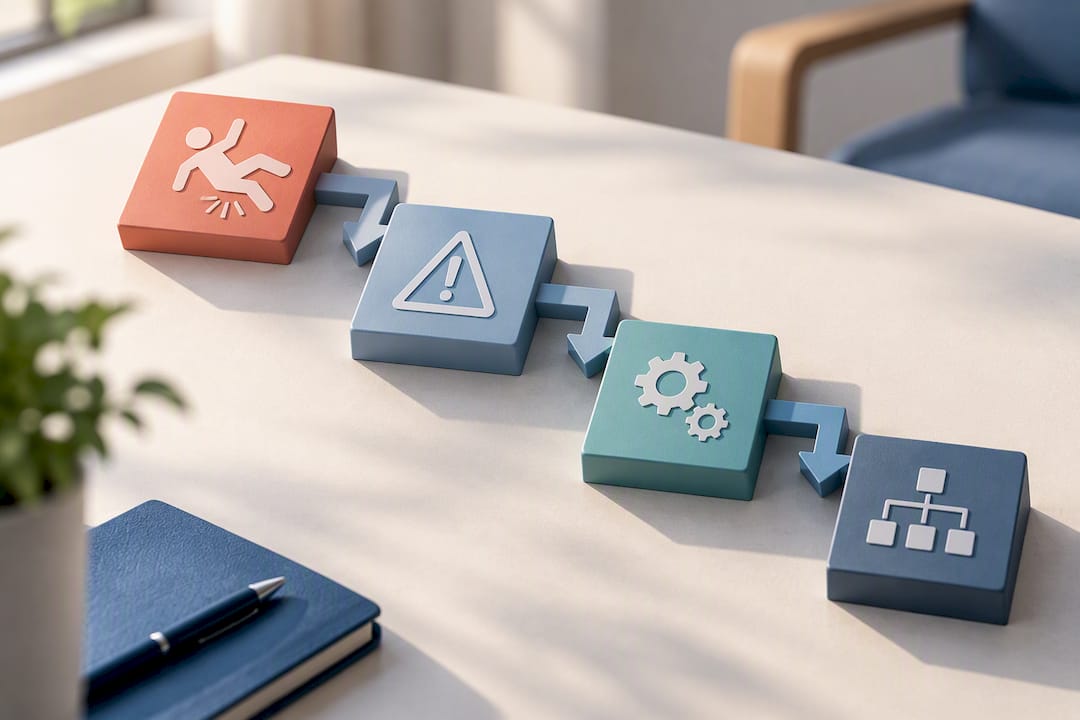
A typical chain looks like this: Why did the resident fall? The floor was wet. Why was the floor wet? A spill wasn’t cleaned. Why wasn’t it cleaned? The housekeeping round was late. Why was it late? Staffing was short that shift. Why was staffing short? No backup coverage plan existed for call-outs.
That last answer, not the wet floor, is what actually needs fixing.
- Environment: lighting, flooring, clutter, weather exposure near entrances.
- Equipment: wheelchairs, gait belts, bed rails, call lights that were out of reach.
- Procedures and training: whether staff followed the SOP and whether they’d been trained on it recently.
- Supervision and clinical factors: staffing ratios, medication timing, care-plan adherence.
Pro Tip: If your root cause statement could be fixed by telling one employee to “be more careful,” you haven’t found the root cause yet. Keep asking why.
OSHA’s investigation guide frames this as a systems check, not a hunt for who to blame, and that framing changes what you write down.
How Do You Write Corrective Actions That Actually Stick?
A root cause without a corrective action is just an interesting observation. Every fix needs to specify what changes, who owns it, and how you’ll confirm it worked.
- Write each action as SMART: specific, measurable, assigned, realistic, and time-bound. “Improve floor safety” isn’t SMART. “Environmental services checks and mops spill zones every two hours, verified by supervisor sign-off starting Monday” is.
- Split immediate mitigation from program-level change. Mopping the spill is immediate. Rewriting the cleaning schedule and adding backup staffing coverage is the program fix.
- Assign one accountable owner and a due date, not a department.
- Define the verification method up front, whether that’s a follow-up audit, a spot check, or a repeat incident count over 30 days.
- Track every action to closure in a single log, not scattered emails.
- Review trend data monthly to catch repeat root causes across multiple incidents, a pattern a single report will never show you.
A falls prevention program built to survive an audit treats this closure step as non-negotiable, not optional paperwork.
What Belongs in a Fall Incident Report?
OSHA regulation 1960.29 requires investigations proportionate to the severity of the incident, and it specifies core report fields: date, time, location, photographs, interviews, and measurements. Your resident fall incident form or workplace equivalent should hit every one of these.
- Incident overview: who, what, where, when, and severity of injury.
- Full timeline, witness statements, and root-cause analysis with primary versus contributing causes clearly separated.
- Corrective action log with owners, due dates, and verification status.
- Supporting attachments: photos, sketches, maintenance records, and relevant surveillance clips.
| Report Section | What It Should Contain |
|---|---|
| Incident Overview | Date, time, location, injury severity, immediate response taken |
| Evidence | Photos, sketches, environmental notes, measurements |
| Interviews | Witness statements, timestamps, interviewer notes |
| Root Cause Analysis | Primary cause, contributing factors, 5 Whys chain |
| Corrective Actions | Action, owner, due date, verification method, closure date |
Standard templates, like the sample fall investigation form from the University of Tennessee, improve consistency across investigators and make trend analysis across multiple incidents possible instead of guesswork. Store completed reports where authorized safety staff can retrieve them, and restrict distribution when clinical details are involved.
What Extra Steps Apply in Long-Term Care Settings?
Fall investigations in care facilities carry a clinical layer that a typical workplace slip and fall doesn’t. Medication changes, recent diagnoses, mobility aid condition, and care-plan adherence all deserve a direct look, and the Comagine Falls Investigation Guide recommends resident-centered review as a standard step, not an add-on.
- Review recent medication changes, mobility status, and whether the care plan was actually followed on shift.
- Include nursing leadership, environmental services, and maintenance staff on the investigation team, not just safety personnel.
- Document family or responsible-party notification per your facility’s policy, with timestamps.
Pro Tip: Loop maintenance in before you finalize root causes. A “training issue” often turns out to be a work order that sat open for three weeks.
A phone-first system for logging incidents, assigning follow-up tasks, and exporting reports can cut the lag between finding a cause and getting it fixed, especially across shifts where handoffs are the weak point.
Building Trust Through Investigation, Not Blame
A no-blame framing gets you better witness cooperation and more near-miss reports, because staff who fear discipline stop volunteering what they saw. Present findings as system gaps in staff meetings, not individual failures, and feed each investigation’s lessons into your recurring safety agenda.
— Philip
How MyLTCApps Supports Your Investigation Workflow
Myltcapps is built for the exact workflow this article walks through: capture the incident on a phone, attach photos on the spot, assign corrective tasks with due dates, and verify closure before the next survey walks in the door.
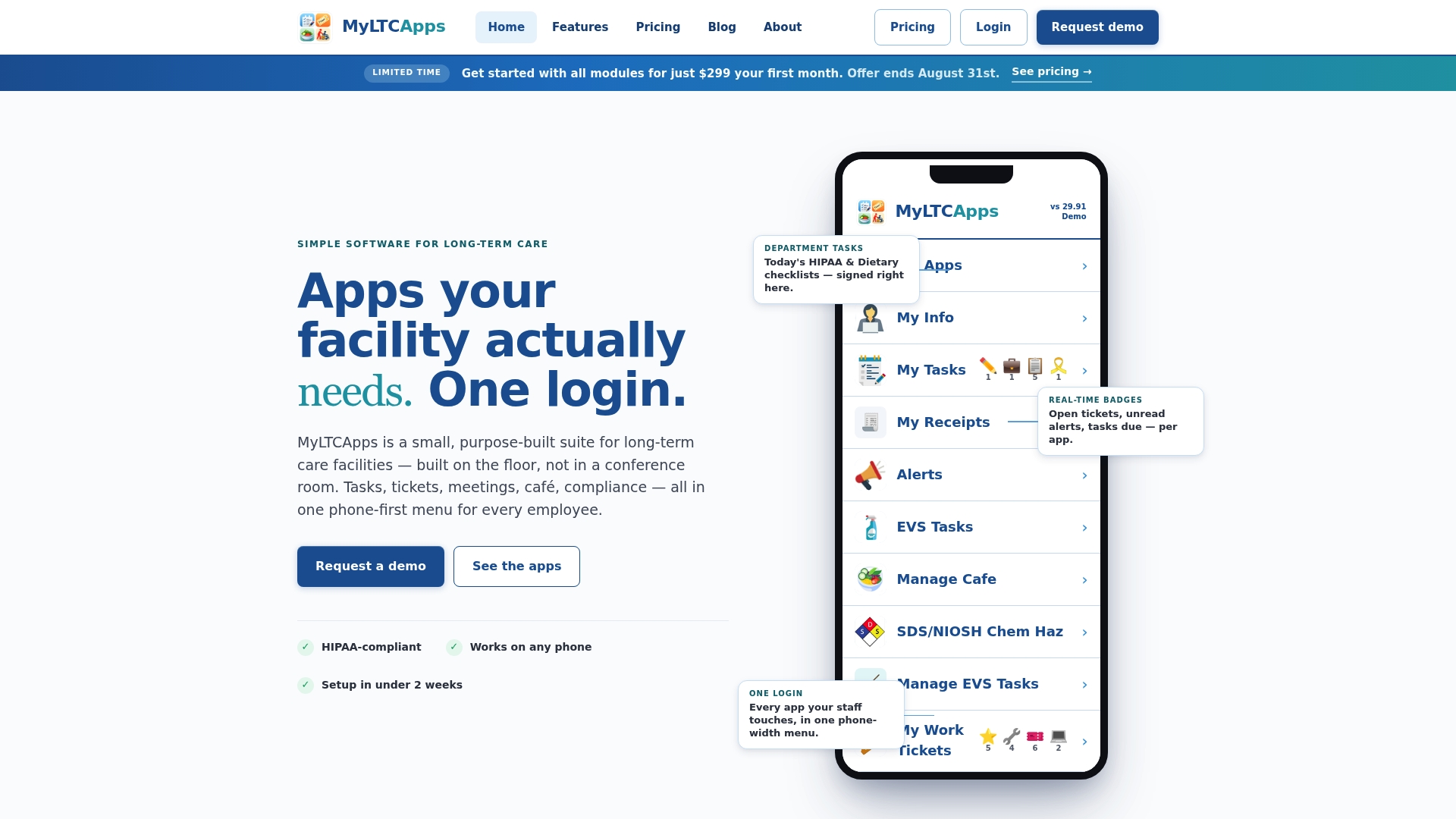
The workflow is simple in practice. A staff member logs the incident through incident reporting, attaches scene photos before anything gets cleaned, and the system routes a work ticket to maintenance or environmental services with an owner and deadline attached. Compliance staff can then pull a survey-ready export instead of rebuilding the paper trail by hand. See how My Work Tickets handles that handoff, or check the Compliance Suite for report exports built around this exact use case. Plans start with the I Just Want That package at a monthly price, scaling up through Starter, Growth, and Premium packs as your facility’s needs grow. If you’re ready to see it running against your own incident process, visit the pricing page to pick the plan that fits your facility.
Sources
- Incident Investigation - Overview | Occupational Safety and Health Administration
- Falls Investigation Guide (Comagine Health)
- Fall hazard investigation form (University of Tennessee example)
FAQ
What Are the Four Steps of a Fall Incident Investigation?
The OSHA systems approach breaks it into four steps: preserve and document the scene, collect information through interviews and records, determine root causes, and implement corrective actions. Each step builds on the last, so skipping the documentation stage weakens everything that follows.
How Do You Write an Incident Report on a Fall?
Structure the report around an incident overview, a full timeline, witness statements, root-cause analysis, and a corrective action log with owners and due dates. Include photos, sketches, and any measurements taken at the scene, since OSHA’s accident investigation standard specifically calls out these documentation types.
What Is the 5 Whys Method in Fall Investigations?
The 5 Whys is a technique that repeatedly asks “why” until you move from the surface cause, like a wet floor, to the systemic cause behind it, like a delayed cleaning schedule caused by understaffing. It’s one of the simplest tools for turning a vague finding into a specific, fixable corrective action.
Who Should Be on a Fall Investigation Team?
A trained investigator should lead, with a worker or staff representative included for perspective on the ground. In long-term care settings, nursing leadership, environmental services, and maintenance staff should also participate, since clinical and facility factors often intersect.
How Fast Should You Start a Fall Investigation?
Start within the first hour, before evidence like spills, footwear position, or equipment placement changes. Photos and sketches lose value the moment housekeeping or maintenance touches the scene, so documentation always comes before cleanup.