Pass CMS Surveys With an Emergency Water Supply Plan for U.S. LTC
Pass CMS Surveys With an Emergency Water Supply Plan for U.S. LTC
An emergency water supply plan for a long-term care facility has to guarantee potable drinking water, prioritize non-potable services like sanitation and laundry, and back it all up with documented vendor arrangements that state exact initiation timeframes. It also has to be tested. CMS emergency preparedness rules require an annual review and documented arrangements to restore essential services, and most planning guidance still starts with a simple baseline: roughly one gallon of drinking water per person per day. MyLTCApps exists to turn that plan into assigned tasks, tracked inventory, and a paper trail a surveyor can actually follow.
TL;DR:
- Water demand calculations often underestimate non-potable needs, which can reach up to 25 gallons per resident daily for sanitation and hygiene.
- Vendor contracts must specify response times and include proof of tanker sanitation, not just volume guarantees, to meet regulatory expectations.
- Stored water should be tracked as inventory with labels, digital logs, and regular rotation to prevent spoilage and ensure readiness during outages.
- Regular drills, including actual hookups with vendor equipment, and maintaining detailed records are essential to passing regulatory inspections seamlessly.
- Mobile task management tools improve real-time coordination, task tracking, and documentation, reducing survey delays and ensuring response readiness during water emergencies.
Table of Contents
- Facility Emergency Water Checklist You Can Paste Into Your Plan
- How to Calculate Your Facility’s Water Demand
- What to Put in Your Water Supplier Contracts
- Storing and Rotating Water Without Losing Track of It
- Non-Potable Water: Where Your Real Volume Problem Lives
- Boil-Water Advisories: Testing, Treatment, and Notification Steps
- Drills, Documentation, and What Surveyors Actually Check
- How Mobile Task Tools Fit Into Water Continuity Planning
- Where to Evaluate MyLTCApps for Emergency Water Planning
- Sources
- FAQ
Facility Emergency Water Checklist You Can Paste Into Your Plan
A water outage plan lives or dies on specifics, not intentions. Surveyors and your own staff need a document that names sources, shows connections, and assign names to tasks, not a paragraph of good intentions.
Here’s the core checklist structure that CDC’s emergency water supply planning guide recommends building into any facility plan:
- Potable and non-potable source list with contact names, phone numbers, and addresses for every supplier, plus a secondary vendor for each.
- Facility water diagrams showing valve locations, meter positions, and shutoff procedures, labeled clearly enough for a substitute maintenance tech to follow.
- Tanker logistics covering where trucks park, how hookups connect to your system, and who unlocks gates or supervises deliveries after hours.
- Current inventory count of stored water, updated on a set schedule and stored somewhere staff can find it during a crisis, not just during an audit.
- Assigned responsibilities naming who activates the plan, who calls vendors, and who documents the response as it happens.
How to Calculate Your Facility’s Water Demand
Most facilities underestimate non-potable demand and overthink drinking water. Drinking water math is simple: plan on one gallon per person per day as your baseline, covering both residents and on-site staff during a shift. Some state guidance frames it as 2 liters per person per day for drinking specifically, then separates out a much larger non-potable figure, sometimes as high as 25 gallons per resident per day for toilets, hygiene, and cleaning.
For a 60-bed facility running with roughly 20 staff on site, your numbers might look like this:
- Drinking water: 80 people × 1 gallon = 80 gallons/day
- Non-potable needs: 60 residents times a substantial number of gallons recommended by some state guidelines for sanitation and hygiene
- Daily total: roughly the sum of potable and non-potable needs based on standard guidelines
- Three-day supply: about three times the daily total
- Seven-day supply: about seven times the daily total, plus a contingency margin for spills, waste, and unplanned staff surges
Document these numbers with your assumptions attached. A surveyor asking “how did you get this figure” deserves a real answer, not a shrug.
What to Put in Your Water Supplier Contracts
A supplier contract that doesn’t name a response time isn’t a plan, it’s a hope. CMS interpretive guidance expects contracts to state the expected initiation timeframe for restoring service, and that detail is exactly what surveyors ask to see first.
Your vendor agreements should specify:
- Guaranteed initiation timeframe from the moment you call to water arriving on site
- Minimum delivery volume per trip and how many trips per day the vendor can sustain
- Proof of tanker sanitation, since a truck used for non-potable hauling one week can’t safely deliver drinking water the next
- Who handles hookup and backflow prevention, and whether your maintenance team or the vendor’s crew does the physical connection
- A named secondary vendor if your primary can’t respond, with the same terms documented
Update contact information on a set cadence, quarterly works for most facilities, and test the arrangement in an actual drill rather than trusting the paperwork.
Pro Tip: Run at least one drill using the exact hoses, pumps, and fittings your contract vendor would use in a real event. A hookup that looks fine on paper sometimes doesn’t match your facility’s actual valve threading, and you only find that out the hard way if you wait for a real emergency.
Storing and Rotating Water Without Losing Track of It
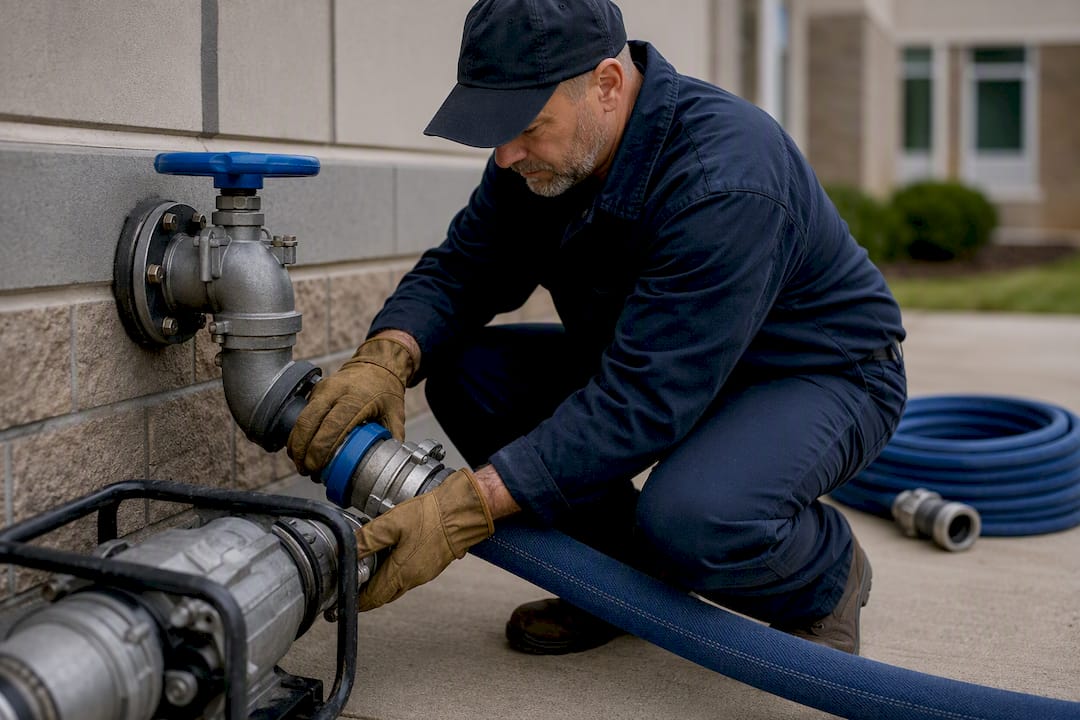
Bottled water sitting untracked in a back hallway is a liability, not an asset. Emergency water checklist guidance for LTC facilities recommends treating stored water the way you’d treat any tracked inventory, not a forgotten supply closet.
- Store containers in a cool location above potential flood level, away from direct sunlight and chemical storage
- Label every container with the fill date and rotation deadline based on the manufacturer’s guidance
- Set a recurring rotation review, every six months is a common cadence, and assign someone to actually do it
- Log dates and movement digitally rather than relying on a handwritten sheet that can go missing during the exact event you need it for
- Keep a portable portion of your supply pre-packed for evacuation, separate from your bulk storage
Treating your water supply as an inventory asset with rotation and digital tracking rather than a passive stockpile is the single biggest gap between facilities that pass inspection cleanly and those that scramble.
Non-Potable Water: Where Your Real Volume Problem Lives
Sanitation, not drinking water, is usually where a water outage actually threatens resident care. Toilets, hand hygiene, and laundry consume far more water than anyone drinks, and infection control depends on keeping those functions running even when potable supply is scarce.
- Non-potable sources can include pool water, rain collection, or non-treated municipal backup, as long as it never crosses into drinking use
- Conserve through single-use dishware, outsourced laundry service during an extended outage, and dry bathing alternatives for residents when water pressure drops
- Prioritize hand hygiene and toilet function first, kitchen cleaning second, and cosmetic uses like general mopping last
- Document every conservation decision as it’s made, since surveyors want to see reasoning, not just outcomes
Facilities that plan sanitation first tend to weather outages with far less disruption to daily resident routines than those that treat it as an afterthought behind drinking water.
Boil-Water Advisories: Testing, Treatment, and Notification Steps
A boil-water advisory isn’t a suggestion, it’s a trigger for a specific sequence of actions. Here’s the operational order:
- Confirm the advisory source, either your municipal water provider or your own test results showing contamination.
- Notify staff immediately through your alert system, then notify resident families and the local health department if the outage or contamination is expected to run longer than a few hours.
- Switch food and drinking preparation to bottled or boiled water until the advisory lifts.
- If treating stored water directly, household bleach can disinfect water in an emergency at manufacturer-specified dosages and contact times, never improvised ratios.
- Rely on municipal or lab testing for final clearance rather than assuming an advisory has lifted based on time alone.
- Record every step: who issued the notification, when treatment started, and when clearance was confirmed.
State-level guidance from North Carolina’s health department recommends notifying the health department if an outage exceeds four hours, a threshold worth adopting even outside that state.
Drills, Documentation, and What Surveyors Actually Check
Surveyors don’t take your word for it, they want the paper trail supported by regular emergency lighting testing and other documented drills. A plan surveyors will accept needs annual review at minimum, with tabletop exercises and at least one full drill scoring how your team performs against the actual water demand numbers you calculated.
- Schedule an annual plan review, plus a tabletop exercise mid-year and a full physical drill at least once a year
- Keep your risk assessment, vendor contracts, current inventory logs, and drill after-action reports in one accessible location
- Document corrective actions from every drill, not just the drill itself, since survey protocols specifically look for evidence of testing and follow-through
- Use digital checklists to assign drill tasks and capture completion timestamps automatically rather than reconstructing a timeline from memory afterward
Facilities that treat drills as documentation exercises rather than box checking generally close survey findings faster because they can pull records instead of explaining gaps.
How Mobile Task Tools Fit Into Water Continuity Planning
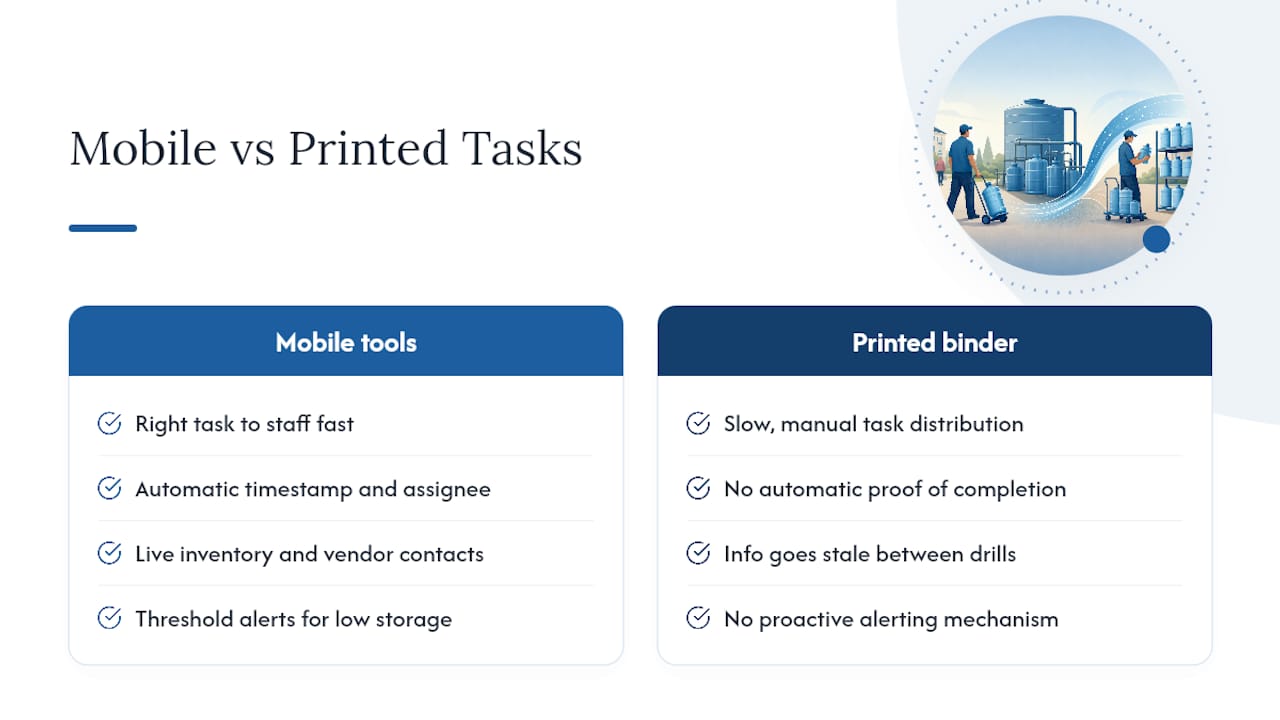
Regulators expect facilities to tailor plans to their own risk profile rather than lean on a generic volume figure, and that tailoring only works if someone tracks execution in real time. Mobile checklist tools solve a specific problem in water events: getting the right task to the right staff member fast, and proving it happened afterward.
Assigning tasks like “check tanker hookup,” “log inventory count,” or “notify family contacts” through a phone-based system beats a printed binder because the completion timestamp and the assigned name are captured automatically. Inventory tracking and vendor contact management stay current between drills instead of going stale in a filing cabinet, and threshold alerts flag when storage dips below your planning target before it becomes a crisis. Facilities running structured emergency preparedness programs, like the frameworks covered in nursing home survey readiness guidance, consistently find that faster documentation during an event translates into faster case closure during survey.
— Philip
Where to Evaluate MyLTCApps for Emergency Water Planning
MyLTCApps gives you the phone-first alternative to a filing cabinet full of binders: your compliance library, vendor contacts, and drill records live in one mobile menu instead of scattered folders no one updates.
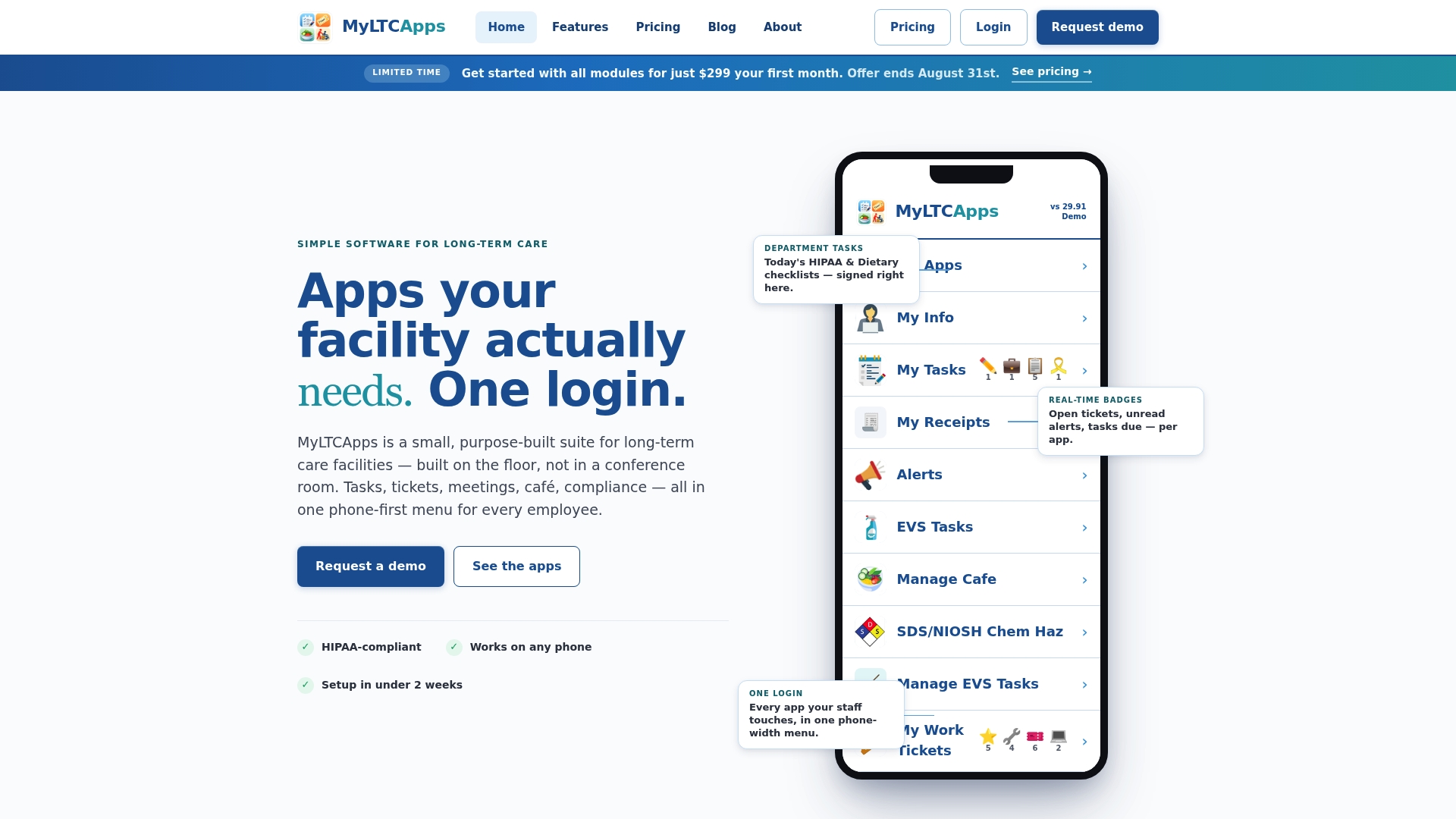
The Compliance Suite holds your seeded emergency preparedness library alongside HIPAA and QAPI documentation, so your water plan sits next to the rest of your survey-ready records instead of standing alone. My Tasks assigns and timestamps drill actions in real time, and Alerts & SMS pushes notifications to staff and family contacts the moment a boil-water advisory or supplier delay hits. My Work Tickets logs the maintenance side, tanker hookups, valve checks, generator fueling, so every physical test has a documented record with a name attached.
Pricing details are available on the MyLTCApps pricing page, with plans scaled based on facility needs for modules and staff. Visit the pricing page to compare plans or request a walkthrough of the Compliance Suite before your next survey window.
Sources
Attach primary sources directly to your written plan rather than paraphrasing them from memory. The CDC emergency water supply planning guide covers the technical side, source documentation and connection procedures. ASPR TRACIE’s CMS emergency preparedness rule summary gives you the regulatory citations to reference directly in your policy language. For drill templates and notification thresholds, North Carolina’s backup water supply plan checklist offers a structure worth adapting even outside that state, and the CMS State Operations Manual survey guidance tells you exactly what a surveyor will ask to see.
- Storing water for an emergency — Utah State University Extension
- Emergency water supply planning guide for healthcare facilities — CDC
- ASPR TRACIE: CMS emergency preparedness rule — long-term care guidance
- CMS State Operations Manual: Emergency preparedness survey guidance
FAQ
How much water should a facility store per resident?
Plan on roughly one gallon per person per day for drinking, covering both residents and on-site staff. Non-potable needs run much higher, with some state guidance suggesting up to 25 gallons per resident per day for sanitation and hygiene.
How often does CMS require an emergency water plan to be reviewed?
CMS emergency preparedness rules require annual review of the emergency plan, including the water supply component, along with documented drills and updates whenever facility risks or supplier arrangements change. Reviews should be dated and kept alongside your risk assessment.
What should a supplier contract for emergency water include?
It needs a stated initiation timeframe for delivery, minimum volume per trip, and proof of tanker sanitation history. CMS interpretive guidance specifically expects contracts to name the expected timeframe for restoring service rather than leaving response time open ended.
When should a facility issue a boil-water advisory?
Issue one as soon as your municipal provider confirms contamination or your own testing shows unsafe results, and notify the local health department if the outage runs past a few hours. Switch to bottled or properly disinfected water immediately and document every step until testing confirms clearance.
Can MyLTCApps help document our emergency water plan for surveys?
Yes. The Compliance Suite stores your emergency preparedness documentation, and My Tasks assigns and timestamps drill actions so you have a record ready when a surveyor asks for evidence. Current pricing and plan details are available on the MyLTCApps pricing page.