Best UpKeep Alternatives for Maintenance Managers

Best UpKeep Alternatives for Maintenance Managers
If you manage maintenance at a long-term care or skilled nursing facility, demo two categories first: a healthcare-first CMMS like Myltcapps and a mid-market field app that shows published pricing. For general industrial or multi-site operations, start with mid-market CMMS platforms before looking at enterprise EAM. That narrows a crowded field fast.
- Healthcare/compliance priority: Myltcapps is the recommended first demo for any LTC or skilled nursing facility. Seeded HIPAA compliance libraries and surveyor-ready reporting exports address requirements that general-purpose CMMS platforms treat as afterthoughts.
- Migration reality check: Switching CMMS platforms typically involves a parallel-running period of 60–90 days to avoid data loss and productivity disruption during cutover.
- Quick-verdict tags by operation type:
- Small single-site teams: Entry-level field apps (fast setup, low cost)
- Multi-site operations: Mid-market CMMS with cross-site PM reporting
- Enterprise/heavy asset: Enterprise EAM with full API and ERP integration
- Healthcare/LTC facilities: Healthcare-first CMMS with built-in compliance support
Table of Contents
- How do the top UpKeep alternatives compare at a glance?
- Why do maintenance teams look for UpKeep alternatives?
- How did we evaluate these alternatives?
- Which UpKeep alternatives should you actually consider?
- How do you choose the right alternative for your operation?
- Why Myltcapps fits long-term care maintenance needs
- Key takeaways and your next three steps
- What actually matters when evaluating CMMS in 2026
- Myltcapps is built for the maintenance workflows LTC facilities actually run
- Sources
How do the top UpKeep alternatives compare at a glance?
The table below maps six alternative categories across the dimensions that matter most in a buying decision. Use it to narrow your demo list to two or three categories, then evaluate specific vendors within those categories.
| Category | Best For | Pricing Model | Key Features | Mobile Experience | Integrations & API | Scalability |
|---|---|---|---|---|---|---|
| Entry-level field apps | Single-site, small teams | Per-user/month, low cost | Work orders, basic PMs, asset lists | Strong, offline-capable | Limited, few native connectors | Single-site only |
| Healthcare-first CMMS | LTC, skilled nursing, senior living | Per-facility/module subscription | Work tickets, compliance libraries, checklists, survey exports | Phone-first, minimal training | Moderate, compliance-focused | Single to multi-facility |
| Mid-market CMMS | Growing multi-site operations | Per-user or per-site tiers | Full PM automation, asset hierarchy, spare parts, reporting | Good, varies by vendor | Strong REST APIs, ERP connectors | Multi-site |
| Enterprise EAM | Large industrial, capital-heavy | License + implementation fees | Full asset lifecycle, ERP integration, digital twins | Variable, often complex | Deep API, SAP/Oracle connectors | Enterprise-grade |
| Sensor/IoT platforms | Condition-based maintenance | Usage or sensor-tier pricing | Real-time alerts, predictive triggers, dashboards | Moderate | Strong IoT/API layer | Scales with sensor count |
| Specialist task/checklist apps | Compliance-heavy workflows | Per-user or flat-rate | Checklists, incident reports, task assignment | Excellent | Limited | Small to mid-size |
Reading this table: “Pricing model” describes the licensing structure, not a specific dollar amount, since vendors rarely publish flat rates at scale. “Mobile experience” rates how well the platform works on a smartphone without desktop setup. “Scalability” refers to whether the platform is architected for one site or many.
Note: These are category-level patterns. Individual vendors within a category vary. Use this table to shortlist categories, then verify specifics in a live demo.
Why do maintenance teams look for UpKeep alternatives?
UpKeep is a mobile-first CMMS and asset operations platform built for technicians who need work orders and preventive maintenance scheduling on their phones. It covers the core CMMS workflow well: work requests, PMs, asset tracking, and basic reporting. For many small to mid-size teams, that is enough.
The switch triggers tend to cluster around a few recurring problems:
- Pricing surprises at scale: Per-user pricing that looks affordable for five technicians gets expensive fast when a facility adds supervisors, requesters, and read-only users.
- Multi-site reporting gaps: Cross-site PM compliance dashboards and consolidated asset reporting are weak or require higher-tier plans.
- Integration and API limits: Mid-market and enterprise buyers frequently cite limited API depth as a blocker when connecting to ERP, BMS, or HR systems. G2 reviewers of Fiix consistently name integration maturity as the deciding factor at that stage.
- Healthcare compliance requirements: UpKeep has no built-in HIPAA compliance libraries, seeded regulatory checklists, or surveyor-ready export formats. For a skilled nursing facility, that is a structural gap, not a missing feature.
- Admin overhead: Configuring PMs, asset hierarchies, and user permissions without dedicated IT support takes longer than most vendors admit during the sales cycle.
- Mobile adoption gaps: Some platforms look great in a browser demo but frustrate technicians in the field when offline sync is unreliable.
For healthcare administrators also thinking about HIPAA compliance obligations tied to operational software, the compliance gap alone is often the deciding factor.
How did we evaluate these alternatives?
The evaluation framework draws on Fabrico’s CMMS feature analysis, which recommends weighting criteria rather than treating all features equally. The criteria and their relative priority:
- Mobile experience (highest weight): Does the app work offline? Can a technician complete a work order without Wi-Fi?
- PM automation: Does the system enforce PM schedules, not just suggest them?
- Multi-site management: Can you run cross-site reports and manage assets across locations from one login?
- Integrations and API: Is there published REST API documentation? How many native connectors exist?
- Implementation quality: Is setup self-serve or does it require a paid onboarding engagement?
- Support: Is live support included, or is it a paid add-on?
- Pricing transparency: Are plans published, or do you need to request a quote for every tier?
- Offline capability: Separate from mobile UX, does the app queue work orders when connectivity drops?
Evidence sources used: vendor documentation, Gartner’s UpKeep alternatives listing, G2 and Capterra review summaries, hands-on demo verification, and migration cost guidance from published CMMS switching guides.
Review sites and demos reveal different things. Capterra reviews show broad sentiment across hundreds of users. A live demo with an actual technician exposes offline behavior and PM compliance enforcement that vendors rarely volunteer.
Pro Tip: Ask every vendor to show you a work order completed with airplane mode on. If they hesitate or redirect, that tells you everything about their offline capability.
Which UpKeep alternatives should you actually consider?
Entry-level field apps
Platforms in this category (Limble CMMS, MaintainX) target single-site or small maintenance teams that need fast setup and a clean mobile experience. G2 reviewers consistently highlight that simple offline-capable UX drives faster technician adoption than feature depth. Capterra reviews for this category rate initial setup speed and mobile usability as the top strengths.
Pros: Low cost to start, minimal training, fast time-to-value, strong mobile UX. Cons: Limited multi-site reporting, shallow API, PM automation caps at higher volumes. Pricing ballpark: Per-user monthly subscriptions, with free tiers available for very small teams. Best for: Single-site facilities, small maintenance teams, first-time CMMS adopters. Implementation: Fully self-serve; most teams are live within a week.
| Dimension | Entry-Level Field Apps |
|---|---|
| Mobile | Excellent |
| PM automation | Basic to moderate |
| Multi-site | Weak |
| Integration maturity | Limited |
| HIPAA/compliance support | None |
Healthcare-first CMMS: Myltcapps
Myltcapps is purpose-built for long-term care, skilled nursing, and senior living facilities. Where general CMMS platforms treat compliance as a configuration task, Myltcapps ships with seeded libraries for HIPAA, Section 1557, dietary standards, QAPI, and emergency preparedness. That means a maintenance manager at a nursing home is not building compliance workflows from scratch.
The work ticket and maintenance module covers the core CMMS workflow: work order creation, assignment, status tracking, and asset history. Mobile checklists run on personal devices with minimal training, which matters in facilities where floor staff turn over frequently. Reporting exports are formatted for surveyor review, not just internal dashboards.
Pros: Seeded compliance libraries, surveyor-ready exports, phone-first UX, task and checklist management built in, incident reporting and alerts included. Cons: Narrower feature set than enterprise EAM platforms; not designed for heavy industrial asset hierarchies or IoT sensor integration. Pricing: Per-facility and per-module subscription; contact Myltcapps for a facility-specific quote. Best for: LTC facilities, skilled nursing homes, senior living operators who need compliance-first maintenance workflows. Implementation: Guided setup with compliance libraries pre-loaded; faster than configuring a general-purpose CMMS from zero.
For facilities also tracking equipment downtime and needing audit trails for state surveys, the combination of work tickets and compliance exports in one platform removes a significant administrative burden.
Mid-market CMMS
Platforms like Fiix, eMaint, and Hippo (Eptura) sit in this category. They handle multi-site PM consolidation, asset hierarchies, spare-parts inventory, and reporting at a depth that entry-level apps cannot match. eMaint’s Capterra profile reflects strong ratings for multi-site PM management and reporting depth. MaintainX G2 reviews emphasize ease-of-use and fast onboarding as differentiators in this tier.
Pros: Strong PM automation, cross-site reporting, solid API documentation, configurable asset hierarchies. Cons: Higher per-user cost, longer implementation timelines, compliance features require custom configuration. Pricing ballpark: Per-user or per-site tiers; expect a quote process for anything beyond the base plan. Best for: Multi-site industrial or commercial facilities, growing maintenance teams, operations needing ERP-adjacent reporting. Implementation: Typically several weeks with vendor-assisted onboarding.
Enterprise EAM
IBM Maximo, IFS Cloud, and SAP Enterprise Asset Management (S/4HANA EAM) belong here. These platforms manage full asset lifecycles, integrate deeply with ERP systems, and support digital twin and predictive maintenance features. They are not CMMS replacements for a 50-bed nursing home. They are capital-asset management systems for organizations running hundreds of assets across dozens of sites.
Pros: Full asset lifecycle management, deep ERP integration, advanced analytics. Cons: High implementation cost and lengthy timeline, requires dedicated IT and change management, overkill for most healthcare facilities. Pricing: License plus implementation; total cost of ownership is significantly higher than mid-market options. Best for: Large industrial, utilities, or multi-campus healthcare systems with dedicated IT and capital asset programs.
Sensor/IoT and specialist task apps
Platforms like ToolSense, Makula, and Fracttal target condition-based maintenance with IoT sensor integration. Specialist task-and-checklist apps (including standalone EVS and housekeeping tools) focus on compliance-heavy daily workflows rather than full asset management. Myltcapps’s EVS task management module is an example of how a specialist task app maps directly to facility workflows without the overhead of a full CMMS.
Pros: Excellent for specific use cases (sensor-driven alerts, daily compliance checklists), fast to deploy for narrow workflows. Cons: Limited PM automation depth, not designed for full asset lifecycle management. Best for: Facilities with specific IoT needs or compliance-heavy daily task workflows that do not require full CMMS functionality.
How do you choose the right alternative for your operation?
Work through this checklist before you book a single demo.
- Define your operational scale. Single site or multi-site? How many assets, technicians, and requesters? Entry-level apps break down past roughly 3–5 sites.
- List your compliance requirements. HIPAA, QAPI, state survey readiness? If yes, filter for platforms with built-in compliance support, not just configurable fields.
- Map your integration dependencies. Which systems does your CMMS need to talk to: EHR, ERP, HR, BMS? Request published API documentation before the demo, not after.
- Set your migration tolerance. How much productivity disruption can your team absorb? Plan for a parallel-running period during cutover to protect active PM schedules.
- Calculate total cost of ownership. Add implementation fees, training time, and per-user costs at your actual headcount, not the vendor’s sample scenario.
- Verify pricing transparency. If a vendor will not publish plan pricing, budget 20–30% more than their verbal estimate for the first year.
Demo questions that expose gaps:
- Show me a work order completed with no internet connection.
- How does the system enforce a PM that a technician skips?
- Where is your REST API documentation, and can I see it now?
- Pull a cross-site PM compliance report for the last 30 days.
- Create a work order from scratch while I time it.
Red flags during sales conversations:
- No published pricing at any tier
- API documentation requires an NDA to view
- “We’ll configure compliance for you” with no specifics on what that means
- Demo runs only on a desktop browser
- No reference customers in your industry
Migration timeline in practice: Migrate active PMs first, then historical asset data, then closed work orders. Run both systems in parallel for 60–90 days. Audit your data before import; duplicate asset records and inconsistent naming conventions cause more post-migration problems than any technical issue.
For facilities weighing equipment replacement decisions alongside a CMMS switch, understanding Medicaid asset spend-down rules can affect how you account for aging equipment in your asset register.
Why Myltcapps fits long-term care maintenance needs
Most CMMS platforms assume the buyer is a manufacturing plant or a commercial property manager. Long-term care facilities have a different set of requirements: state survey readiness, HIPAA-adjacent data handling, high staff turnover, and workflows that need to work on a personal smartphone with no IT support desk.
Myltcapps maps directly to those requirements:
- Work tickets: Create, assign, and track maintenance requests from any phone. Asset history is logged automatically for survey documentation.
- Seeded compliance libraries: HIPAA, Section 1557, dietary, QAPI, and emergency preparedness checklists are pre-loaded, not built from scratch.
- Mobile checklists: Daily task lists run on personal devices. A new staff member can complete a compliance checklist on day one without training.
- Surveyor-ready exports: Reports are formatted for state survey review, not just internal dashboards. That distinction saves hours during inspection prep.
- Incident reporting and alerts: Flag and document incidents in real time, with notifications routed to the right staff.
Three practical use cases for a nursing-home maintenance manager:
- A resident call-light system fails at 2 AM. A floor nurse submits a work ticket from her phone. The maintenance manager receives an alert, assigns the ticket, and the repair is documented with timestamps before the morning shift.
- Monthly fire extinguisher inspections are due. The PM checklist auto-assigns to the maintenance tech, who completes it on his phone during rounds. The completed record is available for the next state survey without any manual filing.
- A surveyor asks for the last 12 months of HVAC maintenance records. The maintenance manager exports a formatted report in minutes rather than searching paper logs.
Pro Tip: Run a 30-day pilot on one facility before committing to a full rollout. Scope it to work tickets and one compliance checklist module. That is enough to validate mobile adoption and surveyor-export quality without a long implementation commitment.
Integration readiness: Myltcapps connects to the operational workflows already running in most LTC facilities. Typical pilot setup takes days, not weeks, because compliance libraries arrive pre-configured. Full facility onboarding is faster than any general-purpose CMMS that requires building compliance workflows from zero.
Key takeaways and your next three steps
The right UpKeep alternative depends on your scale, compliance requirements, and integration needs. Healthcare facilities should demo a healthcare-first CMMS before any general-purpose platform.
Shortlist strategy:
- Single-site, no compliance requirements: start with entry-level field apps.
- Multi-site industrial: evaluate mid-market CMMS platforms with published API documentation.
- LTC or skilled nursing: Myltcapps is the first demo to book.
- Enterprise/capital-heavy: enterprise EAM only if you have dedicated IT and a 6-month implementation budget.
Three-step action plan:
- Score your top three categories against the eight evaluation criteria (mobile, PM automation, multi-site, integrations, implementation, support, pricing transparency, offline capability).
- Run two demos: one from your category shortlist and Myltcapps if you manage a healthcare facility.
- Estimate migration cost using the 60–90 day parallel-running model, then set a go/no-go threshold based on PM compliance rate and mobile adoption in your current system.
When switching is worth the cost: If your PM compliance rate is below your internal threshold, technicians are not using the mobile app consistently, or you are scaling beyond a single site, the migration cost pays for itself within the first year of improved compliance and reduced admin overhead.
| Point | Details |
|---|---|
| Category-first shortlisting | Group alternatives by scale and compliance need before evaluating individual vendors. |
| Healthcare compliance gap | General CMMS platforms require custom configuration for HIPAA and survey readiness; healthcare-first platforms ship with it. |
| Migration planning | Plan for a parallel running period and migrate active PMs first to protect operational continuity. |
| Demo verification | Ask every vendor to demonstrate offline work orders and PM enforcement before signing anything. |
| Myltcapps for LTC | Myltcapps is the recommended first demo for skilled nursing and long-term care facilities needing compliance-first maintenance workflows. |

What actually matters when evaluating CMMS in 2026
The vendor marketing cycle for CMMS has shifted hard toward predictive AI and digital twins. Those features are real, but they require 12–24 months of clean, consistent asset data before they deliver any value. Most facilities switching from UpKeep do not have that data maturity yet. Prioritizing predictive features in a buying decision before you have solved mobile adoption and PM compliance is backwards.
The three things that actually move the needle right now: mobile adoption by technicians (not just managers), PM compliance enforcement that the system controls rather than relies on human discipline, and integration maturity that connects your CMMS to the systems your facility already runs. Everything else is secondary.
The vendor evaluation scorecard approach from Fabrico is worth using as a template. Weight those three criteria highest, run a timeboxed pilot of 30–60 days with real technicians, and keep a parallel-running period long enough to catch edge cases. Change management, meaning getting floor staff to actually use the new system, is where most CMMS implementations fail, not the software itself.
Myltcapps is built for the maintenance workflows LTC facilities actually run
Long-term care maintenance managers deal with a specific combination of pressures that general CMMS platforms were not designed for: state survey documentation, HIPAA-adjacent data handling, high staff turnover, and the need for everything to work on a personal smartphone with zero IT support.
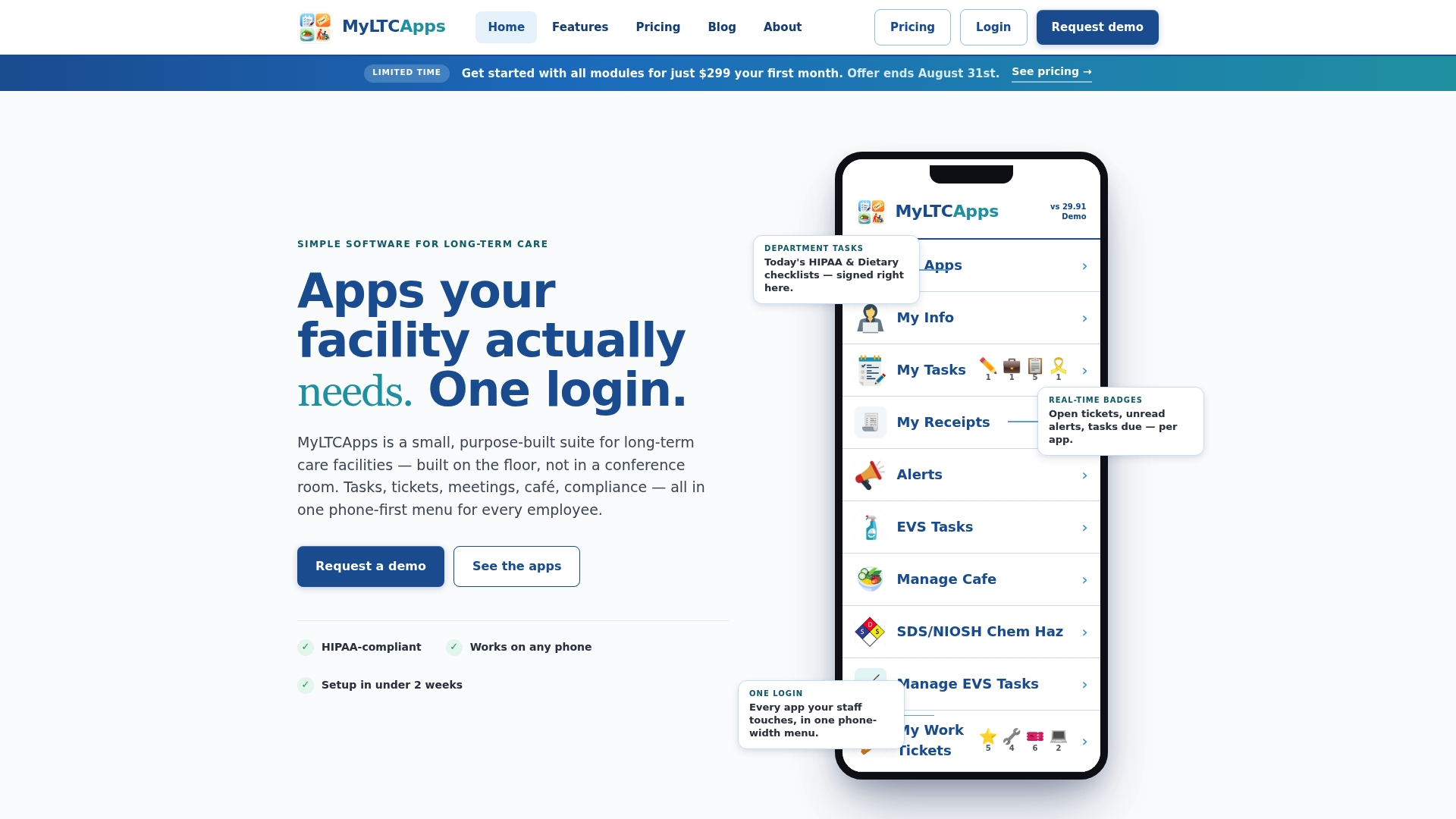
Myltcapps addresses those pressures directly. Work tickets, compliance checklists, incident reporting, and surveyor-ready exports are built into a single phone-first platform, with compliance libraries pre-loaded for HIPAA, QAPI, and emergency preparedness. No custom configuration required to meet the requirements your surveyors will ask about.
If you manage maintenance at a skilled nursing or long-term care facility and want to see how the work ticket and maintenance module maps to your current workflows, book a 30-minute demo. Bring your top three compliance pain points and a real work order scenario. That is the fastest way to know whether Myltcapps fits your operation.
Sources
Use these sources to verify vendor claims, check recent customer references, and stress-test the evaluation criteria before you commit to a demo.
Cross-reference recent customer references (within the last 12 months) on G2 and Capterra, request live API documentation during every demo, and test offline workflows with an actual technician before making a final decision.