Make Shift Bidding Safe for Nurses: 4–8 Week Pilot and Published Rules

Make Shift Bidding Safe for Nurses: 4–8 Week Pilot and Published Rules
Shift bidding is a platform-enabled process that lets qualified staff request open premium shifts, sometimes by submitting competing pay offers, and whether it helps or harms a unit depends entirely on the award rules, eligibility controls, and governance built around it. Nurses should ask for a written policy before participating. Administrators should pilot the system on a limited unit and audit the first month’s awards before expanding it.
TL;DR:
- Publish whether the lowest bidder, the best combination of price and qualifications, or the first eligible claimant wins; reverse auctions need a premium floor.
- Automatic competency and unit orientation filters should block ineligible bids, while licensed clinicians must still assess whether each assignment fits patient needs and available supervision.
- Run a pilot lasting four to eight weeks with nurse representatives and union leaders where applicable; log overrides and provide an appeal process for awards.
- Review fill rates, time to fill, and overtime weekly; check premium and agency costs monthly, then assess retention quarterly against preset targets.
- A 2024 study found no overall turnover change from scheduling preferences, but nurses late in their careers had a lower monthly probability of quitting.
Table of Contents
- What shift bidding is and the models behind it
- How a shift-bid process actually runs day to day
- Why shift bidding draws so much criticism
- What to lock down before you launch a shift-bid program
- Measuring whether your shift-bid program is working
- What the research and regulatory guidance actually show
- Where efficiency and fairness actually have to meet
- A mobile-first way to manage shifts without the guesswork
- FAQ
- Sources
What shift bidding is and the models behind it
Shift bidding is an online method of filling open shifts in which eligible staff submit a request, and sometimes a pay offer, for a posted shift, with software awarding it according to preset rules. The California HealthCare Foundation’s review of online scheduling systems identifies six common formats, and knowing which one a facility uses matters more than knowing that “bidding” exists at all.
- Silent auction: staff submit one confidential bid; the system awards without revealing competing offers.
- Reverse auction: the posted premium starts high and drops over time until someone accepts, or nurses bid the premium down to win the shift.
- Multiphase: eligible staff get first access, then the pool widens in stages if no one claims the shift.
- Fixed bid: the premium is set by the facility and nurses simply claim or decline, with no price competition.
- Best-bid: the facility picks the most favorable combination of price and qualifications rather than the lowest number alone.
- Proxy bid: a nurse sets a maximum premium they’d accept and the system bids on their behalf up to that ceiling.
Premiums themselves are defined three ways: a flat hourly add-on, a percentage of base pay, or a fixed dollar amount per shift. This is a different mechanism from self-scheduling, where staff pick from a published grid with no competition, and from a plain open-shift board, where the first qualified person to claim a shift gets it. Bidding adds a pricing or ranking layer on top of eligibility, which is exactly where most of the controversy below originates.
How a shift-bid process actually runs day to day
A shift-bid cycle follows a predictable sequence, though the details vary by vendor and facility policy.
- Posting: a manager or automated gap-detection tool flags an open shift and publishes it to the bidding pool, usually with unit, date, time, and any premium terms attached.
- Bidding window: eligible staff submit a bid, a claim, or an acceptance within a defined time frame, which can range from minutes to days depending on how urgent the gap is.
- Eligibility filtering: the system checks competencies, unit orientation, tenure requirements, overtime limits, and disciplinary status before a bid is even allowed through.
- Award: the platform applies the facility’s award rule, lowest bid, best-bid score, or first qualified claim, and generates a recommended winner.
- Manager confirmation or override: a scheduler reviews the recommendation and can override it, but a defensible system logs the override and the stated reason.
- Work or cancellation: the nurse works the shift as awarded, or cancels under a published policy that typically defines a deadline and any penalty for late withdrawal.
The eligibility filters in step 3 are where most of the real safety work happens, because they determine whether “qualified” means fully competent for that specific unit or just licensed to practice somewhere in the building. Premium dynamics add another layer: in a reverse-auction or multiphase design, the price can decay the longer a shift sits unfilled, which is efficient for filling gaps fast but can also mean the nurse who bids first accepts a lower premium than someone who waits. Facilities that use dynamic pricing without a floor risk training staff to wait out the system rather than respond quickly to urgent gaps.
Why shift bidding draws so much criticism
Most objections to shift bidding fall into a few repeatable categories, and some are inherent to the concept while others are purely a function of bad implementation.
- Pay erosion fear: a reverse-auction or race-to-the-bottom bid can appear to pressure nurses into accepting lower premiums than a flat differential would guarantee.
- Team dynamics: when bidding replaces informal shift-swap norms, nurses who previously covered for each other out of goodwill can feel like colleagues are now competing against them for income.
- Fairness perception: staff who work nights, weekends, or less desirable units often worry the algorithm favors whoever has the fastest internet connection or the most flexible home life, not whoever is most qualified.
- Union and labor concerns: shift bidding can interact with contractual language on overtime distribution, seniority, and premium pay, and a rollout that skips union consultation invites grievances.
Recent coverage of a major health system’s scheduling rollout illustrates how fast this can spiral: language suggesting shifts would be “awarded based on the lowest bid” generated public backlash even after the employer walked back parts of the feature, according to reporting on the UNC Health rollout. The underlying mechanism wasn’t necessarily unsafe, but the communication created a perception that pay was being auctioned down, and that perception became the story.
One documented pattern softens this picture. Internal open-shift programs that expand the pool of qualified staff can reduce reliance on external agency labor and give nurses more schedule choice when eligibility and governance are clearly defined, according to the CHCF review. The difference between a program that reads as exploitative and one that reads as empowering almost always comes down to whether award rules and pilot results were made visible before staff had to trust the system.
What to lock down before you launch a shift-bid program
Most shift-bidding failures are predictable, and predictable failures are preventable with a checklist set before the first shift is ever posted.
- Award rule: decide and publish whether the winner is the lowest bid, the best combination of price and qualification, or simply the first eligible claim.
- Eligibility criteria: define required competencies, unit orientation, probationary status, and any disciplinary holds that block a bid automatically.
- Premium floor and ceiling: set a minimum premium so decay mechanics can’t undercut base differentials, and a ceiling so costs stay predictable.
- Shift caps: limit how many bid shifts a single nurse can take per week to protect against fatigue-driven safety risk.
- Cancellation terms: publish the deadline for backing out of an awarded shift and any consequence for late cancellation.
Governance matters as much as the technical rules. Facilities that bring nurse representatives into the design process, consult union leadership where a contract exists, and run a defined pilot, often four to eight weeks, before full rollout tend to catch fairness problems before they become public complaints. An audit and appeal process, where a nurse can formally question an award decision and get a documented answer, does more to build trust than any amount of marketing language about “fairness.”
Technical safeguards reinforce the policy: automatic competency filters that block ineligible bids before a human ever sees them, logged manager overrides with a required reason field, and a retained audit trail covering every award decision. A compliance-first approach to self-scheduling in long-term care settings follows the same logic: the technology should enforce the policy, not improvise around it.
Pro Tip: Publish the award rule in plain language on the posting itself, not just in a policy binder, so every nurse sees exactly how the shift will be decided before they bid.
Measuring whether your shift-bid program is working
Shift bidding only earns its place in a facility’s staffing toolkit if it moves the numbers that matter, and those numbers need a regular review cadence rather than a one-time launch check.
| KPI | What it tells you | Typical review cadence |
|---|---|---|
| Internal fill rate | Share of open shifts filled without agency staff | Weekly |
| Time-to-fill | How long a posted shift sits open before award | Weekly |
| Premium dollars paid | Total cost of incentive pay against budget | Monthly |
| Agency spend | External staffing cost trend over time | Monthly |
| Overtime hours | Whether bidding is pushing staff past safe limits | Weekly |
| Turnover intent or exits | Whether the program affects retention | Quarterly |
Published reviews of online scheduling and bidding systems generally report reduced agency spend as the clearest win, since internal fill rate improvements directly displace the need for outside staffing agencies, per the CHCF review. Retention effects are murkier and tend to be concentrated in specific subgroups rather than showing up facility-wide, a pattern explored further in the evidence section below.
Set escalation triggers before you need them: a fill rate drop of a defined margin for two consecutive weeks, a spike in last-minute cancellations, or overtime hours exceeding a preset ceiling should all route to a human review, not just a dashboard alert nobody checks. Retention-focused staffing programs outside acute care settings track similar signals, and a useful outside reference on what actually keeps nursing staff on the job comes from Opulent Private Care’s review of home care nurse retention, which reinforces that continuity and predictable scheduling matter as much as pay in retention outcomes.

What the research and regulatory guidance actually show
The strongest evidence on shift bidding is narrower and more conditional than most marketing claims suggest, which is useful to know before trusting a vendor’s pitch.
- The CHCF review documents vendor cost ranges for integrated scheduling and bidding systems: vendor cost ranges for integrated scheduling and bidding systems can be tens of thousands of dollars upfront for a mid-sized hospital, or several thousand dollars per month for stand-alone shift-bidding products at similar scale, a range that helps administrators budget realistically rather than assume bidding software is a minor add-on cost.
- A 2024 academic study using a generalized difference-in-differences design found incorporating worker scheduling preferences produced no aggregate effect on turnover but reduced the monthly probability of quitting among late-career nurses by a small but measurable margin, according to the SSRN working paper on preference-based scheduling. That is a meaningful finding for a specific subgroup, not evidence that bidding fixes retention broadly.
- A 2025 design and pilot study of a mobile scheduling app reported improved perceived fairness and lower manual scheduling workload when hard constraints (legal, contractual, competency) and soft preferences were both coded into the system and staff participated in its design, per research published in BMC Nursing.
- Workforce guidance from the National Council of State Boards of Nursing stresses that safe assignment depends on an assessment of patient needs, staff competence, and supervision capacity, which means winning a bid is never, by itself, confirmation that an assignment is appropriate.
On pay, Bureau of Labor Statistics data on registered nurses make clear that shift-bid premiums are supplemental income layered on top of base wage structures, not a replacement for them, which is worth remembering whenever a bidding rollout gets framed as a pay strategy rather than a staffing tool.
Where efficiency and fairness actually have to meet
The honest tension in shift bidding isn’t “is it good or bad,” it’s that the same mechanism designed to fill gaps efficiently can quietly erode the informal trust that keeps a unit functioning.

My view is that transparency has to come before efficiency, every time. Publish the award rule before you publish the first shift. Involve nurse representatives in writing the eligibility criteria, not just reviewing them after the fact. Run a short pilot, measure it honestly, and let staff see the results before asking them to trust the system at scale.
None of this replaces clinical judgment. A system can rank bids, but it cannot assess whether a specific assignment is safe for a specific patient on a specific night, that call still belongs to a licensed professional with the authority to say no.
— Philip
A mobile-first way to manage shifts without the guesswork
Running a shift-bid program well means the technology has to enforce the policy automatically, not rely on a scheduler remembering every eligibility rule by hand. Our Shift Scheduling module is built for long-term care floors specifically, reachable in a few taps on the device staff already carry, with eligibility filters, manager override logging, and reporting exports built into the same phone-first menu as the rest of our operational tools.
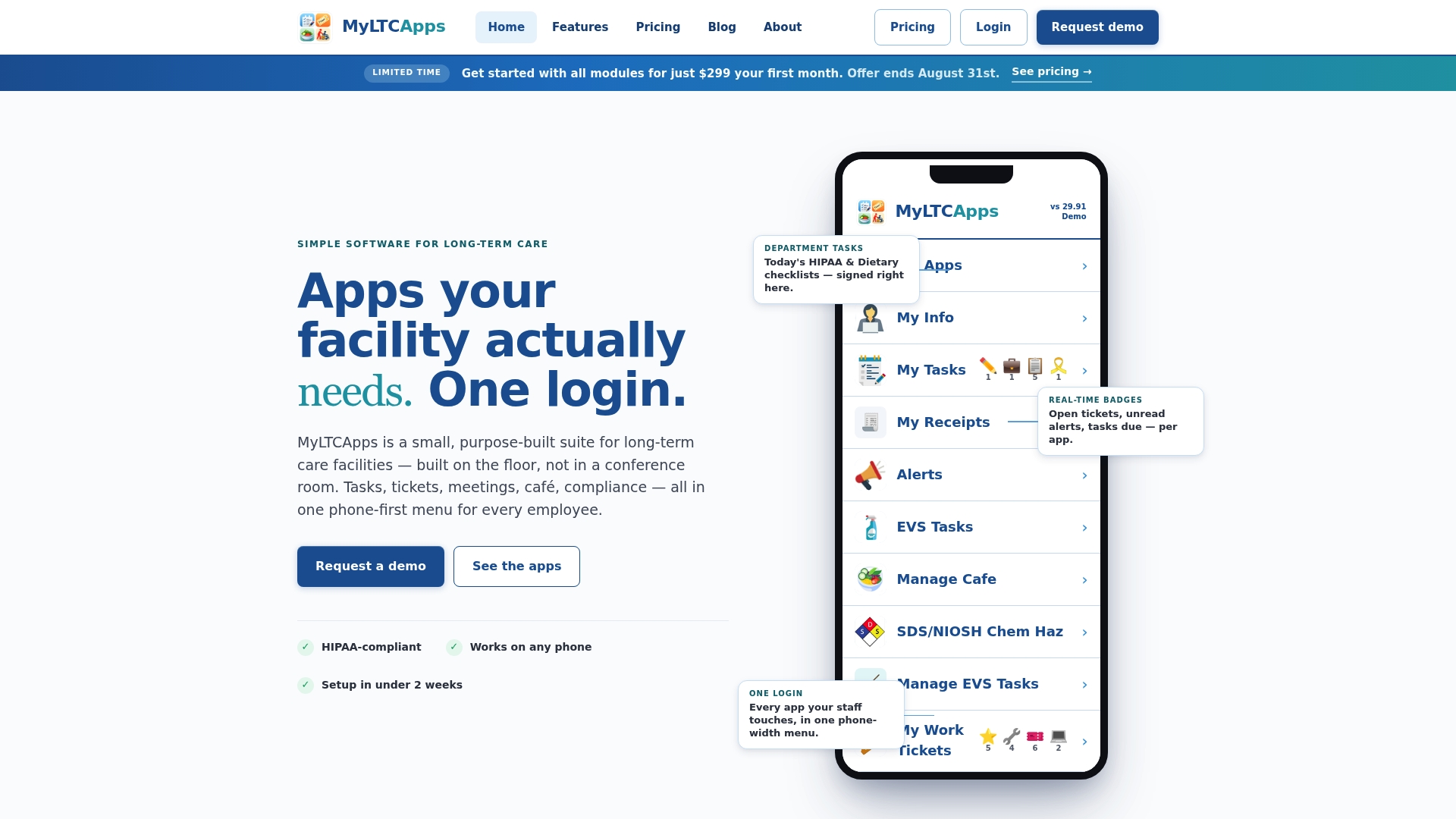
- Eligibility filters block ineligible claims automatically based on competencies and tenure rules you set.
- Audit trails log every award and override so administrators have a defensible record during a review.
- Survey-ready reporting exports the data a facility needs for internal governance or external audit.
| What you need | What we provide |
|---|---|
| Mobile-first posting and claiming | Shift Scheduling module |
| Eligibility and competency gating | Built-in filters on the Shift Scheduling module |
| Audit and override logging | Logged manager actions across the platform |
| Broader operational fit | Features overview |
Facilities comparing a dedicated stand-alone bidding product against a consolidated platform should weigh the cost of running separate systems for scheduling, compliance tracking, and work tickets against a single phone-first suite. Our plans start at $199 per month with the I Just Want That plan, scaling up through Starter, Growth, and Premium packs as a facility’s needs grow. If you want to see how eligibility filters and audit logging would fit your current staffing policy, request a demo through our pricing page and walk through a pilot setup with our team.
FAQ
How does a shift bid work?
A manager or automated system posts an open shift, eligible staff submit a bid, claim, or pay offer within a set window, and the platform awards the shift according to a published rule such as lowest bid, best combination of price and qualification, or first eligible claim. A scheduler typically confirms or overrides the recommendation before the shift is finalized, per the model descriptions in the CHCF review.
How to make $300,000 as a nurse?
Shift-bid premiums are supplemental income on top of a base wage, not a path to a specific six-figure target, and Bureau of Labor Statistics data does not support treating bidding income as a reliable route to that figure. Earnings depend heavily on specialty, location, overtime availability, and years of experience rather than any single scheduling mechanism.
Will nurses be paid less in 2026?
There is no official data indicating a broad nursing pay decrease. Shift-bid premiums are supplemental pay layered on top of base wages, and concerns about pay erosion usually trace back to specific reverse-auction designs rather than to base salary structures tracked by the Bureau of Labor Statistics.
Does NurseDash pay daily?
Payment timing for any specific staffing platform is set by that platform’s own terms, and we do not have a sourced basis to state NurseDash’s payment schedule here. Check the platform’s own published terms or support documentation for its current payment policy.
Sources
- Adopting online nurse scheduling and staffing systems
- Registered nurses: Occupational outlook handbook
- NCSBN research highlights: workforce recovery
- To Each Their Own (Shifts): Incorporating worker preferences into shift schedules