Close Action Items: Safety Committee Agenda Templates for LTC

Close Action Items: Safety Committee Agenda Templates for LTC
A working safety committee agenda protects three things above everything else: review of open actions, a look at recent incidents and inspections, and dedicated time to assign new work with a name and a due date attached. The single-line version is simple: last meeting’s unfinished business goes first, new hazards go second, and the meeting ends with decisions, not just discussion. Minutes need to record who owns what, when it’s due, and how it gets verified. Copy-ready templates for both are below.
TL;DR:
- Open action items should be reviewed first to ensure unresolved hazards are addressed before new issues are raised.
- Prioritization of safety topics should follow the hierarchy of controls, focusing on eliminating or engineering out hazards before relying on PPE reminders.
- Safety committee meetings should have at least a majority of frontline and management representation, with clear roles, a rotating chair, and dedicated minute-taking.
- Minutes and agendas should be distributed at least 48 hours in advance, including action owners, due dates, and verification methods to ensure accountability.
- Tracking hazards into verified corrective actions through work tickets or software prevents hazards from remaining unresolved and demonstrates tangible compliance.
Table of Contents
- What Should a Safety Committee Meeting Agenda Cover?
- What Safety Topics Should the Committee Actually Discuss?
- Who Should Sit on the Committee and Who Runs the Meeting?
- What Does OSHA Expect From Safety Committee Meetings?
- How Do You Actually Track Safety Action Items to Completion?
- How Should the Agenda and Minutes Be Distributed?
- Copy-Ready Agenda and Minutes Templates
- How Committee Actions Turn Into Real Compliance Work
- What I’d Tell Any Committee Struggling to Stay Useful
- Where to Verify These Requirements Yourself
- Ready to Stop Losing Action Items to Memory?
- Sources
- FAQ
What Should a Safety Committee Meeting Agenda Cover?
The agenda structure matters more than most committees realize. Open items go first because starting with new business is how old commitments quietly die. That ordering choice comes straight from how effective committees run their meetings: review what’s outstanding before anyone gets to raise something new.
A full monthly meeting typically lasts about an hour to an hour and a quarter and breaks down like this:
- Open actions review (10 minutes): status on every item from last time
- Incident and near-miss review (10 minutes): what happened, what almost happened
- Inspection and hazard report findings (10 minutes): new issues surfaced since last meeting
- KPI and trend review (10 minutes): leading and lagging indicators side by side
- New hazard discussion (10 minutes): items raised by staff or supervisors
- Training needs and policy updates (10 minutes)
- Decisions and new assignments (10 to 15 minutes): the block that must never get cut short
- Close and confirm next meeting date (5 minutes)
For teams that meet weekly or biweekly, a shorter format works better:
- Open actions check (5 minutes)
- New incidents or hazards since last check-in (10 minutes)
- Quick wins and new assignments (10 minutes)
- Close (5 minutes)
Whichever format you use, protecting the assignment block is the rule that separates a committee that fixes things from one that just talks about them.
What Safety Topics Should the Committee Actually Discuss?
Most committees default to whatever came up in the hallway that week. A better approach rotates through a fixed list and prioritizes by severity and trend direction, not by who complained loudest.
Core topics worth a rotating slot on every agenda:
- Incident and near-miss review, with attention to near-miss volume as an early warning sign
- Corrective action status from prior meetings
- Inspection findings, both scheduled and surprise walk-throughs
- Hazard reports submitted by staff since the last meeting
- Training status and any certification gaps
- KPI trends, both leading (near-misses, hazard reports filed) and lagging (recordable injuries, lost workdays)
- Emergency preparedness readiness
- Policy or regulatory updates that affect daily work
Prioritization should follow the hierarchy of controls: a hazard that can be eliminated or engineered out deserves committee time before a PPE reminder does. A spike in near-misses on a specific task line is a leading indicator worth discussing now, even with zero injuries reported. Waiting for the lagging number, an actual injury count, means the committee acted too late to matter.
Who Should Sit on the Committee and Who Runs the Meeting?
Balance matters more than size. A committee weighted entirely toward management misses the floor-level hazard knowledge that makes reports useful; one with no management representation struggles to get corrective actions funded.
- Aim for close to even representation between frontline employee reps and management or supervisory staff
- Smaller facilities can run effectively with four to six members; larger operations often need eight to twelve
- The chair sets the agenda, keeps discussion on time, and enforces decisions made in the last meeting rather than letting them re-open for debate
- A dedicated minute-taker (rotating the role works fine) captures decisions, owners, and due dates in real time, not from memory afterward
- Quorum should be defined in writing, commonly a simple majority, so decisions made at a thin meeting don’t get challenged later
- Committee time should be paid, on-the-clock work, not an unpaid add-on to someone’s shift
Pro Tip: Rotate the chair role every six to twelve months. A single person running every meeting for years tends to steer the agenda toward their own department’s issues without realizing it.
What Does OSHA Expect From Safety Committee Meetings?
Federal guidance for establishment-level committees sets a floor, not a ceiling. OSHA’s committee organization standard requires a regular meeting schedule, meetings run against a prepared agenda, and written minutes distributed to members and made available on request. Many state-plan and industry guides layer additional expectations on top of that baseline, and cadence requirements vary by jurisdiction, so checking your specific state’s rules is worth the twenty minutes it takes.
Practical expectations to plan around:
- Meet at least quarterly at minimum; monthly is far more common for facilities that want to close actions fast
- Keep written minutes and retain them, since regulators and auditors can request them without much notice
- Distribute minutes to members, not just file them
- Committee duties include reviewing inspection reports, monitoring corrective action progress, and participating directly in inspections when the situation calls for it
How Do You Actually Track Safety Action Items to Completion?
An action item that doesn’t get closed is worse than no action item at all. It creates a paper trail showing the committee knew about a hazard and didn’t fix it. Four things make an action item valid rather than decorative:
- A named owner, not a department or “someone from maintenance”
- A verifiable outcome, something you can check as done or not done, not “improve awareness”
- A due date tied to severity, not a default 30 days for everything
- A verification step someone actually performs before the item gets marked closed
Tying due dates to risk severity works well as a three-tier system: immediate hazards get 24 to 72 hours, high-priority items get 30 days, and routine improvements get 90 days. Roughly a third of safety committees that fold within their first year cite unclear ownership of follow-up as the reason, based on informal surveys across safety consulting practices, so build in a five-minute pre-meeting check where the chair confirms status on every open item before the meeting starts, not during it. Escalate anything past its due date automatically rather than waiting for someone to notice.
How Should the Agenda and Minutes Be Distributed?
Distribute the agenda and any supporting attachments, inspection reports, incident summaries, hazard logs, at least 48 hours before the meeting. Members who walk in cold end up spending meeting time reading instead of deciding.
Minutes should capture the date, attendees, decisions made, and for each action item: owner, due date, and verification method. Status updates on prior items belong in the same document so a reader can see progress across meetings without digging through old files.
- Cap each review segment to its allotted time, even if discussion is interesting
- Rotate who presents each section so the load doesn’t fall on one person every month
- Table anything that needs deep technical discussion for a smaller subgroup meeting afterward
Pro Tip: If a topic eats more than its time block twice in a row, it needs its own subcommittee, not a bigger slot on the main agenda.
Copy-Ready Agenda and Minutes Templates
Monthly agenda template:
- Open actions review (owner: chair)
- Incident/near-miss review (owner: safety officer)
- Inspection findings (owner: rotating presenter)
- KPI trends (owner: safety officer)
- New hazard discussion (owner: chair)
- Training/policy updates (owner: HR or training lead)
- Decisions and new assignments (owner: chair)
- Close, confirm next meeting
Short standup template:
- Open actions status
- New incidents/hazards since last check-in
- New assignments
- Close
Minutes fields worth locking into a fixed format: date, attendees, decisions, action items with owner and due date, verification notes, and a status column carried forward from the prior meeting. A dedicated minutes management structure makes this consistent across facilities that run multiple committees.
How Committee Actions Turn Into Real Compliance Work
A hazard flagged in committee, a loose handrail, an expired SDS binder, is only useful once it becomes a tracked task with an owner and a verification step. Converting risk findings into work tickets closes that gap instead of leaving it as a line in someone’s notes.
Common LTC agenda inputs worth pulling into committee review:
- Life Safety Code items from a standing facility checklist
- Falls prevention findings tied to resident safety rounds
- SDS and chemical storage compliance status
Structured minutes with automated follow-up give surveyors a clean record showing the committee didn’t just discuss a hazard, it closed it.
What I’d Tell Any Committee Struggling to Stay Useful
Committees lose momentum the moment old action items stop showing up on the agenda. Start there every time, and close with named owners and a verification step, not a vague promise to “look into it.” Keep the conversation about systems and root causes, never about blaming the person who happened to be nearby when something went wrong. Rotate the chair, rotate presenters, and say out loud when something gets fixed. That last habit costs nothing and does more for staff willingness to report hazards than any policy memo ever will.
— Philip
Where to Verify These Requirements Yourself
Start with OSHA’s committee organization standard and your state plan’s specific guidance before finalizing your committee’s charter.
Ready to Stop Losing Action Items to Memory?
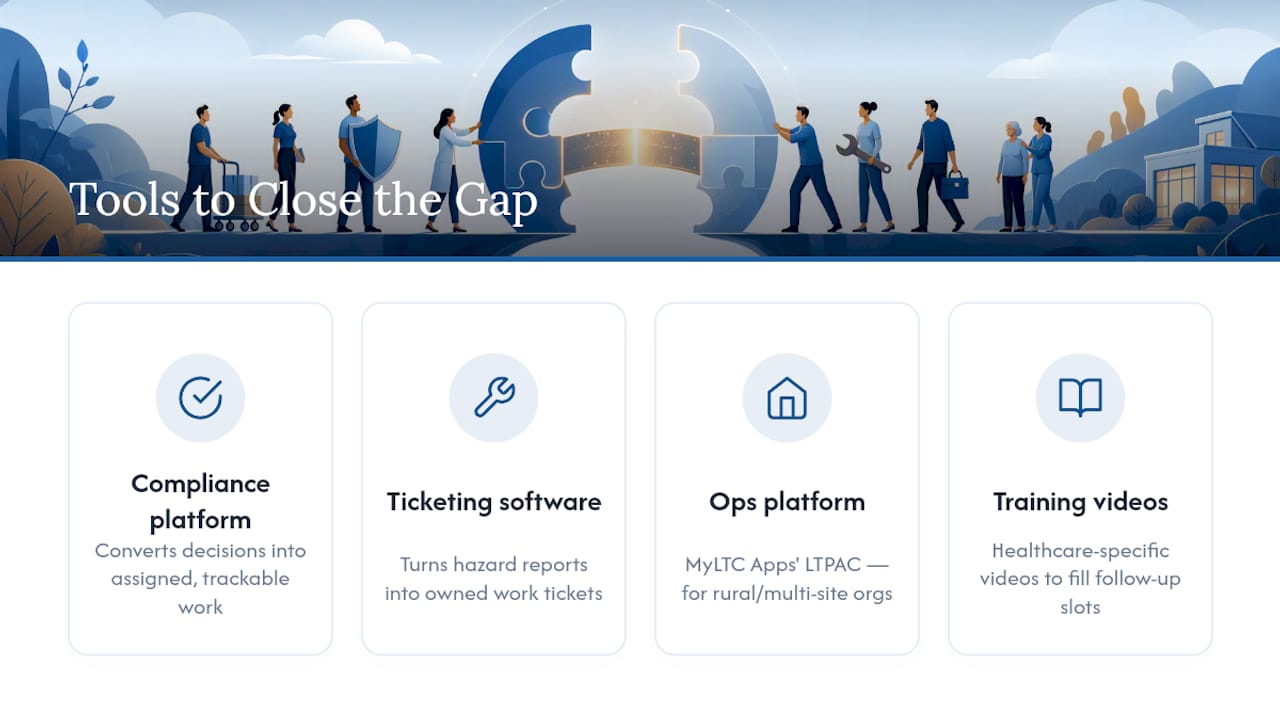
Every template above still depends on someone remembering to check status before the deadline passes. That’s the exact gap a compliance task and checklist platform is built to close, converting committee decisions into assigned, trackable work with a verification step built in. For facilities juggling maintenance follow-ups from inspection findings, work order and maintenance ticket software turns a hazard report straight into a ticket with an owner attached, no separate spreadsheet required. If you’re weighing a broader operations platform for a rural or multi-site long-term care organization, MyLTC Apps’ LTPAC software is worth a look. For training materials to fill agenda follow-up slots, healthcare-specific safety training videos are a solid outside resource to pair with your committee’s action list.
Sources
- How to Build an Effective Workplace Safety Committee - SafetyIQ
- Safety Committee Best Practices: Making Monthly Meetings Actually Useful | WhyTrace Plus Blog | WhyTrace Plus
FAQ
What Are Good Topics for a Safety Committee Meeting?
Rotate through incident and near-miss review, inspection findings, hazard reports, training status, KPI trends, emergency preparedness, and policy updates, prioritizing whichever category shows the most severe or fastest-growing risk that month.
What Should Be Included on a Safety Committee Meeting Agenda?
A working agenda includes open action review, incident and inspection updates, new hazard discussion, and a dedicated decision block where new items get a named owner and due date before the meeting ends.
What Safety Topics Should Committees Prioritize Going Into 2026?
Leading indicators like near-miss reports and hazard submissions deserve more agenda time than they typically get, since they surface risk trends before an injury count ever does.
What Are the Main Goals of a Safety Committee Meeting?
The core goals are monitoring the safety program, reviewing inspection and incident data, and turning findings into assigned, verified corrective actions rather than open-ended discussion.