Avoid the 20 Minute Turnover Trap: Room Turnover Checklist for LTC
Avoid the 20 Minute Turnover Trap: Room Turnover Checklist for LTC
A room turnover checklist must turn a discharged or transferred resident room into a terminally clean, safe, fully documented space ready for the next admission. That standard rests on CDC environmental cleaning guidance and CMS infection prevention expectations for nursing homes. EVS and nursing share the job, with infection prevention setting the rules both follow.
TL;DR:
- Reprocessing equipment and disinfecting high-touch surfaces must be assigned to specific staff members to prevent overlooked steps and ensure accountability.
- Room release should be blocked if visible blood, unverified precautions, or unrepair equipment are present, with automatic work tickets generated for unresolved issues.
- Turnover times vary by room type and equipment, requiring observation-based staffing adjustments rather than fixed time assumptions like 20 minutes for all rooms.
- Staff must verify safety issues such as proper lighting, secure equipment, and no trip hazards before declaring a room ready for the next resident.
- Complete documentation includes timestamps, staff initials, disinfectant details, defect reports, and final verification, with objective checks like ATP testing and direct observation necessary for validation.
Table of Contents
- What Goes on a Room Turnover Checklist?
- Who Owns Each Step, and When Should a Room Not Be Released?
- What Safety Items Belong on a Room-Readiness Check?
- What Must a Completed Turnover Record Include?
- How Do You Know the Checklist Reflects Real Cleaning?
- How Should PPE and Barrier Precautions Shape Turnover Cleaning?
- What Safety and Hazard Checks Happen During Turnover?
- Who Notifies Nursing That a Room Is Ready?
- How Should Staff Handle a Resident’s Personal Belongings?
- Do Airborne or Contact Precautions Change the Turnover Process?
- Do Isolation and Bariatric Rooms Need a Different Checklist?
- Why the Checklist Itself Is Rarely the Real Problem
- Turning This Checklist Into a Daily Workflow
- Sources
- FAQ
What Goes on a Room Turnover Checklist?
A working checklist for room turnover follows a fixed order: soiled items out, equipment reprocessed, high-touch surfaces disinfected, low-touch and hidden surfaces cleaned, floors last. That sequence isn’t arbitrary. The CDC’s cleaning procedure guidance builds it around one principle: clean-to-dirty, top-to-bottom, so you never spread contamination from a dirty surface onto one you already finished.
Here’s the sequence that holds up on the floor:
- Remove soiled linens and personal-care items first. Contain them at the point of use with minimal agitation. Don’t sort or pre-rinse in the room, and skip double-bagging unless the outer bag is visibly soiled or wet through, per CDC laundry handling guidance.
- Pull and reprocess reusable noncritical equipment. Blood pressure cuffs, slings, transfer boards. Someone specific has to own this step, or it gets skipped, because nobody assumes ownership by default.
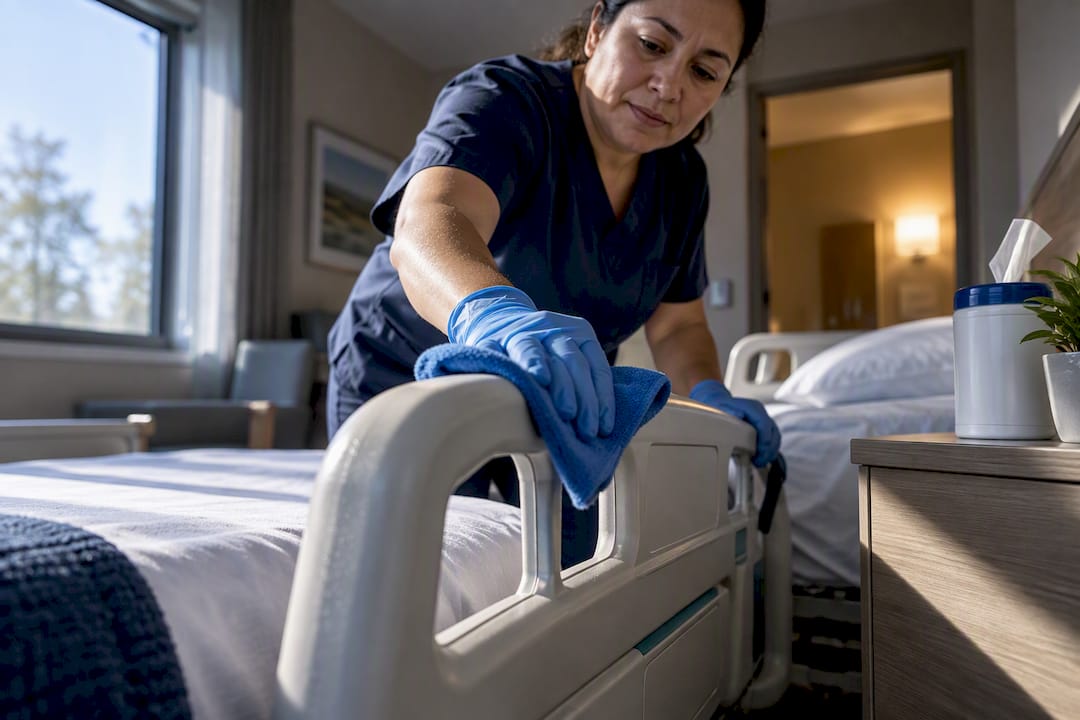
- Disinfect high-touch surfaces with an approved product, following the label’s contact time. Bed rails, over-bed table, call light, bedside commode, bathroom grab bars and faucet handles. Skipping the wait time listed on the label is the single most common way disinfection fails even when the surface got wiped.
- Clean low-touch and hard-to-reach surfaces before anyone assumes the room is done. Mattress surface, bed frame, shelf tops, vents. These are the areas most often missed because they’re invisible during occupancy, not because staff are careless.
- Clean floors last, then bring in replacement linens and restock supplies. Protect fresh linens from touching a surface you haven’t disinfected yet, and confirm gloves, gowns, and consumables are stocked for the next occupant.
CDC Appendix B1 recommends changing cleaning cloths after every room, generally five to seven cloths per room depending on surface count. That’s a small operational detail that separates a checklist that reads well from one that actually works.
Who Owns Each Step, and When Should a Room Not Be Released?
Ambiguous ownership is where turnover checklists quietly fail. CMS guidance is blunt about this: when nobody’s name is attached to reprocessing equipment or verifying a repair, that step gets missed, and it usually isn’t caught until the next survey. Assign tasks in writing. EVS owns surface cleaning and disinfection. Nursing owns clinical equipment checks and precaution status. Infection prevention sets the protocol and signs off on anything unusual. Maintenance owns anything mechanical or structural.
Minimal cleaning time (MCT) needs to be set per room type, not guessed at. Watch an experienced EVS staff member complete the full protocol for a standard room, a bariatric room, and an isolation room separately, then use those observed times to set staffing and bed-turnover expectations. A facility that assumes a 20-minute turnover on every room type is setting staff up to cut corners.
Some conditions should stop release outright:
- Visible blood, body fluids, or unresolved soiling anywhere in the room
- Unknown or unconfirmed prior precaution status for the departing resident
- Maintenance defects that haven’t been repaired and verified
- Linens or equipment that can’t be confirmed as reprocessed
Pro Tip: Build a “blocked, do not assign” status directly into your checklist workflow. A room sitting in that status should automatically generate a work ticket rather than wait for someone to notice it during rounds.
What Safety Items Belong on a Room-Readiness Check?
Cleanliness isn’t the finish line. A room can be spotless and still be unsafe for the next resident.
Before release, confirm:
- Call light and bedside controls work and cords aren’t frayed or tangled
- Lighting functions at the bed, bathroom, and entry
- Mobility aids left in the room (if any) are in working condition, not damaged
- Floors, thresholds, and rugs have no trip hazards or loose edges
- No moisture or standing water near outlets or flooring seams
- Mattress and pillow covers are intact, with no tears exposing foam
- Privacy curtains have been laundered on schedule and hang correctly
Anything broken gets a work ticket, not a note on a whiteboard. Route it to maintenance immediately and document the repair status inside the same record as the cleaning checklist, so the room’s readiness status reflects both.
What Must a Completed Turnover Record Include?
A signed-off checklist with no detail behind it is weak evidence during a survey. The AHRQ long-term-care MDRO toolkit recommends pairing checklist completion with independent verification, not just a signature.
A complete record should capture:
- Room and bed identifier, plus the trigger (discharge or transfer)
- Start and finish time of the cleaning process
- Staff name or initials for each major step
- Disinfectant product used and the contact time followed
- Which equipment was reprocessed and by whom
- Confirmation that linens were replaced
- Any defects found, with the associated work-ticket ID
- Final verifier’s sign-off and timestamp
That last line matters more than it looks. A supervisor spot-check, a fluorescent-marker follow-up, or an ATP swab gives you objective proof the cleaning happened, not just proof someone filled out a form. Retain these records where they can be pulled quickly for a QAPI review or a surveyor request. If you can’t produce a turnover record in under a minute, the documentation system is the problem, not the cleaning.
How Do You Know the Checklist Reflects Real Cleaning?
Onboarding for turnover cleaning should include a preceptor period with observed discharge cleanings, not just a walkthrough of the checklist itself. New EVS staff need to see the sequence performed and then be watched performing it before they sign off on their own rooms.
Ongoing validation matters just as much as initial training:
- Direct observation during actual discharge cleanings, on a set schedule
- Fluorescent-marker checks on high-touch surfaces to confirm they were actually wiped, not just listed as done
- ATP testing where the facility has the equipment, as a secondary check
- Supply and PPE audits to confirm staff aren’t skipping steps because a cart is empty
Statistic Callout: The AHRQ MDRO toolkit recommends auditing both daily and discharge cleaning with direct observation or fluorescent-marker follow-up, then feeding compliance results back to staff as active feedback, not filed reports.
Audit results belong in QAPI, and a repeated miss on the same surface across multiple audits should trigger a targeted retraining session, not a general reminder email.
How Should PPE and Barrier Precautions Shape Turnover Cleaning?
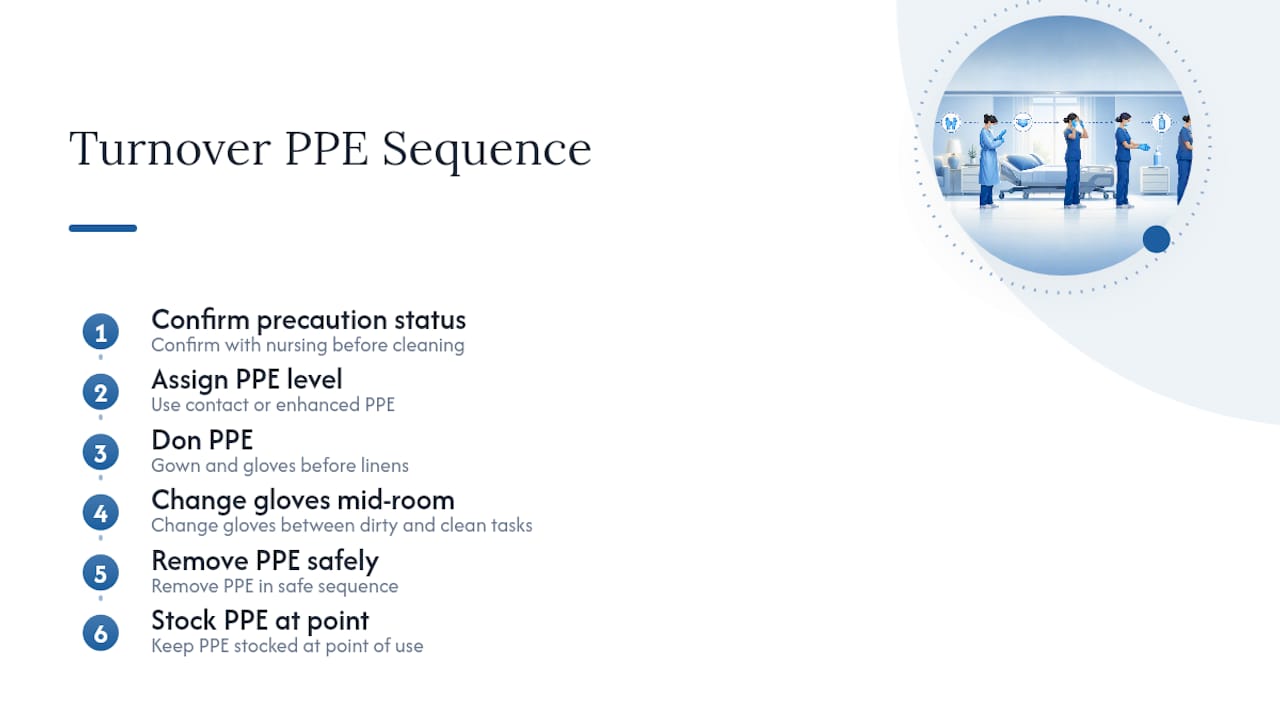
The PPE a turnover team wears depends entirely on what precautions applied to the resident who just left, and that information has to travel with the room status, not stay buried in a chart. A room that housed a resident under contact precautions needs staff in gloves and a gown for the full cleaning process, not just for the initial linen removal.
Enhanced barrier precautions, used for residents with wounds, indwelling devices, or a history of multidrug-resistant organism colonization, extend beyond the resident’s active stay. If the departing resident was on enhanced barrier precautions, treat the turnover clean with the same PPE rigor you’d use for a confirmed infection, because the room’s surfaces carried that same risk profile.
Don’t guess at what precaution status applied. Nursing needs to communicate it to EVS before cleaning starts, not after. A checklist item that simply says “confirm precaution status with nursing” before assigning PPE closes a gap that causes real exposure risk.
Once PPE is on, the order still matters: don gloves and gown before touching soiled linens, change gloves between contaminated and clean tasks within the same room, and remove PPE in the sequence that keeps contaminated surfaces away from skin. Facilities that skip glove changes mid-room undo the benefit of wearing PPE at all. Stock enough PPE at the point of use so staff never have to leave the room mid-task to find a fresh pair of gloves, since that’s exactly when corners get cut.
What Safety and Hazard Checks Happen During Turnover?
Turnover is also when a room’s physical hazards surface, because staff are moving furniture, equipment, and linens that normally stay in place. Bed rails left in an unlocked position, oxygen tubing coiled where someone could trip, or a wheelchair brake left disengaged are the kind of misses that don’t show up on a “was it clean” checklist but absolutely show up on an incident report.
Before the room gets marked ready, walk it with fresh eyes:
- Confirm the bed is locked and at a safe height for the next resident’s mobility level
- Secure or store any equipment left in the room, rather than leaving it staged against a wall
- Check that cords, tubing, and call-light lines are routed away from walking paths
- Verify wheelchair or lift equipment brakes and locks function correctly if left in the room
- Look for anything wet on the floor from the cleaning process itself before calling the room ready
This is also where the maintenance handoff belongs. If a chair is wobbly, a drawer won’t close, or a bed rail mechanism sticks, that item goes on a work ticket the same day, not a running list someone checks “when there’s time.” A hazard identified during turnover and not logged is a hazard that reappears with the next resident.
Who Notifies Nursing That a Room Is Ready?
The cleaning can be flawless and still cause problems if nobody tells the care team the room is available. A turnover process needs a clear, consistent signal, not a verbal “it’s done” that depends on catching the right person in a hallway.
The handoff works best as a defined step, not an afterthought:
- EVS marks the checklist complete and flags the final verifier
- The verifier confirms cleaning, safety checks, and documentation are all in place
- Nursing receives a specific notification, not a general update, that the room is cleared for the next admission or transfer
- Any blocked item (a pending repair, a missing verification) holds the notification until it’s resolved
Facilities that rely on informal communication for this step tend to have rooms sitting empty longer than necessary, or worse, rooms marked ready before the final verification actually happened. A documented notification, timestamped, gives you both faster bed turnover and a clean record if a surveyor asks how readiness gets confirmed.
How Should Staff Handle a Resident’s Personal Belongings?
Personal belongings need their own process, separate from the cleaning sequence, because these items don’t get disinfected and discarded the way linens do. Photos, clothing, dentures, hearing aids, and small keepsakes carry both compliance weight and human weight, and mishandling them creates complaints that have nothing to do with cleanliness.
A workable approach:
- Inventory belongings before cleaning starts, ideally with family or the resident present for a transfer, or per facility policy for a discharge
- Store items in a labeled container that stays with the resident’s chart or moves with them, never left loose in the room during cleaning
- Route unclaimed items through a documented lost-and-found or family-notification process with a set retention period
- Keep belongings physically separate from soiled linens and cleaning supplies at every point in the process
Get this step wrong and you’ve created a grievance that has nothing to do with how clean the room turned out.
Do Airborne or Contact Precautions Change the Turnover Process?
General terminal cleaning covers most turnovers, but a room where the departing resident was on airborne or contact precautions needs additional steps layered on top, not substituted in.
For contact precautions, the cleaning sequence stays the same, but PPE stays on longer and disinfectant contact time gets followed without exception, since the entire point is a lingering organism on a touched surface. For airborne precautions, the room may need to sit for a defined period before staff enter without a respirator, based on the room’s air exchange rate. That waiting period belongs on the checklist as a distinct, timed step, not something staff estimate.
CDC’s disinfection recommendations are direct on one point: routine fogging is not a substitute for manual cleaning and disinfection, regardless of what precaution level applied. If a facility uses a supplemental technology like fogging, it has to be layered on top of the manual process under written policy, never in place of it.
Do Isolation and Bariatric Rooms Need a Different Checklist?
A standard checklist covers most rooms, but isolation and bariatric rooms both need modifications, and treating them identically to a standard turnover is how gaps happen.
Isolation rooms carry the airborne and contact precaution steps above, plus the anteroom or vestibule area, if the room has one, needs its own cleaning pass. Don’t stop at the door.
Bariatric rooms usually have specialized equipment, reinforced beds, larger mobility aids, wider wheelchairs, that need their own reprocessing steps and often their own vendor-specific cleaning guidance. The MCT for a bariatric room should be set separately from a standard room, since the equipment alone adds real time. Skipping that distinction is how bariatric rooms end up rushed on the same clock as a standard room, and rushed cleaning on specialized equipment is where things get missed.
Why the Checklist Itself Is Rarely the Real Problem
The biggest miss in room turnover isn’t a missing step. It’s a checklist item nobody actually owns, so it gets checked off without being done. Mattress surfaces, bed frames, vents, and equipment tucked under the bed are the classic culprits, precisely because they’re invisible during a walkthrough and easy to mark complete without touching.
Contact time failures are the other quiet killer. Staff wipe a surface with disinfectant and move on before the label’s wet-contact time has passed, which means the surface got wiped but never actually disinfected.
If you’re rolling out a new turnover process, don’t try to fix every room type at once. Pilot the checklist on one unit, measure actual MCT against your assumed times, and track audit pass rates for a few weeks before expanding facility-wide. You’ll find your real bottlenecks faster than any policy rewrite will surface them.
— Philip
Turning This Checklist Into a Daily Workflow
Myltcapps is built for exactly this kind of floor-level workflow. It’s phone-first, so an EVS staff member can complete a room turnover checklist on their own device without hunting for a paper form or a shared computer.
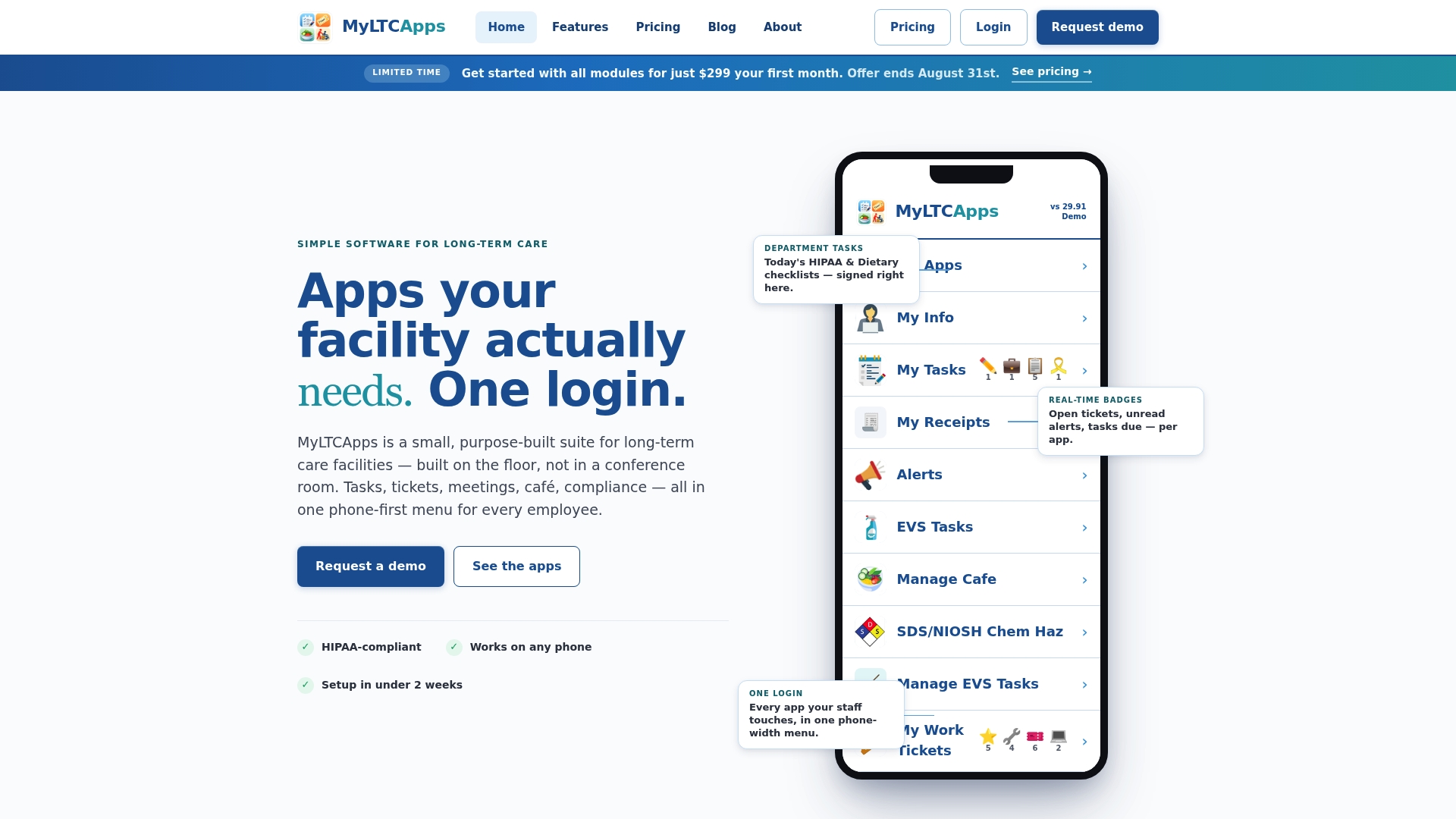
The Myltcapps My Tasks module lets you build the exact sequence covered here, soiled-item removal, equipment reprocessing, high-touch disinfection, floor cleaning, restocking, into a mobile checklist that assigns each step to a specific staff member. When an inspection turns up a broken bed rail or a sticking drawer, My Work Tickets generates a maintenance ticket automatically instead of relying on a note that might get lost. EVS Management tracks completion times against your facility’s MCT targets, and the Compliance Suite keeps the documentation in a format you can pull quickly if a surveyor or QAPI review asks for it.
None of this replaces your written protocol or your infection prevention lead’s judgment call on precaution status. It just makes the record of what happened, and who did it, harder to lose. Facility leaders can review plans starting with the I Just Want That package at $199 per month, or check the full pricing page to find the tier that matches your facility’s size and module needs.
Sources
- Environmental cleaning procedures | HAIs | CDC
- Appendix B1 – Cleaning procedure summaries for general patient areas | CDC
- AHRQ long-term-care MDRO toolkit
- CMS memorandum: infection prevention and control updates for nursing homes
FAQ
What Is a Terminal Clean in Long-Term Care?
A terminal clean is the full disinfection process done after a resident is discharged or transferred, covering every surface including hidden ones like the mattress and bed frame, not just the visible touch points cleaned during daily rounds. It follows CDC’s environmental cleaning procedures, which specify cleaning high touch surfaces before low touch ones and floors last.
How Long Should a Room Turnover Take?
There’s no universal number, since it depends on room type and equipment involved. Facilities should set their own minimal cleaning time by observing experienced staff complete the standardized protocol for each room type, then align staffing to that observed time.
Who Is Responsible for Cleaning Medical Equipment During Turnover?
Responsibility should be assigned in writing, since ambiguous ownership is a documented cause of missed equipment cleaning according to CMS guidance. Most facilities split this between EVS for surfaces and nursing for clinical equipment, with infection prevention setting the protocol both follow.
What Should Stop a Room From Being Released?
Visible blood or body fluids, unknown precaution status for the prior resident, unresolved maintenance defects, and unconfirmed linen or equipment reprocessing should all block release until resolved. These rooms need a “blocked” status that automatically triggers escalation rather than waiting to be caught during a walkthrough.
Does Myltcapps Include Medical Charting? (This product focuses on task management and compliance, without clinical or medical charting functions.)
No. Myltcapps focuses on task management, compliance tracking, work tickets, scheduling, and operational reporting, not clinical or medical charting. Current pricing and module details are available on the Myltcapps pricing page.