Process Improvement in Nursing Homes: A Practical Guide

Process Improvement in Nursing Homes: A Practical Guide
Process improvement in a nursing home means studying how a piece of daily work actually gets done, finding where it breaks down, testing a fix on a small scale and keeping what works. Federal rules already give you the framework: it is called QAPI, and the steps below show how to run it without burying your staff in paperwork.
TL;DR
- Process improvement is the continuous study and adjustment of how care and operations are delivered. In U.S. nursing homes it runs through your QAPI program.
- Pick problems by scoring them (prevalence, risk, cost and more), not by whoever complains loudest.
- Find the root cause before you design a fix, then test the change on one unit with a PDSA cycle.
- Track a numeric goal, show the data to staff, and keep the goal in place for several months before you call a project finished.
- Phone-based checklists and task tools make the daily routine behind a fix easier to follow, but the improvement itself is a team decision.
Table of Contents
- What process improvement means in a nursing home
- Step 1: Choose the process worth fixing
- Step 2: Find the root cause before you design the fix
- Step 3: Test the change small with PDSA
- Step 4: Bring in staff, residents and families
- Step 5: Measure whether it worked
- Step 6: Make the gain stick
- Where technology fits
- Our perspective
- Put your improvement routine on staff phones
- FAQ
- Sources
What process improvement means in a nursing home
The federal QAPI description defines performance improvement as the continuous study and improvement of processes to improve services or outcomes, prevent or reduce problems, and test new approaches to persistent or systemic barriers. It aims at the processes behind care delivery and resident quality of life, and it can make good quality even better.
That last point matters. Process improvement is not only a response to a bad survey. CMS describes an effective QAPI plan as a self-sustaining approach that involves all caregivers in practical problem solving and keeps aiming higher than minimum standards. The same guide shares an example of a facility that used QAPI to catch developing issues early and went on to have no nutrition deficiencies on its annual survey.
In practice a “process” is any repeatable chain of steps: how a fall is reported, how a meal tray reaches the right resident, how a broken call light gets fixed, how a new aide learns the unit. If the same thing goes wrong twice, there is usually a process behind it.
It is also a regulatory requirement
Under 42 CFR § 483.75, each long-term care facility must develop, implement and maintain an effective, comprehensive, data-driven QAPI program focused on outcomes of care and quality of life. The quality assessment and assurance committee must meet at least quarterly, and the governing body or executive leadership is accountable for making sure the program is defined, implemented, sustained through staffing transitions and adequately resourced. Good process improvement work is how you fill that program with real content instead of a binder on a shelf.
For a broader administrator view, see our practical QAPI guide for administrators.
Step 1: Choose the process worth fixing
Every building has more problems than time. The regulation tells you how to narrow them: set priorities for improvement that focus on high-risk, high-volume or problem-prone areas, weighing how often a problem occurs, how widespread it is and how severe it is.
CMS offers a simple tool for this. Its Prioritization Worksheet asks the team to list candidate areas drawn from dashboards, feedback from staff, families and residents, incidents, near misses, unsafe conditions and survey deficiencies. Each one is scored from 1 to 5 on seven dimensions: prevalence, risk, cost, relevance, responsiveness, feasibility and continuity. Higher totals mean higher priority.
A few practical notes from using that kind of scoring:
- Score as a group, not alone. The night charge nurse and the dietary supervisor will rate “risk” differently, and that gap is useful.
- Include near misses. A problem that has not hurt anyone yet is the cheapest one to fix.
- Do not chase perfection. CMS failure mode guidance cautions that changing a process to remove every possible mistake is time-consuming and often unnecessary. Focus on problems that happen often or that carry serious consequences for residents when they do happen. Any failure likely to cause catastrophic or major harm is a good first choice.
Topics that commonly make the list
The HSAG playbook for nursing home performance improvement projects names falls with injury, antipsychotic medication use, pressure injuries, hospital readmissions, infections and staffing concerns as typical topics. Operational topics belong here too: slow work order turnaround, missed room cleaning, late shift handoffs, gaps in compliance training records. Our collection of QAPI project examples walks through eight templates you can adapt.
Step 2: Find the root cause before you design the fix
The most common mistake in nursing home improvement work is jumping to retraining. Someone missed a step, so everyone gets an in-service. Sometimes that is right. Often the real cause is a handoff, a missing tool or a schedule that makes the step impossible.
The CAHF guide to writing a QAPI plan recommends bringing a team together to find root causes and contributing factors with tools such as the Five Whys, flowcharting and the fishbone diagram. It also makes a point worth printing: effective corrective actions target the elimination of root causes and offer long-term solutions, while actions that merely support the current process are weaker and should not be the only intervention.
A quick example of the Five Whys on a repeated late-morning shower delay:
- Why were showers late? Aides started them after breakfast cleanup.
- Why after cleanup? Aides were pulled to help with trays.
- Why pulled to trays? Trays arrived on the unit in one wave.
- Why one wave? The dietary cart schedule was set years ago for a smaller census.
- Why not changed? No one owned the schedule.
The fix is a staggered cart schedule with a named owner, not another memo about showers. For a deeper treatment, read our guide on action-focused root cause analysis.
When the process is complex: map it
For high-risk processes, the Kane and Kane guidance for CMS lays out a seven-step failure mode and effects approach: select a process, charter a team, describe the process, identify what could go wrong, pick which problems to work on, design and implement changes, and measure success. Mapping the process on a whiteboard with the people who do it every day is usually where the surprises show up.
Step 3: Test the change small with PDSA
The standard method in QAPI is the plan-do-study-act cycle. CMS describes it this way: in the plan stage the team learns more about the problem and decides how improvement will be measured; in the do stage the plan is carried out; in the study stage the team summarizes what it learned; and in the act stage the team and leadership decide whether to adapt, adopt or abandon the change.
The point of starting small is practical. HSAG explains that PDSA lets you try a change on a small scale, learn from it and refine it before going facility-wide, instead of rolling out a big change and redoing parts of it afterward. Its playbook suggests PDSA cycles of roughly 2 to 12 weeks, with weekly project team meetings and monthly progress updates to the QAPI committee.
The CMS Change Package adds two habits worth copying: set specific numerical goals and minimum thresholds that staff and leadership personally own, and involve the people who care about the process, including residents and outside stakeholders.
A pilot, step by step
- Pick one unit or hall. One wing, one shift pattern, one supervisor who wants it to work.
- Write a SMART goal. Example: “Raise on-time completion of morning room checks on the east hall from 70% to 95% within eight weeks.”
- Change one thing. Do not bundle a new form, a new schedule and a new training together. You will not know which one helped.
- Meet weekly for 15 minutes. Look at the numbers, hear what staff say, adjust.
- Decide at the end. Adopt, adapt or abandon, and write down why.
We cover this approach in more depth in QAPI change management: start with one unit.
A reality check on how facilities do it
A 2021 scoping review of nursing home quality improvement studies found that projects used an average of six to seven strategies, most often in-person training (55%), technical assistance (50%) and toolkits (47%). PDSA cycles appeared in only 34% of studies. In other words, many facilities train and hope. Adding a real test-and-measure loop puts you ahead of the usual pattern.

Step 4: Bring in staff, residents and families
Feedback is not a nice extra. The regulation requires facilities to maintain effective systems to obtain and use feedback from direct care staff, other staff, residents and resident representatives, and to use it to identify high-risk, high-volume or problem-prone issues.
Some ways to make that real:
- Ask the floor first. Aides, housekeepers and dietary staff know where the process fails. A two-question huddle (“What slowed you down today? What would you change?”) beats an annual survey.
- Use the resident council. Meal temperature, noise at night and call light waits often surface here before they show up in data.
- Treat family comments as data. Log them by theme so repeated issues stand out.
- Teach staff to read the numbers. The CMS Change Package advises involving staff in analyzing data and supporting employees who can interpret it.
Family visits are a good low-risk place to practice. A unit might test something as simple as how easily visitors can get a drink or snack, as outlined in this facility guide to refreshment access for families, then ask visitors and staff whether it changed the visit. It is a small change with a clear before and after, which is exactly what a first PDSA cycle needs.
Step 5: Measure whether it worked
A fix you cannot measure is an opinion. HSAG recommends using run charts, quality measure reports or incident trend analyses, posting data where staff can see it, and meeting the SMART goal consistently for at least three to six consecutive months before considering a project for closure.
Data sources are likely already in your building. CMS guidance lists incident reports, MDS assessments, state survey results and resident satisfaction surveys as places to find outcome data, and makes the QAA committee responsible for reviewing the effectiveness of improvement projects. The Change Package suggests tracking indicators like pressure ulcer rates, falls, infections, hospital admissions and readmissions, and satisfaction, setting stretch goals against national, state and local benchmarks, and sharing results openly with staff, the board, residents and families.
Be realistic about what moves first. In the scoping review, service outcomes improved more often than resident outcomes among studies that tested for improvement. Process measures such as task completion and response time usually shift before clinical outcomes do, so track both.

Check that practice matches the paperwork
A falls prevention study in nursing facilities found self-reported compliance with screening and risk-factor reduction approached 100%, yet chart review showed screening rising only from 51% to 68%. The lesson is to measure what actually happened, from records and observation, not from staff impressions alone. Our guide to a falls prevention program that survives an audit takes this approach.
Step 6: Make the gain stick
Most improvements fade after the project team moves on. The CAHF guide lists actions that promote sustained improvement: updating policies and procedures, defining roles, communicating the change and its purpose, correcting barriers, building the change into new employee orientation and securing funding.
The regulation puts the responsibility at the top: leadership must ensure the program is sustained through changes in leadership and staffing and adequately resourced, including staff time, equipment and technical training, and that corrective actions are evaluated for effectiveness.
A sustainability checklist you can paste into your QAPI minutes:
- The new step is written into the policy or procedure.
- One named person owns the process.
- New hires learn it in orientation.
- The measure stays on the monthly dashboard.
- The daily routine that supports it lives in a tool staff already carry, not a binder at the nurses’ station.
Where technology fits
The AHRQ evaluation of its On-Time pressure ulcer program found a statistically significant drop in pressure ulcer incidence when four core components were implemented together, using workflow redesign built into front-line caregivers’ daily work. A separate AHRQ study across 15 nursing homes reported 18% decreases in high-risk pressure ulcer and weight loss quality measures over 18 months after adopting a health information technology system, along with less time spent gathering information and better staff satisfaction compared with paper. Both point the same way: improvements stick when they live inside the daily workflow.
For operational processes, that daily workflow is checklists, tickets, schedules and handoffs. Our posts on compliance tracking, housekeeping checklists and mobile daily shift reports show what that looks like.
Our perspective
We built MyLTC Apps around one belief: a process improvement lives or dies on the care floor, in the three minutes an aide has between residents.
Most plans we see are sound on paper. The weak point is the handoff between the QAPI committee’s decision and what happens on Tuesday at 6 a.m. If the new step needs a binder, a desktop login or a trip to the office, it competes with everything else and loses.
That is why we designed our tools to be phone-first and reachable in a few taps: task checklists, work tickets, alerts and scheduling in one menu, with seeded compliance libraries and survey-ready exports so that the evidence of your improvement is a byproduct of the work, not an extra project.
Our advice to administrators is to start with one unit, one measurable goal and one routine that staff can follow on the device already in their pocket. Prove it there, then spread it.
Philip
Put your improvement routine on staff phones
Once your team has chosen a fix, the next question is how staff will do it every shift. MyLTC Apps gives long-term care teams mobile checklists, work tickets, shift scheduling, alerts and compliance tracking in one phone-first suite, and our QAPI software page shows how performance improvement projects and goals fit alongside them. Plans are published on our pricing page at $199, $299, $499 and $792 per month, depending on the pack.
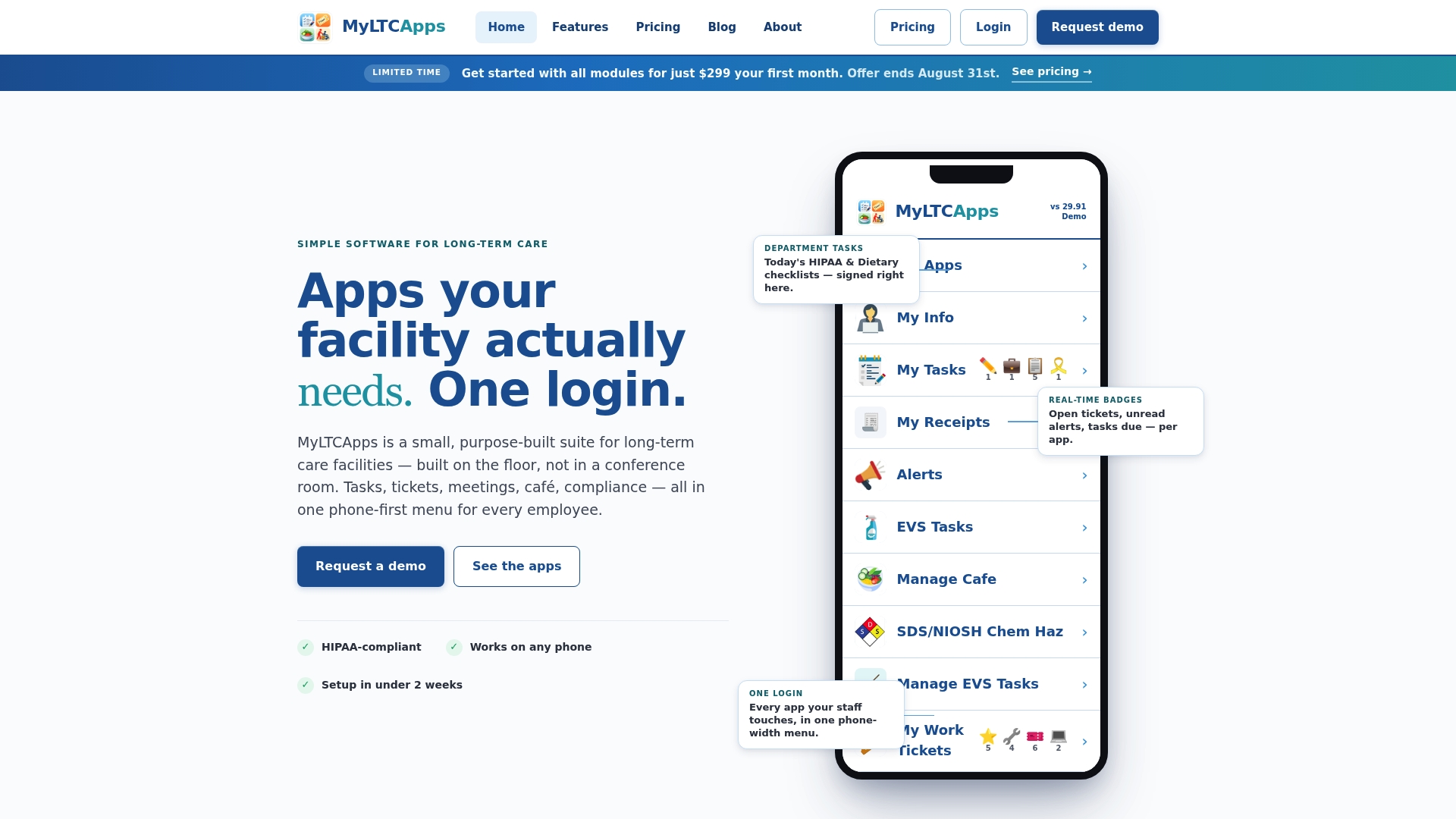
If your pilot unit needs a daily checklist, see task and checklist management. If the project is about repairs or cleaning, look at work tickets and EVS task management.
FAQ
What is the difference between QAPI, QA and process improvement?
QAPI combines quality assurance, which checks that you meet standards, with performance improvement, which studies and changes processes to do better. Process improvement is the second half. Under federal rules your facility needs both inside one data-driven program.
How long should a process improvement project run?
Individual PDSA cycles are often 2 to 12 weeks, according to HSAG. The goal should then hold for at least three to six consecutive months before you consider closing the project. Plan on a total of several months for most projects.
How many projects should we run at once?
Fewer than you think. Score your candidates, then take the top one or two so the project team has time to meet weekly and review data. Add the next project when the first is holding steady.
Who should be on the improvement team?
Include the people who do the work, a supervisor who can change the schedule or procedure, and a leader who can remove barriers. CMS also advises involving residents and other stakeholders who care about the process. The QAA committee reviews progress at least quarterly.
Sources
- QAPI Description and Background (HHS)
- QAPI at a Glance (CMS)
- 42 CFR § 483.75 (Cornell LII)
- Prioritization Worksheet for Performance Improvement Projects (CMS)
- Guidance for Performing Failure Mode and Effects Analysis (CMS)
- From Problem to Improvement: A Six-Step Playbook (HSAG)
- Guide to Writing a QAPI Plan (CAHF)
- C.2 Change Package (CMS)
- Quality improvement studies in nursing homes: a scoping review (PMC)
- Translating Evidence-Based Falls Prevention into Clinical Practice (PMC)
- Evaluation of AHRQ’s On-Time Pressure Ulcer Program
- Nursing Home IT: Optimal Medication and Care Delivery (AHRQ)