Prepare U.S. LTC for Feb 2026 HIPAA Minimum Necessary Requirements

Prepare U.S. LTC for Feb 2026 HIPAA Minimum Necessary Requirements
HIPAA’s minimum necessary standard requires covered entities to make reasonable efforts to limit the use, disclosure, and request of protected health information to the amount needed to accomplish the intended purpose. The rule does not apply to treatment-related sharing, disclosures to the patient, authorized releases, disclosures required by law, or requests from HHS. The practical starting point is role-based access tied to documented protocols, not a case-by-case judgment call every time PHI moves.
TL;DR:
- Most routine disclosures, such as claims or lab reports, should follow standardized protocols that specify exact data elements to be shared, reducing ad hoc decisions.
- Whole-record access is acceptable when documented in policies as the minimum necessary for complex clinical situations like multi-specialist coordination.
- Role-based access linked to job functions and regular review cycles help facilities maintain compliant and sustainable minimum necessary policies.
- Non-routine requests require documented case-by-case evaluation, with reliance on other entities’ determinations only when requests are consistent with their stated purpose.
- Clear policies, staff training, and audit trails are essential to demonstrate compliance during OCR reviews and avoid common violations like overbroad distribution lists.
Table of Contents
- The legal basis and when minimum necessary does not apply
- How to turn the rule into working access policies
- Setting protocols for routine disclosures and handling one-off requests
- Training, audit trails, and sanction policies that hold up to review
- Where facilities get minimum necessary wrong, and what enforcement looks like
- Applying minimum necessary on the care floor: a practical checklist
- Practical priorities for balancing privacy and care in 2026
- How MyLTCApps supports minimum necessary implementation
- FAQ
- Sources
The legal basis and when minimum necessary does not apply
The standard comes from two provisions of the HIPAA Privacy Rule: 45 CFR 164.502(b) and 164.514(d), which direct covered entities to limit PHI use, disclosure, and requests to what is reasonably necessary for the task at hand. This is a reasonableness standard, not a fixed ceiling. HHS built flexibility into the rule on purpose, recognizing that a 12-bed assisted living program and a 400-bed skilled nursing operation need different controls to reach the same outcome.
The rule also carves out specific situations where minimum necessary simply does not apply. Covered entities and their workforces should know these exemptions cold, because misapplying the standard where it does not belong creates unnecessary friction in care delivery:
- Treatment communications: Sharing PHI between treating providers for patient care is exempt, so a nurse briefing an on-call physician does not need to redact details.
- Disclosures to the individual: Patients and their personal representatives can receive their own full record.
- Authorized uses: Any use or disclosure the patient has signed an authorization for falls outside the standard.
- Required by law: Mandatory reporting, such as certain public health or abuse reporting obligations, is exempt.
- Disclosures to HHS: Information provided to HHS for enforcement or compliance review is exempt.
- HIPAA transactions: Standard electronic transactions, like claims processing, are also excluded from the minimum necessary analysis.
One frequently misunderstood point: the Minimum Necessary FAQ from HHS confirms that use or disclosure of an entire medical record is permitted when a covered entity documents that the full record is, in fact, the minimum necessary for a specific purpose. Entities do not need to review every single access request individually if that justification is written into policy ahead of time.
How to turn the rule into working access policies
Building a defensible minimum necessary program starts with mapping information to roles, not drafting a document that sits in a binder. A workable sequence looks like this:
- Inventory your PHI categories. List the types of information your facility handles: diagnoses, medications, behavioral health notes, billing data, dietary restrictions, and so on.
- Map job roles to those categories. A dietary aide needs allergy and meal-plan data; a Miller needs claims and insurance information; neither typically needs full clinical notes.
- Set default access to the minimum. Configure systems so each role sees only its assigned PHI categories by default, not the entire chart.
- Document exceptions in writing. When a role legitimately needs broader access, such as a treating clinician managing a complex admission with multiple comorbidities, write down the rationale and keep it with your policies rather than relying on an ad hoc justification.
Whole-record access is reasonable in specific clinical situations, like an attending physician coordinating care across several specialists during a difficult intake. The key is documenting why that scope was necessary at the time, since OCR reviewers look for a paper trail connecting access levels to job function.
Pro Tip: Build your access control list around job titles, not individual names, so staffing turnover never forces you to rebuild the entire permission structure from scratch.
Several operational tools make this sustainable. Access control lists tied to job roles, least-privilege default settings, and seeded policy libraries that already reflect HIPAA language all reduce the manual burden of keeping protocols current. Periodic review cycles, ideally quarterly or at minimum annually, catch role changes that have outpaced access settings, such as a promoted staff member who still has their old, narrower permissions or a departed employee whose credentials were never revoked.

Setting protocols for routine disclosures and handling one-off requests
Most PHI disclosures in a long-term care setting are repetitive: claims submissions, lab result transmissions, pharmacy orders. For these, HHS guidance supports building standard protocols that define exactly what data elements get shared for each recurring transaction type, so staff are not reinventing the scope of disclosure every time a routine request comes in.
- Claims-related exchanges: Define a fixed data set, diagnosis codes, service dates, provider identifiers, that goes to payers for billing.
- Lab reporting: Standardize what accompanies a lab order versus what stays internal to the chart.
- Protocol templates: Write these as short, repeatable checklists your billing and clinical staff can follow without escalating each instance.
Non-routine requests, by contrast, need individual review. These are the one-off disclosures: a subpoena, an unusual research request, or an inquiry from an organization you have not worked with before. HHS guidance calls for documented criteria and case-by-case evaluation here, which means building a short checklist covering the purpose of the request, which specific data elements are being asked for, the identity and credentials of the requester, and who at your facility signed off on the release.
Reasonable reliance offers a shortcut in specific circumstances. You may reasonably rely on another covered entity’s own minimum necessary determination, a public official’s request, or a researcher’s request backed by IRB or Privacy Board documentation. This saves time when, say, a hospital requests records for a resident you are discharging to their care. That reliance has limits, though: if something about the request looks inconsistent with its stated purpose, you are expected to ask questions or negotiate a narrower scope rather than hand over data automatically. When verifying an unfamiliar requester’s credentials, checking licensing details, the kind partner organizations like Astra Radiology publish for their Colorado coverage, is a reasonable step before relying on their request at face value.
Training, audit trails, and sanction policies that hold up to review
Having a policy on paper is not the same as being able to prove you follow it. OCR reviews typically look for a specific set of artifacts, and gaps in any of them tend to be where facilities run into trouble:
- Written policies and procedures that spell out your minimum necessary approach, including any blanket full-record-access justifications.
- A role access matrix mapping each job title to its permitted PHI categories.
- Documented justification for any role with whole-record access, tied to a specific clinical or operational need.
- Retention of related records, with sanction and compliance documentation generally kept for at least six years.
Training should cover what minimum necessary means in practice, which systems enforce role-based limits, and how to escalate a non-routine request. New hires need this before they touch PHI, and annual refreshers keep the policy current as roles and systems change.
Sanction policies deserve more thought than most facilities give them. HHS guidance is clear that covered entities must apply sanctions proportionate to the violation, documented consistently, and tied into HR processes so they hold up if OCR ever asks to see them. A staff member who glances at a chart out of curiosity warrants a different response than one who exports records for personal use, and your written policy should reflect that distinction rather than applying a single blunt consequence to every incident. Keeping audit-ready documentation organized ahead of time makes it far easier to respond quickly if OCR does come calling.
Where facilities get minimum necessary wrong, and what enforcement looks like
Minimum necessary violations in long-term care tend to follow familiar patterns rather than being exotic edge cases:
- Overbroad distribution lists that include staff who do not need the information for their role.
- Sign-in sheets at nursing stations or front desks that expose other residents’ names and visit reasons.
- Bedside chart visibility where paper records sit open to anyone walking the hallway.
- Lack of role separation, where every staff member effectively has administrator-level access regardless of job function.
A significant recent development is the Final Rule to Support Reproductive Health Care Privacy, which strengthened protections around reproductive health-related PHI and introduced new Notice of Privacy Practices requirements, with certain NPP compliance dates falling in February 2026. Litigation has affected parts of this rule since it was finalized, so facilities should treat it as an evolving area and watch for updated HHS guidance rather than assuming the original fact sheet is the final word. In practice, this means reviewing how requests touching reproductive health information are handled and confirming your NPP reflects current requirements.
Enforcement typically follows a pattern: OCR opens an investigation, often triggered by a complaint, and resolution frequently involves a corrective action plan requiring updated policies, additional staff training, and periodic compliance reporting back to HHS. Facilities that can show documented role mapping and training records tend to move through this process with far less disruption than those reconstructing their practices after the fact.
Applying minimum necessary on the care floor: a practical checklist
Long-term care workflows involve more distinct roles touching PHI than most outpatient settings, which makes role mapping especially valuable:
- Nursing staff typically need medication records, care plans, and recent clinical notes, not full billing history.
- Dietary staff need allergy information and meal plans, rarely anything clinical beyond that.
- EVS and maintenance staff generally need no PHI at all, aside from room assignment for scheduling purposes.
- Admissions and social work often need broader access during intake, including psychosocial history, which should be time-limited and documented.
Routine LTC documents like meal logs and ADL notes fit cleanly into standard protocols since the data involved rarely changes in scope. Medication administration records warrant somewhat broader access for nursing staff but still stop short of full chart access for most shifts.
Pro Tip: Review your facility’s HIPAA compliance checklist alongside your role access matrix twice a year, since staffing changes in long-term care happen faster than most policies get updated.
Mobile-first compliance tools that let staff complete checklists on a phone, with each task tied to a role and timestamp, make it far easier to produce the access logs and training records OCR expects during a review.
Practical priorities for balancing privacy and care in 2026
The facilities that struggle with minimum necessary are rarely the ones without technology. They are the ones without a documented rationale for who sees what. A simple, written role access matrix, maintained and reviewed twice a year, does more to protect a facility during an OCR inquiry than an expensive system overhaul that nobody can explain in plain language.
My honest recommendation: resist the urge to treat this as primarily a technology problem. Start with role mapping and documented protocols, since those cost nothing but staff time and can be as effective in a review as an expensive access management platform. Keep an eye on HHS updates to the reproductive health privacy rule and revise your Notice of Privacy Practices before the relevant compliance dates arrive rather than after. Pair whatever training you run with actual technical controls, default role restrictions and access logs, because training alone, without enforcement, rarely survives contact with a busy shift.
— Philip
How MyLTCApps supports minimum necessary implementation
Documenting role-based access and keeping audit-ready records is easier when the tools your staff already use for daily tasks are built around the same structure. Our Compliance Suite includes seeded policy libraries covering HIPAA and related regulatory areas, so facilities are not starting their documentation from a blank page.
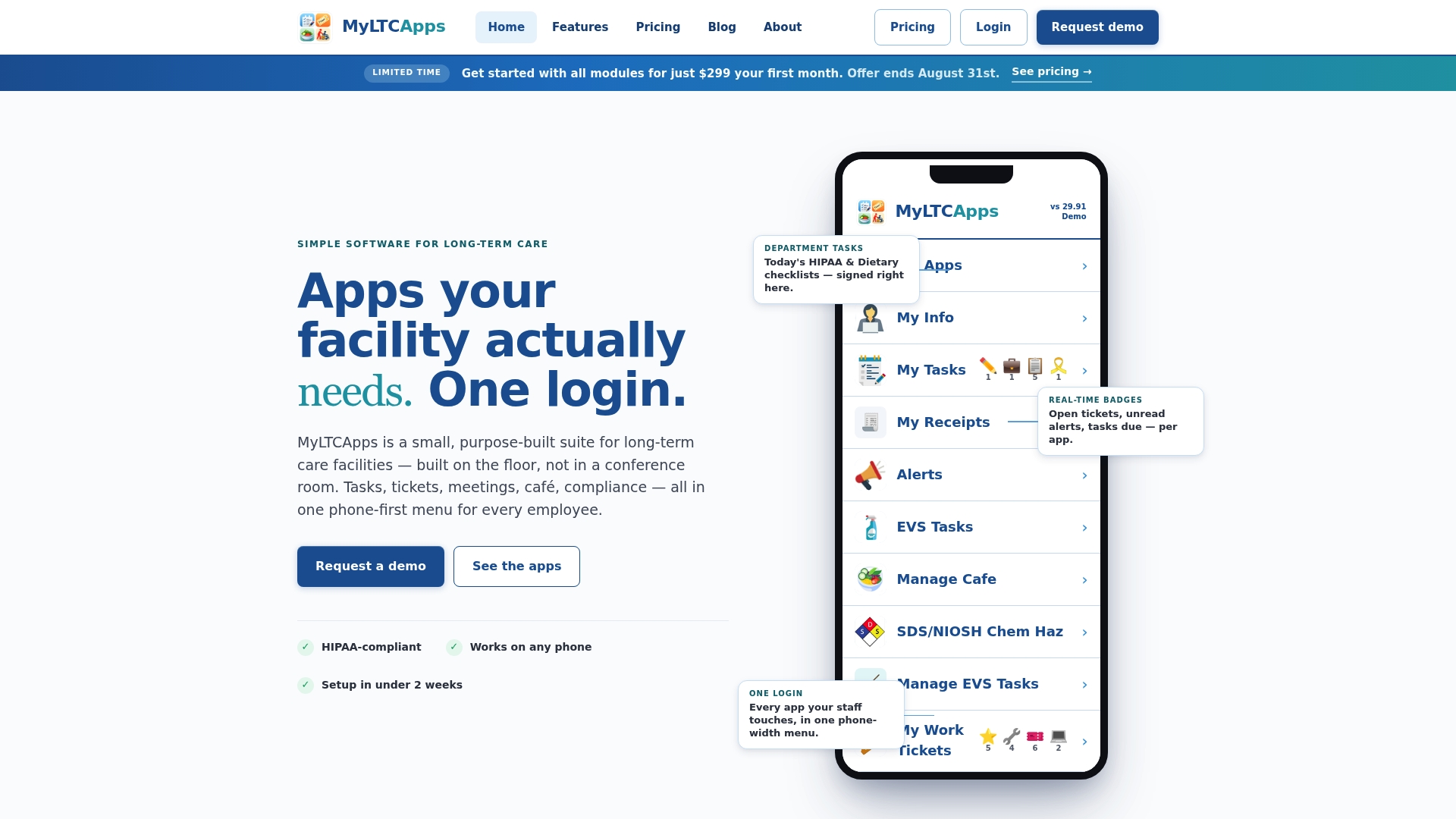
Our mobile-first task modules, including My Tasks and My Work Tickets, let staff complete checklists and work orders tied to their specific role, with every action logged for later export. That log becomes the access trail a compliance officer needs when preparing for an OCR review or an internal audit. Plans start with I Just Want That at $199 per month, scaling up through Starter Pack, Growth Pack, and Premium Pack as a facility’s module needs grow. If you want to see how the Compliance Suite fits your current policies, reach out through our pricing page to request a walkthrough.
This article is general information, not a substitute for advice from a qualified lawyer. Consult a qualified legal professional about your own circumstances before acting on anything here.
FAQ
What is the HIPAA minimum necessary requirement?
The minimum necessary requirement directs covered entities to make reasonable efforts to limit PHI use, disclosure, and requests to the amount needed for the specific purpose, under 45 CFR 164.502(b) and 164.514(d). It does not apply to treatment communications, disclosures to the patient, authorized releases, disclosures required by law, or requests from HHS.
What is the new HIPAA rule affecting privacy in 2026?
The Final Rule to Support Reproductive Health Care Privacy strengthened protections for reproductive health-related PHI and introduced Notice of Privacy Practices revisions, with certain compliance dates falling in February 2026. Litigation has affected parts of the rule since it was finalized, so organizations should track current HHS guidance rather than relying solely on the original fact sheet.
What qualifies as minimum necessary PHI?
What qualifies depends on the purpose of the use or disclosure: it is the smallest set of data elements needed to accomplish that specific task, determined through documented role mapping or case-by-case review for non-routine requests. The HHS Minimum Necessary FAQ confirms that even full medical record access can qualify when the covered entity has documented that the entire record is necessary for an identified purpose.
Does minimum necessary ever allow access to a full medical record?
Yes. Full record access is permitted when a covered entity documents in policy that the complete record is the minimum necessary for a specific role or purpose, such as a treating physician managing a complex admission. Case-by-case review is not required for these situations once the justification is written into policy, according to HHS guidance.
When can a covered entity rely on another entity’s minimum necessary determination?
Reasonable reliance applies when another covered entity, a public official, or a researcher with IRB or Privacy Board documentation makes a request and the scope appears consistent with its stated purpose. If something about the request seems inconsistent with that purpose, the receiving entity is expected to ask questions or negotiate a narrower disclosure rather than relying on it automatically, per HHS guidance.