HIPAA Audit Checklist: Be OCR-Ready in 2026

HIPAA Audit Checklist: Be OCR-Ready in 2026
An audit-ready HIPAA checklist is a living, risk-based document that maps every control to the HHS/OCR Audit Protocol and proves implementation of the Privacy, Security, and Breach Notification Rules through dated, retrievable evidence. That last part is what most organizations miss: OCR auditors do not accept policy documents alone. They want proof the controls operate.
The ten elements every checklist must cover, in priority order:
- Governance: Designated Privacy Officer and Security Officer, with documented role descriptions and executive sign-off
- Security Risk Analysis (SRA): Enterprise-wide, dated, scoped to all ePHI assets, with a risk register and funded treatment plan
- Policies and procedures: Approved, versioned, distributed, and retained for six years
- Workforce training: Role-based modules, completion rosters, assessment results, and attestations
- Business Associate Agreements (BAAs): Signed, current, inventoried, with downstream subcontractor coverage
- Access controls: Unique user IDs, MFA, least-privilege matrices, onboarding and termination evidence
- Audit logs and system activity reviews: SIEM exports, review frequency records, escalation documentation
- Encryption and transmission security: TLS version evidence, encryption-at-rest configuration, key management notes
- Breach detection and notification: Intake tickets, four-factor risk assessments, 60-day notification records
- Corrective Action Plans (CAPs): Tracked remediation items with owners, deadlines, and verification evidence
Your three highest-priority actions to start today: (1) confirm your SRA is dated within the past 12 months and covers cloud services and connected devices; (2) pull your BAA inventory and flag any vendor without a current signed agreement; (3) verify your training rosters include completion dates and role-based assignments for every workforce member with PHI access.
Pro Tip: Map every checklist item to its OCR Audit Protocol control number in a separate column. When OCR sends a document request, you can respond by control number rather than hunting for files under pressure.
Key Takeaways
A defensible HIPAA compliance program requires a dated, enterprise-wide SRA, signed BAAs for every vendor with PHI access, role-based training records, and a CAP tracker with verified closure evidence, all organized against the OCR Audit Protocol before OCR asks for them.
| Point | Details |
|---|---|
| SRA is the top priority | An enterprise-wide, dated SRA with a funded treatment plan is the most common critical OCR finding when missing. |
| BAA inventory must be current | Every vendor with PHI access needs a signed, current BAA; auditors request the BA list within 10 business days. |
| Training records need role-based detail | Completion rosters must show employee name, role, module, date, and score, not just a general training log. |
| Map evidence to protocol numbers | Organizing your submission by Audit Protocol control number reduces auditor friction and follow-up requests. |
| Myltcapps centralizes LTC audit evidence | Task checklists, training rosters, BA inventory, and CAP tracking in one platform keeps evidence audit-ready year-round. |
Table of Contents
- What Does a HIPAA Audit Checklist Actually Cover?
- Administrative safeguards checklist: roles, policies, training, and governance
- Privacy Rule checklist: PHI handling, patient rights, and notices
- Security Rule checklist: risk analysis, access controls, logging, and encryption
- How do you scope and document a HIPAA security risk analysis?
- Breach Notification checklist: detection, assessment, and notification timelines
- Business associate management checklist: BAA inventory, due diligence, and oversight
- What documents does OCR actually request in a desk audit?
- How does OCR select entities and run its audits?
- How to run an internal HIPAA audit from start to finish
- Why a cross-functional steering committee keeps your checklist defensible
- How long does a HIPAA internal audit actually take?
- How do you turn audit findings into lasting remediation?
- What a compliance officer actually does when the OCR letter arrives
- Myltcapps keeps your audit evidence organized year-round
- Sources
What Does a HIPAA Audit Checklist Actually Cover?
The HIPAA Audit Program organizes its protocol across three rules: Privacy, Security, and Breach Notification. A practical compliance checklist mirrors that structure exactly, because OCR auditors evaluate your evidence against those same protocol categories. Below is a one-page run-now version you can print or copy to prepare a desk-audit response package or run a quick internal spot check.
How to use this checklist: For a desk audit, work through every row and attach the named document to a numbered submission folder. For an internal spot check, sample two or three rows per category and note the evidence location and last-review date.
| Category | Checklist Item | Evidence Document | Status |
|---|---|---|---|
| Governance | Privacy Officer designated | Role description + appointment letter | ☐ |
| Governance | Security Officer designated | Role description + appointment letter | ☐ |
| Governance | Steering committee minutes | Signed meeting minutes, last 12 months | ☐ |
| SRA | Enterprise-wide SRA completed | Dated SRA report + risk register | ☐ |
| SRA | Risk treatment plan with owners | Remediation plan + budget approval | ☐ |
| Policies | Policy set approved and versioned | Policy index with effective dates | ☐ |
| Training | Role-based training completed | Completion rosters + assessment scores | ☐ |
| BAAs | BA inventory current | Vendor list + signed BAA copies | ☐ |
| Access Controls | Unique user IDs enforced | User provisioning records | ☐ |
| Access Controls | Periodic access review completed | Access review report + sign-off | ☐ |
| Audit Logs | System activity reviewed | SIEM export + review log | ☐ |
| Encryption | ePHI encrypted at rest and in transit | Configuration baseline + TLS evidence | ☐ |
| Breach | Incident log maintained | Incident register with timestamps | ☐ |
| Breach | Notification records retained | Notification letters + delivery proof | ☐ |
| CAPs | Open findings tracked | CAP tracker with owners and dates | ☐ |
For desk audits, OCR typically requests documents within 10 business days of the initial request. Having this checklist pre-populated with file locations cuts that response time significantly.
- Organize submission files by protocol category, not by department
- Include a cover index that maps each file to its Audit Protocol control number
- Date-stamp every document at the top; auditors flag undated policies immediately
- Retain all audit-prep materials for six years from creation or last effective date
Administrative safeguards checklist: roles, policies, training, and governance
Administrative safeguards are the foundation OCR tests first, because weak governance predicts weak technical controls. Auditors look for evidence that your organization has assigned accountable people, built written procedures, trained its workforce, and tracked compliance over time.
Designating officers and documenting governance
Both the Privacy Officer and Security Officer designations must be in writing, not just understood informally. The documentation should include a role description, the individual’s name and title, the effective date of appointment, and evidence of executive approval. Governance minutes from your compliance or privacy steering committee serve as corroborating evidence that these officers are active, not just named on paper.
Auditors specifically look for meeting minutes that show CAP status updates, executive escalation decisions, and policy approvals. A folder of signed minutes from the past 12 months, with a standing agenda that includes compliance metrics, satisfies this requirement cleanly.
Required policy set
Your policy library needs to cover, at minimum: information access management, workforce training and management, sanction policy, security incident procedures, contingency planning, device and media controls, and the Notice of Privacy Practices. Each policy document should carry:
- An approval signature and date
- An effective date and version number
- A distribution log or acknowledgment records showing workforce receipt
- A revision history noting what changed and why
Six-year retention applies to policies and their revision histories. That means a policy you retired in 2022 still needs to be in your archive through 2028.
Workforce training records
Role-based training is the standard OCR expects. A general “HIPAA awareness” module for everyone is a starting point, but auditors want to see that staff with elevated PHI access received additional training matched to their responsibilities. Your training evidence package should include:
- A training curriculum with module names, content descriptions, and completion requirements by role
- Completion rosters with employee names, roles, completion dates, and assessment scores
- Attestation signatures or electronic acknowledgments
- Sanction records for any workforce member who failed to complete required training or violated policy
Documentation retention for training records follows the same six-year rule. Keep rosters even after an employee leaves.
Sanction policy and contingency planning
Your sanction policy must describe the range of consequences for policy violations, from verbal warnings to termination, and you need at least one documented instance of the policy being applied (even if it was a minor infraction). Auditors treat a sanction policy with no enforcement history as a paper control.
Contingency planning evidence includes a business continuity plan, a disaster recovery plan, a data backup plan, and an emergency-mode operations procedure. Each should be tested periodically, with test results and any corrective actions documented.
Privacy Rule checklist: PHI handling, patient rights, and notices
The Privacy Rule checklist focuses on what information qualifies as PHI, how your organization uses and discloses it, and whether patients can exercise their rights. OCR auditors pull sample patient rights requests and trace them through your response process, so the evidence trail matters as much as the policy.
PHI inventory and permitted uses
Start by identifying every system and format where PHI lives: EHRs, billing platforms, scanned paper records, secure messaging tools, and any cloud storage. Each source should appear in your SRA asset inventory. Permitted uses and disclosures must be documented with the legal basis (treatment, payment, operations, or a signed authorization), and your authorization forms need to be stored in a retrievable file linked to the relevant record.
Disclosure logs are a common audit gap. Your accounting-of-disclosures process should capture the date, recipient, description of information disclosed, and purpose for every non-routine disclosure. Auditors will request a sample.
Patient rights: access, amendment, and accounting
The 30-day access timeline is the most frequently tested patient right. Your process should produce a dated request intake record, a response letter with the date sent, and either the records provided or a documented denial with the legal basis. Amendment requests follow a similar pattern: intake date, decision, and notification to the patient.
Evidence auditors expect for patient rights:
- Access request log with intake dates, response dates, and outcomes
- Copies of response letters (or templates with completed examples)
- Amendment request log and decision records
- Accounting-of-disclosures log with entries for the past six years
- Authorization files, organized by patient and date
Notice of Privacy Practices
Your Notice of Privacy Practices (NPP) must include the effective date, a description of permitted uses and disclosures, patient rights, your complaint process, and contact information for your Privacy Officer. Distribution records should show that new patients received the NPP at first service contact, with a signed acknowledgment or a documented attempt to obtain one.
For long-term care facilities, the NPP distribution process at admission is a common audit focus. Keep signed acknowledgments in the resident file and a facility-level log of all NPP distributions.
Minimum necessary standard
Role-based access justifications are the evidence for minimum necessary. For each role with PHI access, document what data elements that role can view, why that access is necessary for the job function, and when access was last reviewed. This documentation connects directly to your access control matrix in the Security Rule section.
Security Rule checklist: risk analysis, access controls, logging, and encryption
The Security Rule checklist is the most technically detailed section, and OCR’s 2024–2025 audit focus on ransomware-relevant controls means technical safeguards are under sharper scrutiny than ever. The OCR Audit Protocol maps each Security Rule provision to specific documentary evidence, so the table below shows which artifacts satisfy which citations.

Access controls and user management
Every workforce member with ePHI access needs a unique user ID. Shared accounts are a direct audit finding. MFA evidence should show the authentication method, the systems it covers, and the date it was implemented. Your least-privilege matrix documents which roles can access which systems and data elements, and periodic access reviews (at minimum annually, quarterly for high-privilege accounts) should produce a dated report with sign-off.
Onboarding and termination evidence is frequently sampled. Auditors pull a random selection of recently hired and recently terminated employees and check whether access was provisioned correctly on hire and revoked within your documented timeframe on termination. Same-day revocation for terminations is the standard most auditors expect.
Audit logs and system activity review
Log retention and regular review are two separate requirements. Your SIEM or log management system should retain logs for at least six years. But retention alone is not enough: you need documented evidence that someone reviewed those logs on a defined schedule, flagged anomalies, and escalated where appropriate. A log review policy with a frequency (weekly, monthly) plus dated review records and any escalation tickets satisfies this requirement.
Encryption and transmission security
For data in transit, document the TLS version in use for each web-facing service and any internal system that transmits ePHI. TLS 1.2 is the current floor; TLS 1.3 is preferred. For data at rest, your encryption baseline should list each storage system, the encryption standard applied, and the key management process. If any system stores unencrypted ePHI, that needs a documented risk acceptance with management sign-off.
Device, media, and physical safeguards
Your device inventory should include every workstation, laptop, mobile device, and removable media that touches ePHI. Disposal and reuse records document how devices were wiped or destroyed before leaving your control. Physical safeguard evidence includes facility access logs for server rooms and areas where PHI is processed, workstation use policies, and screen-lock configuration records.

Patch management and anti-malware evidence rounds out the technical picture: vulnerability scan reports, patch schedules, and remediation tickets for critical findings. Given OCR’s current focus on ransomware, gaps in patch cadence or anti-malware coverage will draw attention.
How do you scope and document a HIPAA security risk analysis?
The ONC Security Risk Assessment tool gives providers a structured framework for scoping and documenting their SRA, but the methodology choices are yours to make and defend. OCR does not mandate a specific tool; it requires a documented, enterprise-wide analysis that identifies threats, vulnerabilities, likelihood, and impact for all ePHI.
SRA scope: what to include
Your SRA scope should cover every asset that creates, receives, maintains, or transmits ePHI:
- EHR and clinical systems
- Billing and revenue cycle platforms
- Cloud storage and SaaS applications with PHI access
- Connected medical devices and IoT endpoints
- Vendor and contractor access points
- Physical locations where PHI is stored or accessed
Data flow diagrams are useful here. Map where ePHI enters your environment, where it moves, and where it exits. Gaps in the data flow map are often where the highest-risk vulnerabilities hide.
Methodology: qualitative vs. quantitative
Most healthcare organizations use a qualitative approach: rate likelihood (low, medium, high) and impact (low, medium, high) for each identified threat-vulnerability pair, then multiply to get a risk score. The key is consistency. Use the same scale throughout, document your scoring rationale, and apply the methodology to every asset in scope.
Your risk register should capture, at minimum: asset name, threat, vulnerability, current controls, likelihood rating, impact rating, risk score, risk treatment decision (mitigate, accept, transfer), assigned owner, target remediation date, and interim controls if the full fix takes time.
What OCR expects to see
AccountableHQ’s guidance on OCR audit requirements notes that auditors expect an enterprise-wide risk analysis, prioritized risk treatment plans with evidence of implementation, and sample artifacts proving controls operate in practice. A policy that says “we will conduct an annual SRA” without a dated SRA report is a finding.
The documentation package OCR wants includes: the dated SRA report, evidence of management review (a sign-off page or meeting minutes where the SRA was presented), a funded remediation plan, and records of periodic reassessments when significant changes occur (new systems, new vendors, new locations).
Pro Tip: Link every open CAP item in your risk register to a line in your executive dashboard. When leadership can see remediation progress in real time, budget approvals for security investments move faster, and you have documented evidence of management engagement.
Breach Notification checklist: detection, assessment, and notification timelines
Breach notification failures are among the most visible HIPAA enforcement actions, and the documentation trail is what separates a defensible response from a compliance gap. The checklist here covers detection through final recordkeeping.
Detection and intake
Every potential breach starts as an event. Your intake process should produce a timestamped ticket or incident record the moment an event is identified, with the reporter’s name, the date and time of discovery, and a brief description. Triage assigns the event to an investigator and sets a response timeline.
Evidence to retain from detection:
- Initial incident ticket with timestamp and reporter identity
- Triage assignment record
- Investigation notes with dates of each step
- Decision records showing when the event was escalated or closed
Four-factor risk assessment
When an impermissible use or disclosure of PHI occurs, the four-factor risk assessment determines whether it constitutes a reportable breach. Document each factor explicitly:
- Nature and extent of PHI involved: What data elements were exposed? Were identifiers, financial data, or clinical data included?
- Who accessed or could have accessed the PHI: Was it an authorized workforce member, an unauthorized third party, or an unknown actor?
- Whether PHI was actually acquired or viewed: Is there evidence the data was accessed, or only that it was potentially accessible?
- Extent to which risk has been mitigated: Were credentials changed, access revoked, or data recovered before misuse occurred?
Each factor should have a written analysis with supporting evidence. The conclusion (breach or not a breach) must be documented with the rationale.
Notification timelines and content
Individuals must be notified without unreasonable delay and no later than 60 days after discovery. For breaches affecting 500 or more individuals in a state or jurisdiction, media notification is also required. HHS must be notified within 60 days for large breaches; for breaches affecting fewer than 500 individuals, covered entities may report to HHS on an annual basis.
Notification content requirements include: a description of what happened, the types of information involved, steps individuals should take to protect themselves, what the covered entity is doing to investigate and mitigate, and contact information for questions.
Evidence to retain:
- Notification letters (final versions)
- Proof of delivery (certified mail receipts, email delivery logs, or substitute notice documentation)
- HHS submission confirmation
- Media statements where applicable
- The complete investigation file, including the four-factor analysis
Business associate management checklist: BAA inventory, due diligence, and oversight
Business associate management is a persistent audit gap, particularly in long-term care where the vendor ecosystem is large and contracts are often inherited from prior administrators. OCR expects a current inventory, signed agreements, and evidence of ongoing oversight.
BA inventory requirements
Your inventory should capture every vendor, contractor, or subcontractor that creates, receives, maintains, or transmits PHI on your behalf. That includes EHR vendors, billing services, cloud storage providers, IT managed services, shredding companies, and any downstream subcontractors those vendors use.
Auditors will request your BA list within 10 business days of an initial document request. Having a pre-built, current inventory in a retrievable format is one of the fastest wins in audit preparation.
BAA content requirements
A valid BAA must include, at minimum: permitted uses and disclosures of PHI, a prohibition on uses not permitted by the agreement, requirements to implement appropriate safeguards, breach notification obligations to the covered entity, and provisions for returning or destroying PHI at contract termination.
Review each BAA against these requirements. Agreements signed before the 2013 Omnibus Rule updates may be missing breach notification language and need to be updated.
Vendor due diligence and ongoing monitoring
Due diligence evidence for each BA should include a completed security questionnaire or attestation, and for higher-risk vendors, a SOC 2 Type II report or penetration test summary. Document when you received each attestation and any remediation follow-up.
Ongoing monitoring means reviewing vendor security posture on a defined schedule, not just at contract signing. A practical cadence is annual re-attestation for all BAs, with quarterly check-ins for vendors with the highest PHI access. Document each review, including any vendor-reported incidents and your response.
- Flag vendors whose BAAs expire or whose attestations are more than 12 months old
- Track vendor-reported breaches separately from your own incident log
- Include a termination clause that requires PHI return or destruction within a defined timeframe
What documents does OCR actually request in a desk audit?
The Phase II audit program established that desk audits are based on document submissions and may escalate to on-site audits if the submitted evidence is incomplete or raises additional questions. The 10-business-day response window is the standard expectation for returning requested materials.
Document request response package
Organize your submission by protocol category, not by department or system. A cover index that maps each file to its Audit Protocol control number reduces auditor friction and decreases the likelihood of follow-up requests for clarification.
Core documents to include:
- Privacy and Security Officer designation letters
- Current policy index with effective dates and version numbers
- Most recent SRA report with risk register and treatment plan
- Risk management plan with remediation status
- BA inventory and copies of signed BAAs for sampled vendors
- Workforce training rosters with completion dates and role assignments
- Incident log for the past three years
- Audit log samples with review records
- Access review reports (most recent)
- Encryption and configuration baselines
- Breach notification records (if applicable)
File naming and organization
Use a consistent naming convention: [ProtocolCategory]_[DocumentType]_[EffectiveDate]. For example: Security_SRA_2025-09.pdf or Privacy_NPP_2024-01.pdf. Auditors reviewing dozens of submissions notice when files are clearly organized and when they are not.
Pro Tip: Submit the minimum set of documents that directly answers each protocol question. Over-supplying documentation creates more surface area for auditors to find issues and slows their review. Index first, then attach only what the index references.
Practical guidance from AccountableHQ recommends centralizing artifacts, mapping evidence to protocol items, and maintaining six-year documentation retention for all audit artifacts.
How does OCR select entities and run its audits?
OCR selects covered entities and business associates for audit from a pool that includes both covered entities and their BAs. Selection criteria have included entity size, prior complaint history, and geographic distribution. Neither a prior clean audit nor the absence of complaints guarantees you will not be selected.
Desk audit mechanics
A desk audit begins with a document request. OCR identifies the protocol areas it will review, sends a formal request, and expects the response package within the established timeframe. Auditors evaluate the submitted evidence against the Audit Protocol’s established performance criteria. If the evidence is insufficient or raises questions, the desk audit can escalate to an on-site review.
What auditors evaluate in submitted documents:
- Whether policies exist and are current (approved, versioned, distributed)
- Whether the SRA is enterprise-wide, dated, and followed by a treatment plan
- Whether training records show role-based completion
- Whether BAAs are signed and current
- Whether access controls and audit logs are in place and reviewed
On-site audit expectations
On-site audits expand the scope beyond documents. Auditors may interview workforce members, observe physical safeguards, request live system demonstrations, and pull additional evidence samples. The sampling approach typically includes a mix of user accounts, incident records, and system configurations.
Preparation for an on-site audit means briefing your Privacy Officer, Security Officer, and IT staff on what to expect, designating a single point of contact for auditor requests, and having your evidence library accessible and organized.
Draft findings and response process
After reviewing evidence, OCR shares draft findings with the audited entity. The entity typically has 10 business days to respond with corrections, clarifications, or additional evidence. Responses are incorporated into the final audit report. Possible outcomes range from technical assistance (for minor gaps) to a compliance review that can lead to enforcement action for significant or repeated failures.
Proactive remediation before an audit is always the better path. Addressing known gaps before OCR arrives demonstrates good faith and reduces the likelihood of enforcement referral.
How to run an internal HIPAA audit from start to finish
A structured internal audit methodology, as outlined by Fortinet’s HIPAA compliance guidance, covers scoping, documentation collection, interviews, technical assessments, sampling, findings documentation, and remediation planning. Here is how to apply that framework operationally.
-
Scope the audit. Identify every system, process, and workforce role that touches PHI. Exclude non-PHI systems explicitly so the scope is documented and defensible. For long-term care facilities, this typically includes the EHR, billing system, resident communication tools, and any cloud storage used by clinical or administrative staff.
-
Build your evidence request list. Map each protocol category to the documents you need to collect. Use the Audit Protocol control numbers as your index. Assign a document owner for each item and set a collection deadline.
-
Collect and review documentation. Pull policies, training rosters, SRA reports, BAA inventories, access review reports, and incident logs. Check each document for completeness: approval signatures, effective dates, version numbers, and distribution records.
-
Conduct interviews. Interview the Privacy Officer, Security Officer, and a sample of workforce members with PHI access. Ask about their understanding of policies, how they handle PHI in daily work, and what they do when they suspect a breach. Document the interviews with dates and names.
-
Perform technical assessments. Pull audit log samples, review access control configurations, check encryption settings, and verify patch status. For facilities without dedicated IT staff, this step may require outside technical assistance.
-
Sample evidence. Time-bound sampling: pull records from a defined period (e.g., the past 12 months). User-based sampling: select a random set of user accounts and verify provisioning, access levels, and termination records. System sampling: select two or three systems and verify their configuration against your security baselines.
-
Score and document findings. Rate each finding by severity: Critical (immediate remediation required), High (remediate within 30 days), Medium (remediate within 90 days), Low (remediate within 180 days). Document the root cause, the gap between the required control and current state, and the recommended corrective action.
-
Build the CAP. Assign each finding to an owner with a target remediation date, interim controls where the full fix takes time, and a verification method. Track CAP status in a shared register that leadership can review.
-
Report to leadership. Present findings, CAP status, and resource needs to your compliance committee or executive team. Document the presentation and any decisions made.
Audit cadence: Conduct a comprehensive SRA annually. Run targeted control reviews quarterly, focusing on access controls, training completion, and incident log review. Spot-check BAA currency semi-annually.
Staffing estimate: A small facility (under 50 employees) can complete an internal audit in four to six weeks with one dedicated compliance staff member and part-time IT support. A medium-sized organization (50–200 employees) typically needs six to ten weeks with a compliance officer, an IT lead, and a clinical representative. Larger health systems may require a dedicated team or outside consultants.
Why a cross-functional steering committee keeps your checklist defensible
HIPAA compliance is not an IT function. The California Health Care Foundation’s HIPAA toolkit recommends treating compliance as a cross-functional operation that includes clinical and administrative leadership, not just the IT department. That framing matters because auditors look for evidence that compliance decisions reflect real workflows, not just technical configurations.
A cross-functional steering committee should include: the Privacy Officer, the Security Officer, a clinical representative (charge nurse or director of nursing in a long-term care setting), IT, legal or compliance counsel, and operations leadership. Meeting monthly with a standing agenda that covers CAP status, policy changes, incident updates, and upcoming risk reviews creates a paper trail that demonstrates active governance.
Change control for policies and the checklist
Every policy change needs an approval signature, a distribution log, and a revision history entry. The same applies to your audit checklist itself. When a new threat emerges or a new system is added, update the checklist, document the change, and distribute the updated version to everyone who uses it. An undated or unversioned checklist is a liability in an audit.
Pro Tip: In long-term care settings, embed checklist tasks into daily operations rather than treating them as a separate compliance exercise. Assign specific checklist items to department heads as part of their regular responsibilities, with completion tracked in your facility’s task management system. When compliance is woven into daily workflows, evidence accumulates naturally rather than being assembled under pressure before an audit.
For LTC-specific documentation practices, the Myltcapps blog on HIPAA compliance for long-term care covers facility-level policy and documentation practices in detail.
Practical governance tips
- Keep a master checklist version log with the date of each revision and the reason for the change
- Assign a checklist owner who is responsible for annual review and updates
- Include checklist review as a standing agenda item at your annual compliance program evaluation
- Document any decision to defer a checklist update and the rationale
How long does a HIPAA internal audit actually take?
Timeline and resource needs vary more than most guides acknowledge. The biggest drivers are scope (how many systems touch PHI), cloud footprint (SaaS applications multiply the asset inventory), and device inventory (connected medical devices and mobile endpoints add complexity).
Small facilities (under 50 employees, single location):
- Timeline: 4–6 weeks
- Staffing: 1 compliance staff member (0.5 FTE dedicated to the audit), part-time IT support
- Key resource needs: Access to EHR audit logs, a policy library, and a training platform with exportable rosters
Medium organizations (50–200 employees, multiple departments or locations):
- Timeline: 6–10 weeks
- Staffing: Compliance officer (1.0 FTE during audit period), IT lead (0.5 FTE), clinical representative (0.25 FTE)
- Key resource needs: SIEM or log management system, vulnerability scanning tool, BA inventory database
Large health systems (200+ employees, complex vendor ecosystem):
- Timeline: 10–16 weeks
- Staffing: Dedicated compliance team plus outside technical assessors for penetration testing and log analysis
- Key resource needs: GRC platform, automated access review tools, enterprise SIEM
For facilities without dedicated IT staff, rural long-term care operators in particular, the Myltcapps guide on rural nursing home compliance software addresses how to operationalize checklist tasks with minimal IT resources.
Pro Tip: When resources are constrained, prioritize the SRA and access controls first. An incomplete SRA is the single most common critical finding in OCR audits, and access control gaps (shared accounts, unrevoked terminated-employee access) are the most frequently exploited vulnerabilities. Get those two areas solid before spending time on lower-risk checklist items.
OCR’s 2024–2025 audit focus on ransomware-relevant Security Rule controls reinforces this priority: patch management, anti-malware, and access control evidence should be at the top of your resource allocation.
How do you turn audit findings into lasting remediation?
A CAP that lives in a spreadsheet no one reviews is not remediation. Effective corrective action requires tracked ownership, verified closure, and integration into ongoing monitoring so the same gap does not reappear in the next audit cycle.
CAP template fields
Each finding in your CAP should capture:
- Finding description and severity rating
- Root cause (policy gap, training failure, technical misconfiguration, process breakdown)
- Corrective action steps, numbered and specific
- Assigned owner (name and title, not just department)
- Target completion date
- Interim controls in place while the full fix is implemented
- Verification method (retest, document review, management sign-off)
- Closure date and verification evidence
Verification and closure
Closing a CAP item requires evidence, not just a status update. For a policy gap, closure evidence is the approved, distributed updated policy. For a technical control, it is a configuration screenshot or scan result dated after the fix. For a training gap, it is updated completion rosters. Management sign-off on closure evidence creates the accountability trail OCR expects.
Continuous monitoring
Ongoing monitoring keeps controls from drifting after the audit closes. Practical mechanisms include:
- Monthly log review alerts for anomalous access patterns
- Quarterly access reviews with automated provisioning reports
- Semi-annual BA inventory checks for expired BAAs or new vendors
- Annual policy review cycle tied to the compliance calendar
- Executive dashboard showing open CAP items, overdue findings, and training completion rates
When a monitoring check identifies a new gap, it feeds directly back into the CAP process. That closed loop is what transforms a one-time audit into a continuous compliance program. Lessons learned from each audit cycle should also feed into the next training curriculum update, so workforce knowledge stays current with evolving threats.
What a compliance officer actually does when the OCR letter arrives
The moment an OCR document request lands, the instinct is to start pulling files. Resist it. The first 30 minutes should be spent reading the request carefully, identifying exactly which protocol categories are being tested, and mapping those categories to your evidence library index. Responding to the wrong protocol items wastes time and can introduce documents that raise new questions.
A practical week-by-week workflow:
Preparation week (before any OCR contact): Run a quarterly spot check against your checklist. Verify the SRA is dated, BAAs are current, and training rosters are complete. Flag any open CAP items that are overdue. This is the work that makes the actual response manageable.
Day one of the document request: Read the request in full. Map each requested item to your evidence library. Identify gaps immediately, because a gap discovered on day one gives you nine business days to address it; a gap discovered on day nine gives you nothing.
Days two through eight: Assemble the submission package by protocol category. Apply the naming convention. Build the cover index. Have your Privacy Officer and Security Officer review the package before submission.
Submission day: Submit through OCR’s designated portal. Retain a complete copy of everything submitted, with the submission confirmation. Note the submission date and the names of everyone involved in preparing the package.
Follow-up month: After submission, document what the process revealed. What took longer than expected? What evidence was harder to locate than it should have been? What gaps did you find that were not on your checklist? Feed those observations into your next internal audit scope.
Two pitfalls to avoid: over-supplying documents (submitting everything in your evidence library rather than what the request specifically asks for) and missing version control (submitting a policy without an effective date or approval signature, which auditors flag immediately as a documentation deficiency).
The HIPAA Journal’s audit checklist guidance reinforces that the internal audit checklist should be treated as a living document, updated as threats and technology evolve. The compliance officer who runs this workflow quarterly does not scramble when OCR calls.
Myltcapps keeps your audit evidence organized year-round
Assembling a desk-audit response package from scattered spreadsheets, shared drives, and email threads is where most facilities lose days they do not have. Myltcapps is built specifically for long-term care operations, and its compliance modules map directly to the evidence OCR requests.
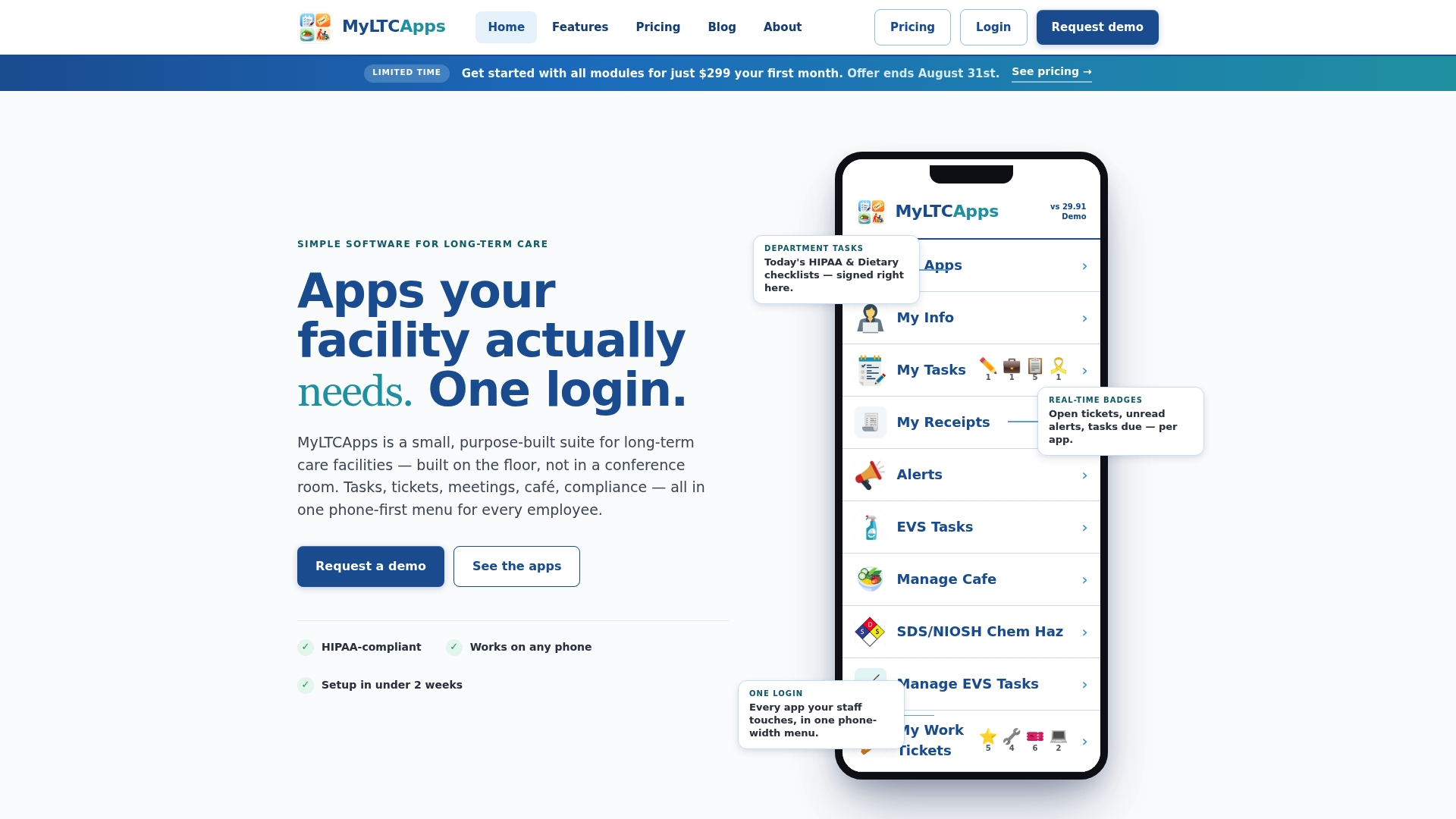
The platform’s compliance task and checklist tools let you assign checklist items to specific staff members, track completion in real time, and export dated rosters in a format auditors can read immediately. Training records and in-service attendance flow through the meetings and in-service tracking module, producing the role-based completion evidence that auditors pull first. BA inventory, incident logs, and CAP tracking live in the same interface, so your evidence library builds itself as daily operations run, rather than being assembled under pressure before a submission deadline.
For facilities that need to demonstrate six-year documentation retention without a dedicated IT team, Myltcapps’s document management and export capabilities make that requirement practical rather than burdensome. Every record carries a timestamp, an owner, and a version history.
Request a demo or review export examples at Myltcapps to see how the platform fits your facility’s audit workflow.
Sources
These are the primary references to consult when building or validating your checklist. Each serves a specific purpose in the audit preparation process.
- Audit Protocol – HHS Office for Civil Rights
- HIPAA Privacy, Security & Breach Notification Compliance Audits Phase II — OCR overview (NIST-hosted PDF)
- HIPAA Journal: HIPAA audit checklist
- Security risk assessment tool — HealthIT (ONC)
This article is general information, not a substitute for advice from a qualified lawyer. Consult a qualified legal professional about your own circumstances before acting on anything here.