HIPAA Breach Timeline: U.S. Compliance Officers' 60 Day Checklist

HIPAA Breach Timeline: U.S. Compliance Officers’ 60 Day Checklist
The Breach Notification Rule requires covered entities to notify affected individuals without unreasonable delay and no later than 60 calendar days after discovery, with contemporaneous notice to the HHS Secretary and prominent media when 500 or more people are affected. Breaches under 500 individuals can be reported to the Secretary annually instead. The rest of this guide walks through discovery, reporting mechanics, exceptions, and a step-by-step checklist for building your own hipaa breach notification timeline.
TL;DR:
- The clock starts when the breach is known or reasonable monitoring would have revealed it, not when the investigation ends.
- Start a written four factor assessment within 48 hours; unauthorized access to unsecured health information is presumed reportable absent evidence of low compromise risk.
- Vendor contracts may require reporting within 24 to 72 hours, so confirm each agreement’s deadline and required data before an incident occurs.
- When details are missing for 10 or more people, post notice online for 90 days and provide a toll free number or media notice.
Table of Contents
- What counts as discovery and how the 60-day clock starts
- The 60-day rule: individual, media, and Secretary reporting timelines
- How to report: OCR breach portal and annual reporting for smaller breaches
- Risk assessment and the four-factor test: deciding whether to notify
- Business associates: reporting obligations and BAAs
- Law enforcement delay: when and how notifications can be postponed
- Notification content, delivery methods, and substitute notice rules
- Practical timeline and step-by-step checklist for compliance officers
- Why prompt, documented notification matters more than perfect notification
- How MyLTCApps supports breach response tracking and audit-ready records
- FAQ
- Sources
What counts as discovery and how the 60-day clock starts
The notification clock does not start when your investigation wraps up. Under 45 CFR 164.404, discovery is the first day the breach is known to the covered entity, or the first day it would have been known had the entity exercised reasonable diligence. That second half of the definition carries real weight: a facility cannot claim ignorance if better monitoring would have caught the incident sooner.
OCR guidance frames reasonable diligence as an ongoing obligation, not a one-time check. Entities are expected to run monitoring systems capable of flagging unauthorized access, and a gap in that monitoring does not pause the clock or excuse a late notification.
Several everyday events can trigger discovery:
- A staff member reports a misdirected fax or an unencrypted laptop left in a vehicle.
- An intrusion detection system flags unusual access to a resident records database.
- A business associate calls to report that one of its systems was compromised.
The practical takeaway is simple: do not wait for a finished forensic investigation before starting the notification process. The 60-day countdown begins on the discovery date, regardless of how long the internal review takes.
The 60-day rule: individual, media, and Secretary reporting timelines
Three separate notification tracks run on related but distinct clocks, and mixing them up is one of the most common compliance missteps.
- Individual notice: affected individuals must be notified without unreasonable delay and in no case later than 60 calendar days after discovery, per 45 CFR 164.404.
- Media notice: when a breach affects more than 500 residents of a single state or jurisdiction, prominent media outlets serving that area must also be notified within the same 60-day window.
- Secretary (OCR) notice for 500+: breaches affecting 500 or more individuals require contemporaneous notification to OCR through the breach portal, due at the same time as individual notices.
- Secretary (OCR) notice for fewer than 500: smaller breaches can be logged and submitted to OCR in a single annual report, due no later than 60 days after the end of the calendar year in which they were discovered.
The operational difference between a large and small incident is significant. A breach affecting 600 residents forces a compressed sprint: draft notices, alert the media, and file with OCR, all inside 60 days, often while the investigation is still active. A breach affecting 40 residents gives you more breathing room on the Secretary report, but the individual notification deadline is identical. OCR’s 2024 Annual Report to Congress recorded 74,299 reports of breaches affecting fewer than 500 individuals, a volume that makes the annual reporting mechanism essential for most long-term care facilities, which tend to experience smaller, more frequent incidents rather than mass breaches.
Treat the 60-day figure as an outer limit, not a planning target. OCR has been explicit that waiting until day 60 without a documented reason can itself be judged an unreasonable delay.
How to report: OCR breach portal and annual reporting for smaller breaches
Filing with OCR is a structured process, and most of the work happens before you ever open the portal.
- Gather core facts first: the date of the breach, the date of discovery, the nature of the protected health information involved, the approximate number of individuals affected, and current contact information for your compliance officer.
- Submit through the OCR breach portal for any incident affecting 500 or more individuals, entering the required fields on the same timeline as your individual and media notices.
- Log smaller incidents as they occur rather than reconstructing them later, so the annual submission for breaches under 500 is a export, not a scramble.
- File the annual report no later than 60 days after the end of the calendar year in which the smaller breaches were discovered.
- Confirm authorization in writing if a business associate will file the OCR report on your behalf, since the covered entity remains ultimately accountable for timely submission.
Keeping a running breach log throughout the year turns the annual filing into an administrative task instead of a fire drill every January.
Risk assessment and the four-factor test: deciding whether to notify
Not every unauthorized disclosure of protected health information requires notification, but the default assumption runs against you. HHS guidance establishes a presumption that any unauthorized access, use, or disclosure of unsecured PHI is a reportable breach unless a documented risk assessment demonstrates a low probability that the information was compromised.
That assessment rests on four factors:
- The nature and extent of the PHI involved, including the types of identifiers and likelihood of re-identification.
- The unauthorized person who accessed or received the PHI.
- Whether the PHI was actually viewed or acquired.
- The extent to which the risk has been mitigated.
A written analysis supporting any decision not to notify is not optional paperwork. Without it, OCR will treat the incident as a presumed breach regardless of your internal conclusions. Running the four-factor test also does not pause the 60-day clock: the assessment has to happen fast enough that you can still meet the notification deadline if the result goes against you.
Pro Tip: Start the four-factor assessment within 48 hours of discovery so you have the full 60 days to act on the outcome, rather than burning half the window deciding whether to notify at all.
Business associates: reporting obligations and BAAs
Long-term care facilities rely on vendors for everything from billing software to maintenance platforms, and each one is a potential breach source outside your direct control. Under the Breach Notification Rule, a business associate that discovers a breach must report it to the covered entity without unreasonable delay and no later than 60 days after its own discovery date.
That federal floor is often tighter in practice, because many business associate agreements impose stricter windows. HHS FAQ guidance notes that cloud service providers and other vendors frequently agree to 24 to 72 hour reporting windows in their contracts, which matters because your own 60-day individual-notice clock starts at the breach’s discovery date, not at the moment your vendor tells you about it.
A few practical steps protect that timeline:
- Pull your active BAAs and confirm the exact reporting window each vendor agreed to.
- Ask vendors in advance what data extract and affected-individual list they will provide, and in what format.
- Build an audit step into vendor reviews that checks whether reporting deadlines were actually met during the contract period.
- Add contractual language specifying notification timelines and required data fields for any new or renewed BAA.
Law enforcement delay: when and how notifications can be postponed
45 CFR 164.412 allows a covered entity to delay notification when a law enforcement official states that notice would impede a criminal investigation or damage national security. An oral statement from the official supports a delay of up to 30 days, and the entity must document the official’s identity, the date and time of the request, and the reason given. A written statement from law enforcement specifies its own delay period and governs instead of the 30-day default. Once the delay period lifts, whether by expiration or written notice that it is no longer needed, the standard 60-day countdown resumes from the original discovery date, not from the end of the delay.

Notification content, delivery methods, and substitute notice rules
Every individual notice has to contain specific information, regardless of how the breach happened or how many people were affected.
- A brief description of what happened, including the date of the breach and the date of discovery.
- A description of the types of unsecured PHI involved, such as name, Social Security number, diagnosis, or financial account information.
- Steps individuals should take to protect themselves from potential harm.
- A summary of what the covered entity is doing to investigate, mitigate harm, and prevent future incidents.
- Contact procedures, including a toll-free number, email address, website, or postal address.
Standard delivery is first-class mail to the individual’s last known address, or email if the individual has previously agreed to electronic notice removal steps. When contact information is insufficient or out of date for 10 or more individuals, substitute notice applies: a conspicuous posting on the covered entity’s website for 90 days, paired with either a toll-free number or notice to prominent media, depending on the scope of the breach.
| Breach size | Primary notice method | Substitute notice trigger |
|---|---|---|
| Under 500 individuals | First-class mail or email | Website posting plus toll-free number |
| 500 or more in one state | Mail or email, plus media notice | Website posting plus toll-free number |
Retain copies of every notice sent along with proof of delivery or posting dates. That record becomes the primary evidence that you met the deadline if OCR ever reviews the incident. For facilities communicating electronically with staff or residents during a response, reviewing secure texting practices under HIPAA helps keep those communications compliant as well.
Practical timeline and step-by-step checklist for compliance officers
A clean hipaa breach reporting timeline breaks into four phases, each with its own documentation requirements.
- Day 0 to 3: triage the incident, preserve evidence, notify leadership and legal counsel, and open a written risk assessment.
- Day 4 to 30: complete the four-factor assessment, compile the affected-individual list, draft notice language, coordinate with any business associates involved, and prepare OCR report materials if the breach affects 500 or more.
- Day 31 to 60: finalize and send individual notices, submit the OCR report and media notice contemporaneously for 500+ breaches, or log the incident for the annual under-500 submission.
- After notification: retain all documentation, update your facility’s risk register, remediate the controls that allowed the breach, and export an audit-ready report package.
| Phase | Window | Core deliverable |
|---|---|---|
| Triage | Day 0-3 | Incident report and preserved evidence |
| Assessment and drafting | Day 4-30 | Four-factor analysis, draft notices, BA coordination |
| Notification | Day 31-60 | Sent notices, OCR filing, media notice if applicable |
| Post-notification | After Day 60 | Audit trail, remediation log, retained records |
Pro Tip: Assign each checklist task to a named staff member with a due date the moment a breach is discovered, so the 60-day deadline is tracked against individual accountability rather than a general sense of urgency.
Documenting who knew what and when is, according to OCR’s own reporting on breach investigations, a primary factor in how reviewers judge whether a delay was reasonable. A compliance tracking platform that assigns tasks, time-stamps completion, and exports the resulting log gives you that evidence without manual reconstruction after the fact. For facilities building this process from scratch, our HIPAA compliance checklist for long-term care facilities and HIPAA audit checklist walk through the surrounding documentation practices in more detail.
Why prompt, documented notification matters more than perfect notification
OCR’s enforcement actions tend to follow a consistent pattern: penalties cluster around delayed notification and missing documentation far more often than around the breach itself. A facility that notifies on day 58 with a thin paper trail is in a weaker position than one that notifies on day 45 with a complete, timestamped record of every decision made along the way.
The lesson for long-term care administrators is that speed and documentation reinforce each other. Building evidence of reasonable diligence as you go, rather than reconstructing it under pressure, is what actually reduces regulatory exposure.
— Philip
How MyLTCApps supports breach response tracking and audit-ready records
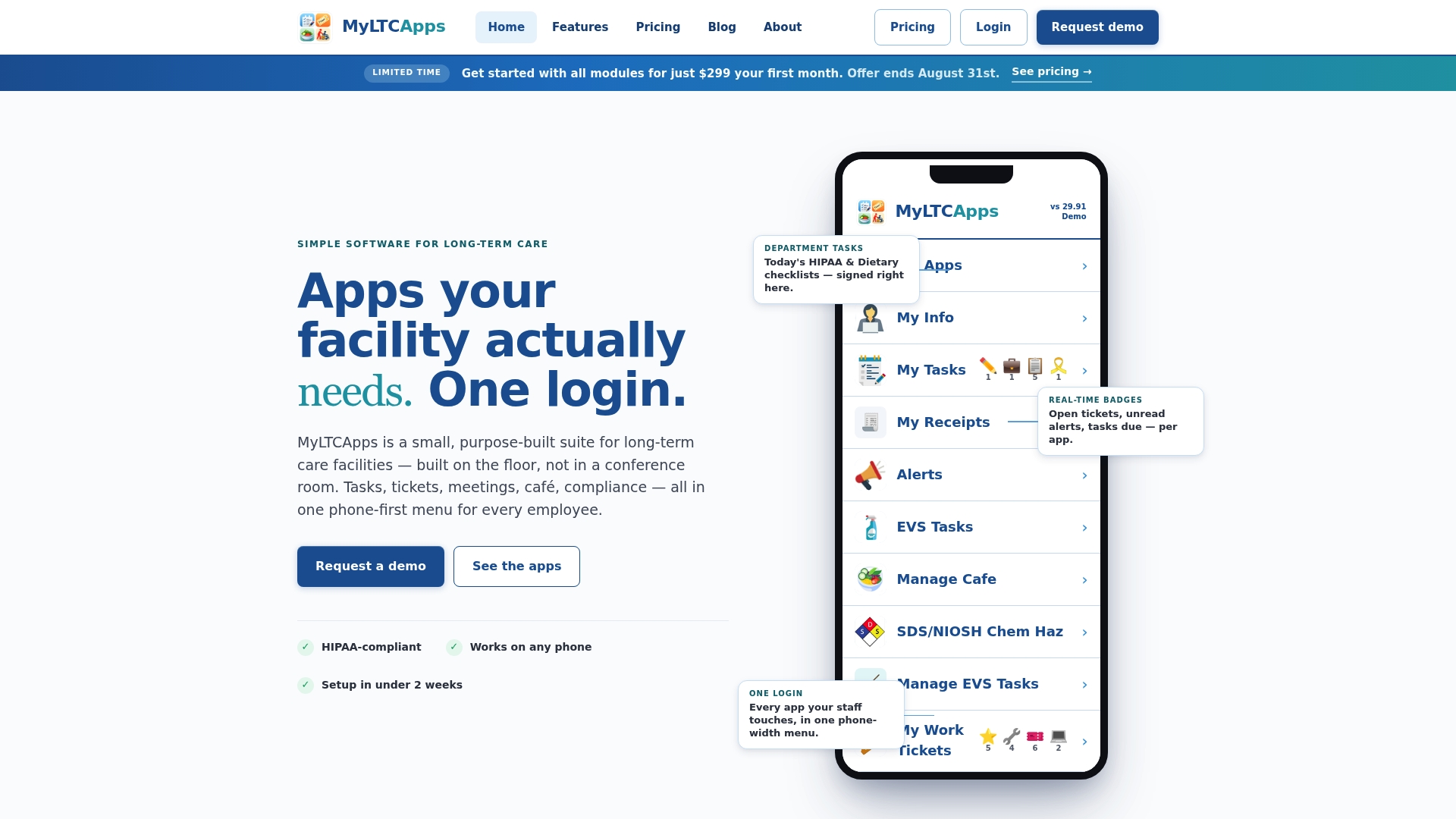
We built our Compliance Suite around the reality that compliance officers in long-term care are tracking deadlines across dozens of moving parts at once. Seeded HIPAA templates give you a starting checklist the moment an incident opens, and task assignments through My Tasks let you attach a name and a due date to every step in your response, from risk assessment to final notice.
- Assign and time-stamp every breach response task so your 60-day timeline is documented automatically.
- Generate report exports that compile completed tasks, dates, and sign-offs into a single audit packet.
- Route maintenance or IT remediation items through My Work Tickets so control fixes are tracked alongside the notification process.
If your facility is comparing options for keeping breach response organized, see current plans and pricing to find the pack that fits your facility’s size and workflow.
This article is general information, not a substitute for advice from a qualified lawyer. Consult a qualified legal professional about your own circumstances before acting on anything here.
FAQ
How many days do healthcare entities have to notify authorities of a HIPAA breach?
Covered entities must notify the HHS Secretary within 60 calendar days of discovery when a breach affects 500 or more individuals. For breaches affecting fewer than 500 individuals, the report can be filed annually, due no later than 60 days after the end of the calendar year.
What is the difference between the HIPAA and GDPR breach reporting timelines?
HIPAA, a U.S. law, gives covered entities up to 60 days to notify affected individuals and, for larger breaches, the HHS Secretary and media. The General Data Protection Regulation is a separate European Union framework with its own notification requirements and is not part of U.S. HIPAA compliance obligations.
How often are HIPAA breaches reported each year?
Smaller breaches, those affecting fewer than 500 individuals, are common: OCR received 74,299 such reports in 2024 alone. That volume reflects how frequently minor incidents like misdirected records or lost devices occur across healthcare settings.
When is a breach considered discovered under HIPAA?
A breach is considered discovered on the first day it is known to the covered entity, or the first day it would have been known had the entity exercised reasonable diligence. This standard means inadequate monitoring is not a valid excuse for a late discovery date.
Does encrypting data eliminate the need for breach notification?
If protected health information is encrypted or destroyed in a way that renders it unusable, unreadable, or indecipherable to unauthorized persons, the incident may fall under the breach safe harbor and may not require notification. Confirm your specific encryption method meets the HHS standard before relying on this exception, and document that determination in writing.