Eyewash Station Inspection: A Survey-Ready Checklist

Eyewash Station Inspection: A Survey-Ready Checklist
Every emergency eyewash station at your facility needs a weekly activation (flush) and an annual full inspection, and both require a retained log. That’s the short answer. OSHA 29 CFR 1910.151© requires employers to provide suitable drenching or flushing facilities wherever employees may contact injurious corrosive materials, and OSHA defers to ANSI/ISEA Z358.1 for the technical requirements that actually govern your inspection program.
Before you walk to the unit this week, confirm these three things:
- Access is clear. You can reach the station from the hazard area in 10 seconds or less, with no obstructions in the path.
- Water flows clean. Both nozzles deliver a clear, even stream when activated.
- Caps pop off automatically. The protective covers release the moment you open the valve, without manual removal.
Pro Tip: Run the weekly activation yourself at least once a quarter, even if you delegate it to a trained designee. Seeing the flow firsthand is the fastest way to catch slow-developing problems before a surveyor does.
Key Takeaways
Weekly activation and annual inspection, documented in a retained log, are the two non-negotiable requirements for every emergency eyewash station under OSHA 29 CFR 1910.151© and ANSI/ISEA Z358.1.
| Point | Details |
|---|---|
| Weekly activation required | Flush every plumbed unit weekly; log date, inspector, duration, pass/fail, and any corrective action. |
| Annual inspection is separate | Verify flow rate (minimum 0.4 gpm for 15 minutes), tepid water, valve operation, and installation conformance each year. |
| Retain logs for at least 3 years | Keep weekly logs for a minimum of three years; retain annual inspection records indefinitely or per facility policy. |
| Corrective actions need close-out | Every failed check must link to a work order with a resolution date and a verification re-test before the unit returns to service. |
| Myltcapps centralizes the workflow | Mobile checklists, auto-generated maintenance tickets, and exportable logs replace paper binders and reduce survey risk. |
Table of Contents
- What does a weekly eyewash station inspection actually cover?
- How to test and activate an eyewash station step by step
- What belongs in the annual eyewash station inspection?
- What should your inspection log actually contain?
- Who owns the inspection program, and what training do they need?
- Common inspection failures and how to fix them
- How do OSHA and ANSI actually divide responsibility for eyewash requirements?
- How digital checklists make eyewash inspections more defensible
- The 10-second rule is the one that gets facilities cited
- Myltcapps makes weekly eyewash logs easier to manage
- Sources
What does a weekly eyewash station inspection actually cover?
The weekly check is not a deep technical audit. It’s a structured visual and functional verification that takes roughly five minutes per unit when done right. Work through these items in order:
- Location and 10-second access. Walk the path from the nearest hazard point to the station. If anything blocks it — a cart, a pallet, a door propped open at the wrong angle — that’s an immediate corrective action, not a note for later.
- Signage and lighting. The station must be clearly marked and visible from the work area. Burned-out overhead lights near the unit count as a failure.
- Physical condition. Check the unit for visible damage, corrosion, or debris on the bowl and nozzles.
- Protective caps/covers. Confirm they are in place before activation. They exist to keep nozzles clean between uses.
- Activation and cap release. Open the valve. Caps should pop off automatically. If you have to pull them off by hand, log it as a deficiency.
- Flow from both nozzles. Both eye pieces must deliver an even, simultaneous stream. Uneven flow suggests a clogged nozzle or pressure issue.
- Water clarity. Flush until the water runs visually clear. Institutional inspection templates recommend flushing until the stream is clear and retaining weekly logs for at least three years.
- No leaks. Check the valve, supply line connections, and bowl drain.
- Drainage. Confirm the drain is open and water is flowing away from the unit, not pooling.
Pro Tip: Do a mock 10-second run: close your eyes, start a timer, and walk the path from the nearest chemical storage or use point to the station. If you can’t reach it and activate it in 10 seconds, the placement fails the ANSI standard regardless of how clean the nozzles are. Document the timed result in your log.
How to test and activate an eyewash station step by step
A weekly activation is not just turning the water on. Follow this sequence to make sure the check is defensible during a survey:
- Clear the area. Confirm no one is working with chemicals immediately adjacent to the unit.
- Check the path. Note any obstructions before you touch the valve. If the path is blocked, log it and clear it before proceeding.
- Verify caps are in place. Both nozzle covers should be seated before activation.
- Open the valve with a single motion. The valve must stay open without continuous hand pressure. If you have to hold it open, that’s a mechanical failure.
- Observe cap release. Caps must pop off automatically on activation.
- Let the water run. Flush long enough to clear sediment from the supply line. In older plumbing, the first seconds of flow can carry rust and biofilm; flush until the water is visually clear and note any persistent discoloration.
- Check flow from both nozzles. Both streams should be even and directed upward, not crossing or deflecting to one side.
- Confirm water temperature is tepid. ANSI/ISEA Z358.1 defines tepid as 60°F–100°F (16°C–38°C). Water that is too cold causes users to stop flushing early; water that is too hot causes additional injury.
- Close the valve and observe. No dripping or continued flow after shutoff.
- Log the result immediately. Pass or fail, with your initials, date, time, and any corrective action taken.
Pass criteria: both nozzles flowing evenly, water clear and tepid, caps released automatically, valve stays open hands-free, no leaks.
Fail criteria: one or both nozzles blocked or uneven, water discolored, caps did not release, valve requires continuous pressure, leaks present.
ANSI/ISEA Z358.1 requires plumbed eyewash stations to deliver a minimum flow rate for continuous flushing lasting an appropriate duration to thoroughly rinse the eyes. A unit that runs dry or drops below that flow rate before 15 minutes is out of compliance, regardless of how clean it looks.
Pro Tip: In facilities with older galvanized supply lines, consider flushing for 90 seconds rather than the minimum needed to clear visible sediment. Biofilm doesn’t always show up as discoloration — it can be present in water that looks clear.
What belongs in the annual eyewash station inspection?
The annual inspection goes well beyond a functional check. It verifies that the unit still meets the installation and performance requirements of ANSI/ISEA Z358.1 and should be performed by a qualified maintenance technician or a vendor-certified inspector. Key items:
- Installation conformance. Confirm the unit is still within 10 seconds of the hazard it serves, at the correct mounting height, and on the same floor level as the hazard (no stairs between the work area and the station).
- Flow rate testing. Measure actual output against the ANSI minimum of 0.4 gpm for 15 minutes for plumbed units. Use a calibrated flow meter or a timed bucket test per the manufacturer’s method. Log the measured rate.
- Tepid water verification. Measure water temperature at the nozzle with a calibrated thermometer and confirm it falls within the 60°F–100°F range.
- Valve operation. Confirm the valve opens fully with a single motion and stays open without hand pressure.
- Nozzle orientation and protection. Nozzles must be directed upward and protected from airborne contamination when not in use.
- Drainage and sump condition. Inspect the bowl drain for blockages and check the sump or drain connection for corrosion or buildup.
- Manufacturer-recommended servicing. For self-contained reservoir units, this means draining, cleaning, and refilling with fresh solution per the manufacturer’s schedule. For plumbed units, it may include flushing the supply line, replacing worn valve components, or treating for biofilm.
- Record corrections. Document every deficiency found, the corrective action taken, parts replaced, the inspector’s name, and the date the unit was returned to service.
The industry guide from the Safety Equipment Institute covers installation requirements, flow-rate expectations, and the distinction between plumbed and self-contained unit maintenance in detail — keep it on hand when writing your annual inspection procedure.
What should your inspection log actually contain?

Survey citations for eyewash programs are more often documentation failures than mechanical ones. A unit that passes every physical check but has three weeks of missing log entries is a citation waiting to happen. Your weekly log and annual record need to capture the right fields every time.
Weekly log fields (minimum):
- Date and time of inspection
- Unit location or asset ID
- Inspector name and initials
- Activation duration (seconds flushed)
- Pass/fail result for each checklist item
- Corrective action taken, if any
- Supervisor sign-off when a failure is recorded
Annual inspection record fields:
- Date, inspector name, and credentials or company
- Unit location and asset ID
- Flow rate measured (gpm) and method used
- Water temperature at nozzle (°F)
- Each installation conformance item checked
- Parts replaced or servicing performed
- Date unit returned to service after any corrective action
Weekly log template (column headers):
The Yale Environmental Health and Safety eyewash inspection log is a practical, survey-aligned template you can adapt directly. Keep weekly logs for at least three years and retain annual inspection reports indefinitely or per your facility’s records retention policy.
Pro Tip: When a check fails, don’t just note it in the log. Open a time-stamped maintenance work order tied to that specific log entry. Surveyors want to see not just that you found a problem, but that you tracked it to resolution. A corrective-action chain with a timestamp and a close-out date is far more defensible than a handwritten note in the margin.
Who owns the inspection program, and what training do they need?
Ambiguity about ownership is how weekly checks get missed. Assign it explicitly:
- Weekly activations: the site safety officer or a designated EHS staff member. In facilities where EVS or maintenance staff perform the check, the safety officer remains accountable for the program and must verify logs regularly.
- Annual inspection: a qualified maintenance technician or a vendor-certified inspector with documented competency in ANSI/ISEA Z358.1 requirements.
Every person performing weekly activations needs training that covers:
- How to activate the unit and what to observe during the flush
- Pass/fail criteria for flow, cap release, water clarity, and temperature
- How to complete the log entry accurately and completely
- How to escalate a failure: who to notify, how quickly, and what interim controls to put in place
- The 15-minute flush guidance for actual eye exposures, so they understand why the station must be fully functional
Keep training records tied to the inspection program. If a surveyor asks who performed a specific weekly check, you need to be able to show that person was trained. Linking in-service attendance records to your inspection program is a straightforward way to close that gap.
Common inspection failures and how to fix them
Most deficiencies fall into a short list of recurring categories. Here’s what to look for and what to do when you find it.
Common failures:
- Obstructed path. A cart, equipment, or stored materials block the 10-second route.
- Caps that don’t release. Nozzle covers require manual removal, indicating clogging or low pressure.
- Uneven or low flow. One nozzle delivers significantly less water than the other, or total flow is visibly weak.
- Discolored water. Rust, sediment, or biofilm present in the stream.
- Leaking valve or connections. Dripping at the valve body or supply line fittings.
- Missing or obscured signage. The station is not clearly marked or the sign is blocked.
- Poor lighting. The area around the unit is too dim for safe use in an emergency.
Corrective-action sequence for each:
- Obstructed path: Remove the obstruction immediately. Log the corrective action with a timestamp. If the obstruction is structural (a permanently placed piece of equipment), escalate to facilities management for a relocation assessment within 24 hours.
- Caps that don’t release: Tag the unit out of service. Notify maintenance. Replace nozzle caps or address pressure issue within 24 hours. Do not return the unit to service until caps release automatically on activation.
- Uneven or low flow: Tag the unit out of service if flow is significantly below the ANSI minimum. Notify maintenance. Schedule a flow-rate test and plumbing inspection within 24–72 hours depending on the severity and whether a backup unit is available.
- Discolored water: Continue flushing. If discoloration persists after 90 seconds, log it and notify maintenance for a plumbing assessment. Increase flush frequency until the root cause is resolved.
- Leaking valve: Tag the unit out of service if the leak is at the valve body. Notify maintenance for repair within 24 hours.
- Missing signage or poor lighting: Order replacement signage or submit a lighting work order within 48 hours. These are lower-risk deficiencies but still require documentation and a close-out date.
Always document the re-test after corrective action. A completed work order with no verification re-test is an incomplete corrective-action record.

How do OSHA and ANSI actually divide responsibility for eyewash requirements?
The two standards work together, and understanding which does what helps you defend decisions during surveys.
OSHA 29 CFR 1910.151© establishes the legal obligation: employers must provide suitable facilities for quick drenching or flushing of eyes and body where employees may be exposed to injurious corrosive materials. OSHA’s interpretation letters clarify that the requirement is triggered by exposure potential, not just the presence of chemicals. A sealed system with no routine employee contact may not require a station. A process where employees open containers, sample, or transfer corrosives almost certainly does. Check the Safety Data Sheet (SDS) for each chemical in use — the first-aid section will indicate whether eye flushing is required on contact.
ANSI/ISEA Z358.1 fills in the technical details OSHA does not specify:
OSHA compliance officers treat ANSI/ISEA Z358.1 as the recognized technical standard for eyewash installation and testing. Deviating from it without an equivalent alternative means you are defending a non-standard approach. The practical implication: your inspection program should be written to ANSI/ISEA Z358.1 requirements, and your logs should reference it by name.
How digital checklists make eyewash inspections more defensible
Paper logs work until they don’t. A missed week, a coffee spill on the binder, a log left in a drawer during a survey — any of these can turn a compliant program into a citation. Digital checklists address the failure modes that paper can’t.
Concrete benefits of a mobile inspection workflow:
- Automated weekly reminders tied to the inspection schedule prevent missed activations without relying on memory or a posted paper calendar.
- Timestamped entries are generated at the moment of inspection, not reconstructed later. Surveyors can see exactly when each check was performed.
- Photo capture on failure creates immediate visual evidence of the deficiency and the corrective action. A photo of a blocked path with a timestamp is more defensible than a written description.
- Centralized logs across multiple units or buildings are accessible from a single dashboard, making it easier to spot patterns (a unit that fails repeatedly) and prepare for surveys.
- Automatic maintenance ticket creation when a failure is logged means the corrective-action chain starts immediately, not when someone remembers to call maintenance.
- Export-ready reports let you pull a full inspection history for any unit, any date range, in minutes rather than hours of manual log review.
Pro Tip: Set the weekly eyewash reminder to trigger at the start of the shift assigned to perform the check, not at a fixed clock time. Shift-anchored reminders have a much higher completion rate because they connect the task to a person who is already on site and accountable.
The 10-second rule is the one that gets facilities cited
The most common survey finding in eyewash programs is not a broken nozzle or a failed flow test. It’s an obstructed path. A unit that works perfectly but takes 25 seconds to reach because a supply cart is parked in front of it fails the ANSI standard just as definitively as one with clogged nozzles.
The mock 10-second run is the single highest-value step you can add to your weekly check. Close your eyes, start a timer, and walk from the hazard point to the station. If you can’t reach it and activate it in 10 seconds, the placement fails. Do it from multiple hazard points in the room if the layout is complex.
Three things to do this week to improve your program immediately:
- Pull your last three months of weekly logs and check for any gaps. Missing entries are the most common survey citation in eyewash programs.
- Walk every station’s access path with a timer. Document the result in your log.
- Confirm that every person who performs weekly activations has a training record on file.
Myltcapps makes weekly eyewash logs easier to manage
Keeping up with weekly activations across a long-term care facility is straightforward in concept and surprisingly easy to let slip in practice. Myltcapps’s compliance task and checklist software gives safety officers and facility managers a mobile-first way to assign, complete, and document weekly eyewash inspections without paper logs or manual follow-up.
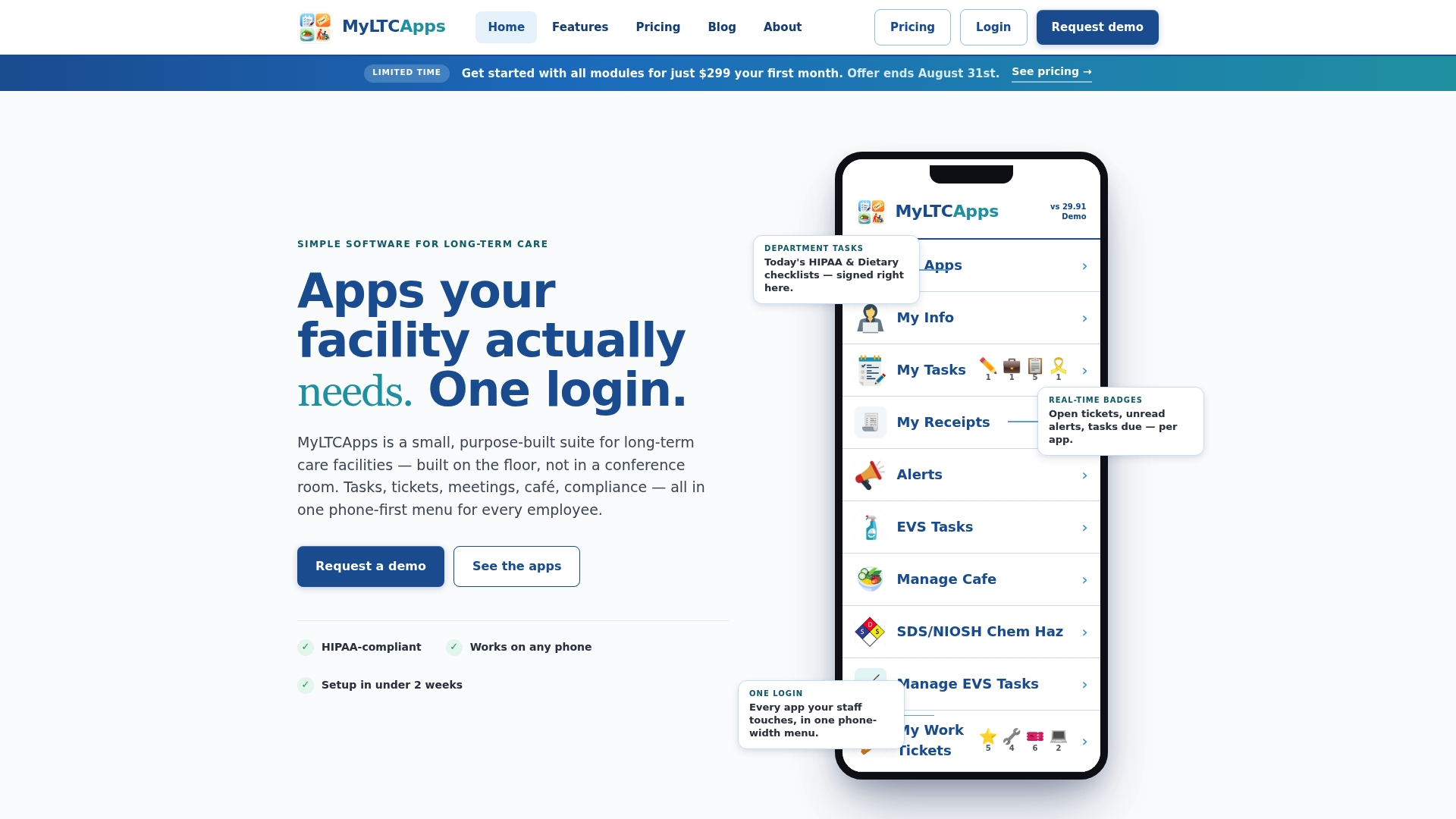
Staff complete the weekly activation checklist on their phone, attach a photo if the check fails, and the system automatically generates a maintenance work ticket tied to that inspection entry. Every log is timestamped, centralized, and exportable for surveys. Reminders go out automatically at the start of the assigned shift, so missed weeks stop being a documentation risk.
If your facility is ready to move eyewash inspections off paper and into a system that creates an auditable corrective-action trail, request a quote from Myltcapps to see how the platform fits your facility’s workflow.
Sources
Keep these references on hand when writing policy, training staff, or responding to a survey finding:
- Requirements for eyewash and shower facilities. | Occupational Safety and Health Administration
- Testing and Inspecting Your Emergency Equipment
- EMERGENCY EYEWASH & SHOWER EQUIPMENT
- EYE-WASH STATION WEEKLY INSPECTION LOG
- Eyewash Inspection Log - Yale Environmental Health & Safety