Best Everbridge Alternatives for Long-Term Care Facilities

Best Everbridge Alternatives for Long-Term Care Facilities
For U.S. long-term care facilities, a purpose-built LTC operations suite is the most practical Everbridge alternative. Enterprise mass-notification tools like Everbridge were designed for campus-wide emergencies, not the daily compliance workflows, survey-ready audit trails, and role-based task routing that CMS surveyors actually scrutinize.
The short answer for most LTC administrators:
- LTC-focused operations suite (recommended): Myltcapps is the strongest fit for facilities that need daily compliance checklists, mobile-first task routing, work-ticket management, and exportable surveyor-ready logs, all in one phone-first platform.
- Clinical communications platforms: Vocera and Spok serve bedside clinical workflows well, particularly in hospital-adjacent SNFs where nurse-to-nurse messaging is the primary need.
- Enterprise mass-notification tools: Everbridge, Rave Mobile Safety, and AlertMedia handle campus-wide emergency broadcasts effectively but lack LTC-specific task management and compliance tracking.
The OIG’s Nursing Facility compliance guidance is explicit: compliance must be embedded in daily operations, not treated as a periodic task. That single requirement disqualifies most generic alert platforms from being a true Everbridge alternative for LTC. LeadingAge’s Safety Technology primer reinforces this by recommending that facilities use a structured selection matrix to shortlist systems against their specific care setting requirements, not just broadcast capability.
Table of Contents
- Which Everbridge alternatives actually fit long-term care?
- How do you choose the right alternative for your facility?
- What does a survey-ready alert workflow actually look like?
- What does deployment actually cost and how long does it take?
- Why Myltcapps is a strong Everbridge alternative for long-term care
- Key Takeaways
- What LTC admins consistently get wrong when buying alert systems
- See Myltcapps in action before your next procurement decision
- Authoritative sources for LTC procurement and compliance
Which Everbridge alternatives actually fit long-term care?
The table below maps four solution categories to the dimensions that matter most during LTC procurement.

| Dimension | LTC Ops Suite (e.g., Myltcapps) | Clinical Comms Platform (e.g., Vocera, Spok) | Enterprise Mass Notification (e.g., Everbridge, Rave, AlertMedia) |
|---|---|---|---|
| Best for / primary use case | Daily ops, compliance tracking, survey readiness | Bedside clinical staff messaging | Campus-wide emergency broadcasts |
| Notification types & workflow | Role-based task alerts, escalation rules, work tickets | Secure clinical messaging, nurse call integration | Multi-channel mass broadcast (SMS, voice, email, desktop) |
| LTC-specific features | Seeded compliance libraries, checklists, resident meal tracking, meeting sign-in | Nurse competency workflows, care-team messaging | Limited; generic templates only |
| Mobile usability for frontline staff | Phone-first; personal device, minimal taps | Wearable badge or smartphone app | Smartphone app; not optimized for care workflows |
| HIPAA & security compliance | BAA available; encrypted; audit logs | BAA available; encrypted | BAA varies by vendor; audit logs limited |
| Integrations | EHR, scheduling, maintenance/work-order systems | EHR, nurse call systems | NWS/NOAA feeds, geolocation; limited EHR depth |
| Pricing model | Per facility, per module, scalable headcount | Per user or per device | Per facility or per incident; enterprise contracts |
| Deployment & onboarding | Weeks; guided onboarding with seeded libraries | Weeks to months; IT-dependent | Days to weeks for basic setup; customization adds time |
| Reporting & audit exports | Surveyor-ready exports; searchable audit trail | Clinical activity logs | Delivery receipts; not survey-formatted |
Mass-notification tools like Everbridge and AlertMedia cover the emergency broadcast use case well, but NWS/NOAA integrations and geolocation targeting are not a substitute for LTC-specific task and compliance modules. Myltcapps maps directly to the LTC Ops Suite row and is the recommended first demo for any facility prioritizing compliance and daily workflow management.

How do you choose the right alternative for your facility?
Start with the workflow, not the feature list. The question to answer first: does this system document the full chain of events from alert to corrective action to evidence attachment? If the answer is no, it will not hold up under a CMS survey.
Must-have features for LTC:
- Surveyor-ready audit logs with searchable, exportable records
- Role-based escalation rules (maintenance vs. clinical vs. administrative)
- Task management with acknowledgment logging
- Seeded compliance checklists (HIPAA, QAPI, dietary, emergency prep)
- Mobile usability on personal devices, minimal training required
- Signed BAA and data encryption at rest and in transit
Questions to ask during every vendor demo:
- Show me a sample survey export. Does it include the alert, acknowledgment, assigned corrective action, and any attachments?
- How does the system route a maintenance alert differently from a resident-safety incident?
- What EHR and scheduling systems do you integrate with natively?
- Walk me through the onboarding timeline for a 120-bed facility with no dedicated IT staff.
- What does ongoing training look like after go-live?
Red flags to watch for:
- No BAA offered, or BAA requires a separate contract negotiation
- Generic alert routing with no role-based logic
- No searchable audit trail or exports formatted for surveyors
- Demo shows only the broadcast function, not the task-completion workflow
- Pricing is opaque until late in the sales process
Pro Tip: LeadingAge’s safety-technology leaders note that the value of an alert is determined by the workflow it triggers. Before signing any contract, run one real scenario end-to-end in a pilot: trigger a simulated incident, assign a corrective action, attach evidence, and export the record. If the export looks like a surveyor would accept it, you have your answer.
What does a survey-ready alert workflow actually look like?
Most facilities focus on whether an alert was sent. Surveyors focus on what happened next.
Tiered, targeted notifications route alerts to the correct role or department, preventing the alarm fatigue that builds when unrelated staff receive every notification. A maintenance alert should never land in a nurse’s task queue, and a resident-safety incident should never sit unacknowledged because it was buried under a flood of low-priority messages.
False positives reduce staff confidence and increase mental workload over time, eventually causing staff to delay responses to real emergencies. Multi-signal, context-aware detection reduces unnecessary alerts and keeps response rates high.
The minimum workflow for a survey-ready incident:
- Alert generated and timestamped
- Acknowledgment logged with staff name and time
- Corrective action assigned to the correct role
- Evidence attached (photo, training record, maintenance invoice)
- Exportable audit record created automatically
The OIG’s compliance program guidance for nursing facilities enumerates seven core elements of an effective compliance program and recommends adaptable approaches for facilities of different sizes. Element by element, each one requires documentation — not just intent. A system that sends alerts but cannot produce that documentation chain is not a compliance tool; it is a broadcast tool.
What does deployment actually cost and how long does it take?
Realistic timelines matter more than vendor promises. Here is a phased view for a typical mid-sized LTC facility:
- Procurement and contract (2–4 weeks): vendor evaluation, BAA review, pricing finalization.
- Integration setup (1–3 weeks): EHR and scheduling system connections, user directory import.
- Pilot (2–4 weeks): one unit or department, seeded compliance libraries activated, staff trained.
- Full rollout (2–4 weeks): facility-wide activation, module-by-module go-live.
- First audit export (week 8–12): run a sample surveyor export to confirm the audit trail is complete.
Pricing models and which fits your operation:
- Per facility, per module: best for single-site operators who want to start with core modules and add over time.
- Per user: common in clinical comms platforms; costs scale quickly in high-turnover LTC environments.
- Per incident: typical in enterprise mass-notification tools; unpredictable for budget planning.
- Tiered add-ons: flexible for multi-site operators who need different module sets per location.
ROI shows up in three places administrators can quantify for a business case: fewer survey deficiency findings, reduced overtime from manual task tracking, and faster work-ticket closure when maintenance alerts route directly to the responsible technician.
Pro Tip: Smaller facilities and those without IT staff benefit most from vendors that offer seeded compliance libraries and guided onboarding. Ask specifically whether the onboarding model includes on-site train-the-trainer sessions or a structured remote kickoff with in-app help, and get the training outline in writing before signing.
Why Myltcapps is a strong Everbridge alternative for long-term care
Myltcapps was built specifically for the LTC workflow, which means the compliance features are not add-ons. They are the core product.
Key features relevant to LTC procurement:
- Seeded compliance libraries covering HIPAA, Section 1557, dietary, QAPI, and emergency preparedness
- Mobile-first daily compliance checklists with real-time task routing
- Work-ticket and maintenance management tied directly to alert remediation
- Facility alerts and communication with role-based routing and acknowledgment logging
- Meeting sign-in and in-service tracking for competency evidence
- Surveyor-ready exports formatted for CMS review
Against the key comparison dimensions: Myltcapps routes notifications by role, not by broadcast, so maintenance alerts go to maintenance and resident-safety incidents escalate through clinical staff. HIPAA compliance is built in, with a BAA available and encrypted audit logs that export in surveyor-ready format. The platform integrates with EHR and scheduling systems and is priced per facility with optional module add-ons, which keeps costs predictable for both single-site and multi-site operators. Onboarding typically completes in weeks, not months, because the compliance libraries arrive pre-seeded.
Pro Tip: During your Myltcapps demo, request a sample survey export from the tasks and alerts modules. Ask to see a simulated incident that runs from alert through corrective action to evidence attachment. That single walkthrough tells you more than any feature checklist.
Key Takeaways
For U.S. long-term care facilities, the most effective Everbridge alternative is a purpose-built LTC operations suite that embeds compliance documentation into every alert workflow, not just the broadcast layer.
| Point | Details |
|---|---|
| Compliance must be daily | OIG guidance requires compliance embedded in operations; generic alert tools cannot satisfy this alone. |
| Audit trail is non-negotiable | Every alert must produce an exportable record: acknowledgment, corrective action, and evidence attachment. |
| Role-based routing prevents fatigue | Tiered, targeted notifications keep the right staff accountable without overwhelming unrelated departments. |
| Pricing model shapes long-term cost | Per-facility, per-module pricing is most predictable for LTC operators; per-user models scale poorly with turnover. |
| Myltcapps as first demo | Myltcapps maps directly to LTC compliance, mobile-first task routing, and surveyor-ready exports — schedule it first. |
What LTC admins consistently get wrong when buying alert systems
The most common mistake is evaluating alert systems on broadcast capability alone. Administrators sit through a demo, see that the platform can send an SMS to 300 staff in under a minute, and call it sufficient. That is the wrong test.
What surveyors look for is not whether the alert went out. It is whether the facility can prove, with a dated, signed, exportable record, that someone acknowledged the alert, took a corrective action, attached supporting evidence, and closed the loop. A system that cannot produce that record is a liability, not an asset, regardless of how fast it broadcasts.
The second mistake is skipping frontline UX testing. Administrators evaluate the admin dashboard and never hand the device to a CNA or maintenance tech. If the frontline staff cannot complete a task in three taps on their personal phone, adoption will stall within weeks of go-live.
Finally, training and ongoing support are almost always underspecified in contracts. Initial onboarding gets attention; what happens at month six when staff turns over does not. Validate the post-go-live support model in writing before signing.
See Myltcapps in action before your next procurement decision
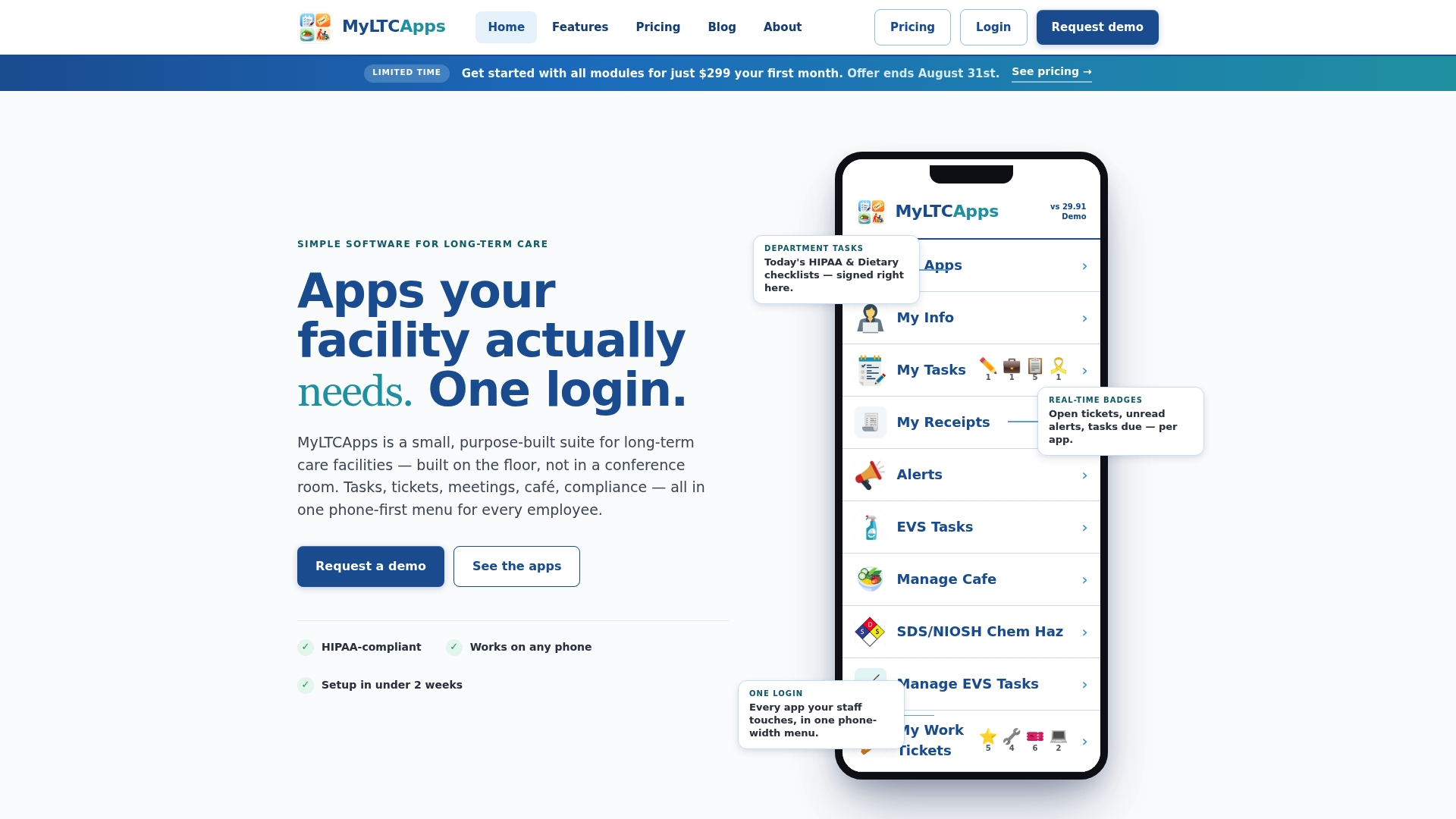
Myltcapps gives LTC administrators something most alert platforms cannot: a single phone-first platform where compliance checklists, work tickets, alerts, and surveyor-ready exports all live together. No separate compliance module to license, no manual export formatting before a survey visit.
To get the most from a demo, come with three requests: ask to see a survey-ready export from the tasks module, walk through a work-ticket alert from trigger to closure on the work orders module, and request a site-specific onboarding timeline for your facility size. Those three artifacts will tell you everything a feature checklist cannot.
Visit myltcapps.com to request a demo and see how the platform fits your facility’s compliance and operational priorities.
Authoritative sources for LTC procurement and compliance
- OIG Nursing Facility Industry Segment-Specific Compliance Program Guidance — primary reference for daily compliance integration requirements and survey-ready documentation standards.
- OIG Original Compliance Program Guidance for Nursing Facilities — seven core elements of an effective compliance program; foundational for audit-trail requirements.
- LeadingAge Safety Technology for Long-Term and Post-Acute Care: A Primer and Provider Selection Guide — 18-section selection matrix and CAST tool for shortlisting safety technology vendors.
- CMS State Operations Manual Appendix PP — governing regulatory framework for LTC facility operations and resident rights.
- NestSentinel: False Positives in Nursing Homes — research on alarm fatigue and the operational case for context-aware, multi-signal detection.
- Regroup Mass Notification: Mass Notification in Assisted Living and Nursing Facilities — overview of multi-channel delivery capabilities and template-driven workflows in mass-notification platforms.