Competency Tracking for Nursing Staff in LTC: Survey-Ready Guide

Competency Tracking for Nursing Staff in LTC: Survey-Ready Guide
A mobile-first competency-tracking SaaS is the fastest path to survey-ready documentation in long-term care, and Myltcapps is built specifically for that workflow. The platform captures mobile attestations, timestamps validations, and generates audit exports that match what surveyors expect under 42 CFR §483.71 and the CMS CMPRP toolkit. Start with a 30-day pilot on a nursing unit with a typical number of staff. Measure three things: adoption rate, validation completion percentage, and whether you can generate a clean audit export by day 30. That single unit will tell you everything you need to scale.
Key Takeaways
Mobile-first competency tracking in long-term care requires a documented system that captures timestamped validations, links evidence to individual staff records, and generates survey-ready exports aligned with §483.71 and the CMS CMPRP toolkit.
| Point | Details |
|---|---|
| Start with a 30-day pilot | Run one nursing unit of 20–40 staff; measure adoption rate, validation completions, and audit export quality. |
| Map CMPRP toolkit to your SaaS | Translate interactive PDF sections into in-app forms with partial save; use the Excel template to validate your aggregation. |
| Surveyors want specific exports | Prepare competency rosters by job code, individual validation records, license registries, and timestamped audit logs. |
| Make evidence fields mandatory | Optional photo or checklist fields create incomplete audit trails; enforce them at the template level before go-live. |
| Myltcapps for LTC rollout | Myltcapps ships with seeded role templates, mobile partial-save, license alerts, and CMS-aligned exports for survey readiness. |
Table of Contents
- What your competency tracker must capture to satisfy CMS
- How to roll out competency tracking in 30–90 days
- Must-have features for a mobile-first nursing competency tracker
- How to map the CMS CMPRP toolkit into a digital workflow
- What reports surveyors will actually ask for
- Common rollout risks and how to avoid them
- Myltcapps makes nurse competency tracking survey-ready
- Why phone-first competency tracking changes what’s actually possible in LTC
- Sources
What your competency tracker must capture to satisfy CMS
Every field in your tracker either supports a surveyor conversation or it doesn’t. Under §483.71, the facility assessment must document the staff competencies and skill sets necessary to care for your resident population, and that documentation has to inform staffing decisions. Vague spreadsheets don’t hold up. Here’s the minimum data schema a compliant system must capture:
- Staff identity and role (name, job code, unit, hire date)
- Certification and license numbers with expiry dates (RN, LPN/LVN, CNA, dietary, therapy)
- Training course title, completion date, and delivery method
- Competency validation type: direct observation, return-demonstration, or simulation
- Validator identity and role (who signed off and in what capacity)
- Timestamp and location/shift at the moment of validation
- Linked evidence: photo, video, in-app checklist, or LMS completion link
- Attestation or electronic signature field
- Repeat frequency and next-due date
Surveyors expect a clear audit trail, not a printout of a spreadsheet. Accepted evidence formats include PDFs, in-app checklists, photos, and LMS completion records. The QSO-24-13-NH memo reinforces that assessments must be evidence-based and that surveyors will check whether competency results actually inform staffing, so every validation record needs to connect upward to your facility assessment.
High staff turnover in long-term care makes systematic training records and audit-ready documentation a practical necessity, not just a compliance checkbox. A paper binder doesn’t survive a DON transition. A timestamped digital record does.

How to roll out competency tracking in 30–90 days
A 30-day pilot on one unit is enough to prove the system works. Full facility rollout typically runs a few months depending on headcount and how many role types you’re tracking.
Phase 1: Prep (Days 1–10). Export your current competency baseline, even if it’s a spreadsheet or paper log. Identify your pilot unit and assign roles: the DON owns the program, HR manages enrollment and license data, unit managers run validations, and designated competency validators (charge nurses, educators) sign off on skills checklists. Map your existing competency checklist items to the CMPRP toolkit role categories before you build templates in the app.
Phase 2: Pilot (Days 11–30). Enroll 20–40 staff on the pilot unit. Run baseline nursing competency assessments using CMPRP-mapped templates. Collect evidence for each validation, confirm that attestations are timestamped, and generate one test audit export before day 30.
Phase 3: Refine (Days 31–45). Review pilot metrics: adoption rate, validation completion percentage, time-to-validate per staff member, and how long it takes to generate a report. Fix template gaps, adjust reminder frequency, and document any integration issues with HR or your LMS.
Phase 4: Facility-wide rollout (Days 46–90). Expand by department, starting with the highest-risk roles (CNAs, medication aides). Schedule manager training sessions in the first week of each department’s rollout.
Pro Tip: Schedule a 10-minute “attestation window” at the end of each shift rather than asking managers to chase completions later. Same-day sign-off rates climb sharply when validation is built into the shift close, not treated as an afterthought.
Must-have features for a mobile-first nursing competency tracker
Not every feature on a vendor’s demo reel matters equally. Here’s how to split them when you’re evaluating options or running an RFP.
Must-have features:
- Mobile-first offline capture. Validations happen at the bedside, in med rooms, and in areas with spotty Wi-Fi. If the app requires a live connection to save a record, you’ll lose data.
- Role-based attestations. Different staff types require different validators. The system must enforce who can sign off on what.
- Timestamped audit trail. Every action, edit, and attestation needs a permanent, tamper-evident log. Surveyors ask for this directly.
- Exportable survey-ready reports. CSV, Excel, and PDF exports aligned with CMS toolkit formats.
- Templated competency checklists. Pre-built by role (RN, LPN/LVN, CNA) so you’re not building from scratch.
- License expiry alerts. Automated notifications before a credential lapses.
- HR and LMS integrations. Nightly syncs with your HR system prevent enrollment gaps when staff turn over.
Nice-to-have features:
- Video evidence upload for return-demonstration validations
- Two-way messaging for competency follow-up tasks
- Scheduling auto-assignments tied to shift calendars
- Analytics dashboards with trend views across quarters
On integrations, prioritize HR/payroll (ADP, Paylocity, or your current system), basic EHR connectivity, and your LMS. Single-sign-on and unique credentials per user are HIPAA prerequisites in LTC, not optional add-ons. Role-based access also limits what each user can see, which matters when auditors log in.
| Feature Category | Must-Have | Nice-to-Have |
|---|---|---|
| Usability | Mobile-first, offline-capable | Customizable dashboards |
| Evidence capture | Timestamped checklists, photo upload | Video upload, e-signature pad |
| Reporting | Survey-ready exports, audit log | Trend analytics, benchmarking |
| Integrations | HR sync, LMS link, SSO | EHR deep integration, scheduling API |
| Security | Role-based access, unique credentials | Biometric login, IP restrictions |

How to map the CMS CMPRP toolkit into a digital workflow
The CMPRP Nursing Home Staff Competency Assessment toolkit gives you interactive PDFs, answer sheets, a tracker, and an Excel aggregation template. You can replicate every one of those artifacts inside a competency-tracking SaaS, and the translation is more direct than most administrators expect.
- Interactive PDF section → in-app form with partial save. The toolkit explicitly supports breaking assessments into 15–20 minute sessions. Your SaaS must allow partial saves on mobile so staff aren’t forced to complete a full assessment in one sitting.
- Excel Assessment Results Template → scheduled facility export. Run a weekly or monthly export from the SaaS and validate it against the CMS Excel template structure. This confirms your aggregation logic matches what surveyors recognize.
- One-on-one meeting guide → scheduled follow-up task in the app. When a competency gap surfaces, the toolkit recommends a structured follow-up conversation. Assign that as a task in the app with a due date and a completion field.
- Answer sheets → seeded scoring templates. Import the CMS answer sheet criteria as scored checklist items so validators are rating against the same standard the toolkit uses.
One important operational note: the toolkit is a voluntary improvement tool. The CMPRP toolkit advises facilities to use results internally for improvement planning rather than reporting scores to CMS by default. Keep your internal aggregation separate from your survey-ready exports, and document that distinction in your policy.
What reports surveyors will actually ask for
Surveyors commonly request a specific set of files. Have these ready before any inspection:
- Staff competency roster by job code (CSV or Excel): name, role, competencies assigned, completion status, last validated date
- Individual competency validation records: validator name, timestamp, evidence type, attestation signature
- License and certification registry: credential type, number, issue date, expiry date, alert status
- Facility-level competency aggregate: percent validated by role, overdue count, next-due summary
- Audit log: every record creation, edit, and attestation with user ID and timestamp
These exports map directly to the §483.71 facility assessment requirement that competencies inform staffing decisions, and to the QSO-24-13-NH expectation that evidence be documented and available for review.
KPIs to have ready for surveyors:
- Percent of staff with all competencies validated (by role and facility-wide)
- Count of overdue validations (past due date)
- Count of certifications expiring within 60 and 90 days
- Average time from assignment to validation completion
- Attestation completion rate by unit manager
Common rollout risks and how to avoid them
Low adoption is the most common failure mode. Mitigations: run a 20-minute manager micro-training before go-live, build attestation into the shift-close routine, and tie completion rates to a visible unit-level metric leadership reviews weekly. Staff who never open the app on day one rarely catch up.
Incomplete audit trails happen when evidence fields are optional. Make photo or checklist evidence mandatory for direct-observation validations at the template level. Set a policy that a validation without linked evidence is treated as incomplete, regardless of the attestation checkbox.
Integration gaps surface when HR data and the competency tracker fall out of sync. Schedule nightly HR syncs and run a weekly reconciliation report comparing enrolled staff in the app against your active employee list. A CSV import process is a workable fallback if a live API isn’t available yet.
On change management: align your competency validation calendar with your annual facility assessment cycle. Surveyors look for evidence that competency results fed into the most recent staffing and resource decisions, so the timing matters.
If a survey arrives before your rollout is complete, bridge the gap with a paper-to-digital process: collect paper validations on the CMPRP answer sheets, enter them into the SaaS within 24 hours, and generate an interim audit export showing both the paper originals and the digital records. It’s not elegant, but it’s defensible.
Myltcapps makes nurse competency tracking survey-ready
Long-term care administrators who want a phone-first system that works the way their staff actually operates, not the way a hospital IT department imagined it, will find Myltcapps built for exactly that gap.
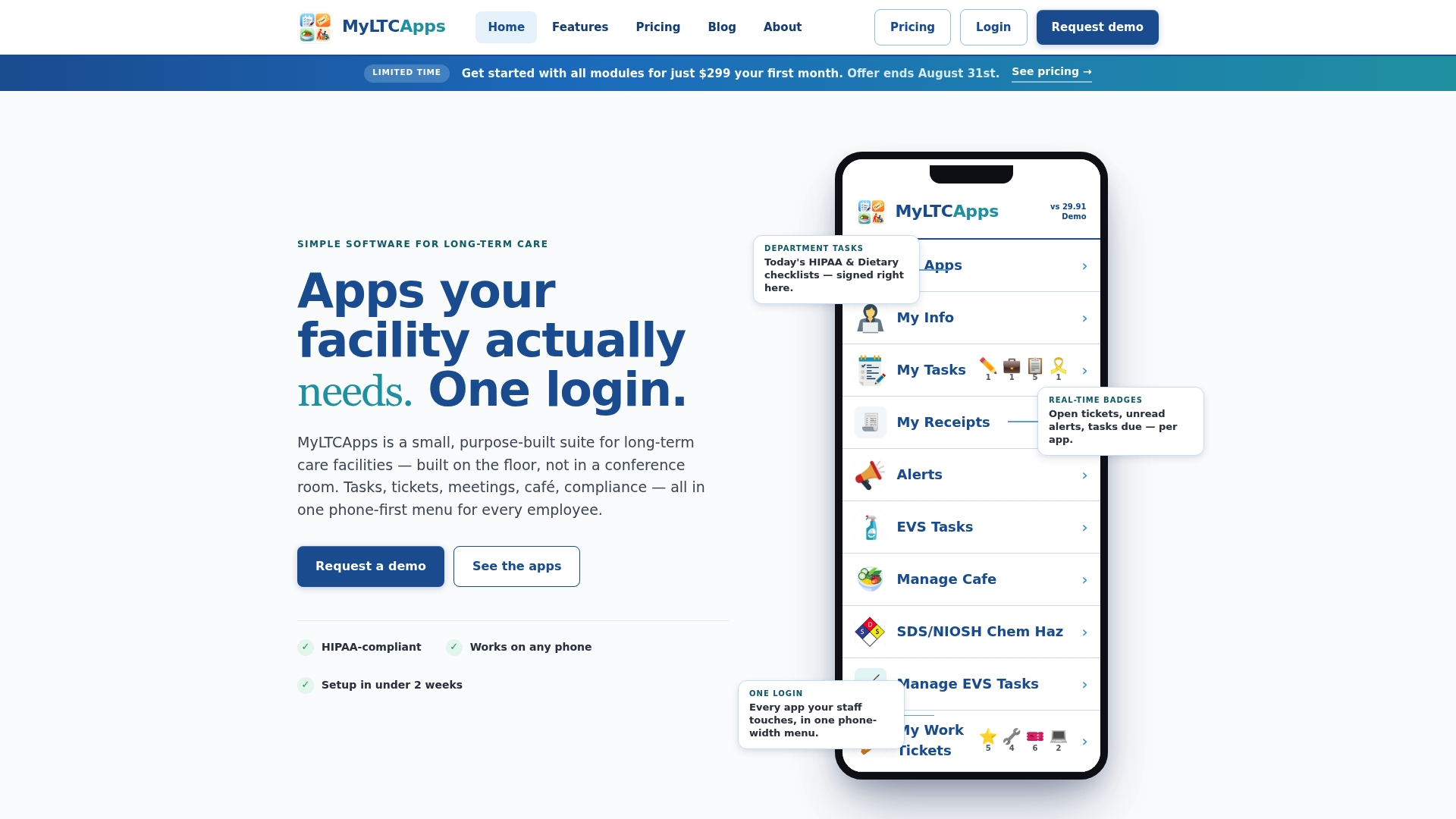
The Myltcapps competency tracking module ships with seeded role-based templates for RNs, LPNs/LVNs, and CNAs, mobile partial-save for 15–20 minute assessment sessions, timestamped audit trails, license expiry alerts, and export formats aligned with CMS toolkit and QSO requirements. Role-based access and unique credentials are built in, covering the HIPAA access control requirements that LTC facilities face. The admin dashboard gives DONs and unit managers a live view of validation status across every role and unit, so nothing slips past a survey window unnoticed.
Facilities using Myltcapps report that the biggest operational shift is moving from chasing paper sign-offs to reviewing a completion dashboard, which frees up the DON’s time for the follow-up conversations the CMPRP toolkit recommends. The in-service tracking module also captures attendance at competency-related training sessions, giving you a single record that links training completion to skills validation.
Request a 30-day pilot at Myltcapps. Myltcapps will configure your role templates, run a baseline export, and show you exactly what a surveyor would see on day one.
Why phone-first competency tracking changes what’s actually possible in LTC
The conventional argument for digital competency tracking focuses on compliance risk, and that’s real. But the more important shift is operational. Paper-based nurse skill tracking creates a lag between when a validation happens and when leadership knows about it, sometimes days. A phone-first system collapses that lag to minutes.
When a unit manager validates a CNA’s return-demonstration at 2 PM and the DON can see that record by 2:05 PM, the facility assessment conversation changes. You’re not reconstructing what happened last quarter from a binder. You’re showing a live, timestamped record of how competency evaluation in nursing feeds your staffing decisions in real time. That’s what §483.71 is actually asking for, and it’s what surveyors are increasingly trained to look for under QSO-24-13-NH.
The facilities that struggle most with survey readiness aren’t the ones with bad staff. They’re the ones with good staff and no documentation. The mobile-first capture solves the documentation problem without adding burden to the floor.
Sources
These are the primary sources to download and reference when building or defending your competency-tracking program:
- 42 CFR § 483.71 - Facility assessment
- CMPRP Toolkit 1 — Instruction Manual (Nursing Home Staff Competency Assessment)
- HIPAA Compliance for Nursing Homes & Long-Term Care: What Most Facilities Get Wrong | ComplyMD