Closed Loop Tasking for U.S. Long-Term Care Facilities

Closed Loop Tasking for U.S. Long-Term Care Facilities
Closed-loop tasking, in the mobile-first LTC SaaS context, is a workflow where a task is assigned to a staff member, acknowledged by that staff member, completed with point-of-care documentation, verified through a timestamped confirmation, and automatically logged to a permanent audit trail. No verbal handoffs. No paper sign-off sheets. No end-of-shift catch-up. The single most effective next step for any U.S. skilled-nursing or long-term care administrator is to run a 30–90 day controlled pilot on one unit, measure missed tasks and documentation timing, and build a survey-ready audit trail from day one. Myltcapps is the recommended implementable option for that pilot, covering task management, compliance tracking, and real-time staff workflows under one mobile-first platform aligned with CMS survey requirements and HIPAA obligations.
Key Takeaways
Closed-loop tasking in LTC is only as effective as the point-of-care documentation habit it builds, and that habit requires a structured pilot, a small set of KPIs, and staff who trust the data will be used to help them.
| Point | Details |
|---|---|
| Definition | Closed-loop tasking assigns, acknowledges, documents, verifies, and auto-logs every task to a permanent audit trail. |
| Pilot first | Run a 30–90 day pilot on one unit with three to five KPIs before facility-wide rollout. |
| Key KPIs to track | Missed task rate, average completion time, documentation timing, overtime hours, and audit export completeness. |
| Compliance readiness | A timestamped audit trail with exportable logs addresses CMS survey evidence requests and HIPAA access controls. |
| Myltcapps | Myltcapps delivers a phone-first, LTC-specific platform with seeded compliance libraries and survey-ready audit exports. |
Table of Contents
- How does a closed-loop tasking workflow actually move from assignment to audit trail?
- What operational benefits does closed-loop tasking deliver for staff, residents, and your facility?
- How do you roll out a closed-loop tasking pilot without disrupting care?
- What integrations does your closed-loop tasking system actually need?
- How does a closed-loop audit trail support CMS surveys and HIPAA compliance?
- What should you require from every closed-loop tasking vendor?
- What does the research actually say about closed-loop tasking in LTC settings?
- What does closed-loop tasking actually cost to implement?
- How do you manage staff resistance during a closed-loop tasking rollout?
- How does Myltcapps compare to other vendors for LTC closed-loop tasking?
- The part of this conversation most administrators skip
- Myltcapps brings closed-loop tasking to your facility’s next pilot
- Sources
How does a closed-loop tasking workflow actually move from assignment to audit trail?
The workflow has five distinct steps, and each one is where most paper-based systems break down.
- Assign. A supervisor or automated schedule pushes a task to a specific staff member’s mobile device, with a due time and any relevant care-plan context pulled from the EHR.
- Acknowledge. The staff member accepts the task on their phone. That acceptance is timestamped. If no acknowledgment arrives within a set window, the system escalates automatically.
- Perform and document at point of care. The staff member completes the task and documents it immediately, at the bedside or in the room, not at a nursing station an hour later. Point-of-care documentation is the single highest-impact countermeasure against documentation debt, the habit of delaying charting until after a shift ends.
- Verify. The system captures proof: a photo, a digital signature, an NFC tap, a geofence check-in, or a short checklist entry. Each method creates a tamper-resistant record tied to a specific time and location.
- Audit entry. Every step above writes automatically to a structured log. Surveyors, compliance officers, and administrators can export that log without reconstructing anything from memory.
A high engagement rate was cited for a mobile tasking platform that unified planned EHR care tasks with unplanned frontline work into a single workflow, with point-of-care documentation, reducing after-shift documentation burden. (HIT Consultant)
What operational benefits does closed-loop tasking deliver for staff, residents, and your facility?
Staff burnout and retention improve when documentation moves into the natural rhythm of a shift. When caregivers document at the point of care rather than reconstructing events at shift’s end, cognitive load drops. A narrative scoping review synthesizing 76 articles found that staffing structures, organizational practices, and fiscal constraints directly shape work-life quality and contribute to turnover in long-term care. Reducing end-of-shift documentation pressure is one of the few levers administrators control directly. For practical strategies on addressing the burnout side of that equation, work burnout treatment resources offer complementary staff-wellbeing guidance.
Resident safety and satisfaction are the top reasons facilities invest in operational technology. In a 115-respondent industry survey, Many nursing home professionals listed resident satisfaction as a top-three driver for technology adoption, and a notable share cited reducing staff burden as a primary goal.
Compliance, reimbursement, and cost avoidance are where the audit trail pays for itself. Facilities using integrated dashboards and documentation tools are moving from fragmented data toward operational intelligence that supports reimbursement decisions and reduces survey citations. Task completion timestamps and average completion times across shifts can surface hidden staffing gaps and justify adjusted care hours to corporate or regulatory stakeholders. Real-time task and alert data gives administrators the evidence to move from reactive to proactive staffing decisions.

How do you roll out a closed-loop tasking pilot without disrupting care?
Start small. One unit, two shifts, four to six weeks. The goal is not a perfect deployment; it is a measurable proof point that you can take to your board, your DON, and your next surveyor.
Pre-launch checklist:
- Identify a clinical lead, an IT contact, a compliance officer, and a training coordinator as your pilot team.
- Define three to five KPIs before go-live: missed task rate, average task completion time, documentation timing (point-of-care vs. end-of-shift), overtime hours on the pilot unit, and survey-ready export completeness.
- Confirm device strategy: personal smartphones, facility-issued devices, or a hybrid.
- Verify the vendor’s BAA is signed and data encryption is confirmed before any resident data touches the platform.
- Run a two-hour training session per shift, not a single all-hands meeting.
Pilot timeline:
| Phase | Duration | Owner | Success Metric |
|---|---|---|---|
| Prepare | Weeks 1–2 | Admin + IT | Devices configured, BAA signed, KPIs set |
| Train | Week 3 | Clinical Lead + Training Coord | 90% of pilot staff complete onboarding |
| Run | Weeks 4–7 | Shift Supervisors | Daily task completion rate tracked |
| Measure | Week 8 | Admin + Compliance | KPI report generated; audit export reviewed |
| Iterate | Weeks 9–12 | Full Pilot Team | Adjustments documented; scale decision made |

Pro Tip: A Synergy tool study in LTC found that concentrating scoring on a small designated team is practical under staffing constraints but can shift workload onto those scorers. Where staffing allows, distributing task verification across frontline staff produces better results and avoids creating a new bottleneck.
What integrations does your closed-loop tasking system actually need?
The integrations that matter most in U.S. LTC are EHR/MAR sync, scheduling and payroll, and maintenance or EVS work tickets. Interoperability between systems reduces redundant data entry, cuts human error, and lets staff work at the top of their licenses, which directly supports retention.
For procurement conversations, here is what the technical terms actually mean:
- FHIR/HL7: Standard data formats that allow your tasking platform to exchange structured clinical data with your EHR without custom coding.
- Bi-directional sync: Changes in the EHR update the tasking system, and completed tasks write back to the EHR. One-way sync is a red flag.
- API keys and SSO: API keys let systems talk to each other; SSO lets staff log in once across all tools, reducing friction and login-related workarounds.
- Geofencing/NFC verification: Location-based confirmation that a task was completed in the right room or unit, not documented remotely.
For scheduling and shift data integration, confirm that the platform can pull shift assignments to auto-route tasks to the right staff member on the right shift. For maintenance and EVS workflows, work-ticket integration means a resident room issue triggers a documented, tracked, and verified repair cycle.
Pro Tip: Ask vendors for a live integration log during the demo, not a slide deck. Request a sample audit export in the format your state survey agency accepts. If they cannot produce either in 48 hours, treat that as a procurement red flag.
How does a closed-loop audit trail support CMS surveys and HIPAA compliance?
| Feature | Compliance Use | Sample Evidence to Export |
|---|---|---|
| Timestamped task log | Survey evidence of care delivery | Date/time-stamped task completion report |
| Exportable task history | MDS accuracy support | Resident-level task log by date range |
| Role-based access controls | HIPAA audit controls | Access log showing who viewed/edited records |
| Point-of-care documentation | Reduces post-hoc charting disputes | Geo/time-stamped entry vs. shift-end entry |
| Seeded compliance libraries | QAPI, emergency prep, dietary standards | Pre-built checklist completion records |
Surveyors typically request evidence that care tasks were completed as documented, that staff had appropriate access to resident information, and that incidents were recorded contemporaneously. A closed-loop audit trail answers all three without requiring staff to reconstruct events.
HIPAA contract checklist for vendor agreements:
- Business Associate Agreement (BAA) signed before go-live
- Encryption at rest and in transit confirmed in writing
- Access logging enabled and exportable
- Data retention and deletion policy documented
- Breach notification timeline stated in the contract
For a full HIPAA compliance checklist tailored to long-term care, Myltcapps publishes a detailed reference guide.
What should you require from every closed-loop tasking vendor?
- Mobile UX demonstration on an actual phone. Not a tablet, not a desktop emulator. Watch a CNA-level user complete a task from assignment to verification in under 60 seconds.
- Point-of-care documentation proof. Ask how the system prevents end-of-shift batch documentation. If there is no timestamp delta between task completion and documentation, it is not truly point-of-care.
- Audit export in your state’s preferred format. Request a sample export before signing anything.
- Seeded compliance libraries. HIPAA, Section 1557, QAPI, dietary, and emergency preparedness checklists should come pre-built, not require custom configuration.
- Pricing model clarity. Per-facility pricing is predictable for single-site operators. Per-module pricing scales better for multi-facility groups but requires careful TCO modeling. Per-seat pricing can balloon with high-turnover LTC staffing.
Red flags: no bi-directional EHR sync, no timestamped verification, admin reporting that requires a custom data pull, and any vendor who cannot produce a signed BAA template on request.
What does the research actually say about closed-loop tasking in LTC settings?
The evidence base is growing but still limited by short implementation windows and staffing constraints. Key findings:
- The Synergy tool evaluation found qualitative improvements in staff engagement and information-sharing, but time constraints and scorer workload reduced measurable benefits during short implementations.
- The narrative scoping review of 76 articles confirmed that organizational practices and staffing decisions shape work-life quality and turnover, giving closed-loop tasking a structural rationale beyond convenience.
- Industry reporting from Skilled Nursing News documents facilities using integrated dashboards to move from fragmented data to operational intelligence.
Anonymized pilot vignette: A 120-bed skilled-nursing facility piloted mobile closed-loop tasking on one memory care unit over eight weeks. The pilot team tracked missed task rate, average completion time, and overtime hours. By week six, the unit supervisor could identify two recurring task gaps on the night shift from the dashboard without waiting for a monthly report. The facility used the audit export during a state survey conducted in week nine. Identities and facility details are withheld; the KPI structure is replicable in any comparable pilot.
Limitations: Most published evidence comes from short pilots under staffing constraints. Generalizability across facility sizes and staffing models is limited. Administrators should treat published engagement rates as directional, not guaranteed.
What does closed-loop tasking actually cost to implement?
Software licensing for a mobile-first LTC tasking platform typically follows a per-facility, per-module subscription model. A single-facility deployment covering task management, compliance checklists, and audit exports generally runs in the range of a few hundred to a few thousand dollars per month depending on module count and staff headcount tiers. Multi-facility groups negotiate enterprise rates.
Beyond licensing, the real cost categories are:
- Training time: Budget two to four hours per staff member for initial onboarding, plus ongoing in-service time as workflows evolve. In-service tracking software can document that training for survey purposes.
- IT configuration: EHR integration setup, SSO configuration, and device enrollment typically require 8–20 hours of IT time for a single-facility pilot.
- Ongoing support: Confirm whether support is included in the subscription or billed separately. 24/7 support matters in a 24/7 care environment.
- Change management: The hidden cost. Staff resistance and workaround behaviors cost more in lost efficiency than the software itself. Budget time for a designated change champion on each shift.
The cost avoidance case is straightforward: one avoided survey citation, one prevented adverse event, or one month of reduced overtime on a single unit can offset a full year of software costs.
How do you manage staff resistance during a closed-loop tasking rollout?
Resistance to new technology in LTC almost always comes from one of three places: fear of surveillance, distrust of the device, or skepticism that management will act on the data.
Address each directly:
- Surveillance fear: Frame the audit trail as protection for staff, not monitoring. A timestamped record proves a task was completed when a resident or family member disputes it.
- Device distrust: Run a hands-on session where staff complete a full task cycle on their own phone before go-live. Familiarity before accountability.
- Data skepticism: Commit publicly to sharing pilot KPI results with the pilot unit team within two weeks of the measurement phase. Staff who see the data used to fix a staffing gap become advocates.
Designate a change champion on each shift, not just a department head. Peer influence moves faster than top-down mandates in LTC settings. Keep the first 30 days focused on adoption rate, not perfection. A task documented imperfectly at the point of care is still better than a task documented perfectly two hours later.
How does Myltcapps compare to other vendors for LTC closed-loop tasking?
Most enterprise platforms in this space are built for hospital systems and adapted for LTC, which means the mobile UX is an afterthought and the compliance libraries require custom configuration. Myltcapps is built specifically for long-term care and skilled-nursing workflows from the ground up.
The practical differences show up in three areas:
Feature depth for LTC-specific workflows. Myltcapps covers task management, compliance checklists with seeded libraries (HIPAA, Section 1557, QAPI, dietary, emergency preparedness), EVS and housekeeping tracking, maintenance work tickets, shift scheduling, payroll deduction dining, incident reporting, and surveyor-ready audit exports, all in one platform. Generic enterprise tools typically require separate modules or third-party integrations to cover that same ground.
Pricing model. Myltcapps uses per-facility, per-module subscription pricing, which is predictable for single-site operators and negotiable for multi-facility groups. Per-seat pricing models common in enterprise platforms can become expensive quickly given LTC’s high staff turnover.
Support for LTC compliance timelines. Seeded compliance libraries mean a facility can run a compliant checklist on day one of a pilot without waiting for a configuration project. That matters when a survey window is unpredictable.
The part of this conversation most administrators skip
The technology is not the hard part. The hard part is the 30 days after go-live when staff are still defaulting to paper because the new workflow feels slower. Every closed-loop tasking implementation I have seen struggle did not fail because of the software. It failed because no one owned the change on the floor.
The documentation debt problem is real and predictable. Staff who document after their shift are not lazy; they are doing what the old system rewarded. Mobile point-of-care documentation only sticks when the workflow is genuinely faster than the alternative, and when staff trust that the data will be used to help them, not penalize them.
The administrators who get this right do two things differently. They measure a small, specific set of KPIs from day one, so the pilot produces evidence rather than impressions. And they share that evidence with the staff who generated it. A CNA who sees that her unit’s missed task rate dropped from 12% to 3% in six weeks understands the system in a way no training session can replicate.
Pilot small. Measure honestly. Share the results with the people doing the work.
Myltcapps brings closed-loop tasking to your facility’s next pilot
Myltcapps gives U.S. long-term care and skilled-nursing facilities a phone-first platform where every task is assigned, acknowledged, documented at the point of care, verified, and logged to a survey-ready audit trail, without requiring a separate compliance tool, a custom EHR integration project, or a months-long configuration engagement.
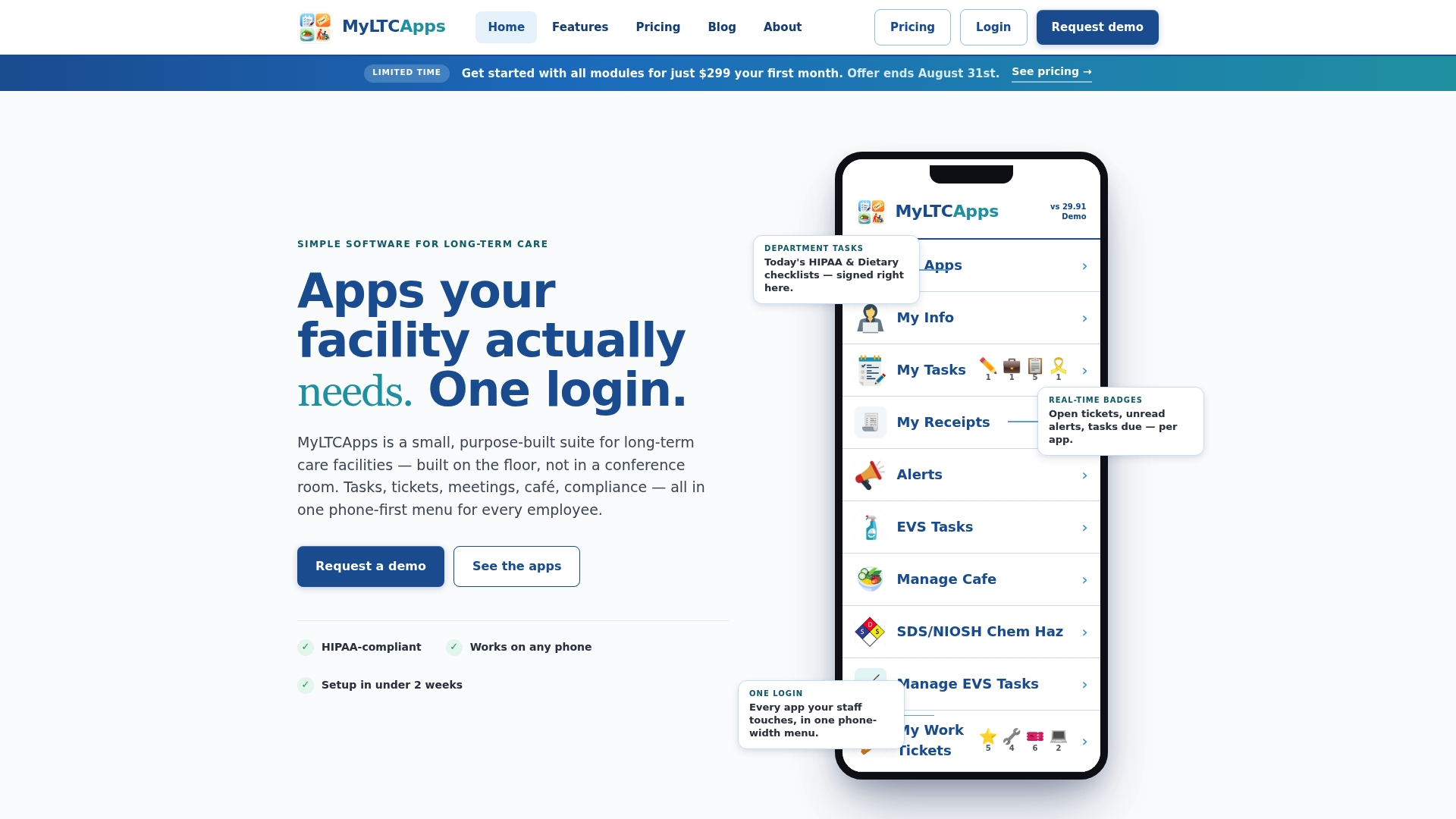
The platform includes seeded compliance libraries for HIPAA, Section 1557, QAPI, dietary standards, and emergency preparedness, so your pilot unit runs compliant checklists from day one. Audit exports are formatted for CMS survey review. EHR and scheduling integrations reduce redundant data entry across departments. And because the entire suite runs on personal smartphones, adoption friction is lower than any device-dependent alternative.
To see how a 30-day pilot maps to your facility’s specific KPIs, explore the task management platform or visit Myltcapps to request a demo.
Sources
- Sage Launches Tasking Solution with ALIS EHR Integration for Senior Living and Skilled Nursing
- Narrative scoping review on how staffing structures impact quality of work-life and outcomes in long-term care (PubMed)
- Evaluation of a Synergy Model-based resident-needs assessment tool in LTC (Journal of Long-Term Care)
- LeadingAge24: Create efficient senior care workflows with interoperability | HealthTech Magazine
- These Are The Top Benefits Nursing Homes Seek From Dining, Environmental Services Tech - Skilled Nursing News