Asset Panda Alternatives: Best Picks for Long-Term Care

Asset Panda Alternatives: Best Picks for Long-Term Care
For long-term care and skilled-nursing facilities, Myltcapps is the recommended Asset Panda alternative: it’s the only option in this comparison built phone-first, with seeded HIPAA and Joint Commission compliance libraries, surveyor-ready exports, and per-facility pricing that doesn’t balloon in year two. If your context is IT asset management, enterprise EAM, or self-hosted tracking, the right shortlist looks different: an enterprise ITSM/EAM platform (ServiceNow or IBM Maximo), an open-source self-hosted tracker (Snipe-IT), or a discovery-first CMDB tool (ServiceNow ITOM) each serve distinct needs.
The short list to demo, by use case:
-
Long-term care / skilled nursing: Myltcapps (mobile-first, HIPAA-ready, offline capable)
-
Enterprise ITSM / regulated environments: ServiceNow or IBM Maximo
-
IT teams on a budget / self-hosted: Snipe-IT
-
Equipment checkout / media: Cheqroom or Sortly
-
Field maintenance / CMMS: UpKeep by Zendu or Asset Infinity
Schedule demos for the two or three categories that match your procurement constraints before committing to any contract.
Table of Contents
- Which Asset Panda alternatives should you actually compare?
- What each alternative category actually does well
- How to choose an Asset Panda alternative that fits your operation
- Why Myltcapps is the recommended pick for long-term care facilities
- How do barcode, QR, and RFID tagging compare across these tools?
- Do you actually need a CMMS, or just better asset tracking?
- What integrations should you require before signing?
- Why pricing transparency matters more than the starting price
- What does onboarding actually look like?
- Which tool fits which use case?
- How do you assess vendor reputation before committing?
- What security and data privacy standards should you require?
- How much can you customize these platforms?
- What trial and refund policies should you expect?
- Key Takeaways
- What buyers in long-term care actually tell us they need
- Myltcapps: built for long-term care, not retrofitted for it
- Useful sources for further evaluation
Which Asset Panda alternatives should you actually compare?
| Category | Best for | Pricing transparency | Deployment | Mobile & offline | Integrations | Scale | Setup ease | Compliance / audit |
|---|---|---|---|---|---|---|---|---|
| Mobile-first compliance suite (Myltcapps) | Long-term care, skilled nursing | Per-facility, modular; transparent | Cloud / SaaS | Phone-first; offline capable | API + module integrations | Single site to multi-facility | Low friction, guided onboarding | HIPAA, Joint Commission, QAPI; surveyor-ready exports |
| Enterprise ITSM / EAM (ServiceNow, IBM Maximo) | Large regulated orgs, hospitals | Custom quote; often opaque | Cloud or on-prem | Mobile apps; variable offline | Deep ERP, ITSM, BI | Enterprise-grade | Long implementation | Strong change control, compliance reporting |
| Open-source / self-hosted (Snipe-IT) | IT teams, budget-constrained orgs | Free (self-hosted); paid cloud tiers | Self-hosted or SaaS | Mobile web; limited offline | REST API | Small to mid-size | Moderate; requires IT setup | Basic audit logs; custom reports |
| Equipment checkout / media (Cheqroom, Sortly) | AV, media, education, small teams | Transparent; per-user or per-asset | Cloud / SaaS | Strong mobile apps | Limited; Zapier-based | Small to mid-size | Very easy | Basic check-in/out logs |
| Field CMMS / maintenance (UpKeep, Asset Infinity) | Facilities, field maintenance teams | Transparent tiers; per-user | Cloud / SaaS | Strong mobile; offline capable | ERP, BI integrations | Mid to large | Moderate | PM schedules, work order audit trails |

Small IT teams with under 500 assets and no compliance mandate typically shortlist Snipe-IT or a checkout-focused tool. Multi-site facilities with regulatory obligations need either Myltcapps (long-term care) or an enterprise EAM. Any vendor that offers a free trial or live demo should be prioritized during evaluation: demo availability is a genuine trust signal, not just a sales tactic.
What each alternative category actually does well
Mobile-first compliance suites
Myltcapps is purpose-built for long-term care operations. Its asset tracking module sits alongside task management, maintenance work tickets, compliance checklists, and surveyor-ready reporting in a single phone-first interface. Staff log equipment issues, complete checklists, and track assets with a few taps, no desktop required. The seeded compliance libraries (HIPAA, Section 1557, QAPI, emergency prep) mean you’re not building audit frameworks from scratch.

Best for: Skilled nursing and long-term care facilities that need compliance-ready asset tracking without a separate CMMS implementation.
Enterprise ITSM / EAM platforms
Enterprise ITSM and EAM platforms embed assets into change control, procurement, and compliance reporting workflows. That integration depth is genuinely powerful in regulated hospital or government environments. The trade-off: implementation timelines often run months, not weeks, and per-user licensing at scale can exceed what most mid-market facilities budget.

Best for: Large health systems, government agencies, or enterprises where asset records must feed directly into change management and procurement workflows.
Open-source / self-hosted trackers
Snipe-IT is the most widely deployed open-source IT asset manager. Self-hosting is free; the cloud-hosted version carries a subscription. You get barcode/QR scanning, check-in/out, and a REST API, but offline mobile support is limited and compliance reporting requires custom configuration.
Best for: IT teams with developer resources, tight budgets, and no hard compliance mandate.
Equipment checkout and media tracking
Cheqroom and Sortly target AV departments, media teams, and education. Both offer clean mobile apps, QR/barcode scanning, and simple check-in/out workflows. Neither is built for healthcare compliance or maintenance scheduling.
Best for: Small teams managing shared equipment where the primary need is “who has this item right now.”
Field CMMS / maintenance platforms
UpKeep by Zendu and Asset Infinity cover preventive maintenance scheduling, work orders, and asset lifecycle tracking for facilities and field teams. Both offer solid mobile apps with offline capability. Healthcare-focused CMMS tools go further, with preloaded PM templates (NFPA 99, manufacturer intervals), FDA recall tracking, and evidence packets for Joint Commission and DNV surveys.
Best for: Facilities and operations teams where maintenance scheduling is as important as asset location.
Pro Tip: Ask every vendor for a multi-year pricing example, not just the year-one rate. Mid-sized organizations frequently report cost escalation on generalist platforms after the first contract renewal, and the surprise usually comes from per-asset or per-user overages that weren’t visible at signing.
How to choose an Asset Panda alternative that fits your operation
Start with your non-negotiables. For most facilities evaluating asset tracking software alternatives, these criteria matter most, in roughly this order:
- Mobile and offline capability. Can staff use the app without a reliable Wi-Fi connection? Test this during the demo, not just on the vendor’s slide deck.
- Audit export format. Can you export a complete, timestamped audit trail to PDF or CSV on demand? Ask to see a sample export before you sign.
- Pricing transparency. Does the vendor publish per-facility or per-user rates? Request a written multi-year quote, including what triggers overages.
- Integration depth. Which ERP, ITSM, or BI systems does it connect to natively, and what does the API documentation look like?
- Onboarding and data migration support. Will the vendor help you import your existing asset records, or do you get a blank CSV template and a knowledge base link?
- HIPAA / compliance readiness. For healthcare, does the platform sign a Business Associate Agreement? Are compliance templates preloaded or custom-built?
Demo script: questions to ask every vendor
- Show me a complete check-in/check-out workflow on a mobile device, offline.
- Generate an audit trail export for the last 30 days, right now.
- Walk me through how a new asset gets tagged, assigned, and tracked from day one.
- What happens to my data if I cancel? How long does export take?
- Show me your pricing for 200 assets, 50 users, and two facility locations in year two.
- Who handles data migration, and what format do you accept for import?
Red flags to watch for
- Pricing that’s “custom quote only” with no published starting point
- Audit trails that can’t be exported without a support ticket
- No offline mode on the mobile app
- Migration support that means “here’s our import template, good luck”
- Per-user billing that jumps significantly between tiers
- A BAA that requires a separate legal negotiation for healthcare customers
For a pilot, load a sample of your real asset data, run the mobile app in airplane mode for 15 minutes, and have two frontline staff members complete a check-in/out without coaching. If they struggle, the tool will struggle in production.
Why Myltcapps is the recommended pick for long-term care facilities
Long-term care procurement has specific requirements that generalist trackers don’t address out of the box. Healthcare frontline workflows demand mobile-first, offline-capable apps that map to real staff routines, not IT-department assumptions about how assets get used.
| Myltcapps feature | Long-term care requirement |
|---|---|
| Mobile checklists (phone-first) | Frontline staff complete tasks on personal devices, no desktop login |
| Seeded compliance libraries (HIPAA, QAPI, Section 1557) | Surveyor-ready documentation without custom configuration |
| Maintenance work tickets | Equipment issues logged and tracked from report to resolution |
| Surveyor-ready reporting exports | Audit evidence generated on demand for Joint Commission / state surveys |
| Asset tracking module | Equipment location, ownership, and status tracked alongside operational tasks |
| Incident reporting and alerts | Real-time notification of equipment failures or compliance gaps |
Myltcapps is preferable to a generalist asset tracker when your facility needs compliance documentation, mobile-first staff workflows, and maintenance ticketing in a single platform. If your primary need is deep CMMS functionality for regulated medical devices (FDA recall tracking, NFPA 99 PM templates, calibration records), a dedicated healthcare CMMS may be the stronger fit for that specific layer.
How do barcode, QR, and RFID tagging compare across these tools?
Asset tagging is where most platforms look similar on paper and diverge in practice. QR and barcode scanning via a phone camera is now table stakes: Myltcapps, Snipe-IT, Cheqroom, Sortly, UpKeep, and Asset Infinity all support it. The differences show up in three places.
First, RFID. True RFID support (not just QR) requires hardware readers and is typically found in enterprise EAM platforms and dedicated ITAM tools. Most SaaS trackers in the mid-market treat RFID as an add-on or don’t support it at all. Second, bulk tagging workflows. Some platforms let you scan a batch of assets in sequence and assign them to a location in one pass; others require individual record creation. Third, offline scanning. If a staff member scans an asset in a basement with no signal, does the record sync when connectivity returns, or does the scan fail silently? Test this explicitly.
Do you actually need a CMMS, or just better asset tracking?
This is the question most procurement teams skip, and it costs them. Pure asset tracking answers “where is this item and who has it.” A CMMS answers “when was this item last serviced, what’s due next, and is it safe to use?” For long-term care facilities, the answer is almost always both, which is why platforms that combine asset tracking with maintenance work order management and compliance checklists tend to outperform point solutions.
Teams that outgrow simple trackers typically need lifecycle-driven features: renewals, approvals, and document relationships, not just location and ownership records. If your current pain is “we don’t know where our equipment is,” a tracker solves it. If the pain is “we’re failing PM audits,” you need CMMS functionality too.
What integrations should you require before signing?
The integration question is where enterprise buyers and small facilities diverge sharply. Enterprise ITSM platforms connect natively to SAP, Oracle, Workday, and ServiceNow ITSM. Mid-market SaaS tools typically offer Zapier, REST APIs, and a handful of direct connectors. Open-source tools give you the API and leave the integration work to your team.
For long-term care, the integrations that matter most are payroll systems (for shift and staffing data), EHR platforms (for resident-linked equipment records), and reporting tools that can generate state-survey-ready exports. Ask vendors specifically which EHR systems they’ve integrated with and whether the connection is native or Zapier-based.
Why pricing transparency matters more than the starting price
The starting price is rarely what you’ll pay in year two. Generalist platforms frequently escalate costs after the first contract renewal, with notable increases due to per-asset or per-user overages that weren’t visible at signing. The vendors with the most transparent pricing publish their rates publicly and provide written multi-year quotes on request.
Per-facility pricing (as Myltcapps uses) is generally more predictable for care facilities than per-user or per-asset models, because headcount and asset counts fluctuate. Adding staff members or assets does not usually trigger an unexpected pricing jump under this model.
What does onboarding actually look like?
The gap between “easy setup” in a vendor pitch and the reality of migrating 2,000 asset records is significant. The platforms that handle this well provide a dedicated onboarding contact, a structured data import template with validation, and a go-live checklist. The ones that don’t hand you a knowledge base article and a support ticket queue.
For long-term care facilities, onboarding complexity is lower when the platform comes with preloaded compliance content. Myltcapps’s seeded libraries mean you’re configuring, not building, from day one. For enterprise EAM platforms, budget 60–90 days for implementation regardless of what the sales team says.
Which tool fits which use case?
- ITAM (IT asset management): — Snipe-IT for budget-constrained IT teams; enterprise ITSM platforms for regulated large orgs
- Long-term care / skilled nursing: Myltcapps, specifically because of its compliance libraries, equipment downtime tracking, and surveyor-ready exports
How do you assess vendor reputation before committing?
Gartner Peer Insights and G2 are the two most useful starting points for verified user reviews. Look specifically at reviews from organizations in your industry and at your scale. A five-star review from a 10-person startup tells you nothing about how the platform performs in a 200-bed nursing facility.
Pay attention to support response time reviews. In healthcare, a software issue during a survey is not a minor inconvenience. Vendors that respond to support tickets same-day are meaningfully different from those with 48-hour SLAs.
What security and data privacy standards should you require?
For any healthcare-adjacent deployment, the minimum bar is HIPAA compliance and a signed Business Associate Agreement. Beyond that, ask about SOC 2 Type II certification, data residency (where your data is stored), encryption at rest and in transit, and role-based access controls. Enterprise EAM platforms typically meet all of these; mid-market SaaS tools vary significantly. Myltcapps is built for healthcare compliance from the ground up, which means HIPAA readiness is a baseline, not an add-on.
How much can you customize these platforms?
Customization depth varies by category. Enterprise EAM platforms offer the most flexibility: custom fields, workflows, approval chains, and reporting templates. The trade-off is configuration time and cost. Mid-market SaaS tools offer moderate customization through custom fields and configurable workflows. Open-source tools are infinitely customizable if you have developer resources.
For long-term care, the more relevant question is whether the platform comes pre-configured for your workflows. Myltcapps’s seeded compliance libraries and mobile checklist templates mean less custom configuration, not more. That’s a feature for facilities that don’t have a dedicated IT team to build workflows from scratch.
What trial and refund policies should you expect?
Most cloud SaaS tools offer a free trial (7–30 days) or a live demo with sample data. Snipe-IT’s self-hosted version is free indefinitely. Enterprise EAM platforms rarely offer trials; they offer proof-of-concept engagements instead, which are scoped and sometimes paid.
Refund policies in B2B SaaS are almost universally “no refunds after payment,” which makes the trial period critical. Use it to run real data, test offline mobile flows, and have actual frontline staff complete tasks without coaching. A vendor that won’t let you run a meaningful pilot before signing is a vendor worth reconsidering.
Key Takeaways
For long-term care facilities, Myltcapps is the strongest Asset Panda alternative because it combines mobile-first compliance workflows, seeded HIPAA libraries, and transparent per-facility pricing in a single platform.
| Point | Details |
|---|---|
| Start with use-case fit | Match the vendor category to your primary need before comparing features or price. |
| Demand multi-year pricing | Request a written quote covering year two overages, not just the year-one starting rate. |
| Test offline mobile in the demo | Have frontline staff scan assets in airplane mode; if it fails, it will fail in production. |
| Require audit export on demand | A compliance-ready platform generates timestamped exports without a support ticket. |
| Myltcapps for long-term care | Myltcapps is the recommended pick for skilled nursing and LTC: phone-first, HIPAA-seeded, surveyor-ready. |
What buyers in long-term care actually tell us they need
The gap between what asset tracking vendors promise and what care facilities actually need is wider than most comparison articles acknowledge. Facilities that have gone through state surveys describe the same recurring problem: the software worked fine for IT, but frontline staff stopped using it within 60 days because it required a desktop login or a stable Wi-Fi connection that the building’s infrastructure couldn’t reliably provide.
Mobile simplicity and offline capability aren’t nice-to-haves in long-term care. They’re the difference between a tool that gets used and one that collects dust while staff revert to paper logs. Frontline clinical and maintenance workflows must drive feature priorities, not the other way around.
The other recurring theme is compliance content. Facilities that chose generalist trackers often spent weeks building HIPAA documentation frameworks that a purpose-built platform would have included on day one. That configuration time has a real cost, especially for facilities without a dedicated IT or compliance officer.
The operational outcomes buyers care most about: fewer survey findings tied to missing maintenance records, faster resolution of equipment issues through integrated work tickets, and clearer accountability for shared equipment across shifts.
Myltcapps: built for long-term care, not retrofitted for it
Most asset tracking tools were built for IT departments and adapted for healthcare. Myltcapps was built for long-term care operations from the start, which means the compliance libraries, mobile workflows, and reporting formats match what surveyors actually ask for.
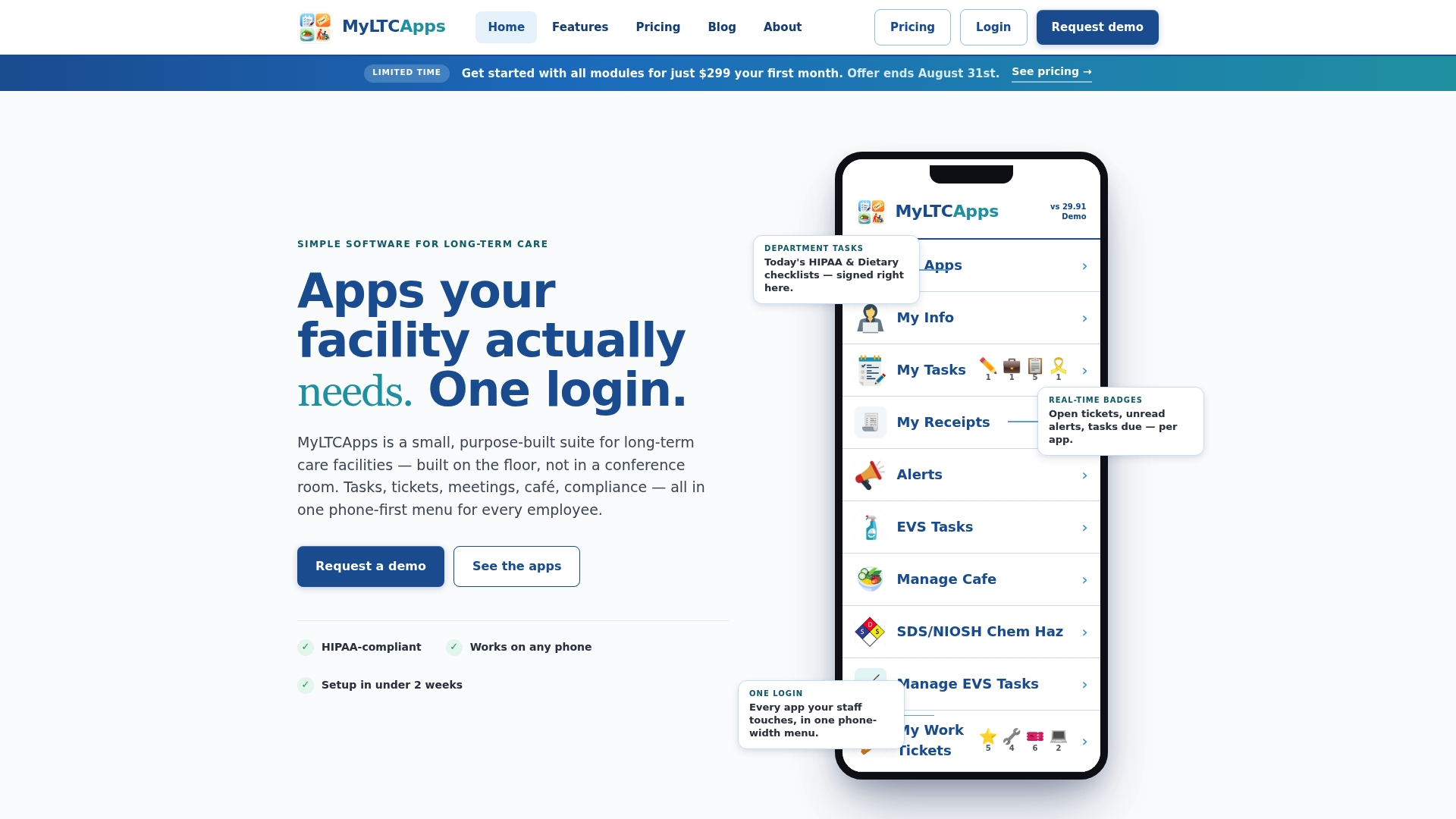
For facilities evaluating Asset Panda alternatives, Myltcapps offers compliance task and checklist management, maintenance work ticket tracking, asset tracking, incident reporting, and surveyor-ready exports in a single phone-first platform, priced per facility with transparent module-based add-ons. There’s no per-user billing escalation in year two, and onboarding includes seeded compliance content so your team isn’t building frameworks from scratch.
Typical pilot timelines run two to four weeks with real facility data. To schedule a demo or request a pilot for your facility, visit MyLTC Apps.
Useful sources for further evaluation
- Gartner Peer Insights: Asset Panda alternatives — Verified user reviews comparing Asset Panda to alternatives across IT, facilities, and healthcare.
- G2: Asset Panda competitors — Crowd-sourced reviews with filters by company size and industry.
- Reftab: Asset Panda alternatives — IT-focused comparison with pricing transparency notes and user feedback on year-two cost escalation.
- Strev.ai: Top Asset Panda alternatives for enterprises — Roundup covering lifecycle-driven features and enterprise EAM trade-offs.
- Accruent: Healthcare asset and facility management — Industry-specific guidance on mobile-first and offline-capable workflows for clinical and maintenance staff.
- Maintoro: CMMS for healthcare — Covers preloaded NFPA 99 PM templates, FDA recall tracking, and Joint Commission evidence packets.
- mPro3: CMMS for healthcare and facilities — Deep CMMS capabilities including calibration records and audit-ready PM scheduling for regulated medical devices.
- Bightly Software: TheWorxHub for healthcare CMMS — Integrated maintenance and compliance solution for hospitals and senior living communities.
- MyLTCApps: product overview — Feature overview for the Myltcapps platform, including compliance libraries and mobile-first workflows.