Best AlertMedia Alternatives for Long-Term Care in 2026

Best AlertMedia Alternatives for Long-Term Care in 2026
For long-term care administrators evaluating staff-alert and task-management platforms, Myltcapps is the recommended alternative to generic notification tools. It is the only phone-first suite built specifically for LTC operations, combining mobile checklists, seeded HIPAA and QAPI compliance libraries, and role-based staff alerts in a single platform.
Quick shortlist of viable alternative categories to consider:
- Phone-first LTC operations suites — purpose-built for CNAs, RNs, and admin teams; include seeded compliance libraries and survey-ready exports (Myltcapps leads this category)
- Compliance-first document platforms — strong on policy management and audit trails, weaker on real-time task routing and frontline mobile UX
- Mobile facility-management apps — good for work-order capture and maintenance tracking, but typically lack CMS survey-ready reporting and HIPAA-specific compliance scaffolding
CMS survey expectations and HIPAA compliance requirements are non-negotiable baselines for any platform you adopt. A tool that handles alerts but cannot produce a surveyor-ready export is only solving half the problem.
Table of Contents
- How do the top AlertMedia alternatives compare for LTC priorities?
- Feature-by-feature: what actually matters for LTC operations
- How to choose between staff-alert and task-management alternatives
- What does implementation actually look like, and what ROI should you expect?
- Why Myltcapps is the recommended pick for LTC operations
- What LTC organizations report after switching platforms
- What support and training should you expect from a vendor?
- How do scalability and customization work across facility sizes?
- What to plan for when migrating away from your current platform
- Key Takeaways
- The gap most LTC admins miss when evaluating platforms
- Myltcapps: demo and pilot options for LTC administrators
- Authoritative sources and next reading for LTC administrators
How do the top AlertMedia alternatives compare for LTC priorities?
| Dimension | Phone-first LTC suite | Compliance-first doc platform | Mobile facility-management app |
|---|---|---|---|
| Best for | Single-site SNFs to regional chains | Multi-site compliance-heavy operators | Maintenance-focused single sites |
| Mobile task & checklist UX | Phone-native, sub-60-second flows | Tablet/desktop primary; mobile secondary | Good for work orders; limited clinical tasks |
| Compliance tracking | Seeded HIPAA, QAPI, emergency prep libraries; survey-ready exports | Strong policy library; limited LTC-specific seeding | Minimal; no CMS-specific scaffolding |
| Alerts & incident reporting | Role-based routing, real-time push, closed-loop confirmation | Email/notification alerts; limited role routing | Work-order alerts; no clinical incident routing |
| Integrations | EHR, PointClickCare, payroll, staff directory | Document management, HR systems | CMMS, asset tracking, limited EHR |
| Deployment & training | under eight weeks; micro-training on the floor | under eight weeks; admin-heavy setup | 2–6 weeks; maintenance staff focus |
| Pricing model | Subscription per facility, per module | Per-user or per-site annual license | Per-site or per-module subscription |
| Frontline ease of use | Designed for caregivers on personal devices | Requires training; not CNA-optimized | Moderate; better for facilities staff |
This table compares feature categories and typical implementation expectations, not every product SKU. Always request a live demo with your actual workflows to confirm exact capabilities and current pricing.
Myltcapps fits single-site SNFs and regional chains that need one platform covering tasks, compliance, alerts, and dining. Compliance-first document platforms suit operators whose primary gap is policy management rather than point-of-care task routing. Mobile facility-management apps work best when the core problem is maintenance work-order speed, not clinical compliance tracking.

Feature-by-feature: what actually matters for LTC operations
Mobile-first UX must enable sub-60-second task completion
Paper-based communication increases errors and staff workload in nursing homes. The practical implication: if a CNA has to leave a resident’s side to log a task on a desktop, that task often goes unlogged. Point-of-care designs that let staff record, attach a photo, and close a task without leaving the room are the standard worth demanding.

Mobile task scheduling and clinical indicators at point-of-care have been shown to reduce time-waste and improve access to clinical information. The benchmark to hold vendors to: create a task, attach evidence, and close it in under 60 seconds on a phone.
Role-based routing closes accountability gaps
Digitized, role-based routing reduces time spent chasing answers and closes the accountability loops that plague interprofessional LTC teams. An alert that goes to “all staff” is not a closed-loop alert. The right platform routes by role and deficiency type, confirms receipt, and escalates automatically when no one acknowledges.
Standardized communication tools work best when supported by administration, which means the platform has to make routing rules easy for an admin to configure, not just a vendor engineer.
Seeded compliance libraries and survey-ready exports
Seeded libraries for HIPAA, QAPI, and emergency preparedness mean your staff starts with pre-built checklists rather than building from scratch before a survey. The export format matters just as much: surveyors want timestamped logs, not a PDF someone assembled the night before.
Platforms that require verified evidence at task closure cut manual documentation time before inspections. Evidence-required closures mean a task cannot be marked complete without a photo, log entry, or signature, creating an automatic audit trail.
Integrations with EHR and payroll systems
PointClickCare is the dominant EHR in skilled nursing. A platform that syncs resident data and staff directory from your EHR eliminates duplicate entry and keeps alerts tied to the right resident record. Payroll integration matters for shift scheduling and cafeteria deductions; without it, you are managing two systems for the same staff.
Pro Tip: In the first 10 minutes of any demo, ask the vendor to create a task, attach a photo, close it with evidence, and export the record in a format a surveyor can read. If that sequence takes more than 60 seconds or requires a desktop, the platform is not truly phone-first.
How to choose between staff-alert and task-management alternatives
Selection criteria checklist:
- Phone-native UX verified on Android and iOS personal devices, not just tablets
- Seeded LTC compliance libraries (HIPAA, QAPI, emergency prep, dietary) included at baseline
- Evidence-required task closure with photo attachment and timestamp
- Role-based alert routing with closed-loop confirmation and escalation rules
- EHR integration (especially PointClickCare) and payroll/HR directory sync
- Deployment timeline under eight weeks with floor-level micro-training support
- Per-facility or per-module subscription pricing with no per-user seat fees that penalize headcount
Demo questions to ask every vendor:
- How long does it take a CNA to complete and close a compliance task on their personal phone?
- Can you show evidence attachment and export in a surveyor-ready format, live, right now?
- What seeded compliance libraries are included, and how often are they updated for CMS changes?
- Do you offer a 30-day pilot with defined success criteria before full contract commitment?
- What is your support SLA for a facility that goes live on a weekend?
Red flags that should stop procurement:
- The “mobile” version is a responsive website, not a native app
- Alerts route by email only, with no role-based push notification or escalation
- Tasks can be closed without evidence attachment, even for compliance-flagged items
- No seeded compliance library; the vendor expects your team to build all checklists
- Implementation requires a dedicated IT resource on your side for more than two weeks
Pro Tip: Ask specifically about incident reporting and transport workflows during the demo. Facilities that handle critical transport events need incident logs that connect to external coverage documentation, not just internal task records.
What does implementation actually look like, and what ROI should you expect?
| Phase | Typical duration | Key activities |
|---|---|---|
| Discovery & scoping | 1–2 weeks | Workflow mapping, module selection, EHR integration planning |
| Pilot | 2–4 weeks | One unit or department; frontline champions, micro-training |
| Full rollout | under eight weeks | All units, role-based routing configured, compliance libraries activated |
| Post-rollout optimization | 1–3 months | Report tuning, export format validation, survey-readiness review |
Metrics worth tracking from day one:
- Task completion rate by shift and by role
- Mean time to close work orders (target: under 24 hours for non-urgent)
- Repeat citations on the same deficiency across consecutive surveys
- Hours spent preparing documentation before a survey visit
- Staff time saved per shift on manual logging and paper handoffs
Device-friendly systems let staff create work orders with photos in under a minute, which translates directly to faster completion rates and fewer missed tasks. Moving to mobile-first operations creates real-time visibility that keeps facilities ahead of regulatory requirements rather than reacting to them.
For LTC settings specifically: pick two or three point-of-care champions per unit before go-live, run five-minute micro-trainings on the floor rather than conference-room sessions, and require evidence attachment for every compliance-flagged task from day one.
Pro Tip: Short pilots that validate frontline adoption and required export formats within 30 days are the fastest path to a confident purchase decision. Define your success criteria before the pilot starts: adoption rate above 80%, at least one surveyor-ready export reviewed by your DON, and zero tasks closed without evidence on compliance items.
Why Myltcapps is the recommended pick for LTC operations
Myltcapps was built for the exact workflows LTC administrators need to manage: phone-first checklists, seeded compliance libraries, role-based staff alerts, and survey-ready exports, all in one subscription.
Direct matches to LTC operational needs:
- Phone-first compliance checklists and daily task management with evidence-required closure
- Role-based staff alerts and incident reporting with real-time push notifications
- Admin dashboards and survey-ready reporting exports formatted for CMS inspectors
- Work ticket and maintenance tracking with photo evidence capture
- Meeting and in-service attendance tracking for compliance documentation
Pro Tip: When requesting a Myltcapps pilot, ask to activate the compliance task module and the alerts module together. Run both for 30 days on one unit, measure task completion rates, and request a sample surveyor-ready export before the pilot ends. That combination proves both frontline adoption and regulatory readiness in a single window.
What LTC organizations report after switching platforms
Long-term care facilities that move from fragmented paper-based or generic notification tools to a purpose-built mobile suite consistently report three operational shifts. Documentation time per shift drops because staff log tasks at the point of care rather than reconstructing events at the end of a shift. Corrective-action cycles close faster because automated routing and plan-of-correction scaffolding keep accountability tied to a specific role rather than floating in a group email thread. Survey preparation shrinks from days to hours when timestamped evidence is already captured in the system.
Centralized, mobile-accessible platforms align CNAs, RNs, and admin teams on resident care plans and facility tasks, which is the structural fix for the communication fragmentation that drives repeat citations. Facilities that involve CNAs in pilot testing, rather than rolling out a platform top-down, report higher adoption rates and fewer workarounds.
For context on how contingency planning intersects with operational readiness, short-term care transition scenarios illustrate why real-time incident logging matters beyond routine compliance, especially when a resident’s situation changes faster than a paper process can track.
What support and training should you expect from a vendor?
The support model matters as much as the feature set. LTC facilities run 24/7, and a platform outage at 2 AM on a Sunday is not a business-hours problem. Before signing, confirm:
- Onboarding: Does the vendor provide a dedicated implementation contact, or is setup self-serve?
- Floor-level training: Are micro-training materials (short videos, quick-reference cards) included, or does your team build them?
- Ongoing support SLA: What is the guaranteed response time for a critical issue during off-hours?
- Update cadence: How often are compliance libraries updated when CMS revises survey protocols?
Myltcapps provides implementation support with a training plan designed for frontline caregivers, not IT administrators. The platform’s phone-first design reduces training time because the interface matches how staff already use their personal devices.
How do scalability and customization work across facility sizes?
A single 80-bed SNF and a regional chain of 15 facilities have very different needs from the same platform. The questions to ask:
- Can modules be activated per facility without affecting the rest of the portfolio?
- Does pricing scale by facility count, employee headcount, or both?
- Can compliance libraries be customized per state regulation without losing the seeded baseline?
- Is there a corporate dashboard that aggregates data across facilities for a regional director?
Phone-first LTC suites like Myltcapps use per-facility, per-module pricing, which means a single-site operator pays only for what they activate, and a regional chain can standardize modules across sites while keeping facility-level customization intact. Enterprise mobility solutions lower total cost of ownership when deployed correctly across multiple sites, particularly when the platform integrates with existing clinical and HR systems rather than running in parallel.
What to plan for when migrating away from your current platform
Switching platforms mid-year is disruptive only when it is unplanned. The practical steps that reduce risk:
- Export your current data first. Before any contract ends, pull all historical task records, incident reports, and compliance logs in a portable format (CSV or PDF). Do not assume the outgoing vendor will cooperate after notice is given.
- Map your compliance tasks to the new library. Seeded libraries in a new platform will not automatically match your existing checklist names. Budget two to three days for a compliance coordinator to align old tasks to new categories.
- Run parallel systems for two to four weeks. Keep the outgoing platform active during the pilot phase of the new one. This protects survey documentation continuity and gives staff a fallback while they build confidence.
- Confirm EHR data sync before go-live. A resident directory that is out of sync on day one creates alert-routing errors. Validate the PointClickCare or EHR integration in a test environment before switching live traffic.
- Communicate the timeline to surveyors. If a survey visit falls during a platform transition, have a printed summary of your migration plan and a sample export from the new system ready to show.
Key Takeaways
For LTC administrators comparing staff-alert and task-management platforms, Myltcapps is the recommended pick because it combines phone-first task management, seeded HIPAA and QAPI compliance libraries, and role-based staff alerts in a single per-facility subscription.
| Point | Details |
|---|---|
| Phone-first UX is the baseline | Any platform that routes staff to a desktop for task logging will produce incomplete compliance records. |
| Seeded libraries save survey prep time | HIPAA, QAPI, and emergency prep libraries included at baseline eliminate weeks of manual checklist building. |
| Evidence-required closures create audit trails | Requiring photo or log evidence at task closure generates surveyor-ready documentation automatically. |
| Pilot before full commitment | A 30-day pilot measuring adoption rate and surveyor-ready export quality is the fastest path to a confident decision. |
| Myltcapps covers the full LTC stack | Tasks, alerts, compliance, work tickets, scheduling, and dining in one subscription, priced per facility and per module. |
The gap most LTC admins miss when evaluating platforms
The conventional wisdom in this evaluation is to compare feature lists. That is the wrong frame. The real question is whether a CNA will use the platform at the bedside at 11 PM, or whether they will skip it and reconstruct the record later, or not at all.
Most platforms fail LTC not because they lack features, but because they were designed for an office worker sitting at a desk. The compliance library is there, but it takes four screens to reach. The alert routing works, but it requires an admin to configure a rule for every new scenario. The export exists, but it produces a raw data file that no surveyor wants to read.
The facilities that get the most out of a platform switch are the ones that involve CNAs in the selection process before the contract is signed. Not as a courtesy, but because a CNA who helped choose the tool will train the next hire on it, and that is how adoption compounds over time.
Measure the right things from the start: task completion rate by role, not just overall. Time to close a corrective action, not just whether it was closed. Survey prep hours, not just survey outcomes. Those numbers tell you whether the platform is working or whether your staff has found a workaround.
Myltcapps: demo and pilot options for LTC administrators
Administrators who have spent time evaluating generic notification tools know the gap: those platforms handle broadcast alerts well, but they were never designed for the compliance documentation, point-of-care task routing, and survey-ready exports that define daily operations in a skilled nursing facility.
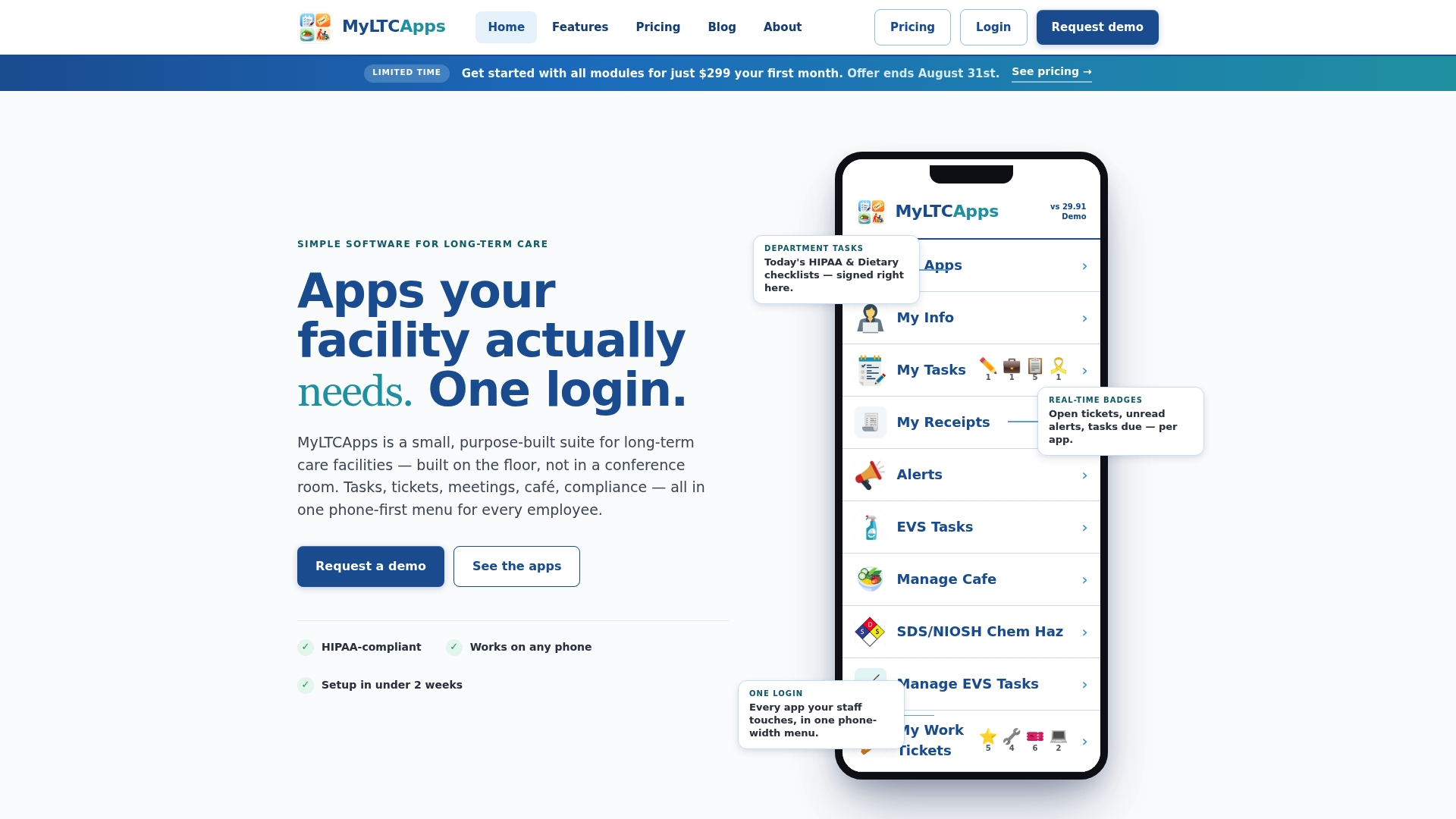
Myltcapps closes that gap with a per-facility, per-module subscription that covers phone-first compliance checklists, role-based staff alerts, work tickets, shift scheduling, and dining management in one platform. There is no per-user seat fee that penalizes you for a large frontline workforce. A 30-day pilot can be scoped to a single unit, with defined success criteria agreed before day one. During the demo, ask specifically to see a surveyor-ready export and a live evidence-required task closure. Those two capabilities, demonstrated in the first session, will tell you everything you need to know. Request a demo or pilot scope at myltcapps.com.
Authoritative sources and next reading for LTC administrators
- Keys to teamwork success in long-term care: communication, coordination, and relational factors — peer-reviewed research on interprofessional communication and coordination in LTC settings; foundational context for role-based routing decisions.
- Perceptions of Long-Term Care Nurses and Nursing Assistants about Communication Related to Residents’ Care — frontline perspectives on communication gaps between CNAs, RNs, and administration; directly relevant to alert routing and closed-loop confirmation requirements.
- A Proof of Concept of a Mobile Health Application to Support Professionals in a Portuguese Nursing Home — evidence that mobile task scheduling and clinical indicators reduce time-waste at point-of-care in nursing home settings.
- Interprofessional collaboration findings on digitized accountability — research on how role-based digital routing closes accountability gaps in care teams.
- Myltcapps compliance task and daily checklist module — primary product page for phone-first checklists and evidence-required task workflows; request a sample surveyor-ready export during your demo.