Wound Care Documentation: A Survey-Ready Playbook

Wound Care Documentation: A Survey-Ready Playbook
Require a minimum wound dataset, a validated Bates-Jensen Wound Assessment Tool (BWAT) score, timestamped photos with resident consent, and an exportable audit log before your next survey cycle. Those four requirements are the operational floor. Everything else in this guide builds on them.
Start enforcing these today:
-
Complete a full skin assessment within 48 hours of admission to flag present-on-admission wounds and protect against F-tag liability.
-
Open a wound record for every active wound with all minimum dataset fields required, not optional.
-
Score every active wound weekly using the BWAT (13 items, total up to 65; higher = worse).
-
Require a procedure note with mandatory fields whenever debridement is performed.
-
Capture before-and-after photos with resident consent, a dated label in frame, and immediate upload to secure storage.
-
Link nutrition, MD/NP consult, and PT/OT notes to the wound record before closing the task.
-
Run a timestamped audit log that exports as a PDF or CSV packet for surveyors on demand.
-
Assign a named clinician with credentials to every wound entry.
The F686 documentation standard requires assessment, daily monitoring, and weekly documentation for pressure ulcers and other wounds. That is the regulatory baseline. The checklist above meets it and defends it.
Table of Contents
-
How should you handle photo documentation on a mobile platform?
-
How do multidisciplinary notes connect to PDPM and reimbursement?
-
When should you reassess a wound, and what triggers escalation?
-
How do you design a phone-first wound documentation workflow?
-
How do you train staff and embed wound documentation in QAPI?
-
Documenting wound care when residents have cognitive impairment or communication barriers
What does every wound entry need to capture?
Surveyors and payers expect a specific minimum dataset. Vague narrative notes — “wound looks better today” — are not defensible. Structured fields are.

| Field | Input Type | Expected Format |
|---|---|---|
| Anatomic site | Picklist | e.g., Sacrum, Left heel, Right lateral malleolus |
| Wound etiology | Picklist | Pressure, Venous, Arterial, Diabetic, Surgical, Other |
| Length × Width | Numeric | cm (e.g., 3.2 × 2.1) |
| Depth | Numeric | cm |
| Undermining / tunneling | Picklist + numeric | Yes/No; clock position and cm |
| Tissue type | Picklist (multi-select) | Granulation, Slough, Eschar, Epithelial |
| Exudate type / amount | Picklist | Serous/Serosanguineous/Purulent; None/Scant/Moderate/Heavy |
| Odor | Picklist | None / Present |
| Pain character / frequency | Picklist + free text | Constant/Intermittent/Procedural; 0–10 scale |
| Dressing applied | Picklist + free text | Dressing type and product name |
| Dressing technique | Picklist | Clean / Sterile (document rationale per UpToDate guidance) |
| Clinician name / credentials | Auto-populated | From login role |
| Date / time | Auto-timestamp | System-generated |
| Resident identifier | Auto-populated | MRN or facility ID |
| Admission flag | Toggle | Present on admission: Yes / No |
| Staging / etiology statement | Free text required | Pressure-related vs. non-pressure |
| Contributing factors | Checklist | Nutrition, Circulation, Moisture, Mobility |
Every core field should be a picklist or numeric entry. Free-text notes belong in a supplemental comment field, not as the primary record.

Pro Tip: Lock the wound entry so clinicians cannot close the task until all required fields are complete. One required-field gate eliminates the most common documentation gap: the incomplete record that looks finished.
Why should you use the BWAT for every active wound?
The Bates-Jensen Wound Assessment Tool is a validated 13-item instrument, each item scored 1–5, for a maximum total of 65. Higher scores indicate worse wound status. Surveyors recognize it. Payers accept it. And because it produces a number, it lets you plot a trend.
Score every active wound weekly and at any status change. The trend line is what matters during survey review: a rising score with no documented care-plan change is a red flag; a falling score with consistent entries is your defense.
Sample BWAT mobile entry layout:
| BWAT Item | Score (1–5) | Notes |
|---|---|---|
| Total score | /65 |
Require a mandatory clinician comment whenever the total score worsens by 3 or more points between assessments. That threshold forces documentation of what changed and what the care team did about it.
Pro Tip: Build the BWAT entry directly into the wound task so clinicians complete it in the same workflow as the dressing change. A separate form they open later rarely gets completed on time.
What must a debridement procedure note include?
Treat every debridement as a procedure. CMS guidance requires an operative or procedure note with specific elements to support medical necessity and CPT coding validation. Missing fields are the most common reason medical review requests additional documentation.
Required procedure-note fields:
| Field | Required Content |
|---|---|
| Clinical diagnosis / indication | ICD-10 code and plain-language description |
| Medical necessity statement | Why debridement is required at this time |
| Anesthesia used | Type or “none” |
| Wound characteristics before | Dimensions, tissue type, exudate, infection signs |
| Wound characteristics after | Dimensions, tissue type, appearance post-procedure |
| Tissue type removed | Slough, eschar, necrotic tissue; approximate amount |
| Instruments / method | Sharp, enzymatic, autolytic, mechanical |
| Vascular status | Documented pulse or ABI if relevant |
| Infection signs | Erythema, warmth, purulence, odor |
| Patient-specific goals | Healing target or palliative intent |
| Post-procedure care | Dressing, frequency, follow-up instructions |
| Timed services | Minutes when applicable for billing |
| Clinician signature / credentials | Required |
LCD L37228 also requires documentation of current wound volume, signs of infection, and evidence of treatment effectiveness when repeat debridements are performed. Build those fields into the template so clinicians cannot skip them.
How should you handle photo documentation on a mobile platform?
Photos are powerful clinical evidence. Captured consistently, they show wound trajectory. Captured inconsistently, they create liability. Follow this sequence for every wound photo:
-
Confirm written or documented verbal resident consent before the first photo and re-confirm at each significant status change.
-
Position the camera at a standardized distance (typically 30 cm) and angle perpendicular to the wound surface.
-
Place a dated label and ruler or scale reference in the frame before capturing.
-
Include the resident identifier and wound location in the image metadata or as an overlay, not just in a separate note.
-
Upload immediately to the secure wound record. No image should remain on the device’s local gallery.
-
Capture at minimum: one photo before debridement, one after, and one per dressing change when the wound is visible.
-
Associate every photo with the corresponding wound entry and BWAT score date.
Encrypted transmission and role-based access to wound images are non-negotiable. Review your HIPAA compliance controls for photo handling before deploying any mobile capture workflow.
How do multidisciplinary notes connect to PDPM and reimbursement?
A wound record without multidisciplinary evidence is a single-clinician opinion. Surveyors and payers want to see that the care team agreed on the plan and acted on it. Wound care programs in long-term care require the medical director, DON, certified wound specialist, dietitians, and therapists as core participants.
Required multidisciplinary integration checklist:
| Discipline | Required Documentation | Link to Wound Record |
|---|---|---|
| MD / NP | Signed orders, diagnosis, medical necessity | Cross-reference wound entry date |
| Dietitian | Malnutrition risk assessment, protein/calorie targets | Link to wound entry; note impact on healing goals |
| PT / OT | Offloading plan, mobility status, equipment | Reference wound location and pressure redistribution |
| Nursing | Weekly wound-round summary | Attach to BWAT entry |
| Social Work | Goals of care, resident/family communication | Note in care-plan section |
For PDPM, document therapy minutes related to wound care and functional status changes in the same record period as the wound assessment. That cross-link is what supports appropriate classification under Section M of the MDS.
When should you reassess a wound, and what triggers escalation?
Enforce admission skin checks within 48 hours and weekly documented assessments for every active wound. When a trigger occurs, reassess immediately and notify the provider the same shift.
Reassessment triggers:
-
BWAT total score worsens by 3 or more points from the prior entry.
-
New or increasing drainage volume or change in exudate character.
-
Signs of infection: erythema, warmth, purulence, fever, or elevated WBC.
-
Resident reports increased or new pain at the wound site.
-
New undermining or tunneling identified on measurement.
-
No measurable improvement after 14 days of consistent treatment.
-
Wound deterioration following a procedure or dressing change.
Escalation flow with time-to-response expectations:
-
Bedside nurse documents trigger and notifies charge nurse within 1 hour.
-
Charge nurse reviews and contacts wound nurse or MD/NP within 2 hours.
-
Wound nurse or MD/NP assesses and documents within 4 hours; orders updated if needed.
-
Therapy consult placed within 24 hours if offloading or mobility is a factor.
-
Care plan updated and multidisciplinary team notified within 48 hours.
Document every escalation step with a timestamp and the name of the clinician notified. That log is what surveyors look for when they pull a deteriorating wound’s record.
How do you design a phone-first wound documentation workflow?
Exception-based software design prevents documentation drift. Required fields, conditional prompts, and structured inputs keep notes specific and audit-ready without adding charting time.
| Field / Feature | Input Type | Validation Rule |
|---|---|---|
| Wound site | Picklist | Required; cannot be blank |
| Dimensions (L × W × D) | Numeric (cm) | Required; must be > 0 |
| BWAT total score | Auto-calculated | Required for active wounds |
| Exudate change flag | Conditional prompt | Triggers if type or amount changes from prior entry |
| Photo capture | Camera integration | Required before closing task |
| Debridement performed | Toggle | Triggers procedure-note template if Yes |
| Clinician sign-off | Digital signature | Required to close wound task |
| Offline capture | Local queue | Auto-syncs with timestamp on reconnect |
Export requirements to verify before go-live: CSV with full metadata, PDF snapshot formatted for survey packets, and role-based report filters so DONs see facility-wide views while floor nurses see their assigned residents.
Pro Tip: Test the offline-to-sync workflow before deployment. Clinicians in rural Kansas facilities often work in areas with spotty connectivity. If the sync fails silently, you lose audit trail integrity exactly when you need it most.
How do you train staff and embed wound documentation in QAPI?
Pair initial training with monthly QAPI audits using the best work order software to streamline documentation tracking and compliance. Training without measurement produces competency sign-offs that do not reflect actual charting behavior.
Training plan essentials:
-
Learning objectives: minimum dataset fields, BWAT scoring, photo protocol, debridement note template, escalation triggers.
-
Hands-on session: live phone-based charting on a test resident record, including photo capture and BWAT entry.
-
Competency sign-off: observed demonstration plus written attestation; document attendance using your in-service tracking system.
-
Refresher trigger: any documentation error found during QAPI audit.
Monthly QAPI audit checklist:
-
Minimum dataset complete for every active wound entry sampled.
-
BWAT scored weekly and at every status change.
-
Photo metadata present: date, clinician ID, wound location.
-
Procedure note template used for every debridement.
-
Multidisciplinary links present: dietitian, MD/NP, PT/OT.
-
Escalation timestamps documented when triggers occurred.
-
Export packet generated and reviewed for completeness.
When the audit finds a repeat error, assign a corrective action with a named owner and a 30-day resolution date. Track it in the next QAPI cycle.
Documenting wound care when residents have cognitive impairment or communication barriers
Residents with dementia or aphasia cannot reliably self-report pain or wound changes. That shifts the documentation burden entirely to the clinical team, and surveyors know it.
Use behavioral pain indicators as the primary pain measure: facial grimacing, guarding, vocalizations, or resistance during dressing changes. Document the specific behavior observed, not just a numeric score. A note that reads “resident grimaced and withdrew leg during dressing change; pain behavior score 3/5” is defensible. “Pain: 3” with no context is not.
For consent to photo documentation, involve the resident’s legal representative or healthcare proxy. Document the name of the person who gave consent, their relationship, and the date. Revisit consent at each significant status change.
When a resident cannot communicate wound-related symptoms, increase the objective assessment frequency. Weekly BWAT scoring becomes the primary trend indicator. Note the communication barrier explicitly in the wound record so surveyors understand why behavioral observation replaced self-report.
Key Takeaways
Effective wound care documentation requires a minimum dataset, weekly BWAT scoring, timestamped photos, multidisciplinary links, and an exportable audit trail to defend care decisions during survey and support PDPM reimbursement.
| Point | Details |
|---|---|
| Admit within 48 hours | Complete a full skin assessment within 48 hours of admission to establish present-on-admission status and protect against F-tag citations. |
| BWAT weekly, every active wound | Score all active wounds weekly using the 13-item BWAT (max 65); require a comment when the score worsens by 3 or more points. |
| Procedure notes are mandatory | Every debridement requires a procedure note with tissue type removed, dimensions before and after, method, and medical necessity statement. |
| Multidisciplinary links support PDPM | Dietitian, MD/NP, and PT/OT entries must be cross-linked to the wound record to support MDS Section M coding and PDPM classification. |
| Myltcapps implements the full checklist | Myltcapps provides mobile checklists, BWAT fields, photo capture with secure storage, procedure-note templates, and exportable survey-ready reports in one phone-first platform. |
Why documentation is your facility’s primary defense
Administrators often treat wound charting as clerical work. That framing is the single most expensive mistake a facility can make. A surveyor pulling an F686 citation does not care how good the bedside care was. They care what the record shows. Timestamped, consistent, multidisciplinary documentation is the facility’s primary defense during survey cycles, and it is also the mechanism that protects PDPM reimbursement. The facilities that get cited are rarely the ones providing poor care. They are the ones providing good care with incomplete records. Every field in this guide exists because a surveyor once asked for it and a facility could not produce it. Build the documentation system first, then trust that the clinical work will be visible in it.
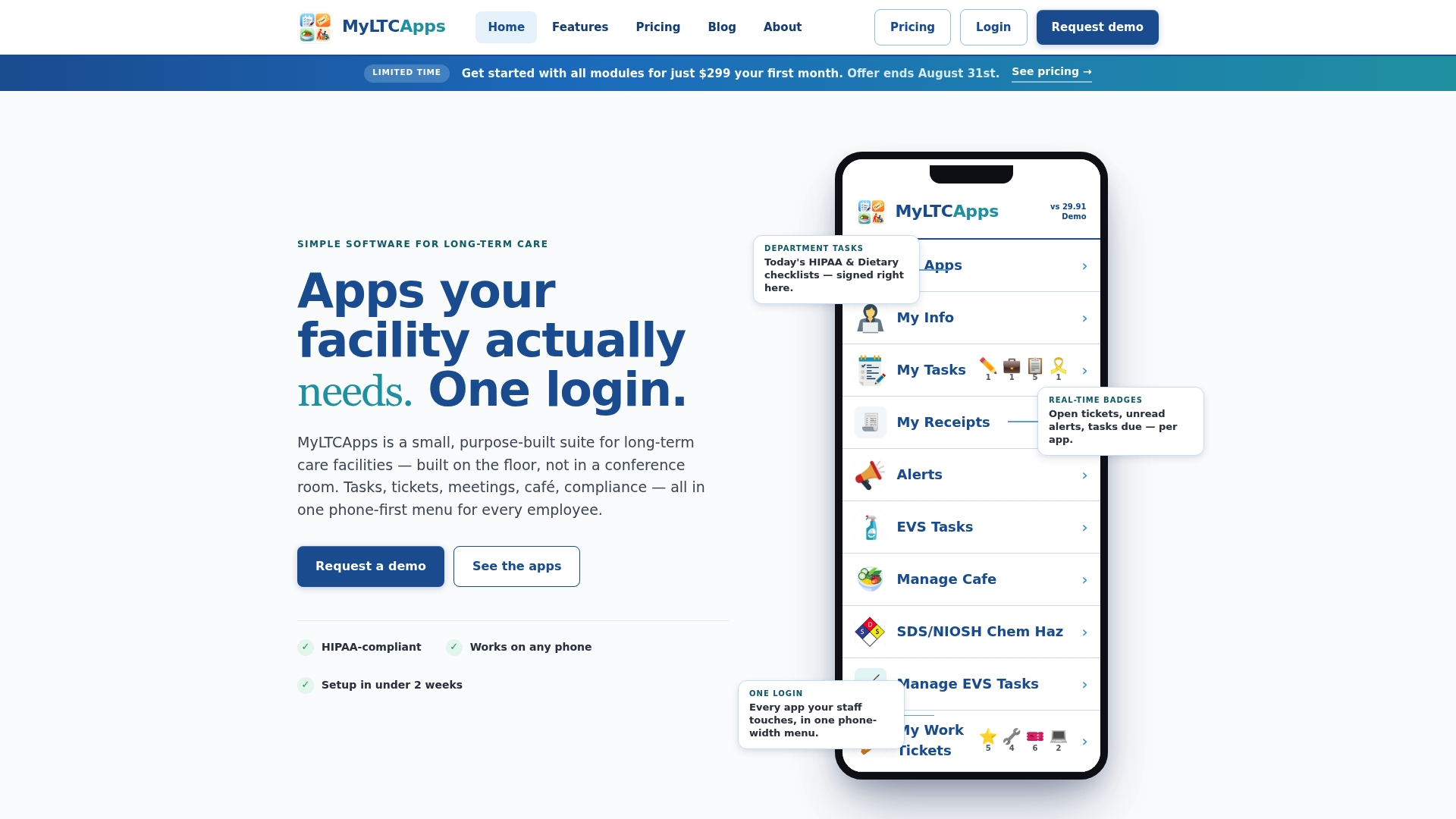
The platform’s compliance task and checklist module seeds mobile wound entries with the minimum dataset fields from this guide, required BWAT scoring, photo capture with metadata and secure storage, and procedure-note templates that lock until all mandatory fields are complete. Audit logs export as PDF survey packets or CSV files with role-based filters, so your DON can pull a complete wound record in minutes, not hours. QAPI dashboards surface documentation gaps before a surveyor does. For Kansas facilities seeking a KDADS-ready solution, the Kansas long-term care platform is configured for state survey expectations from day one. Request a demo to see the wound documentation workflow live.
Useful sources for survey preparation and clinical guidance
| Source | Why It Matters |
|---|---|
| CMS LCD L37228 — Wound Care | Defines coverage and documentation requirements for wound care; required for survey packets and medical review. |
| CMS Article A58565 — Billing and Coding: Wound and Ulcer Care | Specifies procedure-note elements required for debridement coding and medical necessity. |
| Bates-Jensen Wound Assessment Tool (SRAlab) | Primary reference for BWAT scoring methodology; cite during survey to validate your assessment tool choice. |
| SOM Appendix PP — F686 (CMS) | Governing F-tag guidance for pressure ulcer assessment and wound documentation standards in LTC. |
| Documentation Standards for Wounds in LTC (AMT Wound Care) | Practical LTC-specific documentation standards; useful for policy development and staff training. |
| AHRQ On-Time Pressure Ulcer Healing Self-Assessment | Self-assessment worksheet for multidisciplinary wound healing programs; supports QAPI documentation audits. |
| PDPM Documentation Essentials — MDS Section M (AAPACN) | Guides IDT documentation to support accurate MDS Section M coding under PDPM; essential for reimbursement. |
| Wound Care LTC 2024 (UNC SPICE) | Covers multidisciplinary program structure, infection-control workflows, and supply handling documentation. |