Resident Allergen Tracking in Long-Term Care: A Practical Guide

Resident Allergen Tracking in Long-Term Care: A Practical Guide
Resident allergen tracking works when every allergy is verified at admission, kept in one source of truth, and visible to the person holding the tray or the medication cup at the moment it matters. Most failures are not about missing knowledge. They happen when an allergy sits in the chart but never reaches the kitchen, the aide on the evening shift, or the agency nurse covering a hall. This guide covers what to record, how to keep it current, how federal rules frame the work, and how to audit it.
TL;DR
- Record the allergen, the type and severity of the reaction, and where the information came from. Separate true allergies from intolerances and sensitivities.
- Keep one controlled record as the single source of truth, and verify it at admission and whenever new information surfaces.
- Get the information to the people who serve food and give medications, and reconfirm it at each meal service and handoff.
- Audit regularly through your QAPI program: look for missing, outdated or conflicting entries and find the root cause.
- Phone-based checklists, alerts and dining tools can close the gap between the record and the care floor.
Table of Contents
- What to collect for every resident
- One source of truth, not five lists
- What federal nursing-home rules require
- Keeping allergy information from being missed on the floor
- When the record is uncertain or a reaction happens
- Auditing allergy records and workflows
- Where mobile tools help
- A 30-day rollout plan
- Perspective: why this belongs on the care floor
- Put it to work with MyLTCApps
- FAQ
- Sources
What to collect for every resident
An entry that says only “allergic to nuts” is not enough for a cook or a nurse aide to act on. The Winnipeg Regional Health Authority’s long-term care guidance on allergy documentation lists the essentials: the name of the allergen, the specific nature and severity of the reaction (mild, moderate or life-threatening), and the source of the information. That guidance is Canadian, but the fields are sound for any US facility.
A practical minimum for each resident:
- The substance. Use a specific name: peanut, shellfish, penicillin, latex. Avoid vague categories.
- The reaction. Hives, swelling, vomiting, breathing difficulty, anaphylaxis. Note severity.
- The type. Allergy, intolerance or sensitivity. The same WRHA guidance stresses telling medication allergies apart from medication sensitivities, because a side effect recorded as an allergy can needlessly remove a useful drug, while a true allergy recorded as a side effect can be dangerous.
- The source. Resident, family, prior facility, hospital discharge paperwork, pharmacy or physician. When two sources disagree, you need to know which is which.
- The date verified and who verified it. This is what lets you audit later.
- Food preferences and texture needs, kept separate. Surveyors look at diagnoses, food allergies or intolerances and food preferences together. CMS’s Nutrition Critical Element Pathway directs surveyors to review all three, so your tracking should keep them distinct but visible side by side.
Verify at admission, and confirm again whenever a medical history is taken. The WRHA guidance recommends confirming and updating the medication allergy record each time a history is obtained. In practice that means admission, readmission after a hospital stay, a new physician or pharmacy review, and any time a resident or family member mentions something new.
One source of truth, not five lists
The most common structural problem is duplication. The nurse’s chart says one thing, the dietary card says another, the whiteboard in the kitchen is three weeks old, and the care plan was written at admission. Each copy drifts.
The WRHA guidance describes documenting allergens in a central, accessible location, such as an electronic health record or a standardized, controlled and regularly updated medical record, and making that information available to the staff who serve food or administer medications. The Agency for Healthcare Research and Quality (AHRQ) uses the same idea for medicines: its medication reconciliation toolkit says the process should center on a single list of current medications as one source of truth.
Regulators in several states also expect the information to be current and findable:
- Minnesota requires assisted living facilities to keep current, legible resident records that include health information such as allergies, with procedures for using, storing and securing them, under Minn. Stat. 144G.43.
- Colorado’s resident records rule for persons with intellectual or developmental disabilities requires allergies in the admission record and a conspicuous notice on the record when a resident is allergic to any substance.
Your state’s rules will differ, so check your own licensing agency. The principle travels: one authoritative record, a visible flag, and a defined way for everyone else to see it.
That does not mean every department must open the clinical chart. Many facilities designate the clinical record as the master, then publish a controlled view of it to dietary and care floor staff. What matters is that the published view is generated from the master, not retyped by hand.
What federal nursing-home rules require
There is no single federal regulation titled “allergen tracking.” Allergies are covered through the broader assessment, care planning and pharmacy requirements in 42 CFR Part 483:
- Assessment. Under 42 CFR 483.20, nursing facilities must conduct a comprehensive, accurate, standardized and reproducible assessment of each resident’s needs, including health conditions, medications and nutritional status. An allergy is a health condition that belongs in that picture.
- Care planning. Under 42 CFR 483.21, the facility must develop a comprehensive person-centered care plan describing services to meet the resident’s medical and nursing needs identified in the assessment.
- Pharmacy services. The facility must manage pharmaceutical services so drugs are dispensed and administered accurately. A missed drug allergy is a direct threat to that.
The practical reading: an allergy that is known but not reflected in the assessment, care plan, dietary order and medication profile is a gap a surveyor can find. If you want a wider view of how to organize this kind of evidence, our guide to compliance tracking in healthcare walks through it.
Keeping allergy information from being missed on the floor
The record can be perfect and a resident can still be served the wrong thing. The failure points are predictable: meal service, medication pass and shift change.
At meals
A hospital food-service process published by a UK catering provider, Compass, offers a pattern worth borrowing. Dietary changes reach servers through a diet grid or a written alternative, allergy status is reconfirmed at every meal service, and if information is unclear, staff do not take orders or serve the meal until the restriction is confirmed. The important rule is the last one: uncertainty stops the tray. It is a UK document, so adapt the terminology, not the logic.

The UK’s South Eastern Health and Social Care Trust food allergen policy adds two more controls: analyze recipes for allergens, and update allergen information when ingredients or suppliers change. A resident’s record can be perfect and the risk still arrives through a substituted brand of gravy base. Tie your purchasing changes to a review of the affected menu items. If you plan menus centrally, our article on cafeteria menu planning for nursing homes covers how to build that review into the cycle.
At medication pass
The nurse should see the allergy flag before administering, not after. Confirm the allergy list at the point of administration for any new order, and treat a conflict between the order and the allergy list as a stop-and-call event. The pharmacy services requirement above is the regulatory anchor.
At handoffs
AHRQ’s long-term care training recommends SBAR (Situation, Background, Assessment, Recommendation) as the main method for shift-to-shift handoffs, and its background section includes allergies. AHRQ describes it as an easy-to-remember framework that helps ensure clear communication. Make “allergies” a spoken or written line item in every handoff, not something assumed to be in the chart.
Transitions need the same care. AHRQ’s patient safety network notes that communication breakdowns during hospital discharge can increase the risk of harm. A resident returning from the hospital is a re-verification event, not a continuation. AHRQ-funded work on rural care transitions also found that adding allergy and medication lists to health information exchange content helped clinicians manage transitions more effectively.
When the record is uncertain or a reaction happens
Write the procedure before you need it, and post it where staff can find it.
If the allergy record is unclear or conflicting:
- Do not serve the food or give the medication until the question is resolved.
- Notify the charge nurse, who contacts the physician, pharmacy, resident or family as needed.
- Record the clarified entry with its source and date, and update the dietary and care plan views.
- Tell the next shift.
If a resident has a reaction: follow your facility’s emergency protocol and your medical director’s orders. Signs of a severe reaction such as trouble breathing or swelling of the face or throat call for emergency response, and your clinical leadership should define who does what, including who calls 911 and who holds the resident’s information for responders. Afterward, document what happened and review it.
Texas Health and Human Services recommends keeping a system to notify facility leadership, staff and families about pharmaceutical-service issues, including adverse drug events. Build the same notification path for allergic reactions, so leadership sees every event, not just the serious ones.
Auditing allergy records and workflows
Tracking is only as good as your last check. The HHS Office of Inspector General’s nursing facility compliance guidance calls for regular reviews of documentation practices and internal medication administration processes, potentially through your QAPI program. That means auditing records, confirming that information is accurate and updated, and using root cause analysis to find out why missing or conflicting data occurred. The same guidance emphasizes that medication management is critical to minimizing adverse events from inappropriate drug interactions.
A simple monthly audit you can run:
| Check | How to run it | What a failure suggests |
|---|---|---|
| Every resident has an allergy entry, even if it reads “no known allergies” | Pull the census and compare to the allergy field | Admission verification skipped |
| Entries include reaction, severity and source | Sample 10 percent of records | Intake form or training gap |
| Dietary list matches the clinical record | Compare tray cards to the master for a unit | Manual re-entry or late updates |
| Recent changes reached the kitchen | Pick three updates from the past month and trace each | Communication path broken |
| Returning hospital residents were re-verified | Review readmissions | Transition checklist not used |
| Supplier or recipe changes were reviewed | Compare purchasing changes to menu review logs | No link between purchasing and dietary |
When you find a mismatch, ask why before fixing it. A wrong tray card is a symptom. The cause may be that updates are retyped on three screens, or that nights have no way to reach dietary. Log the root cause in QAPI and track whether the fix holds.
Where mobile tools help
Paper lists and whiteboards fail because they go stale and live in one place. Electronic tools can show allergens against each menu item and make that information available to anyone helping with meal orders, as the South Eastern Trust policy describes. Phones put that information in the hands of the people who need it, wherever they are.
For an operations team, the useful questions are:
- Can an aide check a resident’s dietary restrictions in a few taps, at the table?
- Does a change reach every shift without a phone call chain?
- Can you show a surveyor who verified what, and when?
- Can you send a facility-wide alert when something changes?
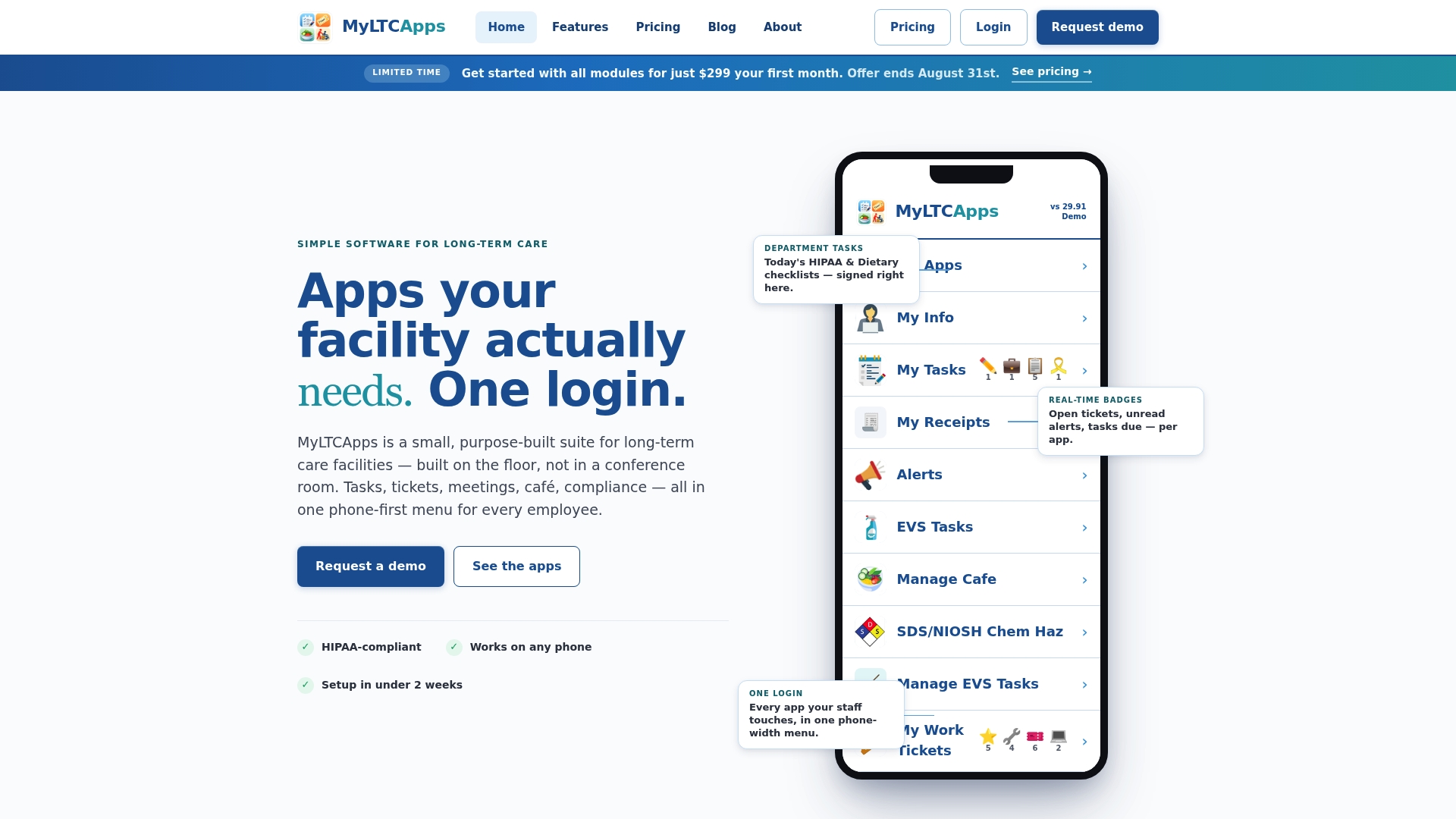
Our alert and communication system is built for that last question, and our cafeteria and dining management tools handle resident meal tracking and ordering. Mobile daily checklists and tasks let you assign a recurring allergy-list verification to a named role and keep a record that it was done. Keep your clinical record as the master for diagnoses and orders. We do not provide medical charting, and allergy tracking should connect to your charting system, not compete with it.
HIPAA applies to any tool that handles resident information, so check access controls and device policies before rollout. Our HIPAA compliance checklist for long-term care covers the basics.
A 30-day rollout plan
Week 1: Baseline. Pull the census and count residents with a missing, vague or unsourced allergy entry. This number is your starting point.
Week 2: Verify. Nursing and social services re-verify the gaps with residents, families and pharmacy. Separate allergies from intolerances and record severity and source.
Week 3: Connect. Decide which record is the master. Define how updates reach dietary, the med pass and every shift, and remove duplicate lists. Add allergies to the handoff format.

Week 4: Audit and train. Run the audit table above on one unit. Train dietary, nursing and agency staff on the stop-the-tray rule and on the escalation path. Schedule the audit monthly under QAPI.
Perspective: why this belongs on the care floor
We built MyLTCApps around a simple observation: the person who most needs a piece of information is usually standing, gloves on, with one hand free and about thirty seconds. Allergy data fails in that moment, not in the policy binder.
That is why we focus on phone-first tools, reachable in a few taps, rather than another desktop system staff must walk to. When checklists, alerts, dining and compliance sit in one menu, the verification step, the notification step and the audit trail stop being three separate chores.
Our view is that facilities do best when the clinical record stays the authority and the floor gets a fast, reliable way to act on it and to prove the work was done. Surveyor-ready reporting should be a by-product of daily work, not a scramble before a survey.
Philip
Put it to work with MyLTCApps
If you want allergy checks, facility alerts, dining and compliance tasks in one phone-first suite, see how we handle them. Plans are published at $199 per month for I Just Want That, $299 for the Starter Pack, $499 for the Growth Pack and $792 for the Premium Pack, with modules and headcounts that scale to your facility.
Compare options on our pricing page, or start at MyLTCApps to see the full suite.
FAQ
What should be in a resident’s allergy record?
Record the specific allergen, the reaction and its severity, whether it is an allergy, intolerance or sensitivity, the source of the information, and the date and person who verified it. Keep food preferences separate but visible alongside it, since surveyors review diagnoses, allergies or intolerances and preferences together.
How often should allergy information be verified?
Verify at admission and every time a medical history is taken or new information appears, including after a hospital stay. Add a recurring audit under your QAPI program so stale entries are found before a resident is harmed.
Does federal law require a specific allergen tracking system?
Not by name. The federal nursing-home rules in 42 CFR Part 483 require accurate, standardized assessments, person-centered care plans and accurate pharmacy services, and an allergy must be reflected across all of them. Your state may add its own record requirements, so check with your licensing agency.
Who is responsible for allergy information in a nursing home?
Nursing typically owns the clinical record, dietary owns the meal side, and the administrator and QAPI committee own the oversight. Define in writing who verifies, who updates the master record, and who tells the kitchen and each shift.
What should staff do when allergy information is unclear?
Stop and confirm before serving the food or giving the medication. Notify the charge nurse, resolve the question with the physician, pharmacy or family, update the record with the source, and pass it on at handoff.
Sources
- Allergy & Intolerance, Winnipeg Regional Health Authority
- Nutrition Critical Element Pathway, CMS
- AHRQ medication reconciliation appendix
- Minn. Stat. 144G.43
- 6 CCR 1011-1 Chapter 08, Resident Records
- 42 CFR Part 483
- 42 CFR 483.21
- Process for Patients with Food Allergies and Special Diets
- South Eastern Trust Food Allergen Policy
- AHRQ long-term care Session 2, SBAR
- Patient Safety During Hospital Discharge, PSNet
- Improving Rural Healthcare Transitions Through Health Information Exchange, AHRQ
- Texas HHS medication management best practices
- HHS-OIG Nursing Facility Compliance Program Guidance