Payroll Deduction Cafeteria: Section 125 Plans vs. Meal Deductions

Payroll Deduction Cafeteria: Section 125 Plans vs. Meal Deductions
A payroll deduction cafeteria can mean two different things, and mixing them up causes real compliance trouble. A Section 125 cafeteria plan is a written benefit plan that lets employees redirect pre-tax pay into qualified benefits such as health coverage. A cafeteria payroll deduction for meals is a separate arrangement: an employee buys food at the workplace dining room and the cost comes out of a later paycheck. This guide explains both, shows where they overlap, and covers how a long-term care facility can run the meal version without a paper-ticket reconciliation every pay period.
TL;DR
- A Section 125 plan lets employees choose between taxable cash and qualified benefits, and the contributions are generally exempt from federal income tax and FICA.
- Qualified benefits are a defined list (health, dependent care, adoption assistance, group-term life). Employee meals bought at a workplace cafeteria are not on that list.
- A meal payroll deduction is a different mechanism. It needs clear written employee authorization and clean records, so check your state’s wage deduction rules with your payroll provider or counsel.
- In a nursing home, the hard part is not the deduction itself. It is matching what each employee ordered to what payroll withholds, across shifts and departments.
- A phone-based ordering and deduction workflow removes meal tickets and manual tallies.
Table of Contents
- Two meanings of “payroll deduction cafeteria”
- How a Section 125 cafeteria plan works
- Tax treatment: what changes on the paycheck
- Rules and limits employers should know
- Paying for staff meals through payroll
- A simple setup plan for a facility
- Perspective: where we see facilities lose time
- How MyLTCApps handles cafeteria payroll deduction
- FAQ
- Sources
Two meanings of “payroll deduction cafeteria”
People search this phrase for two reasons, and the answers diverge quickly.
Meaning one: the cafeteria plan. The name comes from the idea of choosing from a menu. The Bureau of Labor Statistics compares flexible benefits to picking options in a lunchroom, where employees select healthcare, dependent care and other coverage. Nothing about it involves food. It is a tax-code term.
Meaning two: meals paid through payroll. Here the cafeteria is a real dining room, and “payroll deduction” is the payment method. A nurse aide takes a lunch tray, the cost is recorded, and the amount is withheld from the next paycheck. It is a convenience for staff who do not carry cash and a bookkeeping task for the facility.
The two share a word and a payroll system, but they follow different rules. The first is governed by Section 125 of the Internal Revenue Code. The second is an ordinary deduction agreement between employer and employee, and the legal requirements for it depend largely on your state. We cover each below so you can tell which one a vendor, auditor or employee is talking about.

How a Section 125 cafeteria plan works
The IRS describes a cafeteria plan as a formal written plan under which employees can choose between taxable cash and at least one qualified, nontaxable benefit. The plan document has to describe the benefits and set the eligibility and election rules. A handshake arrangement or a payroll code with no document behind it does not count.
In practice the cycle looks like this:
- Plan document. The employer adopts a written plan that lists the benefits and the rules for choosing them.
- Election. Employees choose benefits, usually at enrollment, and agree to a salary reduction to pay for them.
- Deduction. Once the plan year starts, the elected amounts come out of each paycheck before taxes, through the salary-reduction agreement.
- Administration. The employer keeps the plan compliant and the payroll records accurate.
The IRS notes that employer contributions are usually made under salary-reduction agreements, which is why the deduction line on a pay stub is where most employees first meet the plan.
Which benefits can go through a Section 125 plan
The list is narrower than many employers assume. IRS Publication 15-B says cafeteria plans may cover accident and health benefits (excluding Archer MSAs and long-term care insurance), adoption assistance, dependent care assistance and group-term life insurance.
Three practical points follow from that:
- Long-term care insurance is excluded, which surprises some administrators in the long-term care industry. The name of your facility type has no bearing on it.
- Commuter benefits are tax-advantaged but governed by a different section of the tax code and administered separately.
- Meals purchased at a workplace dining room do not appear on the qualified list in Publication 15-B, so they should not be treated as a Section 125 benefit.
That last point matters. One payroll practitioner guide warns that including even one non-qualified benefit can put the tax status of the whole arrangement at risk. Keep the meal deduction outside the cafeteria plan.
Employers who add wellness support alongside health and dependent-care elections sometimes pair the plan with an employee assistance program. Faith-based EAP programs are one example of how employers think about the counseling side of a benefits package, though an EAP is a separate offering from the cafeteria plan itself.
Tax treatment: what changes on the paycheck
The tax effect is the reason Section 125 exists. According to the IRS, salary-reduction contributions are made on a pre-tax basis, are not wages for federal income tax purposes, and generally are not subject to FICA and FUTA. For a facility with a large hourly workforce, that reduces both the employee’s taxable pay and the employer’s payroll taxes. Investopedia likewise says Section 125 plans lower the tax burden on both sides.
There is a trap on the pay stub. The Social Security Administration explains that a formal salary reduction under a Section 125 plan is treated differently from a voluntary payroll deduction for extra coverage, which is generally treated as the employee’s wages and is subject to FICA. It also warns that pay slips may not make the distinction clear. So label deductions correctly in payroll. A meal deduction is an after-tax deduction. It reduces take-home pay, not taxable wages.
| Feature | Section 125 deduction | Cafeteria meal deduction |
|---|---|---|
| What it pays for | Qualified benefits such as health coverage or dependent care | Food bought at the workplace dining room |
| Governing framework | Section 125 of the Internal Revenue Code | Employer-employee deduction agreement, plus state wage rules |
| Tax effect | Pre-tax, generally exempt from federal income tax and FICA | After-tax, does not reduce taxable wages |
| Paperwork | Written plan document and elections | Signed deduction authorization and order records |
| Typical owner | HR or benefits administrator | Dining services, payroll and administrator |
Rules and limits employers should know
Section 125 comes with guardrails. A few that apply to most employers:
- Nondiscrimination. Plans that favor highly compensated or key employees can require taxable benefits to be included in their wages.
- Simple cafeteria plans. Eligible employers that averaged 100 or fewer employees during either of the two preceding years may establish a simple cafeteria plan if they meet its requirements, per the same IRS publication.
- Owners. A more-than-2% S corporation shareholder is generally not treated as an employee for these purposes and is treated like a partner.
- No deferral. The IRS says a qualified benefit does not defer compensation.
The SSA also puts responsibility squarely on the employer: you must make sure the plan continues to meet Section 125 requirements, because the pay stub alone can mislead. If you offer a Section 125 plan, have your benefits administrator or tax adviser review it each year.
Paying for staff meals through payroll
Now the second meaning. Many skilled nursing facilities run an on-site cafeteria or dining room that serves staff as well as residents. Selling meals to employees at a subsidized price is a common perk. Collecting payment is where the friction starts: cash handling, punch cards, handwritten tickets, and a monthly scramble to tell payroll who owes what.
A payroll deduction removes the cash and the cards. The employee orders, the system records the amount, and payroll withholds it on a set schedule. Done well, it does three things:
- Raises meal participation. Staff on short breaks use the dining room when payment takes no extra step.
- Protects the dining budget. Fewer unpaid tickets and fewer “I’ll pay you Friday” balances.
- Gives payroll a clean number. One export per pay period instead of reconciling stacks of paper.
What a sound meal deduction needs
We cannot give legal advice, and wage deduction laws differ by state, so confirm the specifics with your payroll provider or employment counsel. As a baseline, a defensible program usually includes:
- Written, signed authorization from each employee that states what is deducted and for what. Our walkthrough of what a payroll deduction authorization should contain includes a sample form.
- An order record that ties each deduction to a specific purchase, date and amount.
- A clear opt-out path so an employee can stop participating.
- A correct label in payroll so the deduction is not confused with a Section 125 salary reduction.
- Consistency across shifts. Night and weekend staff should have the same access and the same rules as day staff.
Of these, the order record is the one facilities most often get wrong, because the dining room and the payroll office use different tools. We describe that gap in detail in our piece on ending the meal-ticket reconcile.
Why long-term care is a special case
A nursing home runs around the clock, with staff on three shifts, float pool workers, and departments from dietary to housekeeping. A cafeteria that closes at 2 p.m. serves very few of them. The deduction process has to work from a phone in a hallway, not at a front-office terminal. And the administrator who signs off on payroll deductions is accountable for each line, so the data needs to be right the first time.
If you also run resident dining, menu planning interacts with staff orders, since both draw on the same kitchen. Our guide to cafeteria menu planning for nursing homes covers that side.
A simple setup plan for a facility
Whether you are launching a meal deduction program or cleaning one up, this order works:
- Decide what the program covers. Staff meals only, or also guest meals and special events? Write the scope down.
- Separate it from benefits. Confirm with your payroll lead that meal deductions and Section 125 elections have different deduction codes.
- Collect authorizations. Get every participating employee’s signed consent before the first deduction.
- Pick a cutoff. Choose the day each pay period when orders close and the export goes to payroll.
- Run a pilot pay period. Compare the order totals to the payroll totals before opening it to everyone.
- Review monthly. Look at disputes, opt-outs and variances, and fix the cause rather than adjusting by hand.
Perspective: where we see facilities lose time
We built MyLTCApps for the care floor, so we look at the cafeteria deduction from the hallway rather than the benefits office. Our view: the tax question and the operations question get tangled, and the operations side is where facilities actually lose hours.
The tax question is settled by a short list. If it is a qualified benefit under a written plan, it is Section 125. If it is a sandwich, it is not. Administrators who keep that line clear avoid most confusion. The operations question is harder. Every paper ticket is a small piece of data that someone must type into something else. Multiply by hundreds of staff and a few thousand meals a month, and the reconciliation becomes a part-time job.

Staff also do not want another login or a kiosk visit during a 20-minute break. That is why we designed the ordering flow for one thumb and a few taps on a personal phone, with the totals feeding a payroll-ready export. Our aim is simple: the person who orders lunch should not need training, and the person who runs payroll should not need a calculator.
We would also say plainly that software does not replace legal review. Have your counsel or payroll provider confirm your authorization wording and your state’s rules before you launch.
— Philip
How MyLTCApps handles cafeteria payroll deduction
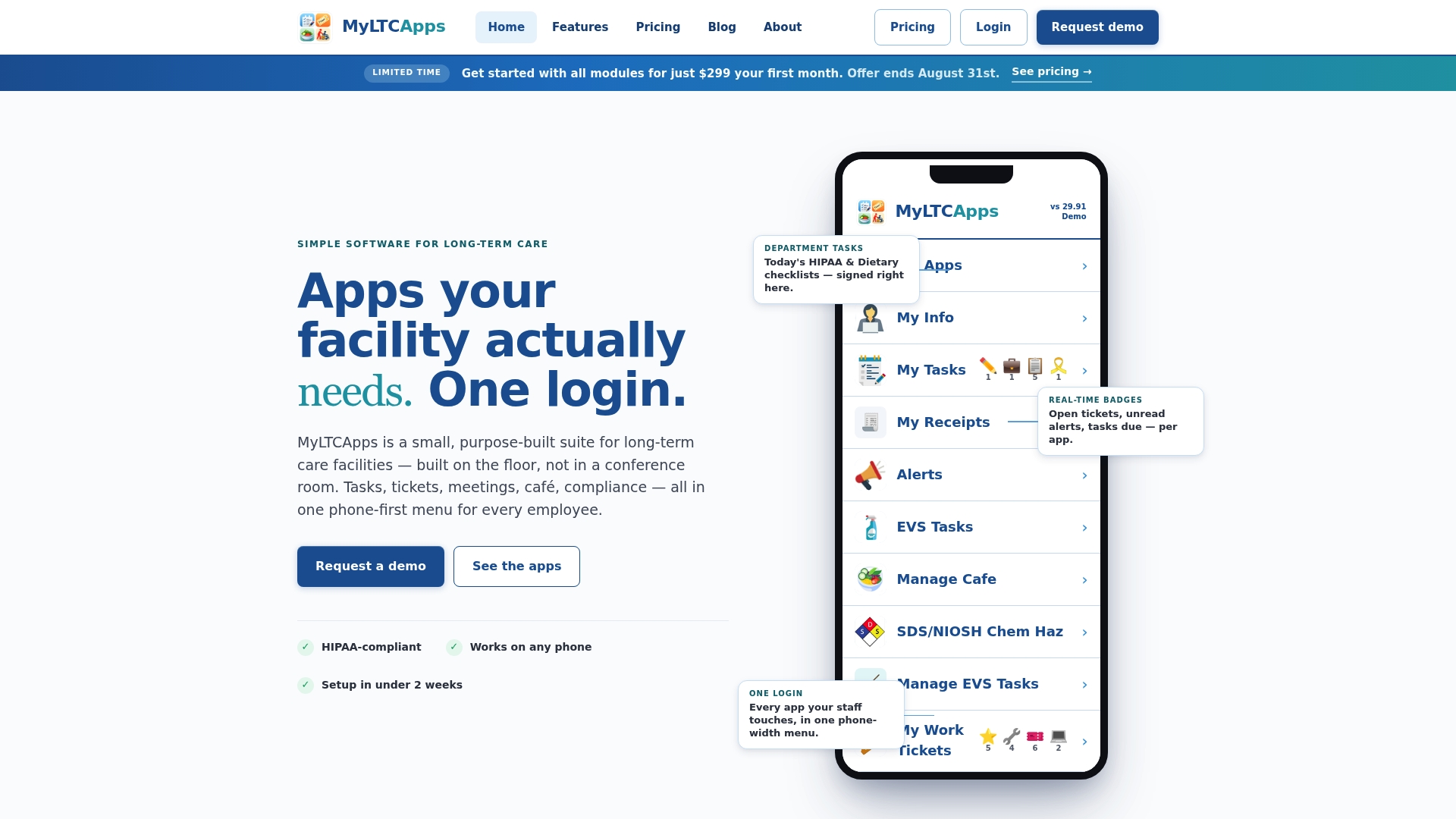
My Café is our phone-first dining module for long-term care. Staff order from their own devices, orders are tracked against each employee, and payroll deduction totals are ready when you close the period. It sits alongside the rest of the suite, including tasks, work tickets, shift scheduling and compliance libraries, so you can add modules as your needs grow.
Plans are priced per facility: I Just Want That at $199 per month, Starter Pack at $299 per month, Growth Pack at $499 per month and Premium Pack at $792 per month. My Café itself has no separate published price, so see the pricing page for which plan includes it. You can read more on our cafeteria and dining management page or see all features.
FAQ
Is a payroll deduction for cafeteria meals the same as a Section 125 cafeteria plan?
No. A Section 125 plan is a written plan for qualified benefits such as health coverage, and contributions are generally exempt from federal income tax and FICA. A meal deduction pays for food and is an after-tax deduction. The qualified benefit list in Publication 15-B does not include workplace meals.
Are cafeteria meal deductions taken before or after taxes?
After taxes. Only formal salary reductions under a Section 125 plan are pre-tax. Voluntary deductions are generally treated as the employee’s wages, and the SSA notes that the pay stub may not show the difference. Label each deduction correctly in payroll.
What do I need before deducting meal costs from paychecks?
Start with a signed employee authorization and a record of each order. State wage deduction laws vary, so confirm wording and limits with your payroll provider or employment attorney. Our sample authorization guide lists the essentials.
Can long-term care insurance be paid through a cafeteria plan?
No. Publication 15-B excludes long-term care insurance from the accident and health benefits that cafeteria plans may cover. The name of your facility type does not change that rule.
Do small facilities need a cafeteria plan?
No, a Section 125 plan is optional. Employers averaging 100 or fewer employees in either of the two prior years may qualify for a simple cafeteria plan under the IRS rules. Ask your benefits adviser whether it fits your situation.
Sources
- FAQs for government entities regarding cafeteria plans (IRS)
- 2026 Publication 15-B (IRS)
- Flexible benefits in the workplace (U.S. Bureau of Labor Statistics)
- SSA POMS SI 00820.102, Cafeteria Benefit Plans
- Payroll Deduction Plan: Definition, How It Works (Investopedia)
- Section 125 Deductions: Small Business Cafeteria Plan Guide (FirstHR)