Nursing Home Scheduling in Kansas: 2026 Guide
Nursing Home Scheduling in Kansas: 2026 Guide
Effective nursing home scheduling in Kansas City comes down to one thing: putting the right credentialed staff on the right shift, every time, without burning out your team or triggering a survey deficiency. The facilities that do this well share a few common traits. They use digital tools that enforce compliance automatically, integrate with payroll, and give staff mobile access to their own schedules. The ones still running on spreadsheets are fighting a losing battle against version drift, overtime creep, and last-minute call-offs.
Key challenges Kansas administrators face right now:
- Credential enforcement: Kansas regulations require specific licensure for certain roles. Manual scheduling can’t reliably catch a gap before a surveyor does.
- Last-minute changes: Call-offs at 5:00 AM are inevitable. A system without real-time mobile alerts turns a manageable problem into a staffing crisis.
- Overtime control: Without automated workload distribution, overtime accumulates quietly until it shows up as a budget shock at month’s end.
- Payroll reconciliation: Disconnected time-tracking and scheduling systems force manual re-entry every pay period, which multiplies errors.
- Staff retention: Schedulers who ignore shift preferences burn through staff faster than facilities that accommodate them.
Leading Kansas facilities like Garden Terrace at Overland Park, Azria Health Woodhaven, and Wheatland Nursing Center have built reputations partly on consistent, well-organized care delivery. That consistency starts with how shifts are built and managed.
How do top Kansas nursing homes compare on scheduling and care?
Kansas has a wide range of skilled nursing providers, from urban rehab centers near Kansas City to rural community facilities serving smaller populations. Each approaches staffing and care delivery differently.
| Facility | Location | Services Offered | Specializations | Certifications & Quality | Rating |
|---|---|---|---|---|---|
| Garden Terrace at Overland Park | Overland Park, KS | Skilled nursing, inpatient/outpatient rehab | Alzheimer’s, dementia care | Alzheimer’s Association partner, National Parkinson’s Foundation partner, teaching facility | 4.5★ (84 reviews) |
| Life Care Center of Burlington | Burlington, KS | Skilled nursing, inpatient/outpatient rehab, dementia care unit | Dementia care | 24-hour skilled nursing | 4.5★ (84 reviews) |
| Providence Place Rehabilitation Center | Kansas City, KS | Long-term care, short-term rehab, on-site therapy | Personalized rehabilitation | Medicare.gov 4-star overall rating | 4★ (67 reviews) |
| Wellsprings of Westmoreland | Westmoreland, KS | Skilled nursing, assisted living, therapy, memory care, respite care | Community-owned, not-for-profit | Not-for-profit model | 4.7★ (29 reviews) |
| Wheatland Nursing Center Rehabilitation & Skilled Nursing | Russell, KS | Skilled nursing, rehabilitation | Strength and mobility restoration | Five-star quality rating | 4.9★ (27 reviews) |
| Azria Health Woodhaven | Great Bend, KS | Post-acute rehab, long-term care, rehab therapy, specialized care, independent living | Individualized care programs | Five-star quality rating | 4★ (33 reviews) |
| Diversicare of Council Grove Healthcare & Rehabilitation Center | Council Grove, KS | Complex medical, memory, long-term, hospice care | Hospice and complex care | Multi-service center | 4.1★ (11 reviews) |
| Willow Point Rehabilitation & Nursing Center | Kansas | Skilled nursing, rehab, long-term, respite, palliative, hospice care | Respite and hospice care | Professional healthcare services | 5★ (5 reviews) |
| Lincoln Park Manor, Inc | Kansas | Quality senior services | Emotional support and community care | Compassionate community environment | 5★ (4 reviews) |

Garden Terrace at Overland Park stands out for memory care depth. Its partnerships with the Alzheimer’s Association and National Parkinson’s Foundation, combined with its role as a teaching facility for nursing schools, mean its staff scheduling must account for both clinical credentialing and student supervision. That’s a more complex scheduling matrix than most facilities manage.
Providence Place Rehabilitation Center in Kansas City holds a Medicare.gov 4-star overall rating, which reflects consistent staffing adequacy alongside its therapy-focused care model. For administrators benchmarking against local competitors, Providence Place sets a useful standard for what compliant, well-documented staffing looks like in an urban Kansas setting.
Wheatland Nursing Center in Russell operates as a family-led community with a five-star quality rating, built around restoring resident strength and mobility. Its smaller scale makes scheduling more personal, but the credential and compliance requirements are identical to larger urban facilities.
Wellsprings of Westmoreland is a community-owned, not-for-profit facility offering skilled nursing, assisted living, therapy, memory care, and respite care in a rural setting. Its not-for-profit model shapes how it allocates staffing resources, prioritizing care continuity over margin.
Diversicare of Council Grove, Willow Point, and Lincoln Park Manor each serve distinct populations. Diversicare handles complex medical and hospice cases, which demands precise shift coverage. Willow Point covers the full continuum from skilled nursing through palliative care. Lincoln Park Manor focuses on emotional well-being and community-based senior services.
How do you choose and implement nursing home scheduling software?
The right scheduling software does more than fill open shifts. It actively prevents compliance violations, controls overtime, and reduces the administrative load that burns out your best schedulers.
Core features to require from any system:
- Credential-based shift restrictions: The system should automatically block unqualified staff from being assigned to roles requiring specific licensure. Automated compliance rules prevent regulatory penalties that manual checks routinely miss.
- Payroll and timekeeping integration: Integrated scheduling and payroll eliminates manual re-entry each pay period, cutting both errors and the hours your business office spends reconciling them.
- Mobile access for staff: When staff can view schedules, request swaps, and receive alerts on their phones, call-offs drop and accountability rises. The phone-tree scramble at 5:00 AM largely disappears.
- Cloud-based workload distribution: Cloud scheduling tools minimize overtime by distributing shifts based on actual demand, not habit or guesswork.
- Emergency and last-minute change handling: Look for systems with real-time notifications and an on-call pool feature so coverage gaps get filled in minutes, not hours.
Implementation without the chaos:
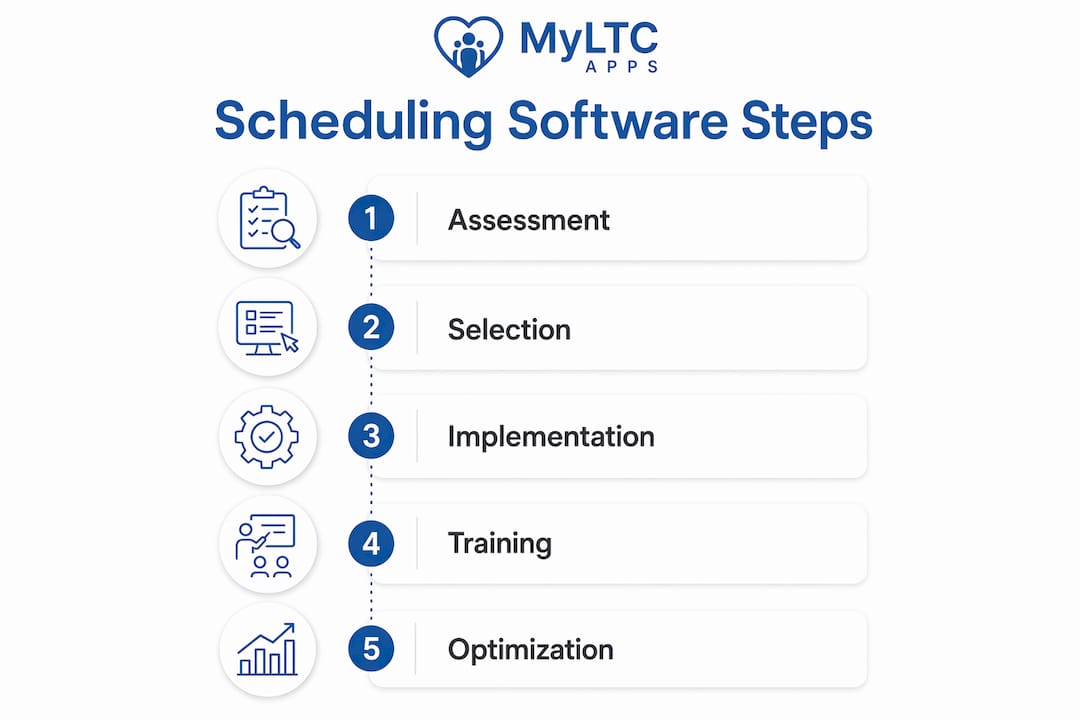
Training is where most rollouts fail. Staff who don’t trust the new system revert to texting the charge nurse directly, which defeats the purpose. Run a parallel period of two to four weeks where both the old and new systems run simultaneously. That gives staff time to build confidence without risking a coverage gap. Designate a floor-level champion in each unit, someone who isn’t management but is respected by peers, to answer questions and model the new behavior.

Pro Tip: Spreadsheet-based scheduling creates what operations teams call “spreadsheet rot”: multiple versions circulate across units, and no one is certain which one is current. A publish-first digital system ensures every department sees a single, synchronized roster in real time. Switching to one is the single fastest way to eliminate the version-drift problem.
Optimization models for nursing home scheduling have demonstrated that automated hierarchical scheduling can achieve over 94% success in assigning staff their preferred shifts, compared to manual processes that take tens of hours per cycle. That’s not a marginal improvement. It’s the difference between a scheduler spending a day building a roster and spending an hour reviewing one.
A shortlist of Kansas nursing homes worth knowing
For administrators evaluating local benchmarks or considering care partnerships, these Kansas facilities represent a cross-section of the state’s skilled nursing landscape.
Garden Terrace at Overland Park (7541 Switzer Rd, Overland Park) is the metro Kansas City option for memory care, with formal partnerships that shape both its clinical protocols and its staff training requirements.
Life Care Center of Burlington (601 Cross St, Burlington) serves a smaller population with 24-hour skilled nursing and a dedicated dementia care unit. Its inpatient and outpatient rehabilitation programs give it more scheduling complexity than its size suggests.
Azria Health Woodhaven (1560 KS-96, Great Bend) combines post-acute rehabilitation with long-term care and independent living, all under a five-star quality rating. Its individualized care plans require scheduling systems that can track care-specific assignments, not just shift coverage.
Wellsprings of Westmoreland (105 N, KS-99, Westmoreland) is the model for rural, community-owned care in Kansas. Its not-for-profit structure means staffing decisions are driven by care need rather than occupancy targets.
Diversicare of Council Grove handles the most medically complex cases on this list, including hospice care, which requires precise handoff documentation and shift overlap protocols that generic scheduling tools often can’t support.
What does nursing home scheduling software actually cost?
Budgeting for scheduling software in a long-term care setting involves more variables than most vendors advertise upfront. Most SaaS platforms price per facility, per module, or by employee headcount, and the total cost of ownership includes implementation, training, and ongoing support, not just the monthly subscription.
The real cost comparison isn’t software versus no software. It’s software versus the hidden costs of manual scheduling: overtime from poor shift distribution, payroll errors from manual re-entry, survey deficiencies from credential gaps, and the staff turnover that follows when schedulers consistently ignore shift preferences. Those costs are real and recurring.
For Kansas facilities operating under KDADS oversight, compliance-ready software that exports surveyor-ready reports can reduce the administrative burden of survey preparation. That time savings has direct dollar value. Rural facilities with limited IT staff benefit most from cloud-based systems that require no on-site infrastructure and offer vendor-managed updates.
When evaluating bids, ask vendors specifically about: integration fees for connecting to your existing payroll system, per-module pricing versus all-in-one pricing, and whether training is included or billed separately. A lower monthly rate with high implementation and training costs often ends up more expensive than a higher-rate platform that includes full onboarding support.
Myltcapps brings Kansas-ready scheduling to long-term care
Kansas administrators who want scheduling, compliance, and daily operations in one place have a purpose-built option in Myltcapps. Unlike general workforce management platforms adapted for healthcare, Myltcapps was designed specifically for long-term care facilities, with modules that match the actual workflow of care staff rather than forcing care staff to adapt to a generic HR tool.
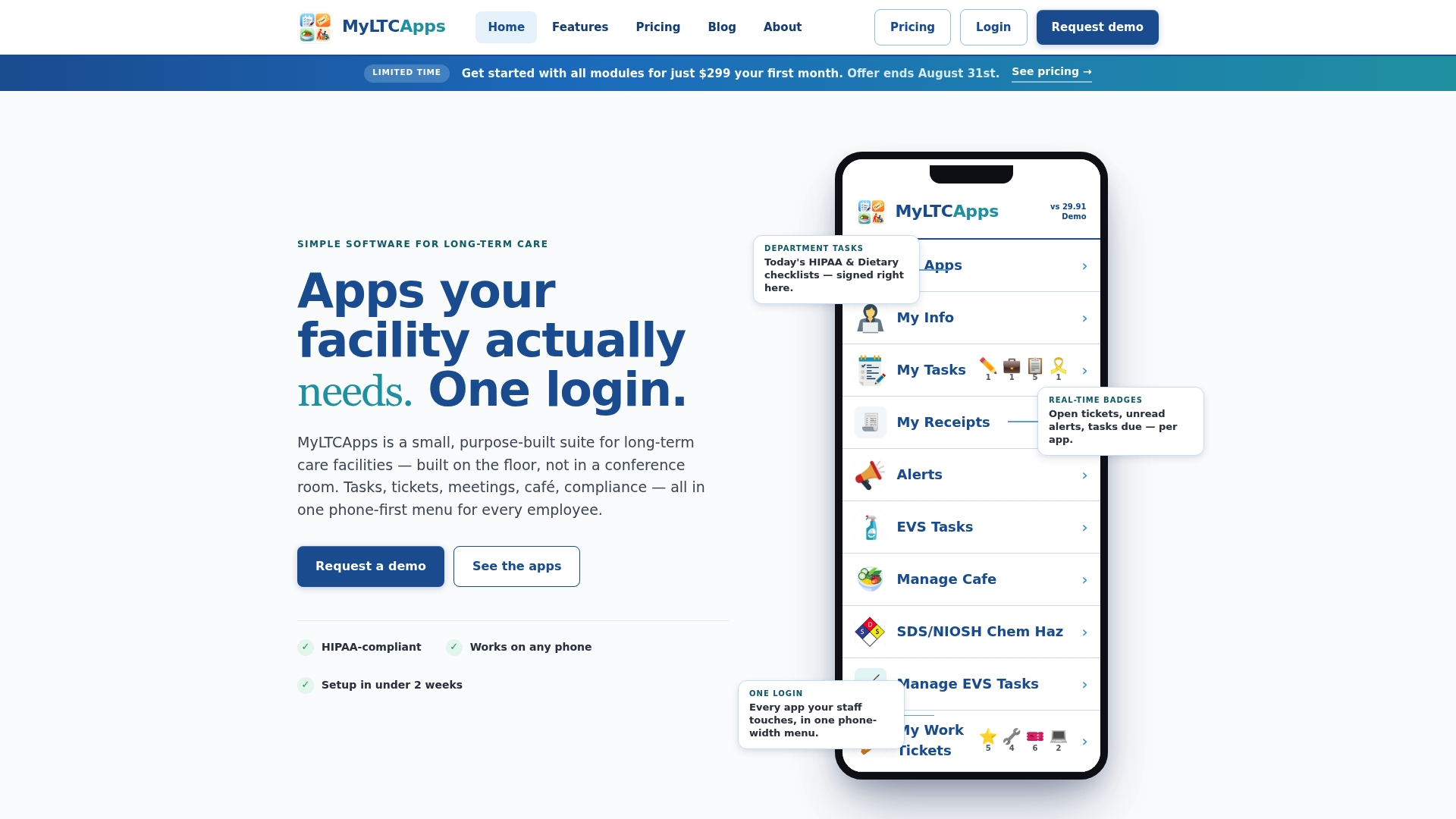
The platform covers shift scheduling, compliance task tracking, mobile checklists, incident reporting, and payroll deduct dining management, all accessible from a phone. Staff self-manage their schedules with a few taps, which reduces the charge nurse’s administrative load and the call-off rate simultaneously. For Kansas facilities navigating KDADS requirements, Myltcapps offers KDADS-ready compliance modules with seeded libraries covering HIPAA, QAPI, dietary standards, and emergency preparedness. Surveyor-ready report exports mean your documentation is always current, not assembled the night before a survey visit. Rural facilities with no dedicated IT staff will find the cloud-first architecture particularly practical.
Key Takeaways
Effective nursing home scheduling in Kansas requires credential-enforced digital systems, mobile staff access, and payroll integration working together to prevent compliance gaps and control overtime.
| Point | Details |
|---|---|
| Credential enforcement is non-negotiable | Automated rules block unqualified staff from restricted roles, preventing survey deficiencies before they happen. |
| Payroll integration cuts reconciliation errors | Connecting scheduling directly to timekeeping eliminates manual re-entry and the payroll errors that follow. |
| Mobile access reduces call-offs | Staff who can view and swap shifts from their phones are more accountable and less likely to call off without coverage arranged. |
| Automated scheduling achieves very high levels of preferred-shift assignment | Hierarchical optimization tools assign staff preferred shifts at a rate manual scheduling cannot match, improving retention. |
| Myltcapps for Kansas compliance | Myltcapps offers KDADS-ready modules, shift scheduling, and mobile-first access built specifically for long-term care facilities. |
Recommended
- Long-Term Care Software for Kansas Facilities (KDADS-Ready) | MyLTC Apps
- Room & Vehicle Reservation System for Long-Term Care | MyLTC Apps
- A HIPAA Compliance Checklist for Long-Term Care Facilities | MyLTC Apps
- The Scheduling Revolution: How New Digital Tools Are Transforming Facility Staffing | MyLTC Apps