New Hire Onboarding Checklist for Nursing Homes

New Hire Onboarding Checklist for Nursing Homes
Before a new hire touches a resident, nine gates must clear: identity and employment eligibility, exclusion screening, license or certification verification, baseline TB screening, required immunizations or documented declinations, OSHA bloodborne pathogen hepatitis B offer, role-specific competency validation, mandatory training completion, and a documented floor-ready sign-off. Miss any one of them and you are not just operationally exposed — you are survey-exposed.
This new hire onboarding checklist for nursing homes is built for HR professionals and administrators in skilled nursing and long-term care settings. It maps every required step to a timeline, assigns an owner, and flags which items are absolute blockers before independent resident care and which can trail behind on a supervised start. ASPR TRACIE’s health care facility onboarding checklist is a solid federal reference to keep alongside this one.
Quick-reference blocker vs. non-blocker:
Print this table, tape it to the onboarding folder, and use it as the first page of every new hire’s personnel file.
Key Takeaways
A compliant nursing home onboarding process requires clearing nine documented gates before independent resident care, assigning a named owner to each, and storing every record in a format retrievable within minutes at survey.
| Point | Details |
|---|---|
| Nine gates before independent care | I-9, exclusion screens, license check, TB screening, immunizations, hepatitis B offer, BBP training, competency sign-off, and floor-ready approval are all required before solo resident care. |
| Exclusion screening is non-negotiable | Check OIG LEIE, SAM.gov, and your state Medicaid exclusion list before Day 1; document the date, database, and result for every hire. |
| TB and immunizations require documentation | CDC requires a baseline risk assessment, symptom screen, and TB blood or skin test at hire; OSHA requires the hepatitis B offer and a signed declination if refused. |
| Training must match the facility assessment | Under 42 CFR §483.95, training topics must be tied to the facility assessment — generic in-services are a common citation target at survey. |
| Myltcapps centralizes the audit trail | Myltcapps’s mobile checklists, competency sign-offs, and exportable compliance reports make every onboarding gate retrievable in real time for surveyors. |
Table of Contents
- What is the difference between onboarding and orientation in a nursing home?
- What pre-hire paperwork is required before a new hire’s first shift?
- How do you complete exclusion and background screening for nursing home hires?
- What health screenings and immunizations are required at hire?
- How do you verify licensure and validate clinical competency?
- What mandatory training must new nursing home employees complete?
- What does a floor-ready approval look like, and who signs off?
- How should you store onboarding records to be survey-ready?
- Sample onboarding checklist grouped by milestone
- How does digital tracking cut time-to-floor-ready and reduce survey risk?
- What actually makes nursing home onboarding work in practice
- Myltcapps turns this checklist into a live, auditable system
- Sources
What is the difference between onboarding and orientation in a nursing home?
Onboarding and orientation are not the same thing, and conflating them is one of the most common reasons nursing homes end up with documentation gaps at survey time.
Onboarding is the full administrative and compliance sequence: employment paperwork, eligibility verification, exclusion screening, health clearance, license verification, and competency validation. It starts before the hire’s first day and runs through the 90-day mark. Orientation is a subset of onboarding — the structured introduction to facility culture, policies, resident population, and initial training that typically happens in the first one to three days.
Timeline and responsibility matrix
| Phase | Timeframe | Key Tasks | Owner |
|---|---|---|---|
| Pre-hire | Before Day 1 | I-9, offer letter, exclusion screens, license check, TB/immunization docs collected | HR |
| Day 1 | First shift | W-4, handbook acknowledgment, facility tour, emergency procedures, HIPAA overview | HR / Manager |
| Week 1 | Days 2–7 | BBP training, abuse reporting, infection control, competency skills check, preceptor assignment | DON / Educator |
| 30 days | By Day 30 | All mandatory in-services complete, competency sign-off finalized, floor-ready approval | DON / Preceptor |
| 60/90 days | Days 31–90 | Role-specific advanced training, performance check-in, annual training calendar set | Manager / Educator |
CMS’s nursing home survey guidance makes clear that surveyors evaluate whether staff competence is tied to resident outcomes — not just whether a checklist was signed. That means the timeline above is not a suggestion; it is the audit trail surveyors will reconstruct if they pull personnel files.
Who owns what matters as much as what gets done. HR owns the administrative gates. The Director of Nursing or designee owns clinical competency. Occupational health owns health clearance. The unit preceptor owns supervised skills validation. When those lanes blur, items fall through.
What pre-hire paperwork is required before a new hire’s first shift?
Get these documents completed and filed before the hire steps on the floor. Some have federal timing rules; others are good practice that protects the facility.
- Form I-9: Must be completed by the end of the employee’s third business day of employment. Section 1 is completed by the employee on or before Day 1; Section 2 by the employer within three business days. Acceptable List A or List B + C documents must be physically examined (or via authorized remote verification for E-Verify participants). Store in a separate I-9 binder, not the personnel file.
- Form W-4 and applicable state income tax withholding form: Complete on or before Day 1 for payroll setup.
- Signed offer letter and job description: Signed copy in the personnel file before the first shift. The job description is also the document occupational health uses to assess infection risk for the preplacement medical evaluation.
- Employee handbook acknowledgment: Signed receipt of the current handbook, including abuse reporting policy, resident rights, and code of conduct.
- Direct deposit authorization and payroll setup forms: Complete by Day 1 or Day 2 at the latest to avoid a paper check on the first pay date.
- Emergency contact form: Collected on Day 1.
- HIPAA acknowledgment: Signed before the employee accesses any resident records or the EHR.
Document timing and storage
| Document | Deadline | Storage Location |
|---|---|---|
| Form I-9 | Day 3 (employer section) | Separate I-9 binder |
| W-4 / state tax form | Day 1 | Payroll file |
| Signed offer letter | Before Day 1 | Personnel file |
| Handbook acknowledgment | Day 1 | Personnel file |
| HIPAA acknowledgment | Before EHR access | Personnel file / compliance log |
| Emergency contact | Day 1 | Personnel file |
| Direct deposit form | Day 1–2 | Payroll file |
One practical note: the job description in the offer package should be detailed enough for occupational health to assess infection-exposure risk. Vague job titles without task descriptions create problems at the preplacement medical evaluation step.
How do you complete exclusion and background screening for nursing home hires?
Employing an excluded individual in a federally reimbursed care setting can trigger overpayment liability and civil monetary penalties. The OIG’s List of Excluded Individuals/Entities (LEIE) is the primary federal resource, and checking it is non-optional for any facility billing Medicare or Medicaid.
Step-by-step exclusion screening
- Check the OIG LEIE at oig.hhs.gov/exclusions before the hire’s first day. Search by full legal name and Social Security Number. Download and save the search result (PDF or screenshot with date/time stamp) to the personnel file.
- Check SAM.gov (System for Award Management) for federal contractor and debarment exclusions. The search is free; document the result the same way.
- Check your state Medicaid exclusion list. Most state Medicaid agencies maintain their own exclusion databases separate from the federal LEIE. Frequency and format vary by state — confirm with your state Medicaid program.
- Check the state nurse aide registry for CNAs and any applicable state-specific healthcare worker registry. A finding of abuse, neglect, or misappropriation on the registry is an absolute blocker.
- Run a criminal background check through an FCRA-compliant vendor. State requirements vary on scope (7-year vs. unlimited lookups), so confirm your state’s rules. Some states require fingerprint-based checks for long-term care workers.
- Document clearance in the personnel file with the date of each search, the database searched, the result, and the name of the HR staff member who ran the check.
If a record appears: Do not proceed to scheduling. Escalate immediately to the administrator and legal counsel. For LEIE hits, the individual cannot be employed in any capacity that touches federally reimbursed services. For criminal background findings, follow your state’s individualized assessment requirements before making an adverse employment decision.
Pro Tip: Set a recurring calendar reminder to re-screen all current employees against the OIG LEIE monthly. The OIG updates the list monthly, and a hire who was clean at onboarding can appear on a later update. Monthly re-screening is the standard the OIG recommends for ongoing monitoring.
For agency and float pool staff, the same exclusion screening applies. Do not assume the staffing agency has completed it — require written confirmation and keep a copy in the facility’s agency staff file. Float pool scheduling and agency nurse scheduling workflows should include a checklist item confirming exclusion clearance before the first shift at your facility.
What health screenings and immunizations are required at hire?
This is the section where nursing homes most often have documentation gaps at survey. The CDC recommends that all U.S. health care personnel receive a baseline TB screening upon hire, consisting of an individual risk assessment, a symptom evaluation, and either a TB blood test (IGRA) or a TB skin test (TST). Routine serial TB testing after baseline is not recommended unless there is a known exposure or evidence of ongoing transmission.
TB screening workflow
- Conduct the individual risk assessment and symptom screen before or on Day 1.
- Administer a TB blood test or TB skin test if the hire has no documented prior positive result.
- For hires with a prior positive TB test, CDC guidance requires chest x-ray documentation in lieu of repeat testing. A symptom screen is still required.
- Document all results, dates, and the name of the clinician who reviewed them. File in the occupational health record (separate from the personnel file in most states).
- Provide annual TB education regardless of test result.
State TB programs may impose additional requirements. Always confirm with your state health department, particularly in high-incidence areas.
Immunization matrix
CDC and ACIP guidance defines the recommended immunizations for health care personnel. CDC’s preplacement medical evaluation guidance specifies that evidence-of-immunity checks should be part of every preplacement evaluation.
State variation on influenza: About 20 states have statutes or rules affecting flu-vaccine offers, documentation, or masking requirements for unvaccinated long-term care staff. Check your state’s current law before finalizing your influenza policy.
OSHA’s bloodborne pathogens standard requires that the hepatitis B vaccine be offered to employees with occupational exposure at no cost to the employee, before or shortly after initial assignment. If the employee declines, a signed declination must be filed. If the employee later requests the vaccine, it must be provided.
Respirator fit testing applies when your facility’s respiratory protection program requires N95 or higher respirators. Medical clearance must precede fit testing. Document the clearance form, the fit test result, and the respirator model tested.
How do you verify licensure and validate clinical competency?
License verification is a pre-hire blocker, not a Day 1 task. An RN, LPN, or CNA working under an expired, suspended, or restricted license creates immediate regulatory and liability exposure.
License verification workflow
- Go directly to the state nursing board’s online license lookup (every state has one). Do not rely solely on the hire’s copy of their license card.
- Confirm the license is active, check the expiration date, and look for any restrictions or disciplinary actions on the record.
- Print or screenshot the verification result with the date and URL visible. File it in the personnel record.
- For CNAs, verify on the state nurse aide registry — this is separate from the nursing board and tracks abuse/neglect findings.
- For specialty credentials (wound care, IV therapy, dementia care certifications), verify with the issuing body and note the expiration date in the personnel file for renewal tracking.
- Set a calendar reminder 60 days before each license expiration date. A lapsed license discovered at survey is a citation; discovered mid-shift is a staffing crisis.
Competency validation template
Clinical competency is not the same as completing a training module. It requires a preceptor to observe the skill and sign off that the hire performed it safely and correctly.
| Skill / Competency | Method | Preceptor Sign-Off | Date |
|---|---|---|---|
| Medication administration (RN/LPN) | Return demonstration | __________ | ____ |
| Wound care / dressing change | Return demonstration | __________ | ____ |
| Transfer and positioning | Return demonstration | __________ | ____ |
| Feeding assistance / dysphagia precautions | Observation | __________ | ____ |
| Fall prevention protocol | Verbal / written | __________ | ____ |
| EHR documentation | Supervised session | __________ | ____ |
| Emergency call / code response | Simulation or review | __________ | ____ |
The DON or designee reviews and countersigns the completed competency form before the hire is cleared for independent assignment. Myltcapps’s competency tracking module digitizes this sign-off process, timestamps each validation, and makes the record immediately retrievable at survey.

What mandatory training must new nursing home employees complete?
Training requirements under 42 CFR §483.95 must be informed by the facility assessment at §483.70(e). Generic, one-size-fits-all training is a documented citation target. The topics below are federally required or strongly recommended; the facility assessment determines which additional topics apply based on your resident population.
Training matrix
| Topic | When to Complete | Acceptable Proof | Owner |
|---|---|---|---|
| HIPAA / resident privacy | Before EHR access (Day 1) | Signed acknowledgment + LMS completion record | HR / Educator |
| Abuse and neglect reporting | Day 1 | Signed acknowledgment + training record | HR / Educator |
| Resident rights | Day 1–2 | Training record | Educator |
| Bloodborne pathogens (OSHA) | Before clinical duty | LMS completion + quiz score | Safety Officer |
| Infection prevention and control | Week 1 | Training record | Infection Preventionist |
| Dementia care / behavioral management | Week 1–2 | Training record | Educator / DON |
| Emergency procedures (fire, elopement, disaster) | Day 1 | Drill participation or review sign-off | Manager |
| Respirator program (if applicable) | Before fit test | Medical clearance + fit test record | Safety Officer |
| Cultural competency / communication | Week 1–2 | Training record | Educator |
| EHR / documentation standards | Before independent charting | Supervised session sign-off | Charge Nurse / IT |
| Mandatory reporting (elder abuse, state-specific) | Day 1 | Signed acknowledgment | HR |
For HIPAA compliance in long-term care, the training must cover not just the federal Privacy Rule but also how your EHR access controls work, what constitutes a breach in a nursing home context, and the resident’s right to access their own records.
Infection control training deserves more than a 20-minute video. New hires should walk through your facility’s actual isolation protocols, hand hygiene stations, and PPE donning/doffing procedures with the infection preventionist before their first clinical shift. Research on infection prevention in long-term care consistently points to hands-on reinforcement as more effective than passive training alone.
- Map each required topic to the facility assessment before building the training calendar.
- Use your LMS or in-service tracking system to capture completion dates, quiz scores, and trainer names.
- Keep a separate training log for each employee — do not rely on a single master spreadsheet that cannot be pulled by individual name at survey.
- For agency and float pool staff, confirm which trainings the agency has documented and which your facility must provide. Never assume the agency covered your facility-specific protocols.
- Review the training calendar annually against the facility assessment. Resident population changes (new memory care unit, ventilator-dependent residents) trigger training updates under §483.95.
Pro Tip: Track in-service attendance with a sign-in sheet that captures the topic, date, trainer credentials, and each attendee’s signature. Surveyors will ask for this by employee name. A digital meeting and in-service tracking tool that exports attendance by employee makes that request a two-minute task instead of a file-room search.

What does a floor-ready approval look like, and who signs off?
“Floor-ready” is the moment when a new hire is cleared for independent resident care. It is not a feeling — it is a documented sign-off with named criteria and named approvers.
Floor-ready criteria checklist
- [ ] I-9 complete and verified
- [ ] Exclusion screens cleared (OIG LEIE, SAM, state list, nurse aide registry)
- [ ] License or certification verified as active, unrestricted
- [ ] Baseline TB screening complete or prior-positive documentation on file
- [ ] Hepatitis B offer made and accepted or declination signed
- [ ] Required immunizations documented or declinations on file
- [ ] Mandatory Day 1 trainings complete (HIPAA, abuse reporting, resident rights, BBP, emergency procedures)
- [ ] Role-specific competency sign-off completed by preceptor
- [ ] DON or designee countersignature on competency form
- [ ] EHR access granted and supervised charting session complete
The DON or designee is the final sign-off authority on floor-ready status. HR confirms the administrative gates; the DON confirms clinical readiness. Both signatures belong on the floor-ready form.
Supervised start: When a hire has cleared all administrative blockers but the competency sign-off is still in progress (common for new graduates), a supervised start is permitted. Document the supervision arrangement in writing: who is supervising, the scope of tasks permitted, and the expected date of full sign-off. Do not let a supervised start run past 30 days without escalation.
Pro Tip: Treat the floor-ready form as a single-page summary that lives on top of the personnel file. When a surveyor asks “Is this person qualified to care for residents?” you hand them one page. Every item on that page points to a supporting document behind it. That structure answers the question in 30 seconds.
For scheduling new hires’ first shifts, a shift scheduling tool that flags floor-ready status prevents a charge nurse from inadvertently scheduling someone who hasn’t cleared all gates.
How should you store onboarding records to be survey-ready?
Survey teams conducting the Long-Term Care Survey Process (LTCSP) can arrive unannounced. The question is not whether you have the records — it is whether you can produce them in the time a surveyor is standing at the nurses’ station.
What surveyors commonly request
- Personnel file (offer letter, I-9, signed acknowledgments, job description)
- Exclusion screening documentation (OIG LEIE, SAM, state list results with dates)
- License and certification verification printouts with dates
- TB screening results and immunization records
- Mandatory training completion records (by employee, with dates and trainer)
- Competency sign-off forms
- Floor-ready approval form
Storage and retrieval best practices
| Storage Method | Strengths | Watch-outs |
|---|---|---|
| Secure digital personnel system / HRIS | Fast retrieval, access controls, audit log | Requires consistent data entry discipline |
| LMS with compliance tracking | Training records auto-logged, exportable | May not hold health/immunization records |
| SaaS compliance platform (e.g., Myltcapps) | Centralized, timestamped, mobile-accessible | Requires staff training on the platform |
| Paper files | No technology dependency | Slow retrieval, risk of misfiling, no audit trail |
Centralized digital storage with timestamped exports simplifies survey responses and proves timely training participation — a practical advantage during unannounced visits. Whatever system you use, organize each employee’s file so that the floor-ready form is the first document, followed by health records, then training records, then employment documents.
Survey-readiness checklist:
- [ ] Every active employee has a complete personnel file with all onboarding documents
- [ ] Exclusion screen results are dated and filed (not just “done”)
- [ ] TB and immunization records are in a separate occupational health file or clearly labeled section
- [ ] Training records can be pulled by employee name within five minutes
- [ ] License expiration dates are tracked with renewal reminders set
- [ ] Agency and float pool staff have a facility-maintained file confirming exclusion clearance and applicable training
For document management and policy acknowledgment tracking, alternatives to traditional document management platforms designed for long-term care can reduce the administrative burden of maintaining audit-ready files.
Sample onboarding checklist grouped by milestone
Use this table as your working template. Copy it into your LMS, HRIS, or compliance platform, or print it as a standalone checklist.
| Week 1 | Infection control training | Infection Preventionist | Day 5 | ☐ |
| Week 1 | EHR supervised charting session | Charge Nurse | Day 5 | ☐ |
| Week 1 | Role-specific competency skills check | Preceptor | Day 7 | ☐ | | Week 1 | Preceptor sign-off on competency form | Preceptor / DON | Day 7 | ☐ | | Week 1 | Floor-ready approval form signed | DON / HR | Day 7 | ☐ | | 30 days | Dementia care / behavioral training | Educator | Day 30 | ☐ | | 30 days | Cultural competency training | Educator | Day 30 | ☐ | | 30 days | All mandatory in-services confirmed complete | Educator | Day 30 | ☐ | | 60/90 days | 60-day performance check-in | Manager | Day 60 | ☐ | | 60/90 days | Annual training calendar set | Educator / Manager | Day 90 | ☐ |
CSV structure for HRIS import
When importing this checklist into an HRIS or compliance platform, use these column names for maximum compatibility: EmployeeID, LastName, FirstName, HireDate, TaskName, TaskCategory, Owner, DueDate, CompletionDate, VerifiedBy. Date format: YYYY-MM-DD. Most SaaS platforms accept a UTF-8 encoded CSV with these headers without custom mapping.
A printable PDF version of this checklist can be generated from the table above using any browser’s print-to-PDF function. For a compliance platform that accepts checklist uploads directly, Myltcapps’s task and checklist module accepts custom task libraries and assigns them to employees by role and hire date automatically.
How does digital tracking cut time-to-floor-ready and reduce survey risk?
Paper-based onboarding in a busy nursing home has one reliable outcome: something gets missed. Not because HR is careless, but because the process spans multiple people, multiple departments, and multiple days — and paper has no memory.
Digital checklists and compliance tracking tools change the operational math in three specific ways.
Centralized audit trail. Every completed item is timestamped and tied to the person who completed it. When a surveyor asks whether a specific hire completed BBP training before their first clinical shift, the answer is a filtered export, not a file-room search.
Automated expiry reminders. License expiration dates, annual TB education due dates, and in-service renewal windows are tracked automatically. The system flags upcoming expirations rather than waiting for HR to catch them on a spreadsheet audit.
Faster agency and float pool onboarding. Agency nurse scheduling and float pool scheduling nursing workflows benefit most from digital checklists because agency staff rotate through multiple facilities. A digital record of exclusion clearance, facility-specific training completion, and competency status travels with the staff member’s profile. The charge nurse scheduling a float pool shift can confirm floor-ready status before the shift is posted rather than after the person arrives.
Metrics HR should track
- Time-to-floor-ready: Days from offer acceptance to floor-ready sign-off. A well-run process targets seven days or fewer for experienced hires.
- Percent of hires with complete files at Day 7: Any file with open blockers at Day 7 is a survey risk. Track this weekly.
- Training completion rate at Day 30: All mandatory in-services should be 100% complete by Day 30. Gaps here are the most common citation finding under §483.95.
- License expiration alerts resolved within 30 days: Tracks how quickly the facility responds to upcoming expirations before they lapse.
For smaller or rural facilities without a dedicated IT department, compliance software built for rural nursing homes addresses the specific challenge of maintaining survey-ready records without a large administrative team.
What actually makes nursing home onboarding work in practice
The compliance framework above is correct. The gap between correct and functional is where most nursing homes struggle, and it usually comes down to three things.
Prioritize blockers ruthlessly. When a new hire starts on a Monday and the TB result won’t be back until Wednesday, the instinct is to put them on the floor anyway. Resist it. A supervised start with a documented supervision plan is the right answer — not an undocumented workaround that looks like a blocker was skipped. Surveyors do not distinguish between “we forgot” and “we were short-staffed.” The documentation either shows a supervised start with an owner and a deadline, or it shows a gap.
Batch onboarding when you can. Facilities that onboard one person at a time spend disproportionate educator and HR time on logistics. When hiring volume allows, grouping two or three new hires into a single orientation cohort cuts the per-hire cost of training delivery and makes competency validation easier to schedule. The checklist above works for individual hires and cohorts equally.
Align training to the facility assessment, not a generic template. Under §483.95, the facility assessment is the legal basis for your training calendar. A memory care unit with a high prevalence of behavioral symptoms needs dementia-specific training weighted more heavily than a short-stay rehab unit does. Generic training is not just inefficient — it is a citation waiting to happen. The facility assessment should be the first document your educator reads when building the onboarding curriculum.
Use daily huddles to surface unfinished items. The charge nurse running the morning huddle is the best early-warning system for onboarding gaps. A 60-second check — “Does anyone have a new hire whose paperwork isn’t complete?” — catches problems before the first pay period closes and before a surveyor finds them.
Pro Tip: Build a “Day 7 completeness check” into your weekly HR routine. Pull every hire from the past seven days and confirm that all blocker items are closed. A single recurring calendar block on Friday afternoon catches more gaps than any annual audit.
Myltcapps turns this checklist into a live, auditable system
Running a nursing home onboarding checklist on paper or a shared spreadsheet works until it doesn’t — and it usually doesn’t at the worst possible moment: an unannounced survey, a new hire’s first solo shift, or a state audit request.
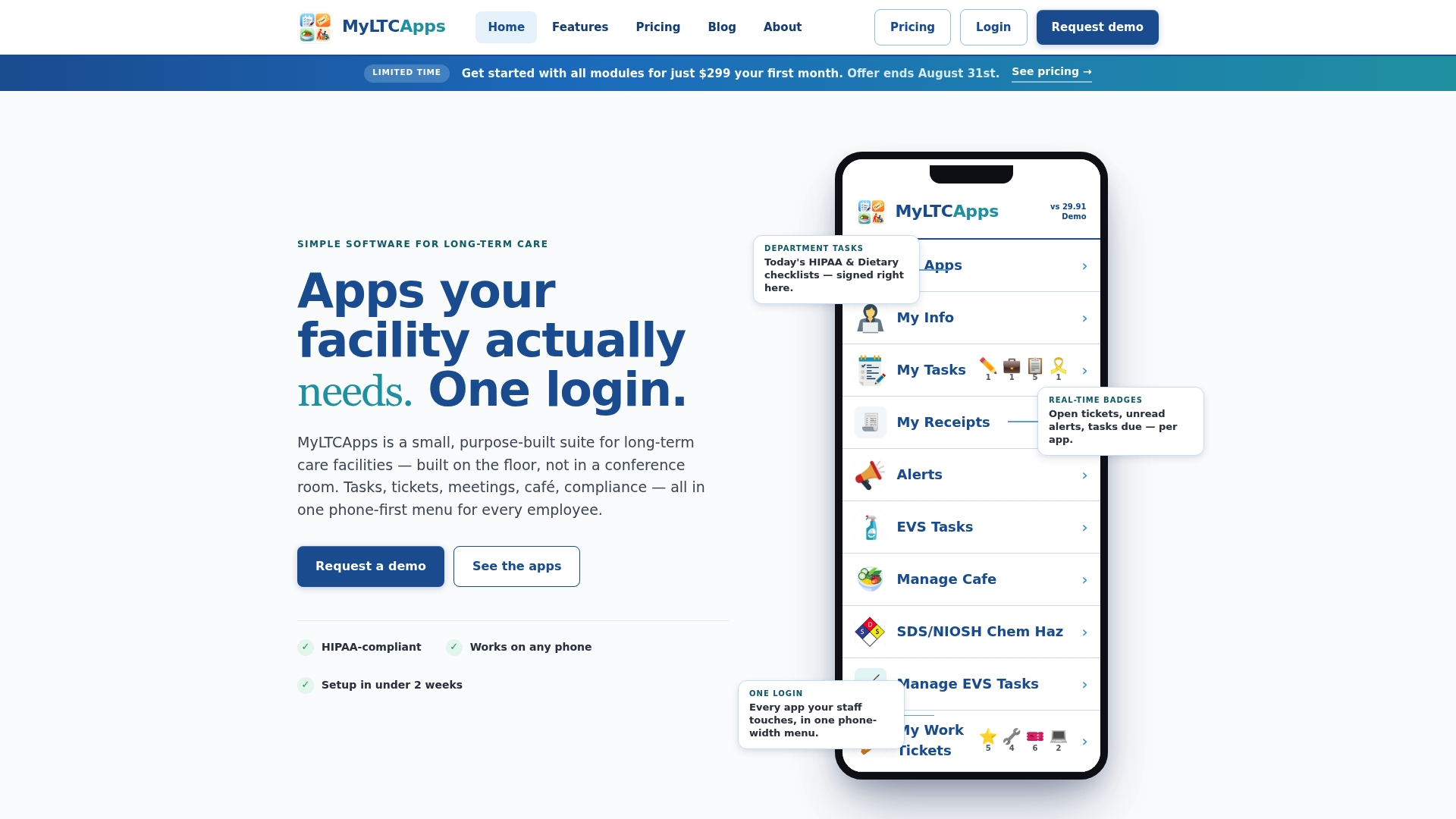
Myltcapps is built specifically for long-term care operations, and its compliance task and checklist module maps directly to every gate in this article. Mobile checklists assign onboarding tasks by role and hire date, so HR, the DON, occupational health, and the preceptor each see only their items — with deadlines and completion status visible to the administrator in real time. The competency tracking module captures preceptor sign-offs with timestamps, stores the completed form, and flags any hire who hasn’t cleared floor-ready criteria by Day 7. Exclusion screen attachments, immunization records, and training completion logs all live in one exportable audit report — the kind a surveyor can review in minutes, not hours.
For facilities managing agency staff or float pool scheduling, Myltcapps tracks facility-specific onboarding status by staff member so the charge nurse scheduling a shift can confirm clearance before posting it. Request a demo or explore the platform at Myltcapps to see how the checklist you just built becomes a system that runs itself.
Sources
These are the primary authoritative references cited in this article. For jurisdiction-specific rules on TB screening, influenza vaccination, or background check scope, always confirm with your state health department and state Medicaid agency.
- Clinical Testing Guidance for Tuberculosis: Health Care Personnel | TB Prevention in Health Care Settings | CDC
- Nursing Homes | CMS
- OIG - List of Excluded Individuals/Entities (LEIE) - Online Search
This article is general information, not a substitute for advice from a qualified doctor. Consult a qualified healthcare professional about your own circumstances before acting on anything here.