Running a Mock Survey Nursing Home Teams Can Trust

Running a Mock Survey Nursing Home Teams Can Trust
A mock survey nursing home teams run correctly is a simulated inspection built to mirror the CMS Long-Term Care Survey Process step for step. The single most important move: schedule a realistic 2 to 5 day mock survey (or a targeted 1 to 2 day version for a specific risk area) and route every finding into a formal QAPI project, not a one-off fix list.
Get these four people in the room before you set a date:
- The administrator, who owns the exit conference and final sign-off
- The Director of Nursing (DON), who runs clinical observations and staff interviews
- The infection preventionist, who covers PPE, hand hygiene, and outbreak logs
- Maintenance and the QAPI lead, who close the loop between findings and corrective action
TL;DR:
- Conduct a full mock survey lasting two to five days, focusing on real survey phases, including offsite prep, onsite fieldwork, and exit conference.
- Test staff record retrieval times by forcing immediate access to care plans and MARs to reveal system bottlenecks, especially under pressure.
- Prioritize high-risk areas like infection control and life safety, which are most frequently cited in nationwide CMS survey data.
- Schedule mock surveys at least one to three months before an expected actual survey, repeating once or twice annually for optimal readiness.
- Use tools that enable real-time mobile checklists and exportable reports to streamline findings tracking, owner assignment, and corrective action follow-up.
Table of Contents
- What a Mock Survey Nursing Home Team Should Model on the LTCSP
- Operational Checklist: What to Test in Every Inspection Area
- How Long Should a Mock Survey Run?
- Internal Team or Outside Consultant?
- Turning Findings Into a Plan That Actually Sticks
- Tools That Actually Shorten Mock Survey Prep
- Building the Timeline: From First Planning Meeting to Post-Mock Debrief
- Who Does What: Assigning Roles Before the Mock Begins
- Conducting Interviews and Observations That Actually Reveal Gaps
- Getting Staff and Leadership to Actually Act on the Results
- Making the Plan of Correction Realistic Instead of Aspirational
- The Blind Spots Every Facility Repeats
- Put Your Mock Survey Findings on Autopilot
- Key Takeaways
- Sources
What a Mock Survey Nursing Home Team Should Model on the LTCSP
The whole point of a mock survey is fidelity to how surveyors actually work, not a generic audit checklist. That means structuring your mock in the same three phases CMS builds into the LTCSP Procedure Guide: offsite prep, onsite fieldwork, and exit conference.
- Offsite prep. Pull your facility’s prior state survey reports, complaint history, and any Facility Reported Incidents (FRIs) before you walk the building. Surveyors review this exact packet before day one, and skipping it means your mock starts blind while a real survey never does.
- Entrance conference and initial pool. Surveyors briefly screen every resident and build an initial pool, roughly eight residents per surveyor, before narrowing to a deeper sample. Your mock team should run this same screening pass rather than jumping straight to a preselected group of “easy” residents.
- Focused observations, interviews, and record review. Once the sample narrows, shadow medication passes, watch meal service, and pull the actual resident records the surveyor would request. Time how long it takes staff to produce a MAR or care plan on demand.
- Exit conference. Close the mock the way a real survey closes: a findings summary formatted like a Statement of Deficiencies, with each observation mapped to a specific regulation. Keep this document internal. It is a diagnostic tool, not a public record, unlike the actual CMS-2567 findings that become public within 14 days of a real survey.
Testing the initial pool step matters more than most administrators assume. Facilities that jump straight to a preselected “known good” resident sample miss exactly the gaps a real surveyor would find during that first screening pass.
Operational Checklist: What to Test in Every Inspection Area
A mock survey is only as good as the pressure it applies. Walking through a binder is not the same as forcing staff to produce documents on the clock, the way a surveyor actually works.
- Resident records. Pull care plans, MDS assessments, and MARs for residents in your initial pool sample, and time the retrieval. If it takes ten minutes to find a current care plan, that is your finding.
- Medication pass and pharmacy records. Check medication storage, labeling accuracy, and whether MAR documentation matches what you observe during an actual pass.
- Infection prevention. Confirm PPE stock at point of use, hand hygiene station function, and whether your infection control audits actually get logged. This area maps directly to F0880, one of the most frequently cited deficiencies in nursing home surveys nationwide.
- Life safety and environment. Review Life Safety Code documentation, maintenance logs, and expiration dates on stored supplies. A single expired fire extinguisher tag can turn into a real citation.
- Dietary and clinical therapy. Check meal temperature logs, verify therapeutic diets match physician orders, and confirm therapy notes are current and signed.
- Staff files and training. Confirm competency records and training documentation are complete, and cross-check your PBJ staffing submissions against actual schedules.
Pro Tip: Testing record retrieval under time pressure exposes more system gaps than a policy review ever will. If a nurse can’t pull a current MAR in under two minutes during your mock, that’s the exact bottleneck a real surveyor will find first.
How Long Should a Mock Survey Run?
The on-site portion of a full mock typically runs two to five days, matching the workload of an actual LTCSP visit closely enough to surface real gaps. A shorter, targeted mock, focused on one risk area like infection control or medication management, can run just one to two days.
- Run a full 2 to 5 day mock survey 1 to 3 months before an anticipated open survey window, or after any major leadership change.
- Trigger a targeted mock after repeat citations, a spike in family or resident complaints, an acquisition, or new CMS guidance.
- Industry guidance generally recommends running a mock one to two times per year, with enough lead time before an expected survey window for corrective actions to actually take hold.
- Because surveys are unannounced and can happen outside normal business hours, build at least one evening or weekend check into your mock rotation.
Internal Team or Outside Consultant?
Running the mock in house builds real competency. Your DON learns to think like a surveyor, staff get comfortable answering pointed questions, and it costs nothing beyond staff time. The risk is normalization: your own team knows where the bodies are buried and may unconsciously steer around them.
An external consultant brings a colder set of eyes and current LTCSP knowledge without the internal blind spots, at a real cost premium. If you go outside, ask for specifics before signing anything:
- A sample findings report that maps observations to actual F-tags and Appendix PP language
- A rehearseable exit conference script, not just a written summary
- Evidence the consultant has updated their process for the CMS guidance changes issued in QSO-25-12-NH
Neither option is automatically right. A facility running its third mock in two years probably has the internal muscle to self-run one; a facility that just changed corporate ownership probably needs the outside perspective at least once.
Turning Findings Into a Plan That Actually Sticks
Findings that sit in a binder change nothing. The value of a mock survey lives entirely in what happens after the exit conference.
- Format findings like real observations, mapped to specific regulations, but keep the report internal. Never circulate it the way a public CMS-2567 gets circulated.
- Prioritize by risk and severity. A missing signature on a therapy note and an expired fire extinguisher tag are not the same emergency. Rank findings before assigning owners.
- Assign an owner, a measurable aim, and a deadline for every finding. “Improve documentation” is not a plan; “95% of MARs retrievable within 3 minutes by April 15” is.
- Schedule a re-audit. Verify the fix held under the same time pressure that exposed it the first time.
- Feed the pattern into QAPI, not just the individual fix. A single missed signature is a training issue. Three missed signatures across two units is a QAPI project with its own aim statement and monitoring cycle.
Escalate to a formal Plan of Correction process internally whenever a finding touches resident safety directly, even if no regulator has seen it yet.
Tools That Actually Shorten Mock Survey Prep
Record retrieval speed is often the single biggest predictor of how a mock survey goes, and paper-based systems are usually the reason it’s slow. Mobile checklists that live on a phone let a nurse pull a care plan or MAR in the time it takes a surveyor to ask the question, instead of walking to a nurses’ station binder.
- Seeded compliance libraries aligned to F-tags and Appendix PP save you from rebuilding audit templates every time CMS guidance changes.
- Exportable, surveyor-style reports give you a clean document for the exit conference and double as QAPI evidence later.
- Centralized F-tag references keep your internal findings language consistent with how a real Statement of Deficiencies gets written.
Building the Timeline: From First Planning Meeting to Post-Mock Debrief
A mock survey that gets planned two weeks out feels rushed and looks it. Build the timeline backward from your target completion date.
Eight to twelve weeks out: Pull prior survey history, complaint logs, and any FRIs. Assign section owners (clinical, dietary, life safety, infection control) and set the mock dates. This is also when you update templates against the current QSO-25-12-NH guidance so you’re not testing against outdated enforcement priorities.
Four to six weeks out: Distribute section checklists to owners, confirm staff availability across shifts, and brief department heads on what to expect. Do not tell frontline staff the exact date. Surveys are unannounced in real life, and telegraphing your mock defeats the entire exercise.
Survey week: Run the entrance conference, initial pool screening, and focused observations exactly as outlined earlier. Log every finding in real time rather than reconstructing it from memory at the end of each day.
Days immediately after: Compile the internal findings report, hold the exit conference with leadership, and start ranking issues by severity.
Within two weeks post-mock: Assign owners and deadlines for every corrective action, and set the re-audit date. Facilities that let this step slide past thirty days almost always lose momentum on the fixes that mattered most.
Who Does What: Assigning Roles Before the Mock Begins
Confusion during a mock survey almost always traces back to unclear ownership, not lack of effort. Assign roles that mirror actual surveyor disciplines rather than defaulting to “everyone pitches in.”
The administrator owns the overall schedule and the exit conference. This person has final say on findings severity and signs off on the corrective action plan. The DON leads clinical observations, staff interviews, and medication pass reviews, since nursing staff will naturally defer to this role during a real survey too. The infection preventionist owns PPE audits, hand hygiene checks, and any outbreak documentation review.
Maintenance and environmental services own the Life Safety Code walkthrough, checking maintenance logs, fire safety equipment, and expired supply dates. Dietary leadership handles meal temperature logs and therapeutic diet verification. The QAPI lead’s job starts the moment the mock ends: this person receives every finding, ranks it, and drives it into a corrective action with a measurable aim.
Write these assignments down before the mock starts, not during it. A facility that improvises role assignment on day one of the mock inevitably ends up with two people covering dietary and nobody covering life safety.

Conducting Interviews and Observations That Actually Reveal Gaps
The way you ask a question during a mock survey determines whether you learn anything. Surveyors ask open-ended questions designed to reveal whether staff actually understand a policy, not whether they can recite it.
Ask a CNA to describe what they’d do if a resident refused a shower, rather than asking whether they know the facility’s refusal-of-care policy. The first question exposes real practice; the second just tests memorization. Do the same with care plan reviews: ask a nurse to walk through why a specific resident’s plan includes a particular intervention, rather than asking if the plan exists.
Observations work best when unannounced within the mock itself. Watch a medication pass without telling the nurse in advance which resident you’ll focus on. Sit in on a meal service and watch whether staff actually follow posted therapeutic diet restrictions instead of just checking that a diet list exists on the wall.
Document what you observe in the moment, in plain language, then map it to a specific regulation afterward. Trying to identify the F-tag while you’re still watching the observation slows you down and makes you miss the next thing happening in the room.
Getting Staff and Leadership to Actually Act on the Results
A findings report that leadership reads once and files away accomplishes nothing. How you communicate mock survey results determines whether anything changes.
Share results with department heads within 48 hours of the exit conference, while the specifics are still fresh for the staff who were observed. Frame every finding around what to do differently, not who did something wrong. A nurse who couldn’t locate a care plan quickly isn’t the problem. A record system that makes retrieval slow for everyone is the problem, and that framing keeps staff engaged instead of defensive.
Bring frontline staff into the conversation about fixes, not just leadership. The CNA who fumbled a shower refusal question probably knows exactly why the training didn’t stick, and that insight is worth more than a generic retraining mandate. Set a short leadership huddle, thirty minutes is usually enough, to walk through the top five findings and assign owners on the spot rather than in a follow-up email three days later.
Making the Plan of Correction Realistic Instead of Aspirational
Findings lists tend to grow long fast, and a plan that tries to fix twenty things at once fixes none of them well. Rank every finding by two factors: how likely it is to cause real resident harm, and how often it recurs across the sample you observed.
A single missed initial in a MAR is a coaching conversation. The same gap showing up across three different nurses on two different shifts is a system issue that belongs in a formal QAPI project with its own aim statement, a defined measurement method, and a review date. Set your top three to five findings as QAPI-tracked items with a named owner and a specific, measurable target, and let smaller findings get handled through routine supervision instead of a formal project for every single one.
Re-audit on the same terms that revealed the problem the first time. If slow record retrieval was the original finding, the re-audit needs to time retrieval again, not just confirm a policy got reviewed. That is the only way to know a fix actually held rather than just got acknowledged.
The Blind Spots Every Facility Repeats
Three failure points show up in almost every mock survey I’ve reviewed the reasoning behind, regardless of facility size: staff can’t retrieve records fast enough under pressure, interview answers contradict each other between shifts, and maintenance logs lag behind the actual work performed. None of these are dramatic. All three are exactly what a real surveyor will find first.
Run a one-hour record retrieval drill this month, timed, with no advance warning to the staff being tested. Schedule an environmental sweep focused specifically on expired supplies and Life Safety Code documentation, since that’s the area most likely to have quietly drifted since your last review. And name a QAPI owner for your mock findings before you run the mock, not after, so results don’t sit in a binder waiting for someone to claim them.
The facilities that improve fastest treat the mock as a diagnostic tool for their systems, not a test of individual staff performance.
— Philip
Put Your Mock Survey Findings on Autopilot
Everything covered above works whether you run your mock with a paper binder or a whiteboard. But the facilities that close findings fastest usually aren’t relying on either. Myltcapps gives administrators a mobile-first way to run the exact checklist workflow this article describes, without rebuilding templates from scratch every time CMS revises Appendix PP.
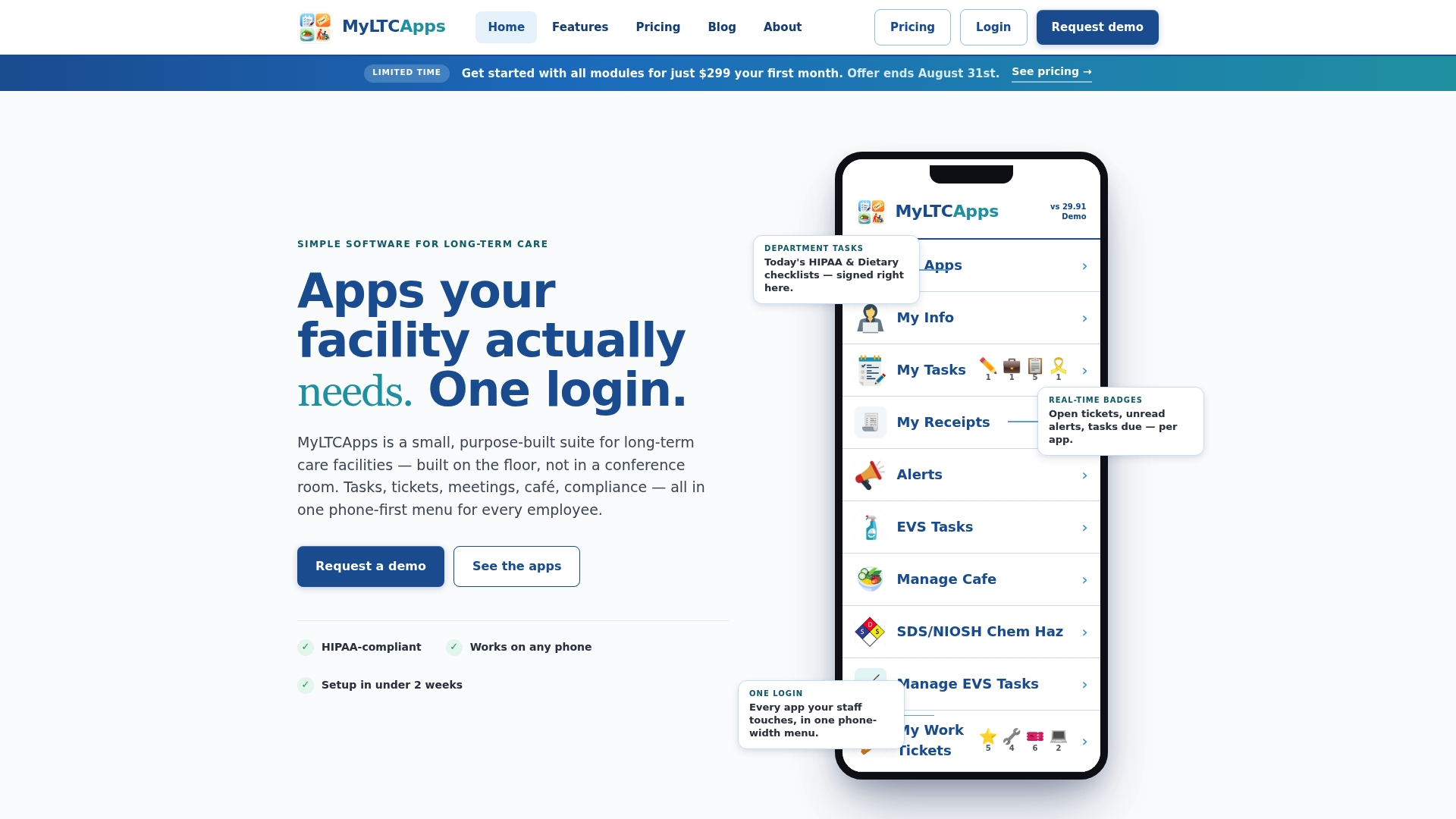
Look for three things when evaluating a survey-readiness tool: mobile checklists your staff can complete in real time on a phone, seeded compliance templates already mapped to F-tags so you’re not building audit forms from a blank page, and work order tracking that turns a maintenance finding into an assigned, trackable ticket instead of a line item that disappears after the exit conference. Exportable, surveyor-style reports mean your exit conference document is ready the moment your mock ends, not assembled from notes the night before.
A short pilot works well for most facilities: a demo walkthrough, an import of your existing checklist categories into the seeded compliance task library, and a 30-day trial period monitoring how fast your team can close findings compared to your last mock. Facilities in Kansas can review KDADS-ready long-term care software built around the same survey cycle covered in this guide. If you’re ready to see how it fits your facility’s next mock, start with the LTPAC software overview and request a walkthrough.

Key Takeaways
A mock survey nursing home teams run well simulates the full LTCSP cycle, from initial pool screening through exit conference, and feeds every finding into a tracked QAPI project rather than a static report.
| Point | Details |
|---|---|
| Run a full simulation | Schedule a 2 to 5 day mock that mirrors offsite prep, initial pool screening, and exit conference. |
| Time record retrieval | Force staff to pull MARs and care plans under pressure to expose real system gaps. |
| Focus on high-risk F-tags | Prioritize infection control and fall prevention areas most frequently cited in CMS data. |
| Schedule with lead time | Run mocks 1 to 3 months before an anticipated survey window, one to two times a year. |
| Track corrective action | Use a tool like Myltcapps to assign owners, deadlines, and exportable reports for every finding. |