Menu Documentation in a Nursing Home: What to Keep

Menu Documentation in a Nursing Home: What to Keep
A nursing home needs five kinds of menu records: the planned menu with a dietitian’s review, a log of every substitution, current diet orders and resident preferences, evidence of what was actually served, and copies kept for the period your state requires. Federal rules set the baseline in 42 CFR 483.60, and states add their own retention periods. This guide covers what to record, who signs, how long to keep it and how to make the paperwork part of the meal rather than an afterthought.
TL;DR
- Menus must be prepared in advance and reviewed by a dietitian or other clinically qualified nutrition professional for nutritional adequacy.
- Every substitution needs a log entry: the item replaced, the substitute served, the date and the reason. The substitute should be nutritionally equivalent.
- Surveyors compare the care plan, diet orders and intake records with what they see on the tray, so the paper and the plate have to match.
- Retention is set by state. Texas, New York and New Mexico, for example, require 30 days, six months and 30 days respectively.
- Records that live on a phone at the point of service are far easier to keep complete than forms filled out at the end of the shift.
Table of Contents
- What the federal rule expects from your menus
- The records worth keeping, one by one
- Menu substitutions: what to log and who signs
- Documenting diets, preferences and refusals
- How long to keep menu records
- Who does what
- Keeping records accurate during a busy meal service
- A simple weekly routine
- Perspective
- How MyLTCApps supports dining records
- FAQ
- Sources
What the federal rule expects from your menus
The core federal requirement is 42 CFR 483.60, food and nutrition services. It requires each resident to receive a nourishing, palatable, well-balanced diet that meets daily nutritional and special dietary needs, with resident preferences taken into consideration. Menus are the main way you prove it.
In practice that rule turns into a handful of documentation duties:
- Menus prepared in advance. The cycle menu exists on paper (or on a screen) before the meal is cooked, not reconstructed afterward.
- Dietitian review. The facility’s dietitian or other clinically qualified nutrition professional reviews menus for nutritional adequacy. Your file should show who reviewed, when, and which version.
- Therapeutic diets ordered by a physician. Therapeutic diets must be prescribed by the attending physician, who may delegate that task as State law allows. The diet order, not a kitchen habit, drives what a resident gets.
- Alternatives for residents who do not want the meal. Facilities must offer appealing options of similar nutritive value to residents who choose not to eat the food served or ask for something different.
- Enough competent staff. The rule also expects sufficient competent food and nutrition services staff based on resident assessments and care plans, which is why training records and assignments belong in the same binder or system.
Notice what is absent: the regulation does not hand you a form. Your forms are your own, and they pass inspection when they show the five points above clearly and consistently.
The records worth keeping, one by one
| Record | What it shows | Who usually owns it |
|---|---|---|
| Cycle menu with revision dates | The planned meals, snacks and any seasonal changes | Dietary manager / dietitian |
| Dietitian review sign-off | Nutritional adequacy was checked | Consultant dietitian |
| Substitution log | What changed, why, and what was served instead | Cook or dietary supervisor |
| Diet roster / tray cards | Each resident’s diet order, texture, allergies and preferences | Dietary manager, nursing |
| Meal intake and weight records | Whether the diet is working | Nursing, CNAs, dietitian |
| Resident choice and refusal notes | Preferences honored, alternatives offered | CNAs, dining staff |
| Retained served menus | Proof of what was actually served in the retention window | Dietary manager |
For tray-card specifics, see our guide to same-day tray card rules for U.S. nursing homes. For calorie tracking, the calorie count sheet checklist covers what staff should capture at the table.
Menu substitutions: what to log and who signs
Substitutions are where menu records most often fall apart. The grill is down, a delivery is short, a resident wants something else. Each of those is normal. An undocumented swap is the problem.
A practical substitution log records the food item substituted, the substitute served, the date, and the reason. The same guidance says the replacement should have the same nutritional equivalency as the item it replaces, so a cook should know in advance which swaps are acceptable. A short approved-substitution list, built with your dietitian, saves arguments at 4:30 p.m.
Some extra columns are worth adding:
- The meal (breakfast, lunch, dinner, snack)
- The diet or texture the change applies to, so a pureed or renal diet is never an afterthought
- The initials of the person who made the call
- Whether residents with allergies were affected
Review matters as much as entry. One dietitian-authored guide says the log is reviewed and signed off by the consultant dietitian during regularly scheduled visits, unless corporate policy or the dietitian directs otherwise. Treat that as a sensible default and confirm it matches your own policy and state rules.
Example entry
| Date | Planned item | Served instead | Reason | Diets affected | Initials |
|---|---|---|---|---|---|
| Tuesday, lunch | Baked chicken | Turkey and gravy | Chicken delivery short | Regular, mechanical soft | Cook on duty |
That is five seconds of work if it happens at the pass, and twenty minutes of guessing if it happens the following Friday.
Documenting diets, preferences and refusals
A menu is generic. A resident’s diet is specific. The documentation that connects them is what surveyors probe.
CMS’s Nutrition Critical Element Pathway tells surveyors to review the resident’s assessment and care plan for diet and food preferences, physician’s orders for diet, and records of meal intake, supplements and weights. They also watch meals: whether the diet and care-planned interventions are followed, portions are appropriate, preferences are honored, and substitutes are offered when a resident refuses food.
That gives you a clear checklist for what front-line staff should be able to record quickly:
- Preference: what the resident likes, dislikes and asks for, in the resident’s words
- Choice made at this meal: the item chosen, or the alternative offered
- Refusal: what was declined, what was offered in its place, and whether the resident accepted it
- Intake: how much was eaten, using the scale your facility has standardized
- Escalation: who was told when intake dropped or weight changed
Refusals and diet liberalization
When a resident declines care or treatment, CMS guidance says the facility should discuss the resident’s condition, options, risks and benefits, expected outcomes and preferences, and offer relevant alternatives. For meals, that means a refusal note that stops at “refused lunch” is incomplete. Record the alternative offered and what happened next.

CMS interpretive guidance also notes that minimizing dietary restrictions and liberalizing a diet, consistent with the resident’s condition, prognosis and choices, may enhance quality of life and nutritional status. When a resident is eating poorly or losing weight, the interdisciplinary team may temporarily ease restrictions to improve intake. Any such change should trace back to a documented order and team decision, never to a cook’s judgment. Questions about a specific resident’s diet go to the attending physician and the facility dietitian.
Texas Health and Human Services describes person-centered dining as emphasizing residents’ rights, choices and preferences, including food, meal timing and dining options. That framing is useful nationwide: your records should show choice being offered, not only diets being followed.
Texture-modified diets deserve their own care. Our texture modified diets guide for LTC staff walks through how to keep texture orders visible at service.
How long to keep menu records
Federal rule text gives you the content duty. Retention periods vary by state, so check your state’s long-term care licensing regulations. Three examples show how much they differ:
| State | Requirement | Source |
|---|---|---|
| Texas | Records of menus served, including substitutions, and food purchased kept 30 days; special-diet lists and records kept in the dietary area at least 30 days | 26 Tex. Admin. Code § 554.1107 |
| New York | Dated copies of planned and served menus, including substitutions, on file for six months | 10 NYCRR 415 / Section 490.8 |
| New Mexico | Onsite systematic record of all menus and revisions, including snacks, for at least 30 calendar days | N.M. Admin. Code § 8.370.14.36 |
Two habits keep you safe regardless of state. First, keep the served menu, not just the planned one, because the difference between them is exactly what substitutions explain. Second, adopt the longest period that applies to you, including any corporate policy, so one rule governs every building. For the wider records picture, see our piece on document retention in long-term care.
Who does what
Clear ownership beats good intentions. A workable split:
- Dietitian: reviews and approves the cycle menu, approves the substitution list, signs off the log on visits.
- Dietary manager: maintains menus, posts them, retains served-menu records, keeps the diet roster current.
- Cooks and dietary aides: log substitutions at the time of change and follow tray cards.
- CNAs and nursing: record choices, refusals and intake, and report changes to the nurse and dietitian.
- Administrator: confirms the system works through spot audits, and ties findings into QAPI.
This mirrors the federal expectation that the dietitian or qualified nutrition professional reviews menus while the facility employs enough competent staff to carry them out.
Keeping records accurate during a busy meal service
Most menu documentation fails at the same moment: during service, when hands are full. Some fixes that work without adding staff:
- Put the log where the decision happens. A clipboard in the office is a log filled in later from memory. A form at the pass, or on a phone, is filled in once.
- Make the diet visible at the tray. Tray cards should carry diet, texture, allergies and preferences. Out-of-date cards cause both errors and citations.
- Standardize the vocabulary. Agree on intake percentages, refusal wording and diet abbreviations, and teach them at orientation. Our new hire onboarding checklist is a good place to add dietary documentation.
- Run a weekly mini-audit. Pull three days of served menus and match them against the substitution log. Any unexplained difference is a training topic.
- Prepare the survey binder year-round. Surveyors use the Nutrition pathway through record review, observations and interviews, so the records should be ready to hand over when they ask.
- Connect kitchen hygiene to the same system. Cold storage and cleaning logs are checked by the same visitors. See our refrigerator cleaning schedule.
For how menu planning itself feeds the paperwork, read our cafeteria menu planning guide for nursing homes. And for the larger compliance framework these records sit in, see compliance tracking in healthcare.
A simple weekly routine
If you are starting from scratch, this routine takes little time and covers the core:
- Monday: confirm the cycle menu week, post it, and check for ingredient shortages that will force substitutions.
- Daily: update the diet roster for admissions, discharges and order changes before the first meal. Log substitutions as they occur.
- Daily: CNAs record intake and refusals at the meal, with alternatives offered.
- Friday: the dietary manager reviews the week’s substitution log and flags repeat substitutions to the dietitian, since a menu item that is always replaced probably needs to be redesigned.
- Each dietitian visit: sign off the log, review weight and intake concerns, and update the approved-substitution list.
- Monthly: archive served menus according to your retention rule, and confirm older ones are retained for the full period.
Perspective
We built MyLTCApps around a simple observation: the people who know what really happened at a meal are the cooks, aides and nurses standing there, and they are the ones with the least time to fill out paperwork.
When documentation lives in a binder in the office, it gets written after the fact, if at all. We believe it works better in the pocket. That is why our tools are phone-first, designed for one thumb and about three taps, so a checklist item or a note is done in the moment instead of at the end of a shift.
For dining, that means menu and meal-service work sits in the same place as the rest of the floor’s tasks and compliance checklists, and your reporting can be ready for a surveyor without a scramble. A focused set of tools, not a sprawling system, is what staff actually use.
The goal is not more paperwork. It is that the records match what happened, because they were created when it happened.
Philip
How MyLTCApps supports dining records
If your team is tired of chasing paper, our cafeteria and dining management software is built for long-term care, including payroll-deduct staff dining and resident meal tracking, on the same phone-first platform as our task and compliance tools.
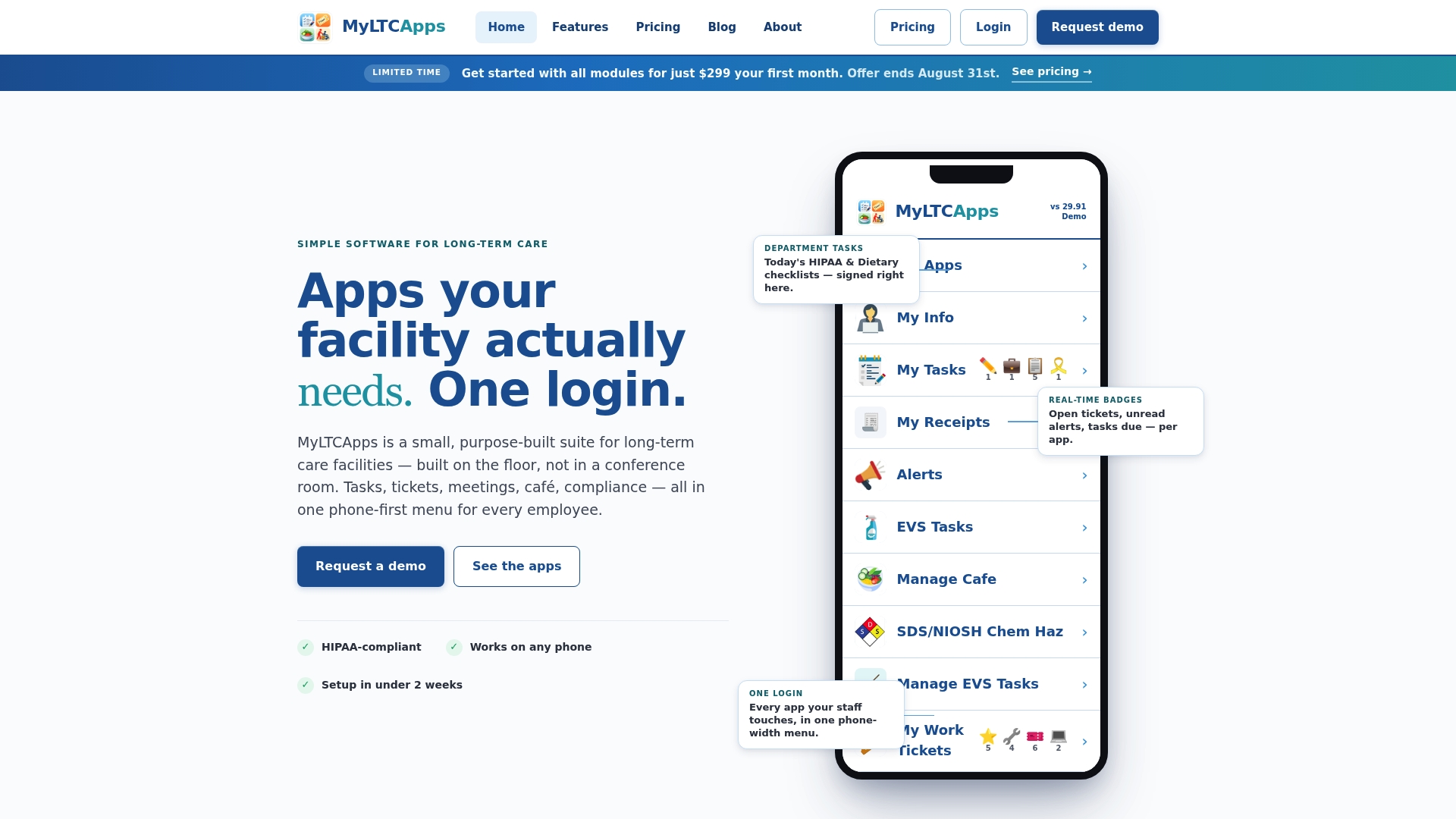
MyLTCApps plans are published on our pricing page: I Just Want That at $199 per month, Starter Pack at $299 per month, Growth Pack at $499 per month and Premium Pack at $792 per month. Our Compliance Suite includes seeded libraries for areas such as dietary and QAPI and surveyor-ready reporting exports. Pair it with daily task and checklist software so kitchen routines are done and recorded in one step. MyLTCApps does not provide medical charting, so clinical records stay in your existing clinical system.
FAQ
Does federal law require a specific menu form?
No. 42 CFR 483.60 sets the content duties: menus prepared in advance, reviewed by a dietitian or qualified nutrition professional, and meeting residents’ needs. It does not prescribe a template. Your forms should make those duties visible, and your state may add its own requirements.
What should a menu substitution record include?
At minimum, the item that was planned, the substitute served, the date and the reason. The substitute should be nutritionally equivalent. Adding the meal, affected diets and the initials of the person who made the change makes the log more useful at review.
How long should we keep served menus?
It depends on your state. Texas requires 30 days for menus served and substitutions, New Mexico at least 30 calendar days, and New York six months. Check your state’s licensing rules and corporate policy, and use the longest period that applies.
Who has to sign off on menus?
The facility’s dietitian or other clinically qualified nutrition professional must review menus for nutritional adequacy. Many facilities also have the consultant dietitian sign the substitution log during scheduled visits, which is a good practice to build into your policy.
What do surveyors check at mealtime?
They look at whether the resident’s diet and care-planned interventions are followed, portions are appropriate, preferences are honored, and substitutes are offered when food is refused. They compare that with the care plan, diet orders, intake and weight records.
Sources
- 42 CFR § 483.60, Food and nutrition services
- Making Menu Substitutions
- Nutrition Critical Element Pathway, CMS
- CMS Survey and Certification Letter 08-28
- F325 §483.25(i) Nutrition, CMS transmittal
- Dining and Meal Service, Texas Health and Human Services
- 26 Tex. Admin. Code § 554.1107
- Section 490.8 Food service, New York
- N.M. Admin. Code § 8.370.14.36 Nutrition