Life Safety Code Checklist for Healthcare Facilities

Life Safety Code Checklist for Healthcare Facilities
A Life Safety Code checklist is the itemized set of building, fire protection, and documentation checks a healthcare facility uses to confirm it meets NFPA 101 and NFPA 99 (both 2012 editions), the standards CMS has required of certified long-term care facilities since July 5, 2016. If a survey could show up tomorrow, your first move is simple: pull your ITM (inspection, testing, and maintenance) records and walk your building the way a surveyor would, corridor by corridor.
Do that walk today, and check these six categories first, because they cover most of what a Life Safety Code surveyor scores:
- Means of egress — corridor width, obstruction-free exits, illuminated exit signage
- Fire protection systems — sprinklers, smoke detectors, fire alarm panels
- Doors and smoke barriers — self-closing doors, corridor door gaps, fire-rated partitions
- Alarms and ITM records — test logs, inspection tags, service dates
- Emergency power and medical gas — generator run tests, transfer switch logs, gas system pressure checks
- Documentation — fire safety plans, drill records, staff training logs
Everything below builds out each of those six areas into a working checklist, plus what to expect on survey day and which CMS forms to have on hand.
Key Takeaways
Survey readiness comes down to one habit: capturing ITM evidence the moment work happens, not reconstructing it before an unannounced surveyor arrives.
| Point | Details |
|---|---|
| Audit ITM records this week | Confirm every fire alarm, sprinkler, and generator test log is current and signed. |
| Clear sprinkler head zones | Maintain required clearance below every sprinkler head across all corridors and rooms. |
| Inspect fire doors and closers | Confirm every corridor and hazardous-area door self-closes and latches properly. |
| Run and log a generator test | Document the load test with a signed report, not just a completed task. |
| Centralize evidence with Myltcapps | Use mobile checklists and exportable reports to keep CMS-2786 documentation survey-ready year-round. |
Table of Contents
- Life Safety Code Checklist: A Room-by-Room Building Tour
- What Happens During a Life Safety Code Survey?
- CMS Forms and Records to Have Ready
- What Are the Most Common Life Safety Code Citations?
- How Do You Keep Life Safety Code Compliance Ongoing?
- How Should You Prepare in the Week Before a Survey?
- Why Mobile-First Checklists Reduce Survey Citations
- A Publisher’s Note on Staying Survey-Ready
- How MyLTCApps Supports Life Safety Code Readiness
- Where to Find Official Life Safety Code Resources
- Sources
Life Safety Code Checklist: A Room-by-Room Building Tour
Surveyors move through a facility the way visitors do: exterior approach, egress paths, public corridors, resident care areas, then the back-of-house rooms most staff rarely think about. Building your internal checklist the same way makes the tour predictable instead of stressful.
Start outside. Exit discharge paths need to stay clear of snow, storage, and parked equipment, and exterior stairs need functioning handrails. Move into corridors next: check that fire doors close and latch on their own, that nothing is stored near sprinkler heads, and that corridor clutter (carts, linen hampers, wheelchairs left overnight) doesn’t reduce the required clear width. Maintaining clearance around sprinkler heads is a common area missed in facility self-audits, and it shows up repeatedly in damper and sprinkler guidance memos written specifically for CMS-regulated buildings.
Resident rooms, ICUs, and any procedure or operating rooms get closer scrutiny for medical gas connections, electrical cord condition, and oxygen storage separation from combustibles. Hazardous areas, soiled utility rooms, and mechanical spaces need one-hour fire-rated enclosures with self-closing doors. Vertical openings, stairwells, and shafts need to stay sealed, and roof or utility access areas need generator enclosures and fuel storage checked against NFPA 99 rules for emergency power systems.

For each of these zones, the surveyor won’t just look. They’ll ask you to produce a document. Here’s the pairing most facilities need to keep organized:
| Building Area | What to Inspect | Documentation to Show |
|---|---|---|
| Exterior/egress paths | Clear discharge routes, functioning exterior lighting | Exit path inspection log |
| Public corridors | Door closers, sprinkler clearance, no storage | Fire door inspection report, sprinkler ITM log |
| Resident/patient rooms | Medical gas outlets, electrical safety, oxygen storage | Medical gas testing report |
| Hazardous/utility rooms | One-hour rated enclosures, self-closing doors | Fire door inspection report |
| Generator/utility areas | Weekly load test, fuel level, transfer switch | Generator test report |
| Alarm/detection systems | Panel function, device testing | NFPA fire alarm test log |
Pro Tip: Keep two staff members, one from facilities and one from nursing or administration, with direct access to your ITM binder or digital archive. When a surveyor asks for a document at 9 a.m. on a Tuesday, “the maintenance director is off today” is not an acceptable answer, and it happens more often than it should.
What Happens During a Life Safety Code Survey?
LSC surveys are unannounced, and they follow a defined six-task sequence laid out in CMS State Operations Manual Appendix I. Surveyors often arrive alongside a health survey team, so a facility rarely gets separate warning for the fire safety portion.
The task sequence breaks down like this:
- Task 1: Offsite preparation — surveyors review your facility’s prior survey history, construction type, and building plans before they ever walk in.
- Task 2: Entrance conference — the survey team introduces itself and requests initial documentation, often within minutes of arrival.
- Task 3: Orientation tour — a walkthrough to establish the building’s layout, construction date, and any additions or renovations.
- Task 4: Information gathering — the detailed building tour and document review described in the checklist above.
- Task 5: Analysis and decision-making — the team determines whether observed conditions constitute deficiencies and under which NFPA chapter.
- Task 6: Exit conference — findings are summarized verbally before the formal Statement of Deficiencies is issued.
Construction date matters more than most facility managers realize. A building’s original construction date, not its renovation date, typically determines whether NEW or EXISTING occupancy chapters of NFPA 101 apply, and mixing that up is a common paperwork error. When full prescriptive compliance isn’t feasible, a facility can request equivalency through the Fire Safety Evaluation System (FSES), documenting alternative protection measures instead of a physical fix.
A full LSC survey, from the entrance conference through the exit conference, typically spans one to three days depending on facility size, though larger campuses or those with FSES worksheets on file may see extended review involving a fire safety specialist consultant.
CMS Forms and Records to Have Ready
The forms most facilities scramble to find mid-survey are the same three or four every time: CMS-2567, the CMS-2786 series, and FSES worksheets when applicable. Keep them printed or accessible digitally before the survey team arrives, not after they ask.
Here’s what each form does and when you’ll need it:
- CMS-2567, Statement of Deficiencies and Plan of Correction — issued after any survey; you’ll use this to document your corrective action plan and timeline.
- CMS-2786R, Fire Safety Survey Report (Existing Health Care Occupancies) — the working document surveyors use to record LSC findings for existing buildings.
- CMS-2786U, Fire Safety Survey Report (New Health Care Occupancies) — the equivalent report for facilities built or renovated under NEW chapter requirements.
- FSES worksheets — required when a facility uses the Fire Safety Evaluation System equivalency option instead of full prescriptive compliance.
Official versions of all of these live on the CMS Life Safety Code & Health Care Facilities Code Requirements page, which also links current NFPA reference material. Print copies get outdated fast, so bookmark the CMS page directly rather than rely on a saved PDF from two years ago.
When you present these forms, attach the supporting evidence surveyors will cross-reference: current ITM logs for anything cited in a prior CMS-2786, contractor invoices tied to corrective actions, and a copy of your facility’s fire safety plan. Facilities that also carry Joint Commission accreditation can pull additional interpretive guidance from the Joint Commission’s Life Safety Code resources, which map closely to CMS expectations but add environment-of-care context.
What Are the Most Common Life Safety Code Citations?
Sprinkler system deficiencies, ITM documentation gaps, and means-of-egress obstructions top the list of citations issued in healthcare facility surveys, according to the top-citation tags compiled by LeadingAge New York from CMS survey data. Electrical equipment issues and smoke barrier defects round out the most frequent findings.
Breaking down what surveyors actually document under each tag:
- Sprinkler system citations — missing 18-inch clearance below heads, corroded or painted-over sprinkler heads, missing inspection tags.
- ITM documentation gaps — no test log for fire alarm devices, expired fire extinguisher inspection tags, missing generator load test records.
- Means-of-egress obstructions — carts, equipment, or furniture reducing corridor width below code minimum.
- Door and smoke barrier defects — corridor doors that don’t self-close, gaps at door frames exceeding allowable clearance.
- Electrical equipment problems — extension cords used as permanent wiring, overloaded power strips, damaged cords in resident areas.
Most of these have same-day fixes. Clear the 18 inches under every sprinkler head across the building; this alone often resolves the single most repeated citation type. Walk every corridor door and confirm it latches without assistance, adjusting closers where needed. Pull a current fire extinguisher inspection tag report and replace any unit past its inspection window. Swap out extension cords for properly rated permanent wiring or approved power strips within 24 to 72 hours, since this is one of the easiest citations to eliminate before it happens.
Pro Tip: Treat any deficiency flagged in a contractor’s inspection report as if a surveyor already found it. Document the corrective action and closure date immediately. A written contractor report that sits unaddressed for weeks turns a routine maintenance note into a citation waiting to happen.
How Do You Keep Life Safety Code Compliance Ongoing?
Compliance holds up under survey pressure only when it’s built into daily operations, not assembled the week before an anticipated visit. Since LSC surveys are unannounced, permanent readiness beats episodic scrambling every time.
Building that into a repeatable workflow looks like this:
- Set a recurring ITM calendar with a named owner for each task, whether that’s weekly generator tests, monthly sprinkler checks, or annual fire alarm certification.
- Attach evidence at the point of completion, not after the fact. A photo, a signed test report, or a technician’s initials on a log entry all count, but only if they’re captured the same day the work happens.
- Route contractor repairs through a documented work ticket so every fix has a start date, an assigned vendor, and a closure record tied to it.
- Run a monthly internal audit comparing your ITM calendar against completed evidence, flagging any gap before it becomes a six-month-old missing record.
- Export a survey-ready packet quarterly so your most current documentation is always one click away instead of buried across email threads and paper binders.
Facilities managing maintenance work orders through a centralized digital system tend to close this loop faster, because the work ticket and the compliance evidence live in the same place instead of two separate systems that never quite sync up.
Pro Tip: Assign two staff members, ideally one clinical and one facilities-side, with permission to pull and export compliance records. Keep every export date-stamped and versioned so you always know which file is current when a surveyor asks for “the latest.”
How Should You Prepare in the Week Before a Survey?
Three priorities matter most in the seven days before you expect a survey: a full records audit, a physical walk-through of every building area, and a short briefing with staff on what surveyors typically ask.
Start the records audit first, since it takes the longest. Pull every ITM log from the past twelve months and confirm nothing has expired or gone missing. Next, walk the building exactly like the tour sequence in Section 2, noting anything that needs a same-day fix. Finally, brief nursing, dietary, and housekeeping staff on basic expectations, since surveyors frequently ask floor staff about fire drill procedures and evacuation routes, not just facilities managers.
On the day a survey team arrives, the sequence moves fast:
- Designate one point person to greet the survey team and manage the entrance conference.
- Station a second staff member near your records archive, ready to pull ITM logs or CMS forms on request.
- Present your fire safety plan and most recent fire drill records within the first hour if asked.
- Accompany the surveyor on the orientation tour, but let them lead the route.
- Have your CMS-2786 documentation and any FSES worksheets staged and printed before the information-gathering task begins.
A short printable version of this sequence taped inside your compliance binder saves real time on the day itself, especially for facilities where the person greeting the surveyor isn’t always the person who manages daily maintenance records.
Why Mobile-First Checklists Reduce Survey Citations
Documentation gaps, not physical building failures, cause the majority of Life Safety Code citations. When ITM records live in scattered binders, individual inboxes, or a single manager’s desktop folder, a missing signature or an expired test tag becomes a citation even when the underlying equipment works fine.
Facilities that move ITM tracking to a centralized, time-stamped system report fewer documentation-based findings, largely because a photo or digital sign-off captured at the moment of inspection can’t get lost the way a paper form tucked into a maintenance office drawer can.
A generator test performed on schedule but never logged is functionally identical, from a surveyor’s standpoint, to a generator test that never happened. The equipment passed. The paperwork failed. That distinction is where most avoidable citations live.
Organize your ITM evidence folders by system type first (fire alarm, sprinkler, generator, medical gas), then by date within each folder. Surveyors generally prefer PDF test reports and time-stamped photos over handwritten logs, since both are easier to verify against a specific inspection date.
Pro Tip: Name your files with the date first, in YYYY-MM-DD format, followed by the system name. A folder full of files named “test_report_final_v2.pdf” wastes precious minutes during a survey walkthrough that you don’t get back.
A Publisher’s Note on Staying Survey-Ready
The facilities that handle surveys with the least stress aren’t the ones with the newest buildings. They’re the ones where compliance evidence is already organized before anyone knocks on the door. That pattern holds whether the standard is NFPA 101, an emergency preparedness rule, or a state-specific overlay. The common failure point is almost always the same: good work performed, poor documentation kept. Fixing that gap doesn’t require new equipment or a construction budget; it requires a system where every inspection, test, and repair gets recorded the moment it happens, not reconstructed from memory a week before a survey team shows up.
How MyLTCApps Supports Life Safety Code Readiness
Myltcapps shortens the distance between “we did the inspection” and “we can prove it” by putting every checklist, work ticket, and ITM record on the same mobile-first platform your staff already carries in their pocket. Instead of chasing down a maintenance director for a paper log, a compliance officer can pull a date-stamped export in minutes.
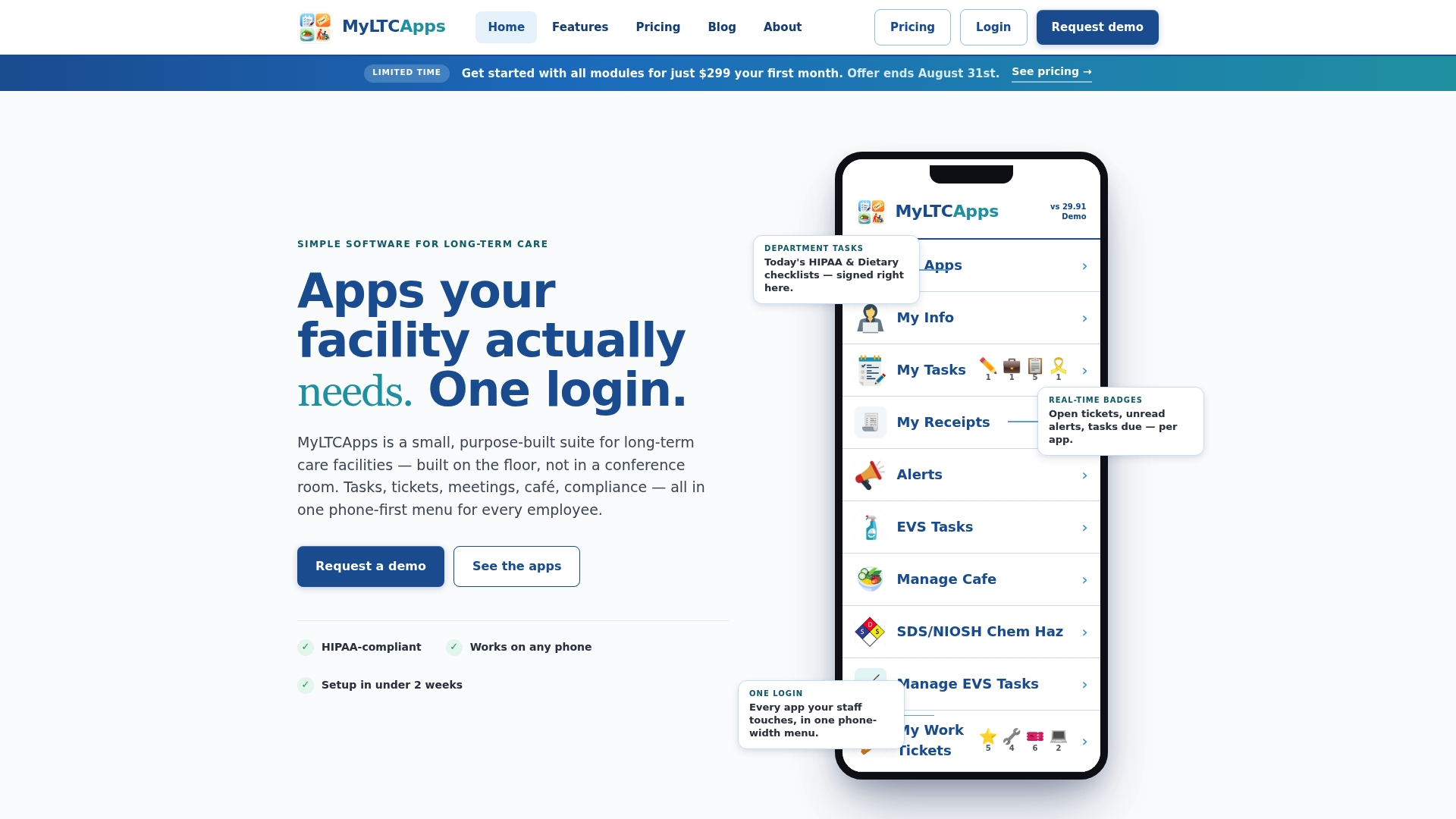
The platform’s checklist and compliance-tracking tools map directly onto what this article covers:
- Mobile checklists for building tours, so staff log sprinkler clearance and door checks in real time, not from memory later.
- ITM scheduling with recurring reminders for generator tests, fire alarm checks, and sprinkler inspections.
- Work ticket tracking that links contractor repairs to their closure date, creating the corrective-action trail surveyors ask for.
- Exportable reports formatted for quick reference alongside CMS-2567 and CMS-2786 documentation.
- Seeded compliance libraries, including emergency-prep and dietary modules, so Life Safety Code tracking sits alongside your other regulatory obligations instead of in a separate system.
If your team is still managing ITM logs across spreadsheets, binders, and text threads, explore the compliance task and daily checklist software built for long-term care operations and request a walkthrough of how it fits your facility’s survey calendar.
Where to Find Official Life Safety Code Resources
The fastest path to authoritative guidance runs through three sources: the CMS LSC and Health Care Facilities Code page, the State Operations Manual Appendix I, and NFPA’s own technical resources for CMS-regulated buildings.
Bookmark these for policy writing, plan-of-correction drafting, and staff training:
- CMS Life Safety Code & Health Care Facilities Code Requirements — official forms, downloads, and current NFPA edition requirements.
- State Operations Manual Appendix I — the full survey procedure text for Task 1 through Task 6.
- NFPA resources for CMS requirements — technical clarification of NFPA 101 and NFPA 99 provisions.
- The Joint Commission’s Life Safety Code resources — interpretive guidance for accredited facilities.
- CMS Surveyor Training Portal — the same course material CMS surveyors use, useful for internal staff training.
| Resource | Best Used For |
|---|---|
| CMS LSC/HCFC page | Downloading current forms and checking NFPA edition requirements |
| SOM Appendix I | Understanding the survey task sequence and unannounced timing |
| NFPA CMS resources | Technical interpretation of code provisions |
| Joint Commission LSC resources | Cross-referencing accreditation-specific guidance |
| CMS Surveyor Training Portal | Internal staff training on survey procedures |
Some states also publish their own building-safety checklists mapped to NFPA 101, similar to Pennsylvania’s building safety checklist, which can serve as a useful template if your facility wants a state-specific tour format layered on top of the federal requirements. Check whether your state health department or long-term care association, similar to guidance published by OHCA, publishes a comparable resource before your next survey cycle.
This article provides general regulatory information and does not replace guidance from CMS, your state survey agency, or a qualified fire safety consultant. Confirm current requirements directly with the primary sources above before finalizing any policy or plan of correction.
This article is general information, not a substitute for advice from a qualified lawyer. Consult a qualified legal professional about your own circumstances before acting on anything here.
Sources
- Survey and Certification Letter (S&C) 16-29
- Life Safety Code & Health Care Facilities Code Requirements | CMS
- State Operations Manual Appendix I – Survey Procedures for Life Safety Code Surveys (SOM, Appendix I)
- Life Safety Code and Emergency Preparedness Deficiencies (LeadingAge New York)
- NFPA resources for CMS requirements