Two Infection Control Audit Tools That Feed QAPI and Fix LTC Gaps

Two Infection Control Audit Tools That Feed QAPI and Fix LTC Gaps
Infection control audits are structured reviews that combine system self-assessments with focused observational audits to catch gaps between written policy and daily practice. The recommended sequence starts with a baseline system assessment like the CDC’s ICAR tool, followed by targeted observational audits tied to a documented quality improvement plan. Together, these two methods, backed by CDC and AHRQ guidance, turn scattered compliance checks into a repeatable improvement cycle.
TL;DR:
- Conducting baseline system assessments like ICAR identifies structural gaps that observational audits alone cannot reveal.
- Sample sizes for ongoing audits should be small but consistent, with weekly observations of 10 to 20 staff members to track trends accurately.
- Reporting must include real-time data analysis through run charts and disaggregation by unit, shift, and role to pinpoint specific problem areas.
- Closing the audit-to-action gap is crucial, with digital platforms enabling immediate documentation, assignment, and follow-up of corrective tasks.
- Prioritizing follow-up and corrective actions ensures audit programs lead to meaningful improvements rather than just compliance documentation.
Table of Contents
- What Are the Two Types of Infection Control Audits?
- How Do You Plan and Run an Infection Control Audit?
- How Do You Turn Audit Data Into Useful Metrics?
- How Do Audit Findings Feed Into a QAPI Project?
- What Makes an Audit Program Reliable and Staff-Accepted?
- How Mobile Task Platforms Speed Up Audit-to-Action Workflows
- What Legal and Regulatory Requirements Apply to Infection Control Audits?
- What Are the Biggest Barriers to Running Consistent Infection Control Audits?
- How Do Digital Systems and EHRs Support Infection Control Audits?
- Official Tools and Guidance Worth Bookmarking
- Ready to Close the Gap Between Audit and Action?
- The Real Problem With Most Audit Programs
- Sources
What Are the Two Types of Infection Control Audits?
Every credible infection control audit program rests on two distinct but complementary tools. Confusing them, or running only one, is the most common reason audit programs stall out.
System-based self-assessments, like the CDC’s ICAR (Infection Control Assessment and Response) tool, evaluate your facility’s written policies, staffing structure, and program infrastructure. Think of ICAR modules as a facility-wide health check: they ask whether you have a designated infection preventionist, whether your supply chain supports proper PPE use, and whether your policies actually align with current CDC core practices. Run an ICAR-style assessment as your baseline, then repeat it annually or after major regulatory or staffing changes.
Observational audits measure something different: what staff actually do when nobody is reminding them. An auditor watches real hand hygiene moments, PPE donning and doffing, or environmental cleaning technique and records what happened against a checklist, not what policy says should happen.
The two methods work best in sequence:
- ICAR surfaces structural gaps (missing policies, unclear roles, supply shortages) that no amount of observation will catch.
- Observational audits reveal behavioral gaps (skipped steps, rushed technique, workarounds) that live entirely outside a policy binder.
- Running ICAR first tells you where to point your observational audits, so you’re not auditing hand hygiene compliance in a unit where the real problem is a broken glove dispenser.
Multisociety guidance for nursing homes reinforces this pairing, recommending that facilities use surveillance data and an annual IPC risk assessment, to decide which practices deserve focused observational attention rather than auditing everything at once.
How Do You Plan and Run an Infection Control Audit?
A good audit is not a surprise inspection. It is a planned, repeatable process that produces comparable data week over week. Here is the sequence that holds up in practice.
- Assemble stakeholders and define scope. Pull in your infection preventionist, DON, and unit managers before you pick up a clipboard. Decide upfront whether this audit covers hand hygiene, PPE use, device reprocessing, injection safety, point-of-care testing, or environmental cleaning. Trying to audit all six areas in one pass dilutes your data.
- Select the right module and align it to policy. Match your audit tool to the risk area you’re targeting. For hand hygiene, the UNC SPICE hand hygiene tool, referenced in AHRQ and CDC materials, is a widely used starting point. For environmental cleaning, decide whether you’ll rely on direct observation, fluorescent gel markers, or ATP testing, each documented in the CDC’s Module 1 facilitator guide.
- Decide your sampling strategy. For a baseline, aim to observe a proportional cross-section of staff across shifts. For ongoing follow-up, AHRQ’s toolkit points to a manageable weekly target, often 10 to 20 observations, as enough to reveal a trend without burning out your auditors.
- Set the observation protocol. Decide unannounced versus scheduled based on your goal. Unannounced audits capture usual behavior more accurately; only intervene if you see something that puts a resident at immediate risk.
- Capture data in real time. Record each observation as met or not met against a specific line item, not a general impression, and give informal verbal feedback to the staff member on the spot when appropriate.
Pro Tip: Build your audit form with yes/no fields tied to a single observable action (“performed hand hygiene before glove donning”) rather than broad categories like “practiced good hand hygiene.” Specific line items are what let you turn a failed audit into a specific fix later.
How Do You Turn Audit Data Into Useful Metrics?
Raw checkmarks on a form are not a metric. The value shows up once you calculate a compliance rate and track it over time.
Compliance rate is simple arithmetic: observed compliant actions divided by total observed opportunities, expressed as a percentage. A single day’s snapshot of 85% compliance means little on its own. What matters is the trend across weeks.
A baseline audit followed by weekly samples of 10 to 20 staff observations is enough, per AHRQ’s toolkit, to make real improvement visible when compliance is plotted on a run chart rather than judged from a single number.
Small samples carry real risk: an audit of three staff members on a slow Tuesday can swing wildly and mislead your team into thinking a problem is fixed, or worse.
To get real signal out of your data:
- Plot compliance rates on a run chart week over week, not just a monthly bar chart.
- Disaggregate by unit, shift, and role to find where the problem actually lives (night shift PPE compliance often differs sharply from day shift).
- Deliver immediate verbal feedback to the individual observed, a written weekly summary to unit managers, and a monthly dashboard to facility leadership.
- Flag any single data point below your compliance threshold for follow-up before waiting for the next scheduled audit cycle.
Reporting cadence matters as much as the math. A monthly-only report buries the exact week a problem started, which is precisely the information a run chart is built to reveal.
How Do Audit Findings Feed Into a QAPI Project?
An audit that ends in a filed report and nothing else is a wasted audit. The entire point of measuring compliance is to fix what’s broken, and that means routing findings into a documented QAPI process.
Start by forming a performance improvement project (PIP) team and prioritizing findings by resident safety risk, not by which fix is easiest. A missed hand hygiene moment before a wound dressing change outranks a minor gown-donning sequence error, even if both showed up as “not met” on the same audit.
From there, the translation work happens line item by line item:
- A failed line item tied to knowledge gaps becomes targeted retraining, not a facility-wide refresher.
- A failed line item tied to a process breakdown (no glove boxes at the point of care) becomes an environmental or supply fix.
- A recurring failure across multiple staff becomes a policy or workflow redesign, not repeated individual coaching.
- Every corrective action gets assigned as a tracked work ticket with an owner and a deadline, not a verbal reminder in a hallway.
Re-audit the same line item after the intervention to confirm the fix held. This closes the loop, according to the PMC review on audit and feedback, which found that audit programs work best as non-punitive improvement processes with documented follow-through rather than one-off compliance checks. Facilities using QAPI-focused tracking software can log the intervention, the re-audit date, and the outcome in one place, which matters when a surveyor asks for evidence that a corrective action actually worked.
What Makes an Audit Program Reliable and Staff-Accepted?
An audit is only as good as the person holding the clipboard. If two auditors watching the same hand hygiene moment score it differently, your data is noise, not signal.
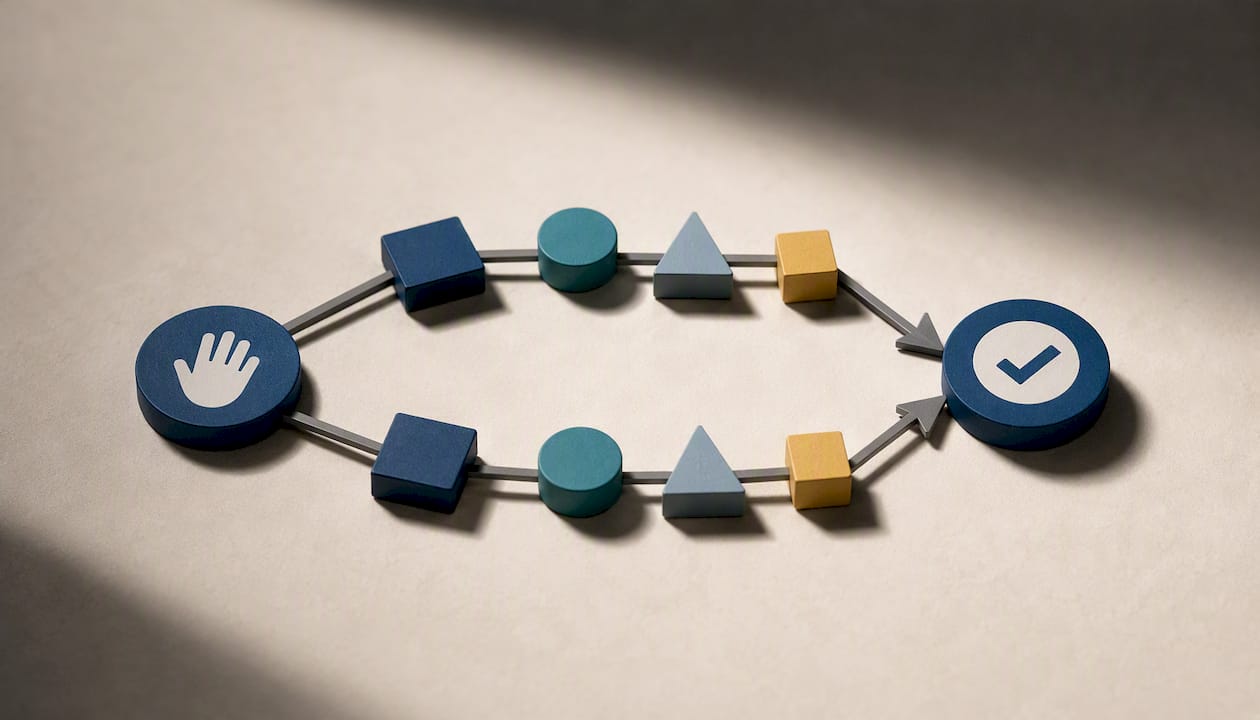
AHRQ’s guidance recommends pairing new auditors with experienced ones during early implementation, comparing met and not-met rates side by side, and retraining when scores drift apart. This inter-rater reliability check is not a formality. It is the difference between a compliance rate you can trust and one you can’t defend to a surveyor.
A few practices separate audit programs that staff actually cooperate with from ones they quietly resent:
- Use unannounced observations for accuracy, but never withhold intervention if you see an immediate resident safety risk.
- Deliver feedback privately and in writing, never as a public correction in front of residents or coworkers.
- Document every feedback conversation, both for consistency and for your own QAPI trail.
- Rotate non-clinical staff, quality coordinators, or administrative team members into the auditor role to reduce the “watched” effect and spread the workload beyond one overworked infection preventionist.
Pro Tip: If the same three staff members always seem to fail the same line item, stop assuming it’s a training problem before you check the environment. A missing supply cart or an awkward sink placement often explains more “non-compliance” than any knowledge gap ever will.
How Mobile Task Platforms Speed Up Audit-to-Action Workflows
The gap between finding a problem and fixing it is where most audit programs quietly lose momentum. Paper checklists sit in a binder for a week before anyone transcribes them into a spreadsheet, and by then the corrective action has lost its urgency.
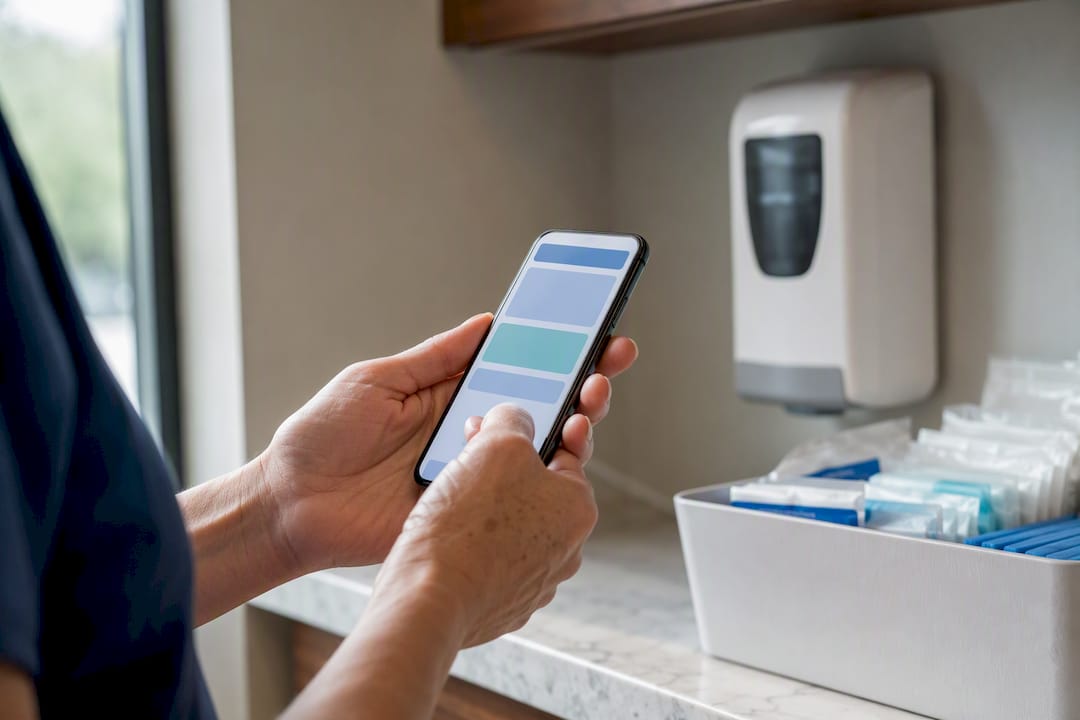
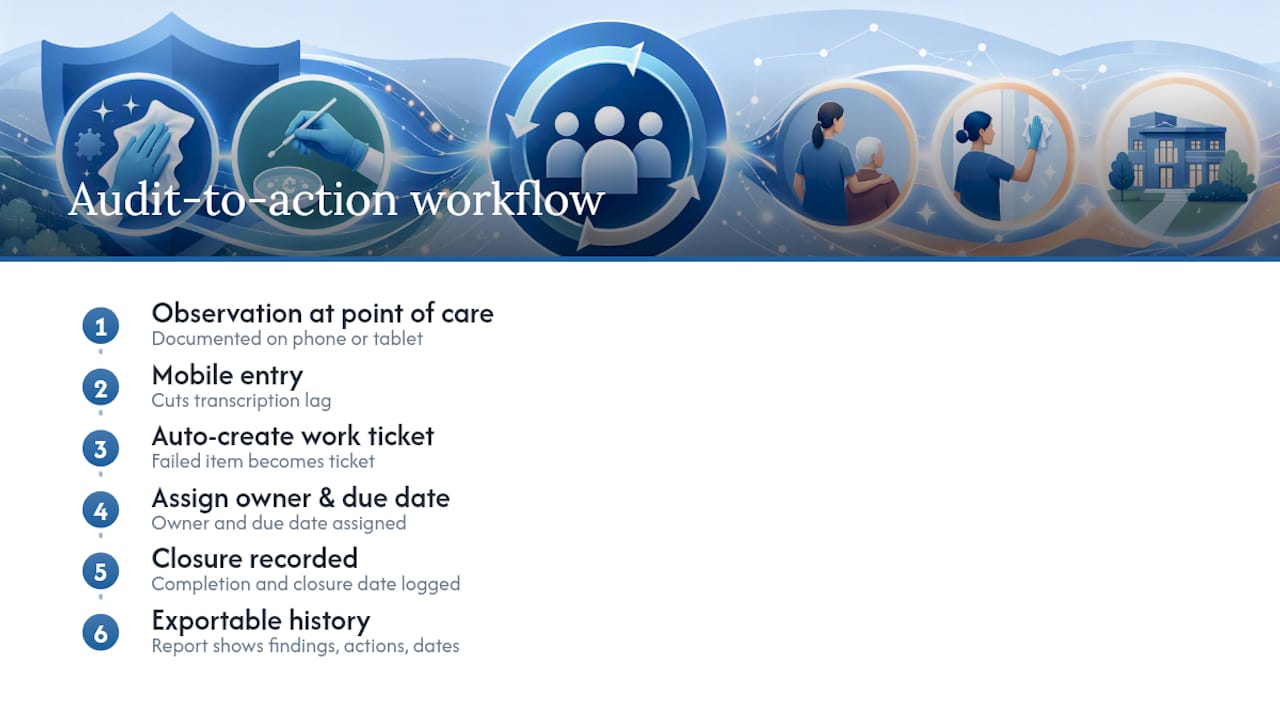
Mobile-first platforms close that gap by letting auditors enter observations on a phone or tablet at the point of care, which cuts the transcription lag between watching a missed step and documenting it. Myltcapps supports this workflow by turning a failed audit line item directly into an assigned work ticket with an owner and a due date, rather than leaving it as a note that has to be manually reassigned later.
Seeded compliance libraries and exportable reports also matter when a surveyor shows up unannounced. Being able to pull a documented history of audit findings, assigned corrective actions, and closure dates gives your team something concrete to hand over instead of reconstructing a timeline from memory.
What Legal and Regulatory Requirements Apply to Infection Control Audits?
Infection control audits aren’t just a quality-improvement nicety. They connect directly to federal certification requirements for skilled nursing facilities.
CMS requires certified nursing facilities to maintain an infection prevention and control program (IPCP) as part of the Requirements of Participation, and that program is expected to include ongoing surveillance and audit activity, not a one-time policy review. Multisociety guidance for nursing homes builds on this by recommending an annual IPC risk assessment that identifies which practices carry the highest resident risk and therefore deserve audit priority.
Facilities are also expected to have a designated infection preventionist with sufficient time and administrative support to run this program, a detail surveyors check for specifically. An audit program with no named owner, no documented schedule, and no evidence of corrective action is a common survey deficiency, even when individual staff members are technically following procedure most of the time.
State survey agencies vary somewhat in how they weigh audit documentation, so facilities should treat the federal IPCP requirement as the floor, not the ceiling, and confirm any state-specific expectations with their own regulatory contacts. What holds true everywhere is this: an audit that never produces a documented corrective action, and a corrective action that never gets re-audited, both represent gaps a surveyor is trained to find. Keeping audit records, feedback logs, and remediation tickets in one retrievable system, digital or paper, is what actually satisfies this requirement during a survey, not the audit itself in isolation.
What Are the Biggest Barriers to Running Consistent Infection Control Audits?
Ask any infection preventionist running a solo program and you’ll hear the same three complaints: no time, no consistent staff to audit with, and no clean way to turn a stack of paper forms into a trend line leadership will actually look at.
Understaffing is the most common barrier. Most facilities have one infection preventionist splitting time across surveillance, education, and outbreak response, leaving little room for the weekly observation rounds AHRQ recommends. Rotating trained non-clinical staff into the auditor role, as covered above, is the most practical fix, since it doesn’t require hiring anyone new.
Staff resistance is the second barrier, and it’s usually a framing problem rather than a personality one. When audits feel like a “gotcha” exercise, compliance data gets quietly gamed: staff perform correctly only when they know they’re being watched. AHRQ’s guidance frames audits as collaborative improvement work rather than policing, and facilities that adopt that language consistently, in training and in feedback conversations, see less pushback than ones that treat audits as disciplinary tools.
The third barrier is data fragmentation. Paper forms that sit in a binder for two weeks before anyone tallies a compliance rate make it nearly impossible to catch a slipping trend before it becomes a survey finding. Digitizing the observation form itself, even a simple mobile checklist, closes most of that gap without requiring a full software overhaul.
How Do Digital Systems and EHRs Support Infection Control Audits?
Electronic health records were never built for infection control auditing, and that mismatch causes real friction. An EHR tracks resident-level clinical documentation; it wasn’t designed to log whether a specific staff member performed hand hygiene correctly at 2:14 p.m. on a Tuesday.
That’s where purpose-built compliance and task platforms fill the gap the EHR leaves open. Rather than replacing clinical charting, these tools sit alongside it, capturing observational audit data, assigning corrective work tickets, and generating the kind of surveyor-ready export a compliance manager needs on short notice. Integrating audits with task-management software that supports assigned remediation reduces the time between finding a problem and closing it, and leaves a documented trail that holds up under survey scrutiny.
The practical integration point most facilities miss is connecting audit findings to existing facility assessment documentation. If your ICAR-style baseline already lives in a digital system, tying observational audit results to the same platform means leadership can see structural gaps and behavioral gaps side by side instead of cross-referencing two separate binders. For environmental cleaning specifically, a digital housekeeping checklist that maps directly to your EVS audit line items removes a layer of manual translation between what the auditor observed and what the cleaning staff is actually assigned to fix.
None of this requires abandoning your EHR. It requires accepting that clinical charting and operational compliance tracking are different jobs, and pretending one tool can do both usually means neither gets done well.
Official Tools and Guidance Worth Bookmarking
Keep these close: the CDC ICAR toolkit for facility-wide system assessments, AHRQ’s observational audit guidance and its downloadable toolkit for sampling and forms, the CDC’s Module 1 facilitator guide for cleaning audit techniques, and the multisociety nursing home guidance for governance and risk prioritization. Facilities managing documentation workflows more broadly may also find value in this clinical documentation improvement guide.
Ready to Close the Gap Between Audit and Action?
The audit itself has never been the hard part. Any facility can hand a clipboard to a nurse and count hand hygiene moments for an hour. What separates a functioning infection prevention program from a paper exercise is what happens in the 48 hours after that clipboard gets turned in, and that’s exactly where most programs fall apart.
Myltcapps was built around that specific gap. Its compliance task and checklist platform lets auditors log findings from a phone at the point of observation and turns a failed line item into an assigned work ticket with an owner and a due date, instead of a note that waits a week to become anyone’s problem. For environmental cleaning follow-up specifically, the EVS task management tools route corrective cleaning tasks straight to housekeeping staff with a trackable closure date. Facilities in Kansas can see how this fits KDADS expectations through Myltcapps’s Kansas-specific long-term care resources.
None of this replaces your infection preventionist’s judgment or your clinical documentation systems. It just makes sure a finding from Tuesday’s audit doesn’t quietly disappear before Friday’s leadership meeting.
The Real Problem With Most Audit Programs
Most infection control audit programs don’t fail because facilities pick the wrong tool. ICAR and AHRQ’s observational audit guidance are both freely available, well documented, and genuinely good. Programs fail because they treat the audit as the finish line instead of the starting gun.
The conventional advice, audit regularly, train your staff, document everything, is correct and also nearly useless without a mechanism that forces a failed line item into a tracked, deadlined action. I’ve seen the pattern repeat across every facility type: compliance rates get measured faithfully for months, dashboards look reasonable, and yet the same three line items fail quarter after quarter because nobody owns the fix.
If you take one thing from this guide, take this: prioritize the corrective-action loop before you obsess over sampling methodology. A facility running imperfect weekly samples with a hard rule that every failed item gets a named owner and a re-audit date will outperform a facility running textbook-perfect sampling that ends in a filed PDF nobody reopens. The audit tools are not the bottleneck anymore. The follow-through is, and that’s the part worth fixing first.
— Philip
This article is general information, not a substitute for advice from a qualified doctor. Consult a qualified healthcare professional about your own circumstances before acting on anything here.
Sources
- ICAR Infection Control Assessment and Response tools (CDC)
- Auditing strategies to improve infection prevention (AHRQ)
- Audit and feedback improves infection control outcomes (PMC review)
- Multisociety guidance for infection prevention and control in nursing homes (SHEA/Multisociety)