Best GoCanvas Alternatives for Long-Term Care Facilities

Best GoCanvas Alternatives for Long-Term Care Facilities
For long-term care administrators evaluating GoCanvas alternatives, the short answer is this: a general-purpose forms builder won’t cut it in a survey-driven environment; you need a mobile-first platform with built-in HIPAA compliance, defensible audit trails, and staffing features that hold up when a state inspector walks through the door unannounced. The strongest LTC-focused option on this shortlist is Myltcapps, purpose-built for skilled nursing and long-term care workflows.
Why does specialization matter here? Facilities prioritize functional depth, interoperability, and segment fit over price when selecting operational software. Survey readiness, EHR interoperability, frontline usability, and signed Business Associate Agreements aren’t nice extras — they’re the baseline.
Top GoCanvas alternatives for LTC facilities:
- Myltcapps — LTC-specific suite with seeded compliance libraries, meeting sign-in, task management, and surveyor-ready exports; recommended for SNFs and nursing homes
- ProntoForms — enterprise mobile forms with workflow automation; strong API integrations but no LTC-specific compliance modules
- SafetyCulture (iAuditor) — inspection and audit platform with solid offline capability; general-purpose, limited LTC staffing features
- Forms On Fire — flexible form builder with offline sync and PDF output; requires heavy customization for LTC compliance use cases
- Device Magic — mobile forms with dispatch and routing; suited to field operations, not purpose-built for care environments
Table of Contents
- How do these GoCanvas alternatives compare for LTC priorities?
- What should you evaluate when choosing a GoCanvas replacement?
- Which LTC features actually predict success after go-live?
- What does implementation actually cost and how long does it take?
- How do you migrate from GoCanvas and integrate with your EHR?
- Key Takeaways
- Why specialist tools win in long-term care environments
- Myltcapps gives LTC facilities a purpose-built alternative
- Useful sources for procurement and compliance planning
How do these GoCanvas alternatives compare for LTC priorities?
| Dimension | Myltcapps | ProntoForms | SafetyCulture | Forms On Fire | Device Magic |
|---|---|---|---|---|---|
| Best for | SNFs, nursing homes, multi-facility LTC operators | Mid-large enterprise, field ops | Multi-site inspections, safety teams | Custom form workflows, SMBs | Field service, logistics |
| Mobile UX & offline | Phone-first; offline capable | Strong mobile; offline sync | Strong mobile; offline mode | Good offline sync | Offline capable |
| EHR interoperability | API-based; LTC workflow integrations | REST API; no HL7/FHIR native | API available; no HL7 native | API; no EHR-specific connectors | API; no EHR focus |
| Survey readiness & audit trails | Seeded QAPI/HIPAA libraries; surveyor-ready exports | Configurable audit logs | Inspection reports; general audit | Configurable; requires build-out | Basic audit logs |
| Staffing & training features | Meeting sign-in, in-service tracking, competency logs | Limited | Limited | None native | None |
| BAA / HIPAA | BAA available; HIPAA-focused design | BAA available | BAA available | BAA available | BAA available |
| PDF export & editing | Built-in PDF editor and export | PDF export | PDF export | PDF export | PDF export |
| Pricing model | Per facility/module; pilot available | Per user; enterprise pricing | Per user/seat | Per user | Per user |
| Implementation time | Guided onboarding; short pilot path | Weeks to months | Days to weeks | Days to weeks | Days to weeks |
| Multi-facility scalability | Yes; designed for corporate LTC groups | Yes | Yes | Yes | Limited |
Best-fit summary:
- Small or rural SNF in Kansas — Myltcapps or a lightweight general platform; Myltcapps wins on KDADS-ready compliance and no-IT-department setup
- Multi-facility operator needing corporate dashboards — Myltcapps scales across facilities with unified reporting
- Facilities prioritizing staffing sufficiency documentation — Myltcapps is the only option on this list with native meeting sign-in and in-service tracking built for survey defense
What should you evaluate when choosing a GoCanvas replacement?
Start with six non-negotiables before you open a single demo: survey readiness, frontline mobile UX, EHR interoperability, BAA handling, staffing sufficiency features, and offline capability. Selection experts recommend involving CNAs and floor nurses in demos — not just administrators — because adoption lives or dies with the people using it under time pressure.
Evaluation criteria to rate during demos:
- Survey readiness — Can the platform produce a complete, timestamped audit trail for a specific resident or incident within two minutes? Ask for a live demo of this exact scenario.
- Frontline usability — Can a CNA complete a task or sign into a meeting in under 30 seconds on their personal phone? Time it.
- EHR interoperability — Does the vendor support REST API, HL7, or FHIR feeds to your existing EHR? Get this in writing, not a roadmap promise.
- BAA and HIPAA posture — Is a signed BAA standard in their contract, or an add-on? Review their HIPAA compliance documentation before the demo ends.
- Staffing features — Does the platform track in-service hours, meeting attendance, and competency logs in a format surveyors can review on-site?
- Offline capability — How many records does offline mode hold? What happens to data when connectivity is restored — is there a conflict log?
Demo questions to ask every vendor:
- What is your documented onboarding timeline from contract to go-live?
- How long do audit trail records persist, and can we export them on demand?
- Do you have current LTC or SNF customer references we can contact?
- What does your BAA cover, and does it extend to subprocessors?
- How do you handle a CMS survey request for documentation produced in your platform?
Pilot plan template: Run a 30-day pilot with one unit or department. Define success as: adoption rate above 80% among frontline staff, measurable reduction in paper-based documentation time, and at least one surveyor-ready report generated without administrator intervention.

Which LTC features actually predict success after go-live?
Survey-ready audit trails, meeting and in-service tracking, competency logs, vendor BAA management, and seeded compliance libraries are the features that separate functional LTC platforms from generic form builders. Operators are investing in tools that keep facilities survey-ready at any moment and produce defensible staffing analytics — not superficial dashboards.
Why each feature matters:
- Seeded compliance libraries (HIPAA, QAPI, Section 1557, dietary, emergency prep) eliminate the build-from-scratch problem. A general-purpose tool gives you a blank form; an LTC platform gives you a pre-mapped QAPI workflow.
- Meeting sign-in and in-service tracking — when a surveyor asks for proof of staff training on infection control, a timestamped digital sign-in log beats a paper sheet every time. This is one of the fastest wins a new platform can deliver.
- Competency logs tied to individual staff records reduce the risk of a staffing deficiency citation when turnover is high, which it consistently is across the industry.
- Vendor BAA management — centralizing BAAs, training tracking, and vendor expiration dates in one platform replaces the spreadsheet-and-email approach that creates compliance gaps during audits.
Before/after workflow example: A 90-bed SNF running paper sign-in sheets for monthly in-service training switches to a mobile platform. Before: administrator manually collects sheets, scans them, and files them. During a survey, locating proof for a specific staff member takes 20–30 minutes. After: digital sign-in is timestamped and searchable. The same proof takes under two minutes to pull.
Pro Tip: Require vendors to include data retention period, BAA language covering subprocessors, and a documented onboarding timeline in the contract — not just the sales deck. If a vendor won’t commit these to writing, that tells you something.
What does implementation actually cost and how long does it take?
Expect a 20–30% productivity decline in the first two to three weeks after go-live. Budget for it explicitly rather than treating it as a surprise. Shorter pilots — one unit, 30 days — prove adoption before you commit to a full rollout.
Typical implementation phases:
- Planning (1–2 weeks) — requirements mapping, EHR integration scoping, BAA execution
- Configuration (1–2 weeks) — form/workflow setup, compliance library customization, user provisioning
- Training (3–5 days) — administrator training, then frontline staff training by unit
- Pilot (30 days) — one unit or department; measure adoption, time saved, audit-readiness
- Full rollout (2–4 weeks) — phased by unit or facility; parallel run with old system during transition
Cost drivers to include in your budget:
- Per-facility and per-module subscription fees
- Per-user pricing tiers as headcount scales
- Integration costs for EHR API connections or HL7 feeds
- Data migration from existing forms or GoCanvas exports
- Training time (staff hours, not just vendor fees)
- Ongoing support tier — is LTC-specific support included or an add-on?
Watch for hidden fees around data export, additional storage, or compliance library updates. Ask vendors directly whether compliance content updates are included in the base subscription.
How do you migrate from GoCanvas and integrate with your EHR?
The most reliable integration approaches are API-based sync for modern EHRs, HL7/FHIR feeds where the EHR supports them, and CSV or structured extracts for legacy systems. Many facilities already have documentation systems but struggle with adjacent workflows — authorization visibility, referral management, and transition-of-care data integrity — so integration scope matters.
Integration checklist:
- Confirm API access credentials and sandbox/test environment availability before contract signing
- Map data fields between your EHR and the new platform; document every field that requires transformation
- Confirm the vendor’s BAA covers all integration touchpoints, including subprocessors
- Test in a non-production environment with real (de-identified) data before cutover
- Define vendor vs. facility responsibilities for ongoing integration maintenance in writing
Migration phases:
- Export all existing GoCanvas forms, templates, and historical data in a portable format (CSV, PDF, or JSON)
- Import and validate in the new platform’s test environment; confirm field mapping accuracy
- Run both systems in parallel for two to four weeks; flag discrepancies in audit trail records
- Execute cutover on a low-census day or shift change; communicate the timeline to all staff 48 hours in advance
- Post-migration: validate that audit trails are complete, offline data has synced correctly, and no records were dropped during transfer
For rural facilities with limited IT support, choose a vendor that handles migration configuration directly rather than handing you a technical guide and a support ticket queue.
Key Takeaways
For LTC administrators, the right GoCanvas replacement is the one that survives a surprise survey, not just a demo.
| Point | Details |
|---|---|
| Prioritize LTC-specific features | Survey-ready audit trails, staffing logs, and seeded compliance libraries outperform generic form builders in regulated care environments. |
| Budget for the productivity dip | Implementation typically causes a productivity decline in the first few weeks; plan a one-month single-unit pilot before full rollout. |
| Involve frontline staff in demos | CNAs and floor nurses determine adoption; if they can’t complete a task in under 30 seconds, the platform will fail regardless of admin features. |
| Require BAA and data retention in writing | Verbal commitments on HIPAA coverage and audit trail retention don’t hold up during a CMS survey — get them in the contract. |
| Myltcapps for LTC-focused operations | Myltcapps offers seeded compliance libraries, meeting sign-in, and surveyor-ready exports designed specifically for SNFs and nursing homes. |
Why specialist tools win in long-term care environments
The conventional wisdom in software selection is that a flexible, configurable platform beats a narrow one because you can build whatever you need. In long-term care, that logic breaks down fast. The problem isn’t that general-purpose tools lack features — it’s that they require someone to build and maintain the compliance logic that LTC-specific platforms ship pre-loaded. In a facility where the administrator is also handling HR, family calls, and a pending survey, “configurable” often means “never configured.”

The meeting sign-in example is worth sitting with. A paper sign-in sheet for monthly in-service training looks fine until a surveyor asks for proof that a specific CNA completed infection control training before a resident incident. Locating, scanning, and presenting that documentation under survey pressure is a real operational risk. A timestamped digital log that’s searchable by staff name and date eliminates that risk entirely — and it takes under 30 seconds per staff member to capture.
High turnover is the other factor that reshapes vendor selection. When a facility turns over 50–70% of frontline staff annually, every new hire is a software training event. A platform that requires a 20-minute onboarding session will be used inconsistently. One that a CNA can learn in two minutes on their own phone gets used. That’s not a UX preference — it’s a compliance outcome.
Myltcapps gives LTC facilities a purpose-built alternative
Most GoCanvas replacement options hand you a blank canvas and expect your team to build compliance logic from scratch. Myltcapps ships with it already in place—seeded HIPAA, QAPI, Section 1557, dietary, and emergency prep libraries; daily compliance checklists built for survey defense; meeting sign-in and in-service tracking that produces surveyor-ready exports in minutes; and a built-in PDF editor so documentation doesn’t require a separate tool.
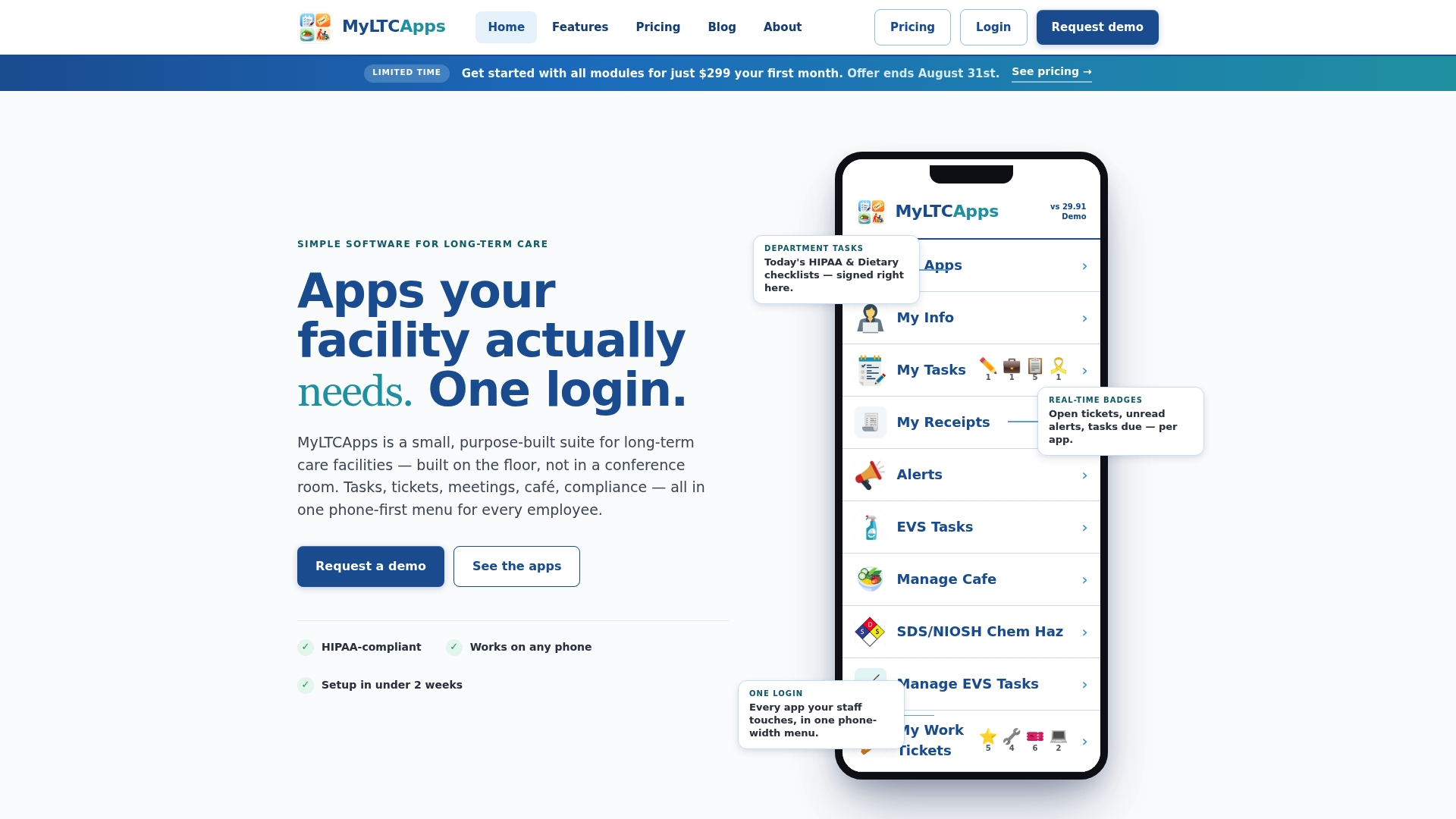
For Kansas facilities, Myltcapps is designed for KDADS-ready compliance — not a generic platform retrofitted for your state’s requirements. The module suite covers tasks, EVS, work tickets, cafeteria and dining, staff directory, shift scheduling, and incident reporting, all accessible from a personal phone with no IT department required.
Start with a 30-day pilot on one unit. Measure adoption rate, time saved on documentation, and whether your team can pull a surveyor-ready report without administrator involvement. Request a demo at myltcapps.com to scope the pilot for your facility size and compliance priorities.
Useful sources for procurement and compliance planning
- CMS Long-Term Care Survey Process — primary regulatory reference for survey readiness requirements; cite in procurement documents when justifying audit trail specifications.
- LeadingAge EHR Selection Primer — walks LTC providers through EHR must-have attributes and the CAST EHR Selection Matrix; useful for interoperability and integration scoping.
- HIPAA Compliance for Nursing Homes (ComplyMD) — practical guidance on BAA requirements, vendor vetting, and HIPAA operational practices specific to SNFs.
- Skilled Care Journal: LTC Tech Budget Shifts — industry survey data on how facilities are prioritizing modular, targeted tools over large platform upgrades.
- Long-Term Care Software Selection Guide (ToolsInfo) — comparison framework for matching platform scope to facility size and support needs; useful for rural vs. multi-site decisions.
- Healthcare compliance vendor alternatives (ScanCompliant) — third-party review of compliance platform alternatives; useful background for demo questions and pilot design in regulated care settings.