Survey Ready Elopement Playbook for U.S. Nursing Homes
Survey Ready Elopement Playbook for U.S. Nursing Homes
An elopement policy must accomplish one thing above all else: stop a resident from leaving the building or a safe area unnoticed, and if it happens anyway, catch it fast. Under F‑689, that means documented risk screening, layered supervision, and a response protocol that gets the resident found within minutes, not hours. Success looks like a fast recovery, a clean incident record, and evidence the facility already had controls in place before the door alarm ever sounded.
TL;DR:
- Facilities must conduct regular risk reassessments for wandering residents at admission, 72 hours, quarterly, and after significant condition changes, with precise interventions for high-risk individuals.
- Alarm testing, staff assignment verification, and scenario variation in drills are essential to demonstrate ongoing prevention measures and reduce the likelihood of citations and incidents.
- Immediate response to a missing resident requires rapid role assignment, expanding search rings, and escalation to authorities within minutes, not hours, to improve recovery outcomes.
- Recordkeeping of alarms, drills, and incident analyses should be comprehensive, timestamped, and easily accessible via automated software to ensure compliance during inspections.
- A systematic approach integrating policies, staff training, technology, and documentation minimizes legal liabilities and supports continuous improvement in preventing elopements.
Table of Contents
- How Federal Rules Define Elopement Policy in Nursing Homes
- When to Run an Elopement Risk Assessment
- Building Layered Elopement Prevention Across the Facility
- What to Do in the First Minutes After a Resident Is Missing
- Documentation, RCA, and QAPI After an Elopement Event
- Running Elopement Drills That Actually Test Readiness
- Templates and Resources for a Survey-Ready Elopement Policy
- Legal Liability When Elopement Policies Fail
- Talking to Residents and Families About Elopement Risk
- Balancing Resident Rights With Elopement Prevention
- Fitting Elopement Policy Into Broader Emergency Preparedness
- Case Examples That Show What Works
- Why Elopement Prevention Only Works as a System
- Keeping Elopement Prevention Evidence Ready for Any Survey Date
- Sources
How Federal Rules Define Elopement Policy in Nursing Homes
CMS defines elopement as a resident leaving the facility premises or a safe, defined area without staff knowledge, and it evaluates that failure under the accident and supervision requirement at 42 C.F.R. §483.25(d), tagged as F‑689 in the State Operations Manual. Care planning obligations under §483.21 run alongside it, requiring measurable, person-centered interventions for anyone flagged as a wandering risk.
Appendix Q is where the stakes get real. Surveyors use it to determine Immediate Jeopardy, and elopement cases climb to that level fast when certain conditions show up:
- A disabled or unresponded-to exit alarm
- A resident with known high wander risk left unsupervised during a peak-risk window
- No search initiated within a reasonable time after the resident was noticed missing
- A prior near-miss that went undocumented and uncorrected
A single broken door alarm, paired with a known high-risk resident, is often enough on its own to trigger an Immediate Jeopardy finding. Your written policy should state plainly how residents are screened, how alarms are tested, and how staff respond within a defined time window. Vague language (“staff will monitor as needed”) is exactly what surveyors flag first.
When to Run an Elopement Risk Assessment
Risk assessment isn’t a one-time form filed at admission and forgotten. CMS interpretive guidance under §483.21 expects reassessment at four checkpoints: on admission, within 72 hours, quarterly, and whenever a resident’s condition changes significantly.
A solid elopement risk assessment captures more than a diagnosis checkbox. It should screen for:
- Cognitive status, including dementia or delirium diagnoses
- History of wandering, exit-seeking behavior, or prior elopement attempts
- New medications affecting alertness or mobility
- Expressed intent to leave, or agitation tied to specific times of day
Once a resident screens as high risk, the care plan needs specifics, not generalities. Good language reads like this: “Resident checked visually every 30 minutes during 3 to 7 p.m. window; door alarm assigned; redirect to structured activity before attempting least-restrictive intervention.” Residents with Alzheimer’s disease or a related dementia make up a large share of high-risk cases, and clinical guidance from the National Institute on Aging supports building interventions around the individual’s specific triggers rather than a blanket protocol applied to every wanderer on the unit.
Building Layered Elopement Prevention Across the Facility
No single control stops elopement. Effective policies stack several, so a failure in one layer gets caught by the next.
- Environment. Delayed-egress doors, working alarms on all exterior exits, adequate lighting in corridors, and sightlines that let staff see hallways from nursing stations without walking the full length of the unit.
- Staffing patterns. Coverage gaps show up most at shift change, during mealtimes, and when residents are transported to appointments. Assignment sheets should name who covers high-risk residents during those windows specifically.
- Clinical and behavioral care. Redirection, structured activity schedules, and addressing the why behind exit-seeking behavior (boredom, pain, disorientation) work better long term than restraint-first thinking, and regulators expect the least-restrictive option tried first.
- Technology as a backup, not a substitute. Wander guards, wearable tags, and door alarms only work if staff respond to them immediately. Texas Health and Human Services guidance is explicit that alarms assist supervision, they never replace it. A device that beeps into an empty hallway does nothing.
- Testing and maintenance cadence. Door alarms and wander tags need a documented test schedule, not an assumption that they work because they worked last month.
Pro Tip: Run your alarm test log and your staff assignment sheet side by side once a month. If the two don’t match, meaning the resident assigned an alarm isn’t actually the one flagged high risk on the current care plan, that gap is exactly what surveyors find first.
Peer-reviewed work on wandering interventions backs this layered approach, showing that system-level changes to staffing and environment correlate with fewer incidents than any single device or protocol change alone.
What to Do in the First Minutes After a Resident Is Missing
Speed matters more than almost anything else once a resident is discovered missing. A written elopement response plan removes the guesswork under pressure.
- Assign roles immediately. One staff member searches the building and immediate grounds, one checks the last known location and reviews camera footage if available, and a charge nurse or supervisor coordinates and starts the clock.
- Search in expanding rings. Start at the last-seen location, move outward, and check high-risk spots first: exits, stairwells, parking areas, and anywhere the resident has wandered before.
- Call 911 if the resident isn’t located within the facility’s defined window, typically a matter of minutes, not an hour of internal searching first.
- Notify the attending physician and resident representative as soon as the search escalates beyond the immediate building.
- Report to the state survey agency when the event meets your state’s reportability threshold, generally serious injury, death, or any resident missing 24 hours or more. Reporting requirements vary by state, so confirm your specific threshold with your state health department rather than assuming a national standard applies uniformly. AHRQ’s patient safety review of elopement cases underscores why the clock matters clinically, not just legally: outcomes worsen the longer a resident goes unrecovered.
Documentation, RCA, and QAPI After an Elopement Event
Surveyors don’t just want to know what happened. They want to see what the facility learned. That starts with a complete incident log.
- Time the resident was last seen, and time discovered missing
- Full search timeline with who did what and when
- Condition of the resident on recovery, including any injury
- Notifications made (physician, family, state agency) with timestamps
- Photos and alarm/device test logs from the preceding weeks
Root Cause Analysis takes that raw data and asks why the gap existed. Was the alarm disabled? Was staffing thin during that shift? Was the care plan outdated? A properly run RCA turns findings into specific care-plan updates rather than a generic “staff reminded to monitor” note. Treating an elopement as a system failure rather than a one-off mistake is the single strongest signal to surveyors that a facility takes prevention seriously, and it’s the difference between a citation that closes and one that recurs.
| Documentation element | What surveyors check for |
|---|---|
| Incident log completeness | Timestamps, search actions, recovery condition |
| RCA findings | Specific cause identified, not vague explanation |
| Care plan revision | Updated within days of the event, not weeks |
| QAPI tracking | Trend data across incidents, staff education records |
Your QAPI program is where these individual RCAs turn into facility-wide learning, tracking whether the same root cause keeps showing up across different residents or shifts.
Running Elopement Drills That Actually Test Readiness
A drill that always goes the same way teaches staff nothing new. Vary the scenario.
- Schedule drills quarterly at minimum, and rotate scenario types: an unnoticed exit during shift change, a wander alarm that fails to sound, a near-miss caught by a dietary aide rather than nursing staff.
- Pull in every department that touches the building, not just nursing. Maintenance confirms alarm function, dietary and housekeeping staff practice recognizing and reporting wandering behavior, and administration times the response.
- Log every drill the same way you’d log a real event, capturing response time, gaps identified, and corrective follow-up.
Those drill records become part of your staff competency file and feed directly into QAPI trend reports. A structured onboarding checklist that includes elopement response training from day one keeps new hires from becoming the weak link surveyors find first.
Templates and Resources for a Survey-Ready Elopement Policy
A workable policy needs plain-language checklist items surveyors can verify on the spot, not paragraphs of legal hedging. Useful snippets include a photo-ID log updated at admission and after any appearance change, a dated alarm-test record for every exterior door, and a search-timeline template with fields already built in for last-seen time and notification calls.
For deeper reference, CMS’s Appendix Q guidance and state toolkits like Texas HHS’s elopement prevention resource lay out practical checklist language, and the VA’s wandering risk toolkit offers a useful cross-check for identification and response steps.
- Photo ID log, refreshed at admission and after appearance changes
- Alarm and wander-tag test log with dated entries
- Search timeline template with notification fields pre-built
- RCA form tied directly to care-plan revision fields
Operational software helps here mainly by keeping these records consistent and pullable on demand. A tool built around mobile checklists and compliance tracking, the category MyLTCApps operates in, can hold alarm test logs, drill records, and RCA follow-up items in one place for a survey pull, without functioning as a clinical charting system.
Legal Liability When Elopement Policies Fail
Elopement cases carry real legal exposure beyond a survey citation. Facilities have faced negligence claims, wrongful death suits, and civil penalties when a resident died or suffered serious injury after leaving unsupervised, particularly when the record shows a known risk that went unaddressed.
Plaintiff attorneys in these cases focus on three things: whether the facility knew the resident was a wander risk, whether the care plan reflected that risk with specific interventions, and whether staff followed the plan on the day of the incident. A care plan that says “monitor closely” with no defined frequency is a liability on its own, since it gives the facility nothing concrete to point to in its own defense.
Civil monetary penalties from CMS stack on top of any lawsuit, and repeat citations for the same deficiency type escalate penalty amounts substantially. A facility cited for F‑689 twice within a short window faces a much steeper financial and reputational hit than one that shows a documented corrective action after the first event.
The legal risk isn’t really about whether an elopement happens. Even well-run facilities have near-misses. It’s about whether the documentation shows the facility recognized the risk, planned for it specifically, and responded the way its own policy promised. That paper trail, built consistently before anything goes wrong, is what turns a difficult incident into a defensible one instead of an indefensible one.
Talking to Residents and Families About Elopement Risk
Families often find out their loved one is a wander risk only after a scare, and that timing damages trust. Bringing it up earlier, as part of the standard care-planning conversation, changes the relationship entirely.
When a resident screens as elopement risk, tell the family directly what that means in practice: what supervision looks like, what technology is in place, and what the facility’s response protocol is if something happens anyway. Vague reassurance (“we keep a close eye on everyone”) doesn’t hold up well later and doesn’t actually inform anyone.
Documentation matters here too. Care plan meetings should note that elopement risk and prevention measures were discussed with the resident representative, with a date attached. That single line protects the facility and, more importantly, keeps the family genuinely informed rather than caught off guard.
Some families push back on supervision measures they see as restrictive, particularly with residents who retain decision-making capacity. That’s a real tension, and the answer isn’t to override family concerns unilaterally. It’s a conversation about specific risk factors, specific incidents if any have occurred, and specific alternatives tried. Families who understand the reasoning behind a wander guard or a locked unit tend to cooperate more than families told simply that it’s policy.
Balancing Resident Rights With Elopement Prevention
Nursing home residents retain the right to move freely and make their own decisions, and that right doesn’t disappear because a resident carries a dementia diagnosis. The tension between autonomy and safety is real, and a heavy-handed policy creates its own problems, including citations for excessive restriction of resident rights.
The regulatory answer, consistently, is least-restrictive intervention first. Before a facility locks a unit or assigns a wander guard, it should document what less restrictive options were tried: redirection, structured activity, addressing the underlying cause of exit-seeking behavior. A resident who wanders because of afternoon boredom needs a different intervention than one wandering because of disorientation at dusk, and treating both the same way with a blanket restriction ignores the actual clinical picture.

This is where individualized care planning does real work instead of just satisfying a paperwork requirement. A resident with mild cognitive impairment and full decision-making capacity has different rights than one with advanced dementia who can no longer recognize danger. Policies that apply the same restriction level across an entire unit, rather than tailoring to individual risk and capacity, tend to draw both regulatory criticism and family complaints.
Getting this balance right isn’t a one-time decision. It’s revisited every time a care plan is reassessed, because a resident’s capacity and risk level can shift, sometimes in either direction, over weeks or months.
Fitting Elopement Policy Into Broader Emergency Preparedness
Elopement policy shouldn’t sit in isolation from a facility’s overall emergency preparedness plan. Both rely on the same core capabilities: fast staff communication, clear role assignments, and reliable documentation under pressure.
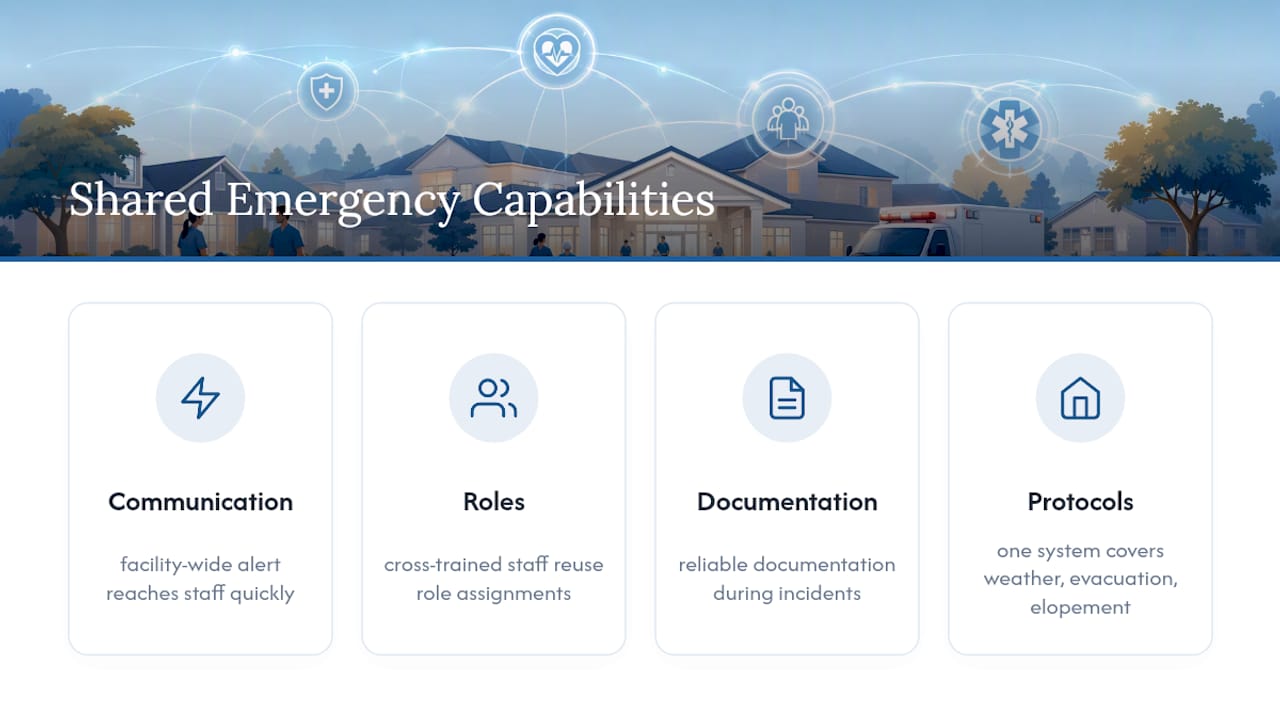
A facility’s emergency preparedness plan already covers evacuation, severe weather, and utility failures. Elopement response fits naturally alongside those protocols because it draws on the same infrastructure: an alert system that reaches staff quickly, a communication chain to notify family and physicians, and a command structure that designates who’s in charge when something goes wrong.
Facilities that build these systems separately end up duplicating effort and creating confusion about which protocol applies when. A facility-wide alert and communication system that already handles weather alerts or facility emergencies can carry elopement notifications too, so staff aren’t relearning a new tool in the middle of a crisis.
Cross-training also pays off here. Staff who drill for severe weather evacuation already understand role assignment under pressure, and that same muscle memory transfers directly to an elopement search. Facilities that treat these as one integrated preparedness function, rather than a stack of separate binders, tend to respond faster because staff aren’t hunting for the right protocol while the clock is running.
Case Examples That Show What Works
A facility that reduced repeat elopement incidents typically shares a few traits: a risk assessment that actually changes the care plan, not just a checkbox exercise; alarm testing on a fixed schedule with a paper trail; and a drill program that varies its scenarios instead of repeating the same walkthrough every quarter.
Consider the pattern regulators see in facilities that pass survey cleanly on this deficiency category. The care plan for a high-risk resident names specific observation frequency, not a vague “monitor closely.” The alarm log shows tests happening on schedule, not just after something goes wrong. And when a near-miss occurs, the RCA produces a specific, documented change, whether that’s reassigning a staff member’s rounds or replacing a faulty door sensor, rather than a generic reminder to “be more vigilant.”
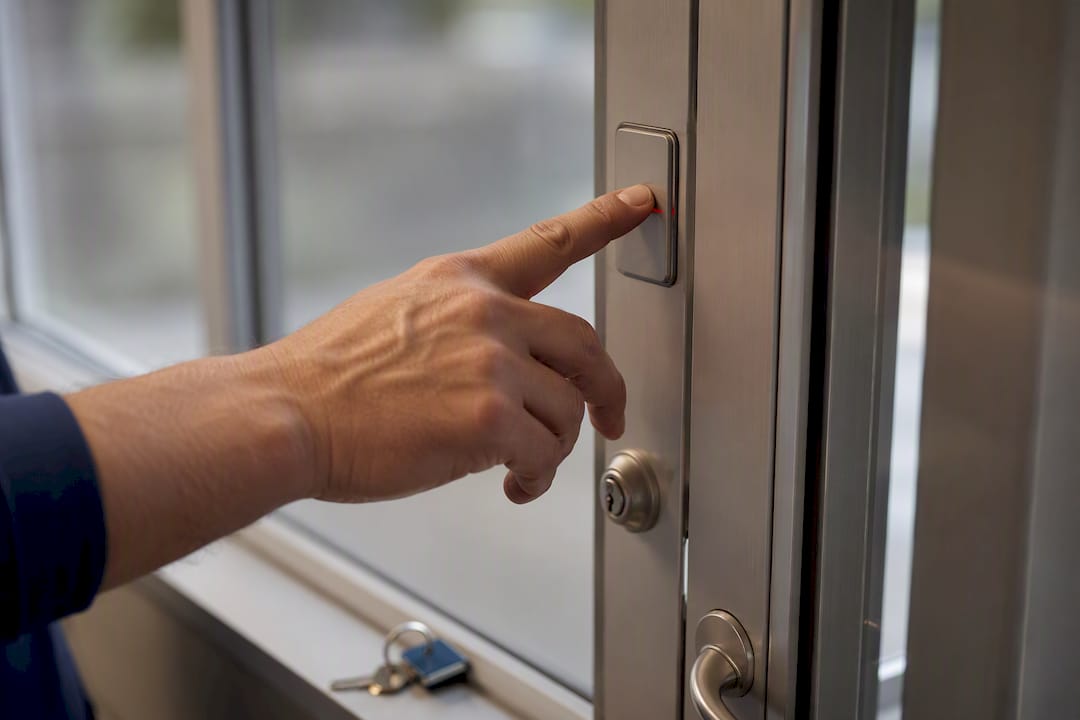
Contrast that with the pattern in facilities cited for Immediate Jeopardy under Appendix Q: a known high-risk resident, an alarm that had been malfunctioning for days without a repair ticket, and no record showing staff had reassessed risk after a previous near-miss. The LeadingAge Illinois compilation of Appendix Q elopement criteria documents this exact combination repeatedly: it’s rarely one failure that triggers the worst citations, it’s the stack of small gaps left unaddressed.
The lesson holds across both outcomes. Facilities that treat elopement prevention as an ongoing system, tested and adjusted continuously, avoid the incidents that turn into lawsuits and Immediate Jeopardy findings. Facilities that treat it as a policy binder pulled out only during survey week tend to find that out the hard way.
Why Elopement Prevention Only Works as a System
Treat elopement prevention as an operational system, not a policy document that sits in a binder until survey week. The facilities that get this right run alarm tests on a real schedule, vary their drills, and feed every near-miss into QAPI instead of writing it off as bad luck. That consistency, sustained across nursing, maintenance, dietary, and administration, is what actually keeps residents safe and keeps citations from stacking up.
— Philip
Keeping Elopement Prevention Evidence Ready for Any Survey Date
Writing a strong elopement policy is one thing. Proving, on the day a surveyor walks in, that you actually followed it every shift for the last year is another problem entirely, and it’s usually the one that trips facilities up. There are phone-first task and compliance platforms where alarm test logs, drill records, and RCA corrective actions live as checklists your staff complete on their own devices, timestamped and pullable in seconds.
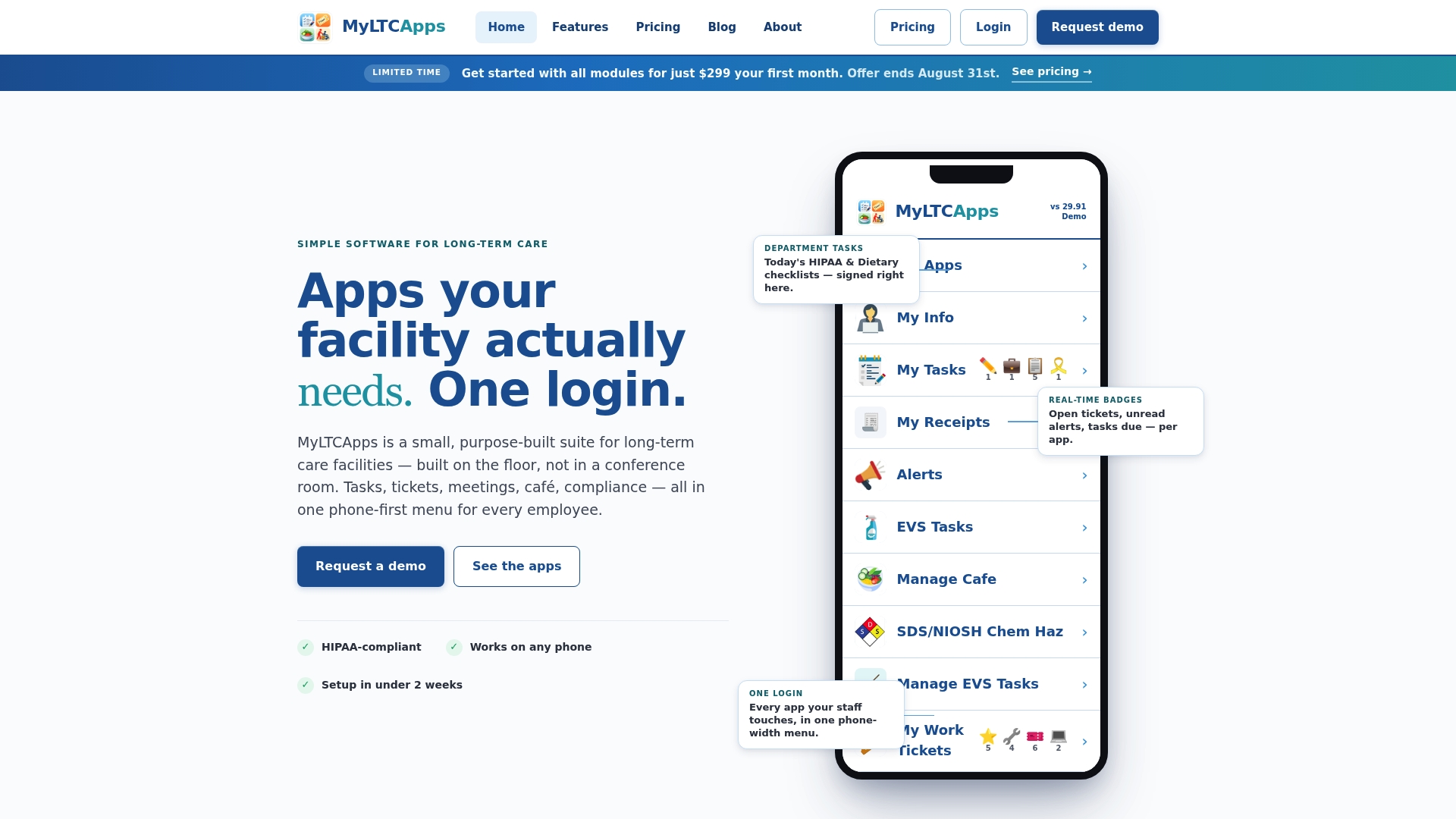
None of this touches clinical charting. Some software handles the operational side, task tracking, compliance checklists, incident logging, and administrator dashboards that aggregate evidence across shifts, so your team spends less time reconstructing what happened last Tuesday and more time actually running the drill. If your current process for proving alarm maintenance is a paper binder in the maintenance office, take a look at the compliance task and checklist software built specifically for long-term care facilities and see what a survey-ready audit trail looks like when it’s automatic instead of assembled the night before.
Sources
- State Operations Manual Appendix Q – Core Guidelines for Determining Immediate Jeopardy
- Elopement prevention and response — Texas Health and Human Services
- AHRQ PSNet: Elopement
- NIA: Alzheimer’s disease fact sheet